history and future of pharmacy
 Call Kai
 Learn
Learn Practice Test
 Spaced Repetition
 Match
Match Flashcards
 Knowt Play
1/32

There's no tags or description
Looks like no tags are added yet.
Name | Mastery | Learn | Test | Matching | Spaced | Call with Kai | Chat |
|---|
No analytics yet
Send a link to your students to track their progress
33 Terms
why should we study our history?
“a profession without a history is merely an occupation with pretensions.” - Dr. Gregory Higby
we need to know where we are coming from to know where we are going
what makes pharmacy a profession?
you can’t just give people drugs just because they asked for them
pharmacists require specialized education and training
they follow prescribed moral and professional code of conduct
committed to continuously develop skills
member of a professional body
apothecary era (~2600 B.C. - 1700 A.D.)
ancient China (~2000 B.C.)
prehistoric and ancient western therapeutics
diagnosed and treated
utilized plants and natural materials
apprenticeship-based
you study under someone who has been practicing (to learn passed on knowledge)
educated others on herbs
some herbs they used at the time are: honey, opium, turmeric, sage, mint
apothecary era (~2600 B.C. - 1700 A.D.)
Arabia and Medieval Europe (~700 A.D. - 1300 A.D.)
private apothecaries emerge by 8th century A.D.
people would come in an purchase versus it being out in the open
standardized instructions for preparing medications appear
recipes
societies separated the arts of apothecaries from physician services
formalized by King Frederick II in 1240 A.D.
still at the time passing down knowledge through apprenticeship
in Arabia and Medieval Europe (~700 A.D. - 1300 A.D.), who formalized the separation of arts of apothecaries from physician services?
King Frederick II in 1240 A.D.
it separated the tasks of diagnosing and treating
in Colonial America (1640)
few physicians immigrated
community members filled the gap relying on folklore, herbs, minerals, and even magic
John Winthrop, 1st Governor of Massachusetts Bay Colony, helped people using plant-based remedies
summary of apothecary era (~2600 B.C. - 1700 A.D.)
healing based on herbs, minerals, and natural remedies
knowledge passed through apprenticeship or family tradition
8th century AD: apothecary shops emerged
1240 A.D.: King Frederick II formalized separation of pharmacy from medicine
17th Century Colonial America: local plants + Native America remedies (e.g., quinine from cinchona bark)
no standard requirements for education, pharmacopeia, or regulation
The United States Pharmacopeia (1820)
United States Pharmacopeia convention in1820
developed list of medicinal drugs with their effects on directs for their use
designed to bring uniformity, promote safety and quality control
wanted to make sure that everyone was getting similar treatments no matter where the patient decided to go get checked at
1820: only physicians at the USP convention; 1840: pharmacists finally included
in 1820, who was at the USP convention?
only physicians
in 1840, who were allowed to the USP convention?
pharmacists and physicians
the first college of Pharmacy was created in 1821. where was it located?
in Philadelphia
Pharmacists of Philadelphia voted in April 1821 to form an associated named the Philadelphia College of Pharmacy. School opened in November 1821
the second college of Pharmacy was created in 1823. where was it located?
in Boston, MA
Massachusetts College of Pharmacy (1823)
founded in 1823 with occasional classes by 14 area pharmacists; first graduation in 1869
the occasional classes were people coming together to exchange their knowledge
what was the first college to admit black students (1867)?
Howard University College of Pharmacy, DC
pharmacy program separated from medicine in 1870
admitted students of all races and genders
who is considered to be the “mother of pharmacy”?
Elizabeth Gooking Greenleaf (1681-1762)
born in 1681 in Cambridge, MA
opened apothecary shop in Boston in 1727
first female apothecary in 13 colonies
first recorded apothecary
operated with her husband, a physician, for decades

evolution of pharmacy education
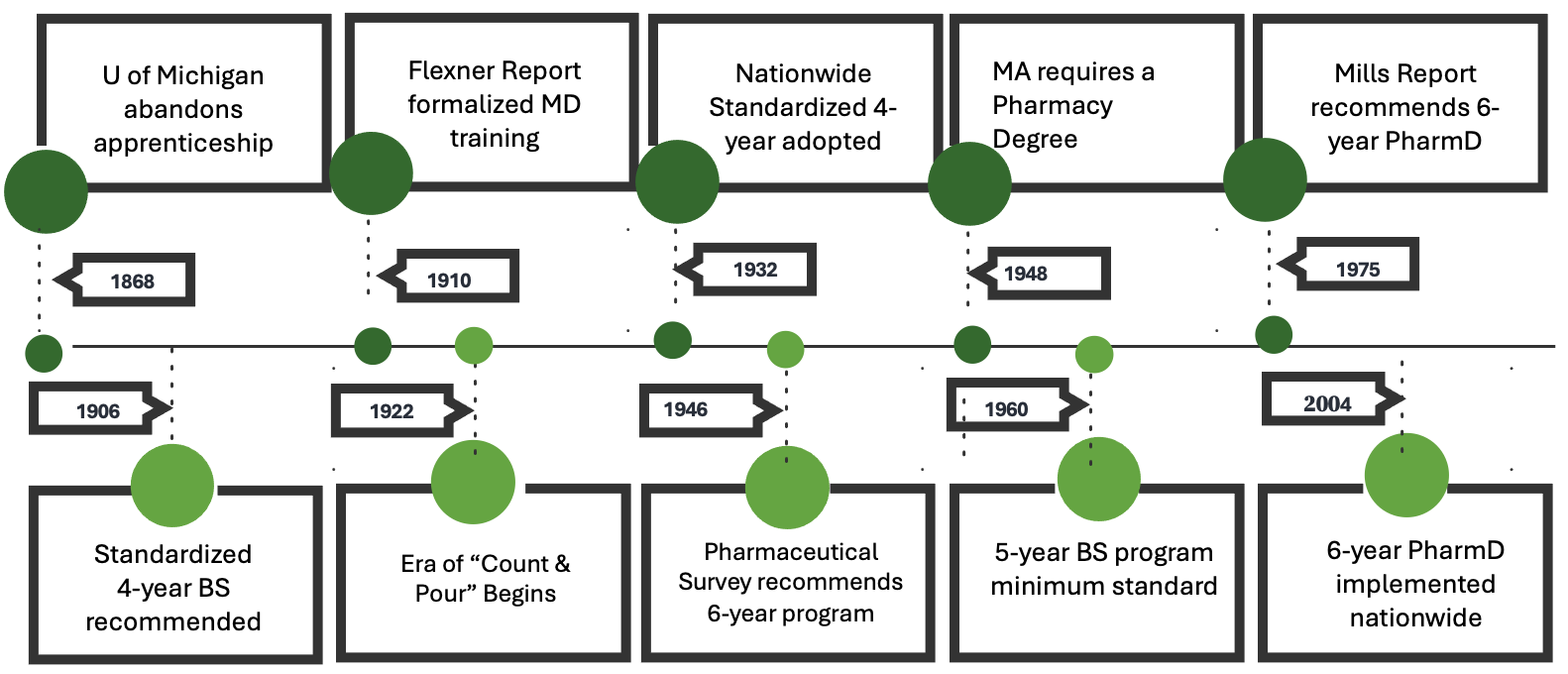
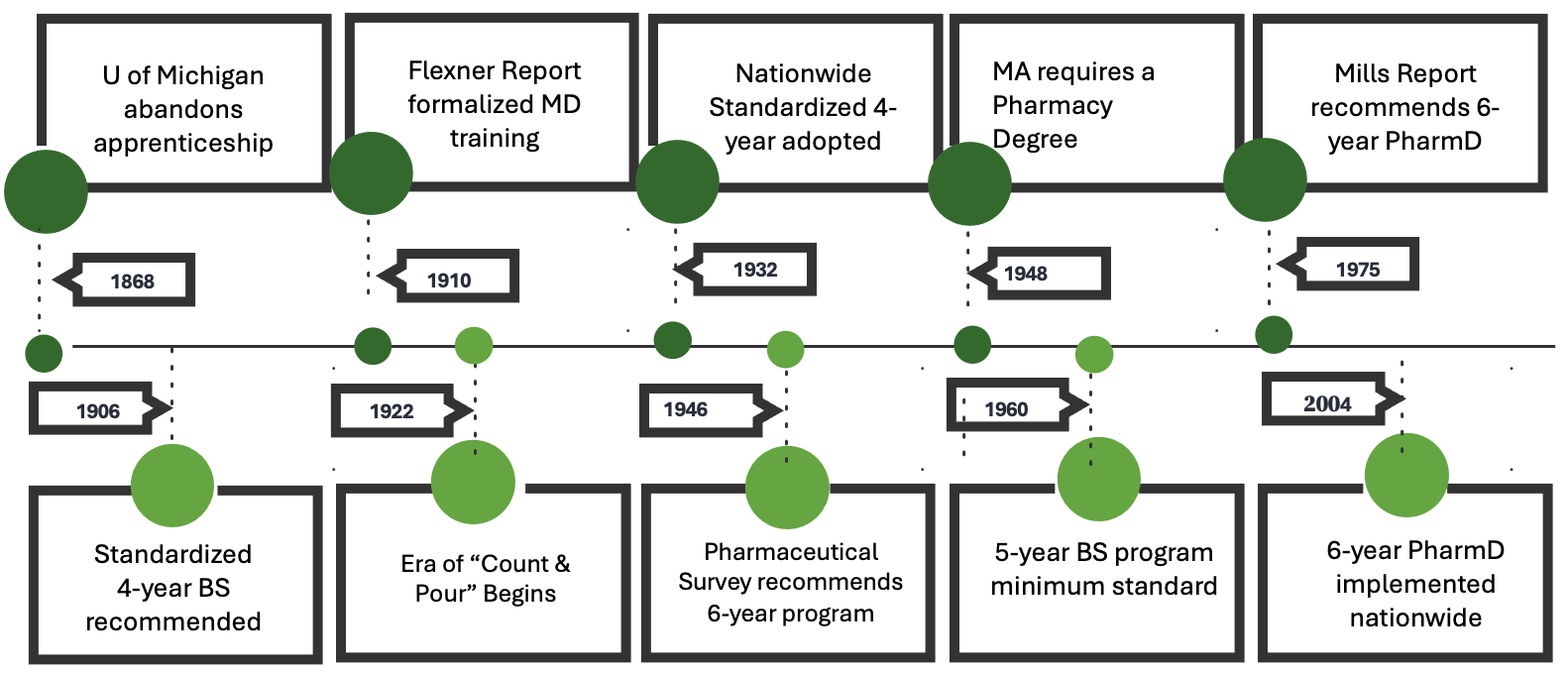
what happened in the year 1868?
U of Michigan abandons apprenticeship?
evolution of pharmacy education
what happened in the year 1906?
standardized 4-year BS recommended

evolution of pharmacy education
what happened in the year 1910?
Flexner Report formalized MD training

evolution of pharmacy education
what happened in the year 1922?
era of “count & pour” begins

evolution of pharmacy education
what happened in the year 1932?
nationwide standardized 4-year adopted

evolution of pharmacy education
what happened in the year 1946?
pharmaceutical survey recommends 6-year program

evolution of pharmacy education
what happened in the year 1948?
MA requires a pharmacy degree

evolution of pharmacy education
what happened in the year 1960?
5-year BS program minimum standard
evolution of pharmacy education
what happened in the year 1975?
Mills Report recommends 6-year PharmD

evolution of pharmacy education
what happened in the year 2004?
6-year PharmD implemented nationwide
evolution of pharmacies
what kind of pharmacies were around in 1800s-early 1900s?
independent apothecaries/drugstores
person starts a pharmacy, trains younger generation (their kids/relatives) and then the cycle keeps going
evolution of pharmacies
what kind of pharmacies were around in mid-1900s?
chain pharmacies grow
inc in consumer demand
health insurance
evolution of pharmacies
what kind of pharmacies were around in 1960s-2000s?
growth of insurance and mail order
evolution of pharmacies
what kind of pharmacies were around in 2010s?
speciality pharmacies enter
evolution of pharmacies
what kind of pharmacies were around in 2020s?
telemedicine & digital pharmacies era
amazon pharmacies and having people mail their prescriptions rather than going to pick it up in person
evolution of pharmacy practice
Mills Report, 1975 → recommended a 6-year PharmD
Pharmaceutical Care → first emerged in 1970s, widely adopted in 1990s
OBRA 1990; Drug Utilization Review (DUR), Patient Counseling, Maintaining Records 2000s. Patient Centered Medical Home concept expands to include pharmacists.
what was the “count & pour” era?
pharmacists were taking the prescription and counting it out and then handing it to the patient
factors driving growth of clinical pharmacy
decline of pharmacology in medical schools
growth of physiology and therapeutics education in pharmacy schools
development of Pharmacists’ Patient Care Process vision
1962: drug info center at U of Kentucky
1966: pharmacists rounding with medical teams at UCSF
pharmacist is there when physicians and the rest of the medical teams are engaging with the patient (provides a more wholistic experience for patients)
evolution of the pharmacist role
diagnostician, preparer of medication and spiritual healer →
preparer of medication →
drug development (still do this) →
dispenser of medication (still do this) →
evaluator of how drugs work (still do this) →
patient educator (still do this)