Chapter 11 (Carbohydrates)
 Call Kai
 Learn
Learn Practice Test
 Spaced Repetition
 Match
Match Flashcards
 Knowt Play
1/58

There's no tags or description
Looks like no tags are added yet.
Name | Mastery | Learn | Test | Matching | Spaced | Call with Kai | Chat |
|---|
No analytics yet
Send a link to your students to track their progress
59 Terms
Galactosemia
Genetic metabolic disorder where the body cannot metabolize galactose (not lactose intolerant → lactase)
Serious/life threatening
Hemiacetal vs Acetal
Term | How it Forms | Groups on Carbon | Reactivity |
|---|---|---|---|
Hemiacetal | Aldehyde + 1 alcohol | –OH + –OR | Reducing sugar, reactive |
Acetal | Hemiacetal + 1 more alcohol | 2 × –OR | Non-reducing, stable |
Hemiacetal
Form from aldehyde and 1 alcohol
Contain groups OH, OR, H, R
Reducing sugar, reactive/unstable
Cyclic are much more stable than the open-chain

Hemiketal
Form from ketone and 1 alcohol
Contain groups OH, OR, R, R
Acetal
Hemiacetal reacts with another alcohol group
Contain group OR, OR, R, H
Chiral Column Chromatography
Separation of enantiomers due to differences in affinity for stationary phase that stemmed from the asymmetry of both entities. (One enantiomer will elude faster than the other)
A chiral adsorbent (chiral material that can selectively bind one enantiomer over the other from a mixture) is used in chiral chromatography
Resolving Agent
Should be enantiomerically pure
Haworth to Fisher Projections
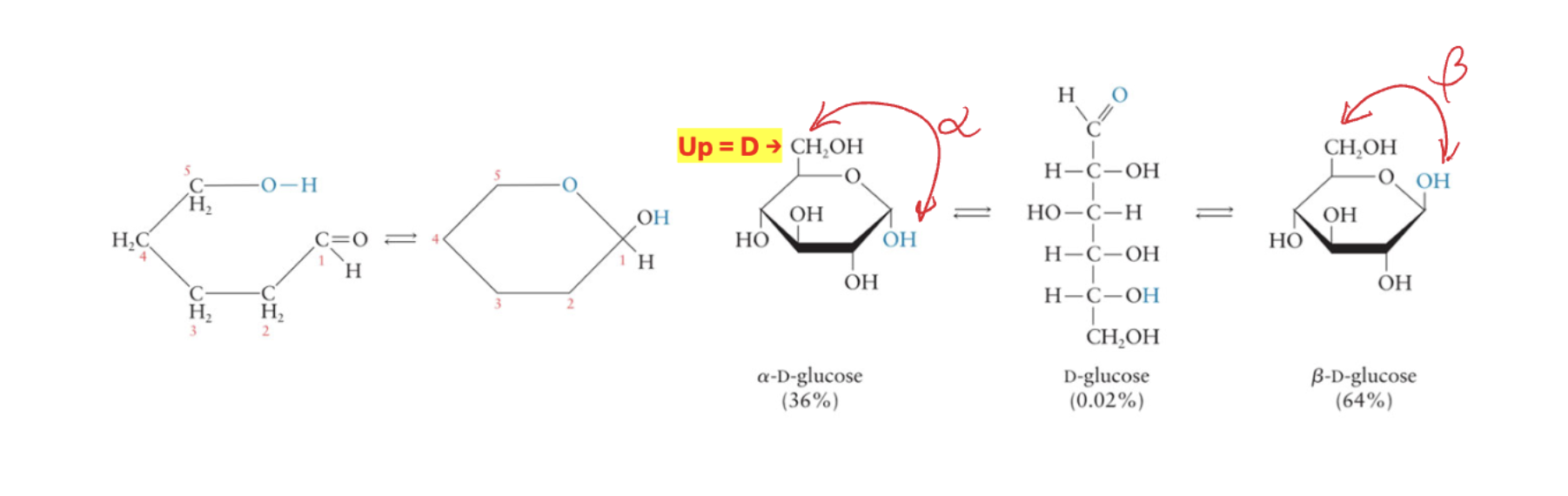
CH2OH up → D classification
CH2OH down → L classification
Carbohydrates Function
Provide energy through oxidation
Supply carbon for cell components synthesis
Serve as chemical energy storage
Form structural elements of cells and tissues
Monosaccharide
Simple carbohydrate consisting of 3-6 carbon atoms
Glucose
Galactose
Fructose
Ribose
Deoxyribose
Oligosaccharide
Carbohydrate formed by combination of 3-10 monosaccharide units
Enantiomers
Non-superimposable (non-identical), mirror image of each other
Have similar chemical and physical properties in achiral environment
Display different physiological effects in a chiral environment, when they interact with another chiral object)
Chiral
A term for compounds or objects that cannot be superimposed on their mirror image
Ex: hands, gloves, shoes are chiral objects
Meso Compound
A molecule with at least two chiral centers with a plane of symmetry
Common Stereoisomers
Polycyclic (compound w/ 2 or more linked hydrocarbon rings) & steroids that are common in nature
Hexoses
Monosaccharides that contains the same formula C6H12O6 such as glucose, fructose, and galactose
Resolution
A process of separating racemic mixture and is very expensive
One method involves converting mixture of enantiomers into diastereomers (more distinct physical/chemical properties). More easily separable then goes through chemical transformation that regenerates original pair of enantiomers

Thalidomide
Morning sickness drug now known to cause birth defects due to levorotatory(-) enantiomer
Drugs Target Biomolecules
Design to target enzymes due to them controlling the manner and speed which chemical reactions in the human body take place
Another target is the biological receptors, whose function is to modulate a signal that leads to physiological response
D/L Classifications
Based on the OH attached to chiral carbon farthest from the carbonyl group
D-compounds have OH projecting to the right
L-compounds have OH projecting to the left
Epimers
Diastereomers that differ in only one chiral center
Carbonyl Group
Carbon double-bonded to an oxygen
Written as CHO in fisher projection
Optically Active Molecules
All chiral molecules are active
All achiral & racemic are inactive
Dextrorotatory (+/d): rotates light clockwise
Levorotatory (-/l): rotates light counter-clockwise
Distinguish enantiomers in ordinary achiral environment
Pyranose Ring
A six-membered sugar ring containing an oxygen atom
Haworth Structure
Depiction of 3-D carbohydrate structures as flat rings with groups pointing up/down around the ring
Anomeric Carbon
A carbonyl carbon in the open-ring form, become chiral by turning to acetal or hemiacetal after the ring closes.
Gives rise to two stereoisomers (alpha/beta)
Anomers
Special type of stereoisomer found in cyclic sugars, differs only at the carbon of an acetal/hemiacetal (anomeric carbon).
Furanose Ring
A five-membered sugar ring containing an oxygen atom
Aldoses
Monosaccharide that contains aldehyde group
Prefix aldo-
Form hemiacetals on cyclization

Ketoses
Monosaccharide that contains ketone group
Prefix keto-
Form hemiketals on cyclization

Monosaccharide Suffix
Name | Number of carbons |
|---|---|
Triose | 3 |
Tetrose | 4 |
Pentose | 5 |
Hexose | 6 |
Heptose | 7 |
Ribose
Monosaccharides that makes up the backbone of ribonucleic acid (RNA)

Deoxyribose
Monosaccharide that makes up the backbone of deoxyribonucleic acid (DNA)
Differs from ribose in carbon 2 such that OH is replaced by H

Disaccharides
Lactose
Sucrose
Maltose
Polysaccharides
Starch
Cellulose
Glycogen
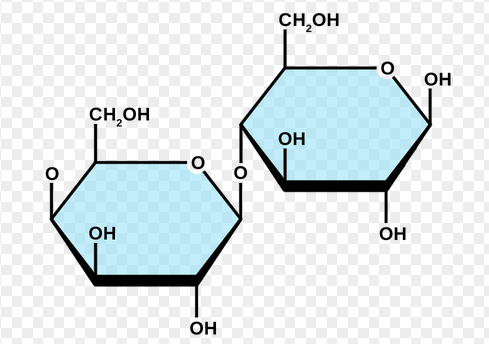
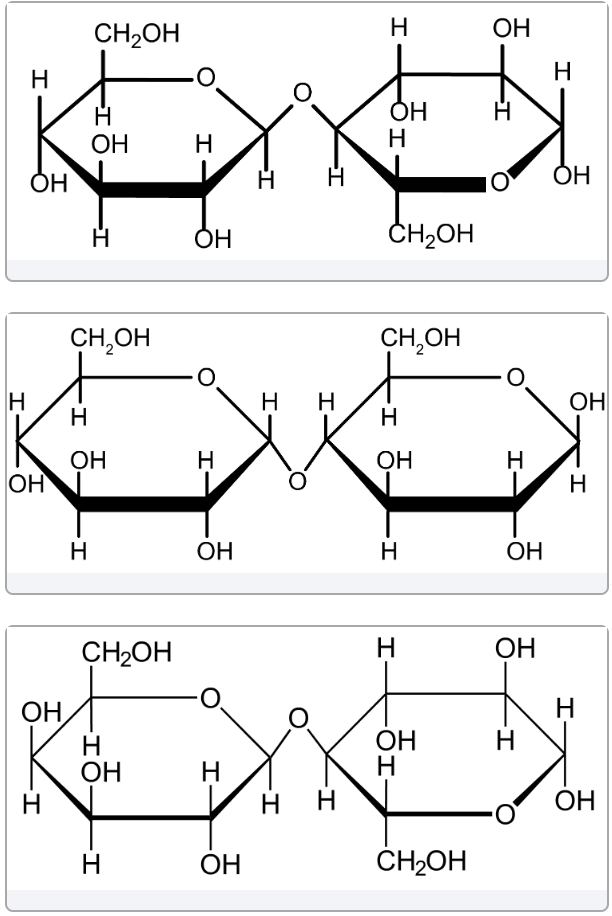
Maltose
Comprised of an alpha-D-glucose and a D-glucose molecule
Alpha (1→4) glycosidic linkage
Hydrolysis of starch
Lactose
Comprise of beta-D-galactose and D-glucose molecule
Beta (1→4) glycosidic linkage
Constitutes 5% cow’s milk and 7% human milk, mammalian milk
Sucrose
Comprise of alpha-D-glucose and beta-D-fructose molecule
Alpha 1 → beta 2 glycosidic linkage
Not a reducing sugar because the anomeric carbons of both sugars are forming an acetal
Sweetener, sugarcane, preservative
Disaccharides Reducing-Sugar Identification
When only one anomeric carbon is involved in glycosidic linkage, it’s reducing sugar
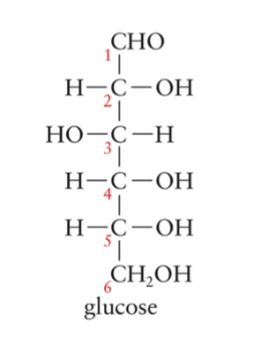
Dextrose/Glucose
Known as blood sugar since it’s transported by the blood to body tissues for energy requirements
Other sugars are absorbed by the liver and converted to glucose
Commonly used as sweetener, and baby foods
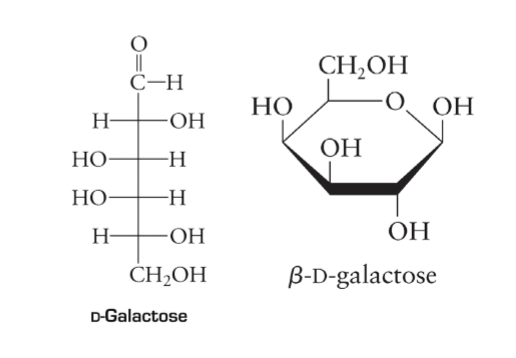
Galactose
Synthesize in the mammary glands and transform into lactose, the sugar found in milk. Also present in the nerve tissue
Fructose
Most important ketohexose
Known as levulose/fruit sugar due to being the sweetest monosaccharides and use as sweetener

Deoxy Sugars
One or more of the carbons missing OH

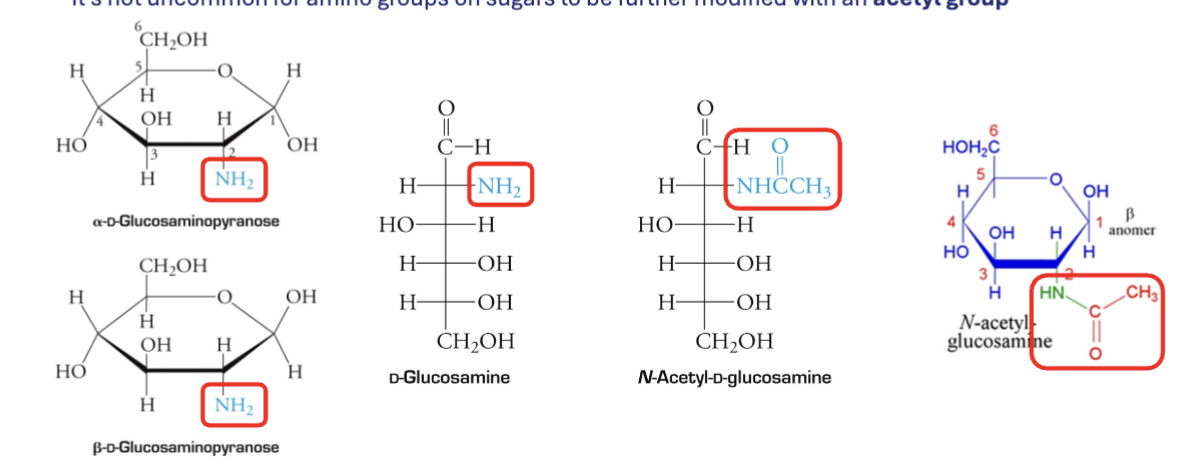
Amino Sugars
One more more carbons where the OH groups are replaced with NH2
Reducing Sugar
A sugar whose anomeric carbon contain OH group and are not tied up to glycosidic bond
Oxidized by weak oxidizing agent such as Benedict’s reagent (Cu2+)
A free hemiacetal/hemiketal or carbonyl in solution
Benedict’s Test
Cannot detect specific sugar
Both galactose & glucose will be positive
* New glucose detection system uses test strips coated with glucose oxidase that only catalyzes oxidation of the aldehyde group glucose
Phosphate Esters
Form by alcohols react with phosphoric acid
The phosphodiester bonds connect the deoxyribose and phosphate group that make up the backbone of DNA

Raffinose, Stachylose, Verbascose
Oligosaccharides composed of galactoses
Contains galactosidic bonds which human lack galactosidase enzymes
Cause bloating due to bacterial metabolism that produces gases
In peas, beans
ABO Blood Group Antigens
A-antigen has N-Acetyl-D-Galactosamine
B-antigen has galactose
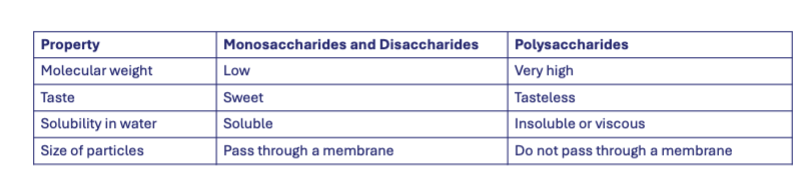
Polysaccharides
High molecular weight
Tasteless
Insoluble
Cannot pass through membrane
Starch
Long chains of D-glucose, there are two major forms
Amylose: long unbranched chains of D-glucose units connected by alpha(1-4)
Amylopectin: branched polymers, the branches linked by alpha(1-6)
Glycogen
Also called animal starch
Homopolysaccharides that joins by glucose
Storage carbohydrate for animals that is structurally similar to amylopectin except more highly branched
Release D-glucose upon hydrolysis, helps mains normal blood sugar levels, provide energy for muscle for human
Cellulose
Homopolysaccharides D-glucose linked by beta(1→4)
Humans do not have enzyme to digest beta(1→4), therefore it serves as dietary fiber that pass through the human digestive tract largely unchanged because humans lack the enzymes to break them down.
Adds bulk to stool and speeds intestinal transit
Hyaluronic Acid
Heteropolysaccharides in connective tissue
Composed alternating of N-acetyl-D-glucosamine and D-glucuronate
Connect alternatively by beta(1→4) and beta(1→3) bonds
The lubricating fluid that surrounds joints, in the vitreous humor present inside the eye, and is an important component of articular cartilage
Chondroitin-4-Sulfate
Heteropolysaccharides in connective tissue
Composed alternating of N-acetyl-D-galactosamine and D-glucuronate
Connect alternatively by beta(1→4) and beta(1→3)
Can be purchased without prescription to repair damaged cartilage
Heparin
Repeating disaccharide made of D-glucuronate-2-sulfate and N-sulfo-D-glucosamine-6-sulfate with alpha (1→4)
Used primarily as anticoagulant
Cis-Trans Isomer
Subtype of diastereomers
Racemic Mixture
Equal mass of two enantiomers
Glycosidic Bond
A hemiacetal/hemiketal on one sugar reacts with an alcohol on another form an acetal