Inorganic Chemistry
 Call Kai
 Learn
Learn Practice Test
 Spaced Repetition
 Match
Match Flashcards
 Knowt Play
1/153

There's no tags or description
Looks like no tags are added yet.
Name | Mastery | Learn | Test | Matching | Spaced | Call with Kai | Chat |
|---|
No analytics yet
Send a link to your students to track their progress
154 Terms
Atom
The smallest subdivision of an element that can participate in a chemical reaction
Atomic nucleus
The dense central part of an atom containing protons and neutrons
Nucleons
The particles found in the nucleus: protons and neutrons
Proton
A positively charged subatomic particle with a mass of approximately 1 amu
Neutron
A subatomic particle with no electrical charge and a mass of approximately 1 amu
Electron
A negatively charged particle located outside the nucleus.
Atomic mass unit (amu)
A unit of mass used for atoms; approximately 1.66×10⁻²⁷ kg
Atomic weight (A)
Approximately the total number of protons and neutrons in an atom
Atomic number (Z)
The number of protons in the nucleus of an atom. It determines the element
Element
A substance that cannot be decomposed into simpler substances through ordinary chemical reactions
Isotope
Atoms of the same element that have the same number of protons but different numbers of neutrons
Chemical compound
A substance made from two or more different atoms chemically bonded together
Molecule
The smallest subdivision of an element or compound that can exist naturally
Group
A vertical column of the periodic table. Elements in the same group generally have similar chemical properties
Period
A horizontal row of the periodic table
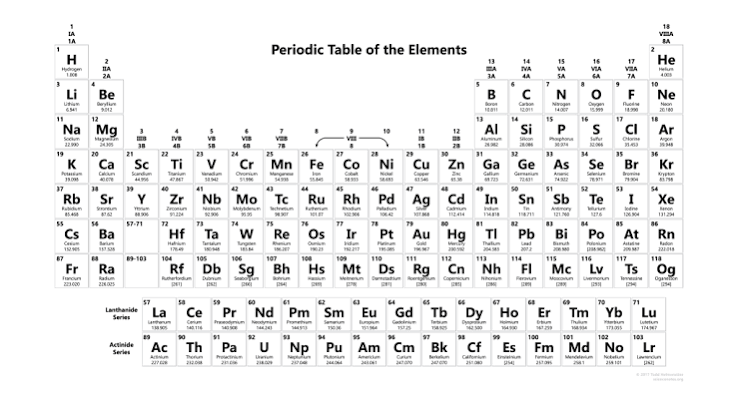
non metals/ metals on periodic table
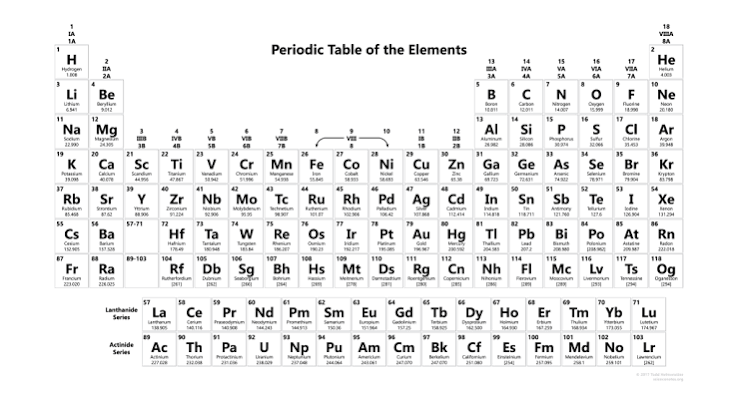
Identify Alkali Metals
Group 1
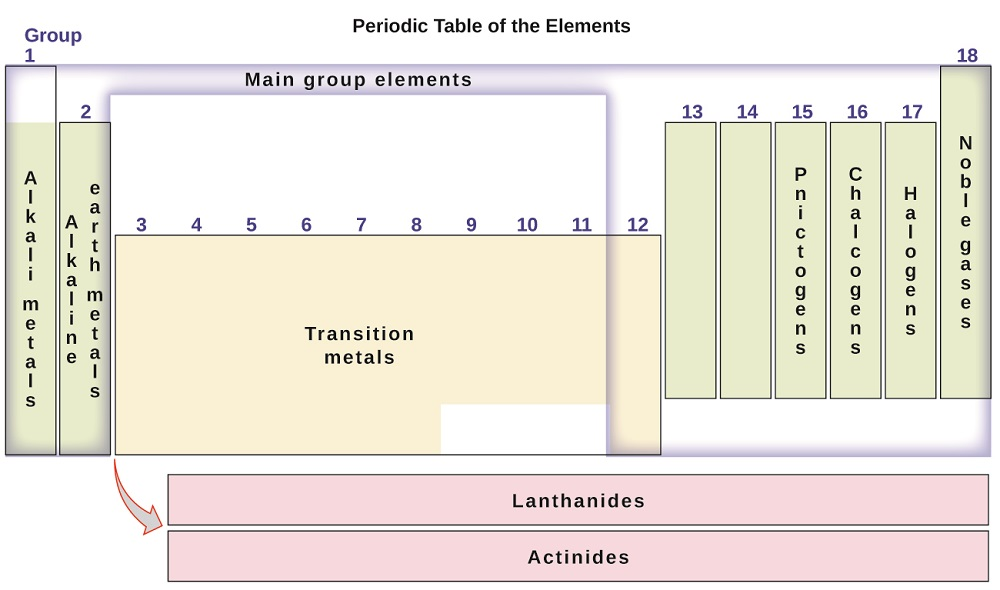
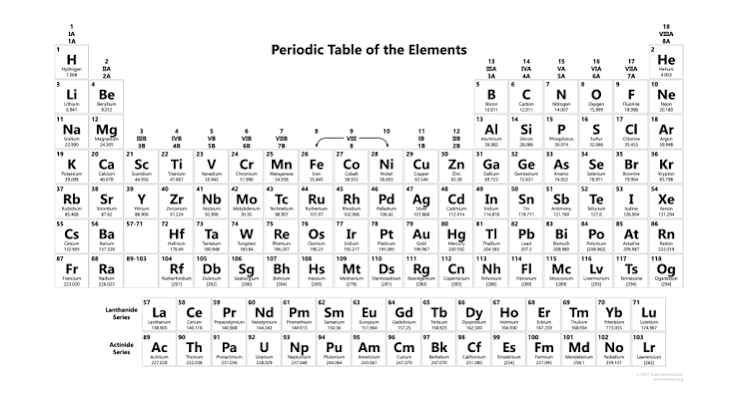
identify alkaline earth metals
Group 2
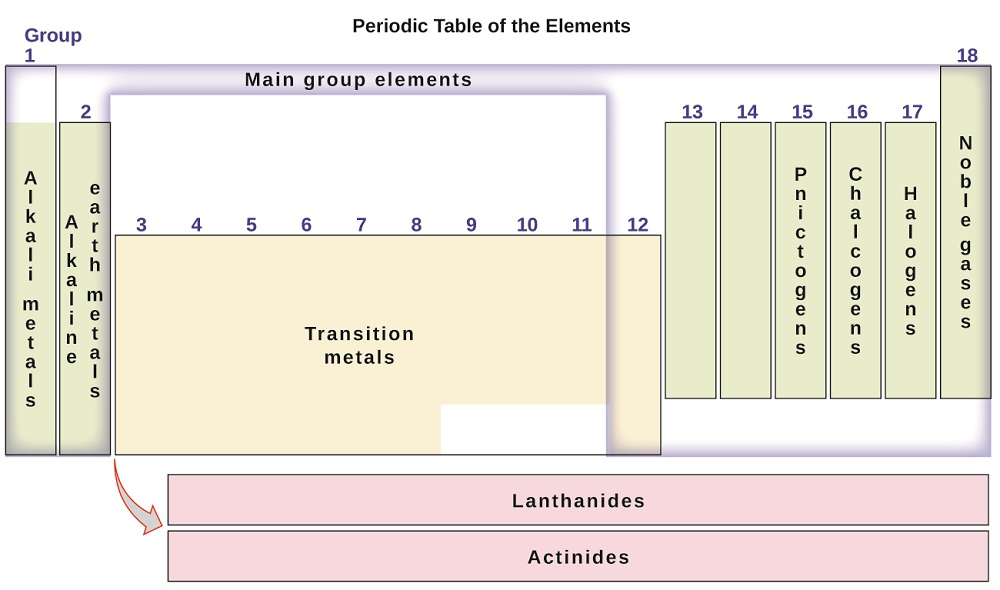
identify transitional metals
groups 3-12
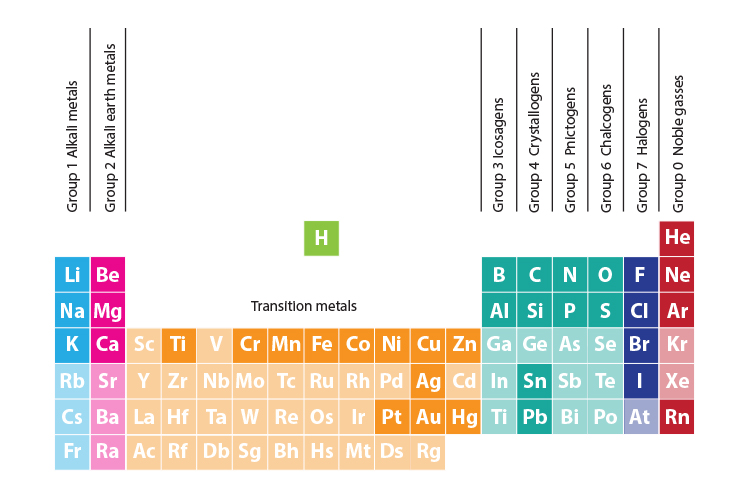
identify the boron family
group 13
identify the carbon groups
group 14
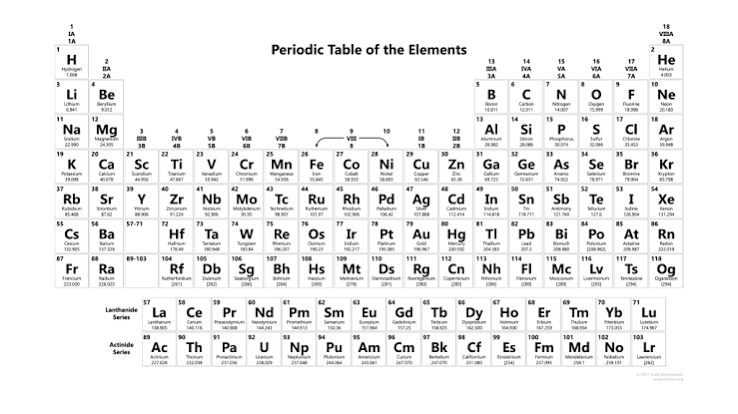
identify the nitrogen family
group 15: pnitogens
identify the oxygen family
group 16: chalcogens
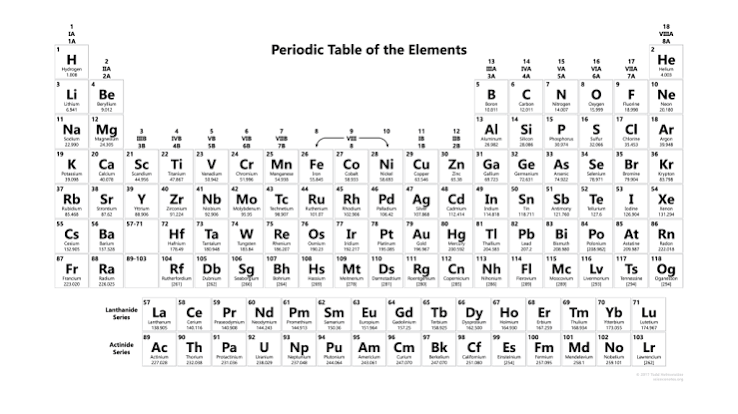
identify group 17 elements
halogens
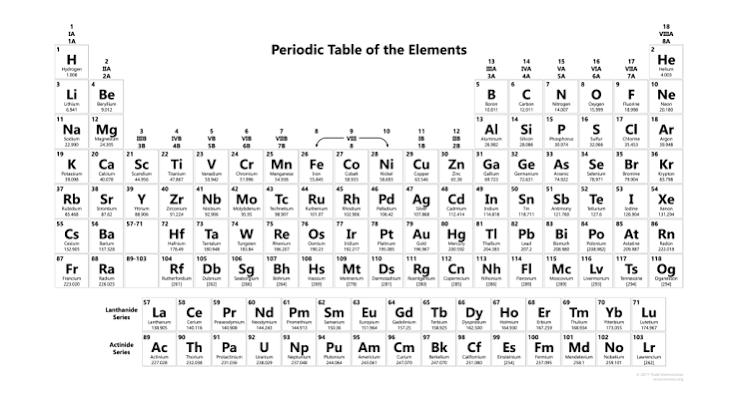
identify group 18
noble gases
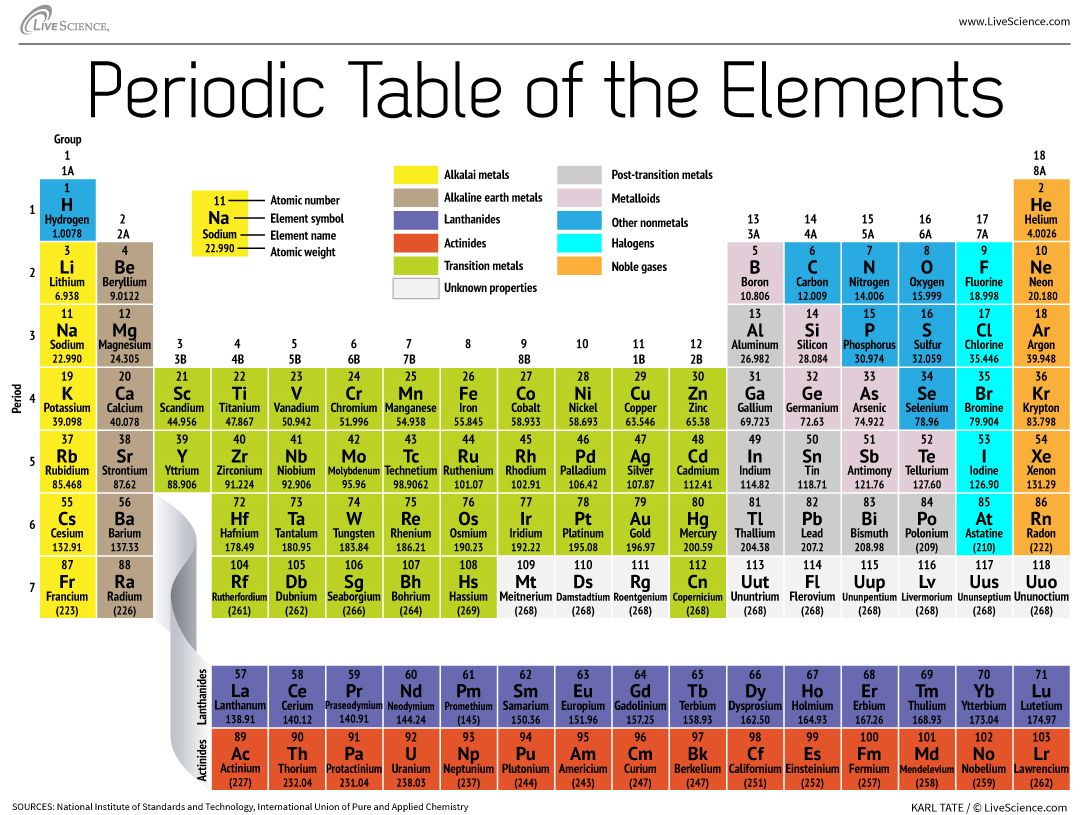
label the 11 families on the periodic table
Electronegativity
A measure of an atom's ability to attract electrons toward itself in a chemical bond
Electronegativity trend
Electronegativity generally increases toward the upper-right of the periodic table and decreases going down a group
Metallic character
The tendency of an element to exhibit metallic properties. It generally increases down a group and toward the left of the periodic table.
Ion
An atom or group of atoms with a net electrical charge due to gaining or losing electrons
Electron affinity
The tendency of an atom to attract or accept electrons
Ionization energy
The energy required to remove an electron from an atom
Valence electrons
Electrons in the outermost shell of an atom that are primarily involved in chemical bonding
Anion
A negatively charged ion formed when an atom gains electrons
Cation
A positively charged ion formed when an atom loses electrons
Oxidation
The loss of electrons or an increase in oxidation state
Reduction
The gain of electrons or a decrease in oxidation state
Anode
The electrode where oxidation occurs
Cathode
The electrode where reduction occurs
Stable electron configuration
An electron arrangement that is energetically stable, commonly associated with a filled outer shell
Chemical bond
An attractive force that holds atoms or ions together
Ionic bond
A bond dominated by electrostatic attraction between oppositely charged ions following electron transfer
Electron transfer
The movement of one or more electrons from one atom to another, characteristic of ionic bonding
Covalent bond
A bond in which atoms predominantly share electrons
Nonpolar covalent bond
A covalent bond in which electrons are shared equally, typically between identical atoms
Polar covalent bond
A covalent bond in which electrons are shared unequally because the atoms have different electronegativities
Electrostatic attraction
The attractive force between opposite electrical charges
Ionic vs. covalent bonding
Bonds with an electronegativity difference of approximately 1.7 or greater are predominantly ionic; differences below approximately 1.7 are predominantly covalent
Diatomic molecule
A molecule consisting of two atoms of the same element, such as H₂, O₂, N₂, or Cl₂
Oxidation number
An assigned electrical charge that represents the charge an atom would have if all bonds were treated as ionic |
Oxidation state
Another name for oxidation number
Oxidation number of a free element
The oxidation number of an element in its elementary/free state is zero
Oxidation number of a monoatomic ion
Equal to the actual charge of the ion
Oxidation number of a neutral compound
The oxidation numbers of all atoms must add up to zero
Oxidation number of fluorine
Usually −1 because fluorine is the most electronegative element
Oxidation state increase
Indicates oxidation/electron loss
Oxidation state decrease
Indicates reduction/electron gain
Binary compound
A compound containing two different elements
Ternary compound
A compound containing three different elements
Formula weight
The sum of the atomic weights represented by a chemical formula
Molecular weight
The sum of the atomic weights of all atoms in a molecule
Ferrous
Indicates the lower oxidation state of iron, commonly Fe(II)
Ferric
Indicates the higher oxidation state of iron, commonly Fe(III)
Binary acid
An acid containing hydrogen and one nonmetal; its name typically begins with “hydro-” and ends in “-ic.”
Ternary acid / oxyacid
An acid generally containing hydrogen, a nonmetal, and oxygen
Law of definite proportions
A pure compound always contains the same elements combined in the same definite proportions by mass
Law of multiple proportions
When two elements form multiple compounds, the masses of the elements combine in ratios of small whole numbers
Empirical vs. molecular formula
The empirical formula gives the simplest ratio, while the molecular formula gives the actual number of atoms
Direct combination / synthesis
A reaction in which two or more substances combine to form a single compound
Decomposition / analysis
A reaction in which a compound breaks down into simpler substances
Single displacement
A reaction in which one element replaces another element in a compound
Double displacement
A reaction in which two compounds exchange components to form two new compounds
Parallel/competing reactions
Reactions that use the same reactants but produce different products
Homogeneous reaction
A reaction in which all reactants and products are in the same phase
Heterogeneous reaction
A reaction involving substances in different phases
Catalyst
A substance that increases the rate of a reaction without undergoing permanent chemical change
Activation energy
The minimum energy required for a chemical reaction to occur
Catalytic reaction
A reaction that occurs in the presence of a catalyst
Biocatalytic reaction
A catalytic reaction involving a biological catalyst
Enzymatic reaction
A biocatalytic reaction in which the catalyst is a protein enzyme
Substrate
A reactant involved in an enzymatic reaction
Stoichiometric reaction
A reaction in which reactants are present in exactly the amounts required by the balanced equation
nonstoichiometric reaction
A reaction in which one or more reactants are intentionally present in excess
Limiting reactant
The reactant that is consumed first and therefore limits the amount of product that can form.
Excess reactant
A reactant supplied in an amount greater than theoretically required
Theoretical yield
The maximum amount of product that could be produced if the reaction goes to completion
Actual yield
The amount of product actually obtained from the reaction
Redox reaction
A reaction involving both oxidation and reduction
Oxidation
Loss of electrons and an increase in oxidation number
Reduction
Gain of electrons and a decrease in oxidation number
Oxidizing agent
A substance that causes another substance to be oxidized; the oxidizing agent itself is reduced
Reducing agent
A substance that causes another substance to be reduced; the reducing agent itself is oxidized
Electron balance in redox reactions
The number of electrons lost during oxidation must equal the number of electrons gained during reduction
Chemical equilibrium
The state in a reversible reaction where the forward and reverse reaction rates are equal
Dynamic equilibrium
An equilibrium in which forward and reverse reactions continue occurring at equal rates
Le Chatelier's Principle
When an equilibrium system is disturbed, it shifts in a direction that tends to reduce the imposed disturbance
Equilibrium constant, K
A quantity representing the ratio of products to reactants at equilibrium according to the law of mass actio
Law of mass action
The reaction behavior/rate is related to the concentrations of the reacting species
According to Le Chatelier's Principle increased temperature…
Equilibrium shifts in the direction that absorbs heat.
According to Le Chatelier's Principle decreased temperature…
Equilibrium shifts in the direction that releases heat.