4.1 - the nature of operations
 Call Kai
 Learn
Learn Practice Test
 Spaced Repetition
 Match
Match Flashcards
 Knowt Play
1/36

There's no tags or description
Looks like no tags are added yet.
Name | Mastery | Learn | Test | Matching | Spaced | Call with Kai | Chat |
|---|
No analytics yet
Send a link to your students to track their progress
37 Terms
factors of production
he resources used to produce goods and services
The production of any good or service requires the use of a combination of all four factors of production
four factors of production
1. Land
Non-man-made natural resources available for production
Some countries have a vast amount of a particular natural resource and are able to specialise in its production
E.g. Kuwait specialises in the product of oil, which accounts for 95% of its exports (goods sold in overseas markets)
2. Capital
Any man-made resource that is used to produce goods or services
Examples include tools, buildings, machines and computers
3. Labour
The human input into the production process, labour involves mental or physical effort
Not all labour is of the same quality
It can be skilled or unskilled
Some workers are more productive than others because of their education, training and experience
4. Enterprise
Enterprise involves taking risks in setting up or running a firm
An entrepreneur decides on the combination of the factors of productionnecessary to produce goods/services with the aim of generating profit
Stages of the transformational process
Businesses take inputs and transform them in order to produce outputs that customers will want to buy
The transformational process
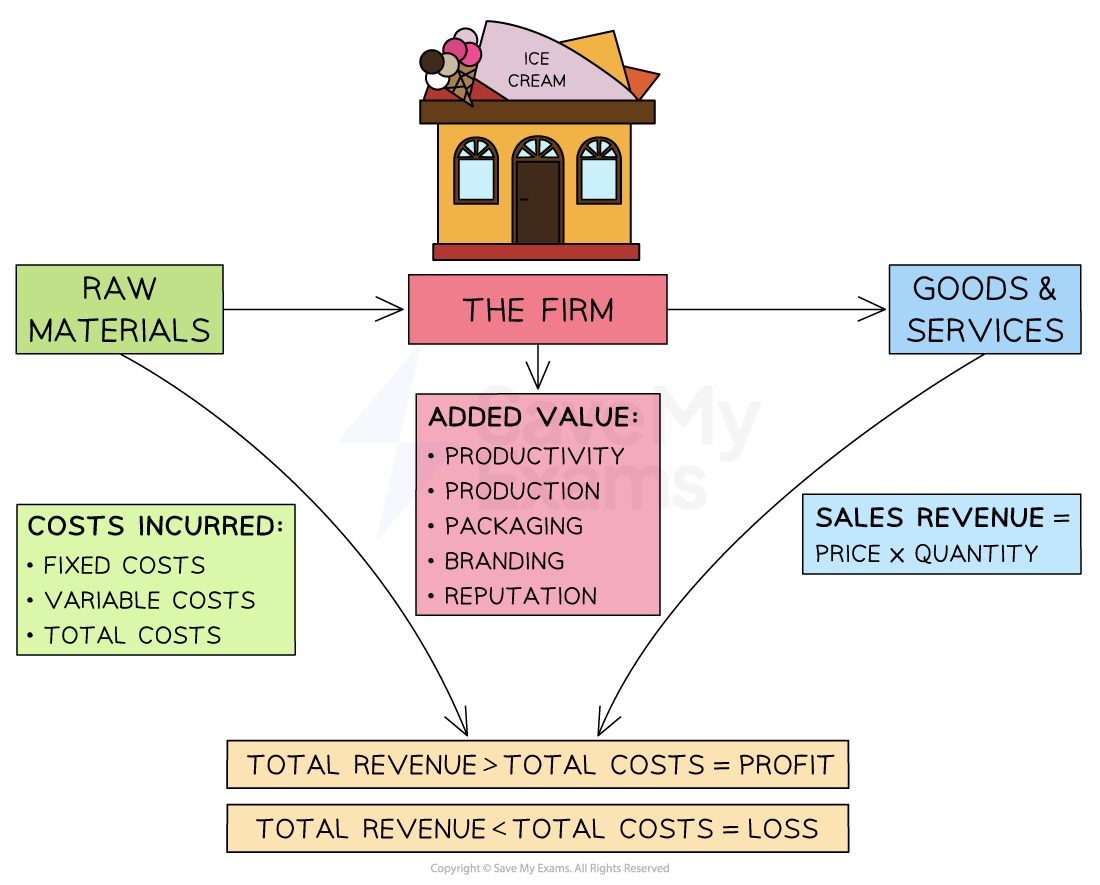
The transformational process
Inputs used in the transformation process may be financial, human or physical resources, as well as enterprise
Outputs are goods and services, as well as by-products and waste
E.g. Rothaus brewery takes inputs including malts, hops and barley and uses the staff on the brewery premises in Freiburg, as well as equipment, such as mash tuns, to transform them by brewing these inputs into its main output — its range of beers — as well as by-products, such as compost
adding value
the process of taking raw materials and using them in such a way that the end product created is worth more than the cost of the raw materials used to create it - value has been added
E.g., customers pay more for potatoes when they are packaged as oven chips than they would be willing to pay for a bag of potatoes
If value is not added to the materials and components that a business buys, fixed costs cannot be paid and no profit will be made
ways of adding value
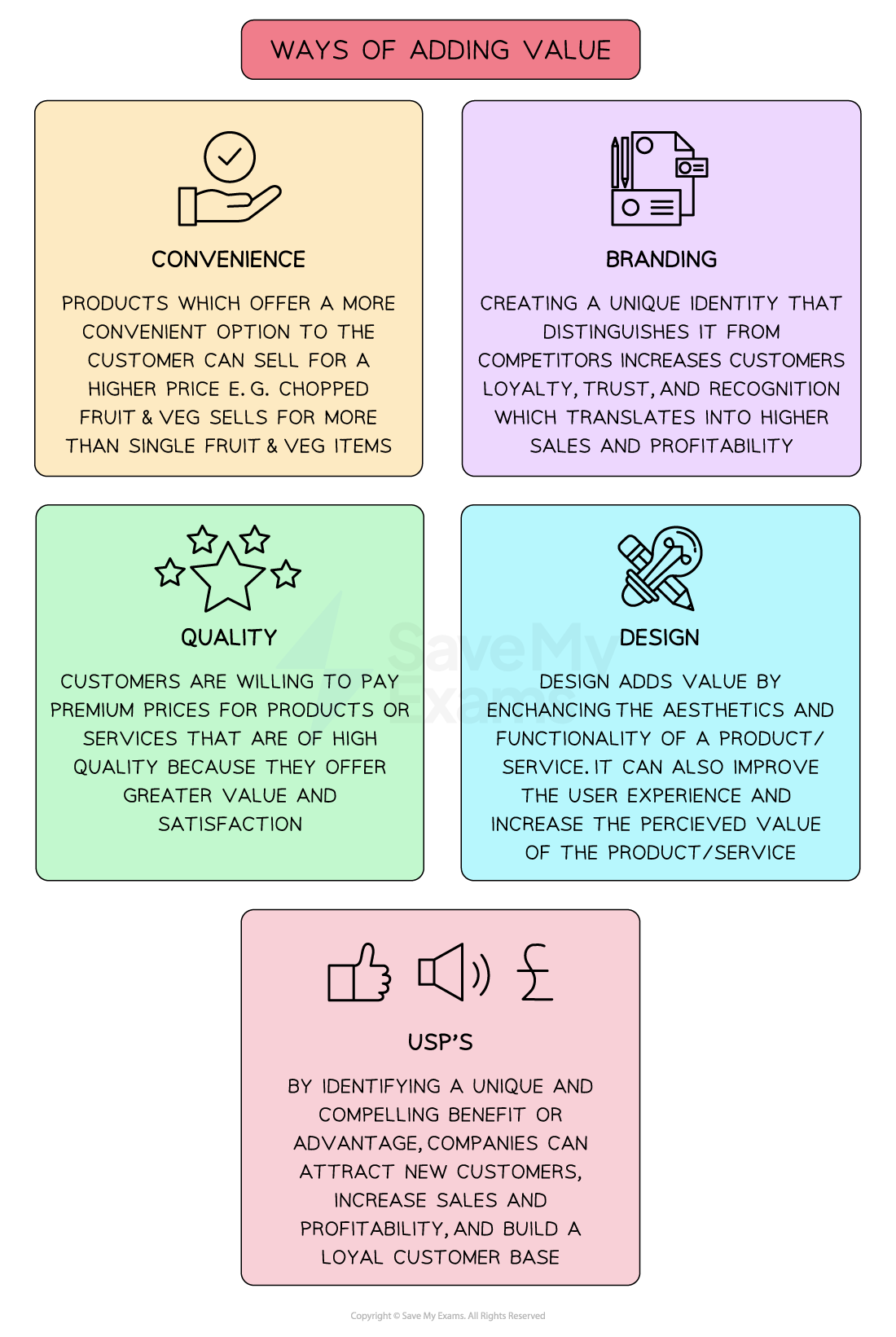
Method | Example |
|---|---|
Branding |
|
Convenience |
|
Quality |
|
Unique selling points (USPs) |
|
Design |
|
efficiency
producing goods or services with the minimum amount of waste, time or resources
effectiveness
achieving the business’s objectives by doing the right things to satisfy customer needs and meet goals
productivity
the volume of output produced per worker (or per hour, machine, etc.) that shows how well available resources are used to generate output
Why are these factors important? (efficiency, effectiveness, productivity, sustainability)
Lower costs
Efficient use of resources helps reduce waste and cut production costs
Higher profit margins
Improved productivity and lower costs can increase the amount of profit made per sale
Better use of resources
Efficient businesses make the most of time, money, staff and materials
Improved competitiveness
Businesses that are productive and effective can offer competitive prices or higher-quality products
Customer satisfaction
Being effective means meeting customer needs, which leads to loyalty and repeat purchases
Faster response to demand
Productive operations allow quicker production and delivery, keeping up with customer demand
Supports business growth
Efficient and productive businesses can expand more easily and take on larger orders
labour productivity
The labour productivity of a business is measure of the output per worker during a specified period of time
Businesses aim to increase the level of labour productivity to improve competitiveness
Labour productivity is calculated using the formula
Labour productivity = Output / Number of workers
The link between high labour productivity and competitive edge
Businesses aim to increase the level of labour productivity to improve competitiveness

Higher labour productivity improves businesses' competitiveness
High labour productivity reduces the labour cost per unit, leading to improved efficiency and the potential for a meaningful competitive edge
sustainability
Sustainability means meeting our current needs without compromising the ability of future generations to meet their own needs
Businesses can contribute to sustainability by changing their operations in a variety of ways
ways to improve sustainability (6)
1. Using renewables in production
More than 99% of the wood used in IKEA's furniture products is either sourced from sustainable sources or recycled
2. Reducing water use in industrial processes
Introduced in 2011, Levi's Water<Less programme reduces the use of water in the manufacture of the company's denim products, so far saving over 4.2 billion litres of water in shortage areas
3. Using green transportation, such as electric vans
Almost 40% of delivery company Evri’s London vehicles are zero-emission and the company operates e-cargo bikes across four UK cities
4. Avoiding the use of toxic substances
Home accessories brand Parachute uses organically-grown textiles, with no harmful chemicals used at any stage of production
5. Using renewable energy, such as solar
Unilever uses 100% renewable electricity across all its factories, offices, R&D facilities, data centres, warehouses and distribution centres. They also generate their own solar power at production facilities in 23 countries.
6. Implementing recycling
Revive Innovations Ltd recycles compact discs, turning them into beautiful items of furniture and home accessories
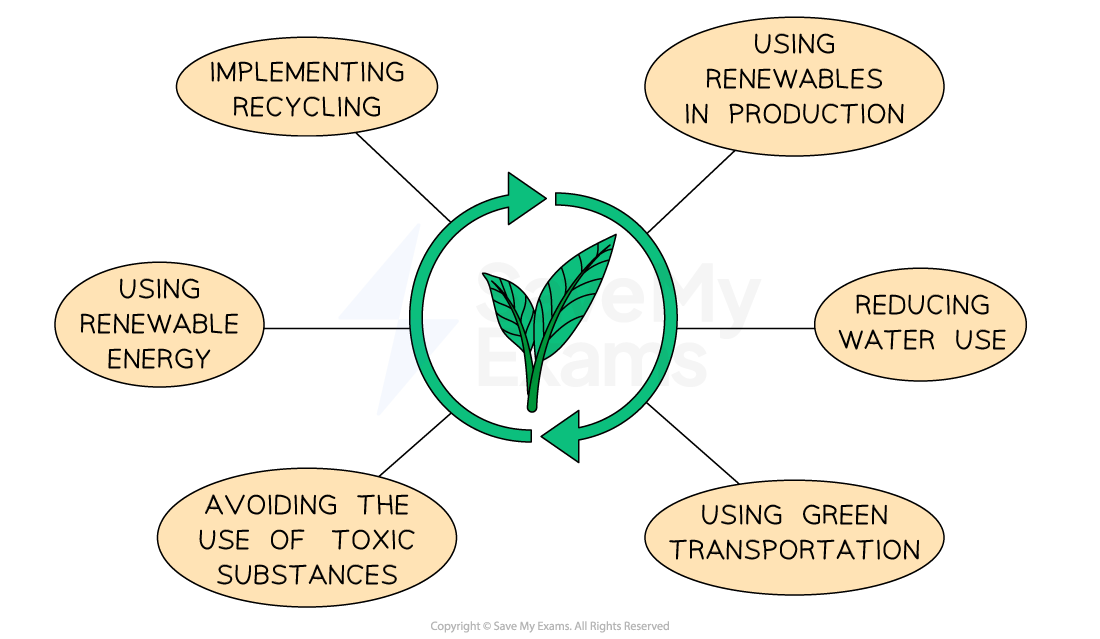
benefits of improving sustainability
Benefit | Explanation |
|---|---|
Meeting customer expectations |
|
Cost savings |
|
Legal and ethical compliance |
|
Competitive advantage |
|
Long-term survival |
|
capital-intensive production
Capital-intensive production predominately uses machinery and technology in the production of goods and services
Large-scale production of standardised products is likely to be capital-intensive
Manufacturing in developed countries where labour costs are relatively highis likely to be capital-intensive
E.g. Vehicle manufacturers such as Ford use robots and other production technology to manufacture cars, with supervisors overseeing the quality of output
Evaluating capital intensive production
Advantages | Disadvantages |
|---|---|
|
|
labour intensive operations
Labour-intensive production predominantly uses physical labour in the production of goods and services
The delivery of services is usually more labour-intensive than manufacturing
In countries where labour costs are low, such as Bangladesh and Vietnam, labour-intensive production is common
Small-scale production is likely to be labour-intensive
E.g. UK schools are labour-intensive operations as teachers plan and deliver lessons and provide pastoral support
evaluating labour intensive production
Advantages | Disadvantages |
|---|---|
|
|
production
the transformation of resources (e.g. raw materials components and processes) into finished goods or services
Goods are physical products, such as bicycles and T-shirts
Services are non-physical items such as hairdressing, tourism and manicures
four main production methods
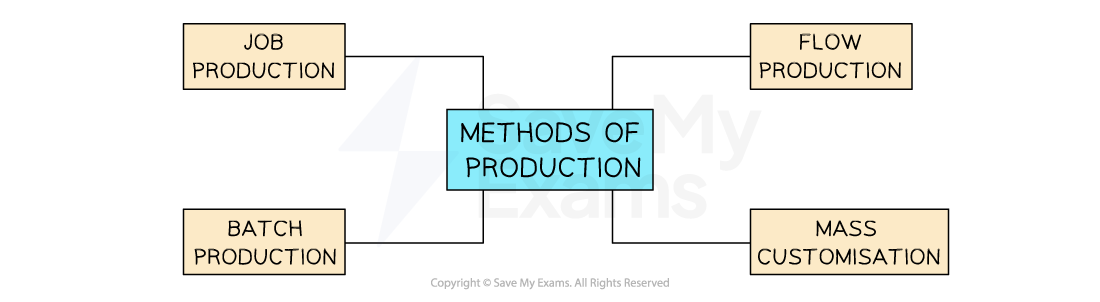
The method of production used by a business depends upon a number of factors (4)
The level of output required to be produced
The nature of the product
Whether the product is standardised or customised
The level of automation used in production
automation - use of machinery, technology, robots in production process
job production
Job production
Products are made to the specific requirements of individual customers.
Each product is made separately and tailored to the customer's specifications.
Used for unique or specialised products produced in small quantities.
Often requires skilled labour due to the specialised production process.
Evaluation
Can generate high added value and profits because products are unique and customised.
Customers are often willing to pay premium prices for products that closely meet their needs.
This advantage may be lost if the business switches to batch or flow production, where products become more standardised.
Examples of job production
Furniture made to order Where customers can choose the design, dimensions, materials and finishes | Tailored clothing Such as wedding suits, where each garment is made to fit the specific preferences of the individual customer | High-end jewellery Especially those with unique designs or personalised engravings |
 |  |  |
advantages and disadvantages of job production
Advantages | Disadvantages |
|---|---|
|
|
|
|
|
|
|
|
batch production
Batch production is when products are made in groups or batches.
A set quantity is produced together, and each batch goes through the full production process before the next one starts.
Batches are usually standardised in size and follow a set sequence of operations.

Batch production strikes a balance between customisation and cost-effectiveness, making it a suitable production method for industries that deal with diverse product ranges and varying customer needs
evaluating batch production
Advantages | Disadvantages |
|---|---|
Flexible: Can switch between batches to produce different products and meet changing demand. | Set-up time: Equipment must be reset between batches, causing delays and idle time between batches. |
Lower costs: More cost-effective than job production/flow production and benefits from some purchasing economies of scale. | Accumulated inventory: Finished goods may need to be stored, increasing storage costs and risk of wastage. |
Quality control: Defects can be identified and corrected within a batch before the next batch is produced. | Less adaptable: Slower and less suitable than flow production for large-scale, continuous production and can be difficult to manage rapid changes in product demand/frequent product variations. |
Machinery wear: Frequent start-ups and shutdowns increase maintenance and repair costs. |
purchasing economies - Occur when large firms buy raw materials in greater volumes and receive a bulk purchase discount which lowers the AC
mass (flow) production
Flow production is when a product is made in a continuous sequence on a production line.
Materials move through different workstations, with each one carrying out a specific task such as assembly, testing, packaging or quality control.
This method is commonly used in industries that produce high volumes of standardised products such as automobiles and consumer electronics
Characteristics of flow production (5)
Division of labour: tasks are split between workstations, so workers can specialise
Standardisation: identical products are made for consistency and smooth production
Continuous movement: products move from one stage to the next with little idle time
High volume: suitable for producing large quantities efficiently
Automation: machinery often carries out repetitive tasks quickly and accurately
evaluating flow production
Advantages | Disadvantages |
|---|---|
Efficient: Continuous production reduces start-up/shutdown time, lowering energy use and material waste. | High capital cost: Requires expensive machinery and automation. |
Lower labour costs: Automation reduces the need for skilled labour. | Breakdowns: A fault in one part of the production line can stop the entire process, causing costly downtime. |
Quality control: Defects can be identified and corrected early, improving consistency. | Costly defects: If a defect is found, the whole production line may need to stop, resulting in significant losses. |
Fast production: High output and short lead times allow businesses to respond quickly to demand. | Supply dependence: Requires a reliable supply of raw materials and components; supply chain disruptions can halt production. |
down time - a period during which a machine (eg a computer/machine) is out of action or unavailable for use.
examiner tips and tricks
When recommending a suitable method of production, carefully consider the needs of the customers. Where the selling price is a key driver of consumer demand, flow production (where unit costs are minimised) is likely to be very suitable. Where demand is driven by quality or where customisation is required, job or batch production are likely to be better choices.
mass customisation
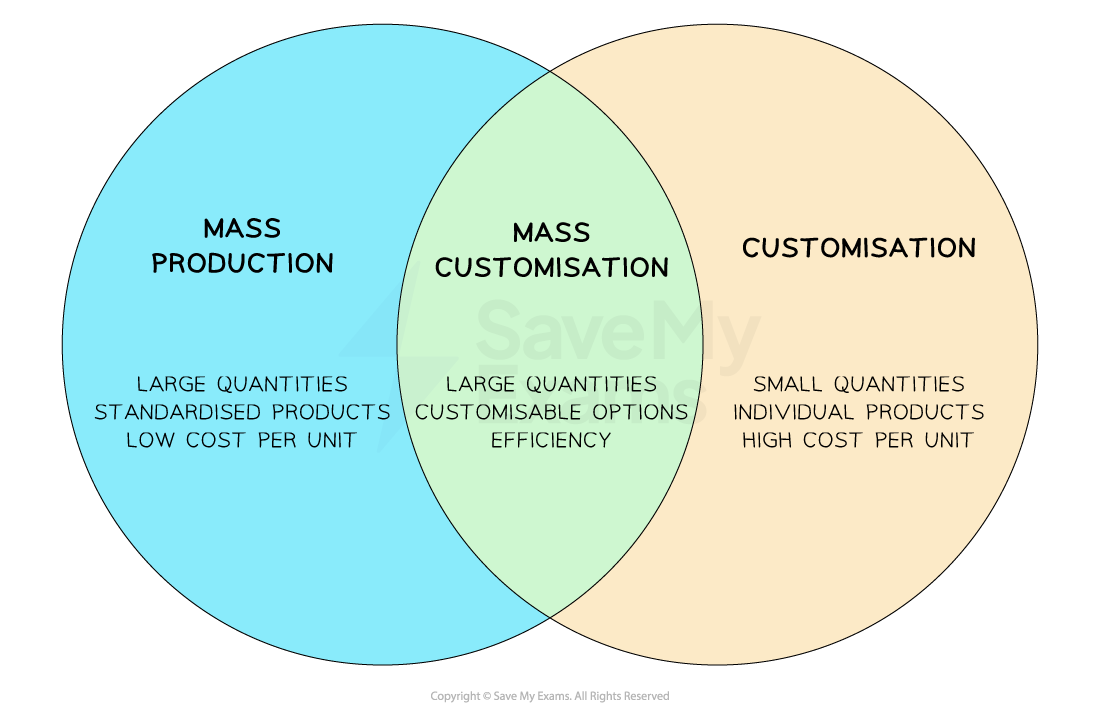
Mass production usually uses flow production to make large quantities of standardised products, which keeps unit costs low.
Customisation is usually linked to job or small-scale batch production, where customers can design products from scratch.
Mass customisation combines both by offering custom options within a standardised process, using technology such as CAD, flexible manufacturing systems and data analytics.
stages of mass customisation (3)
1. Choice
Customers select from a range of pre-designed options, features or configurations.
Example: Audi customers choose the model (Avant, Saloon, Coupé, Sportback) and trim level (Premium, Premium Plus, Prestige).
2. Customisation
Customers personalise their product by selecting specific features, colours, sizes or additional options.
Example: Audi customers can add features such as driver assistance tools, a towbar or dashcam.
3. Production
Once preferences are confirmed, the product is manufactured using flexible production methods such as cell production.
Example: Audi vehicles take 6–12 weeks to manufacture in Germany, using automated production, 3D printing and AI.
cell production
A manufacturing system where the workforce is divided into self-contained teams designed to complete a particular manufacturing process or product
evaluating mass customization
Advantages of mass customisation
Higher customer satisfaction: Customers receive products suited to their preferences, increasing loyalty and positive feedback.
Flexibility: Businesses can offer product variety and respond to changing demand without the cost of full customisation.
Economies of scale: Standardised components and processes reduce stock costs and improve production efficiency.
Competitive advantage: Product variety can differentiate the business, attract customers and create a perception of innovation and value.
Disadvantages of mass customisation
High investment costs: Requires expensive technology and equipment.
Higher variable costs: Customised products usually cost more to produce than standardised mass-produced items.
Why may a business want to change its method of production? (4)
It wants to achieve higher levels of output
It wants to increase quality
Labour costs have increased
Costs of running machinery, such as power, have increased
challenges of changing production methods
High investment costs: Increasing production capacity may require investment in machinery, storage facilities and worker training. Financing this through loans increases fixed costs and gearing, making future borrowing harder.
Employee resistance: Changes may make some skills unnecessary, causing redundancies. Workers may resist change or feel demotivated if jobs become less skilled, reducing productivity.
Risk of lower demand: Businesses should ensure higher demand is sustainable through market research and sales forecasting before investing heavily.
Alternative option: Outsourcing may be a better short-term solution before investing in new equipment and staff training.
outsourcing - when a company hires an external third-party vendor to perform tasks or services that were previously handled in-house (eg - Apple outsources the vast majority of its hardware manufacturing and assembly to third-party firms like Foxconn, allowing Apple to focus entirely on its core strengths of product design, software development, and marketing. )
sales forecasting
Estimating future revenue by predicting how much of a product or service will sell in the next week, month, quarter, or year
gearing
The proportion of assets invested in a business that are financed by long-term borrowing such as loans