Magnetic Force Between Two Parallel Currents
 Studied by 0 people
 Call with Kai
 Learn
Learn Practice Test
 Spaced Repetition
 Match
Match Flashcards
 Knowt Play
1/27

There's no tags or description
Looks like no tags are added yet.
Name | Mastery | Learn | Test | Matching | Spaced | Call with Kai |
|---|
No study sessions yet.
28 Terms
B1
(1)
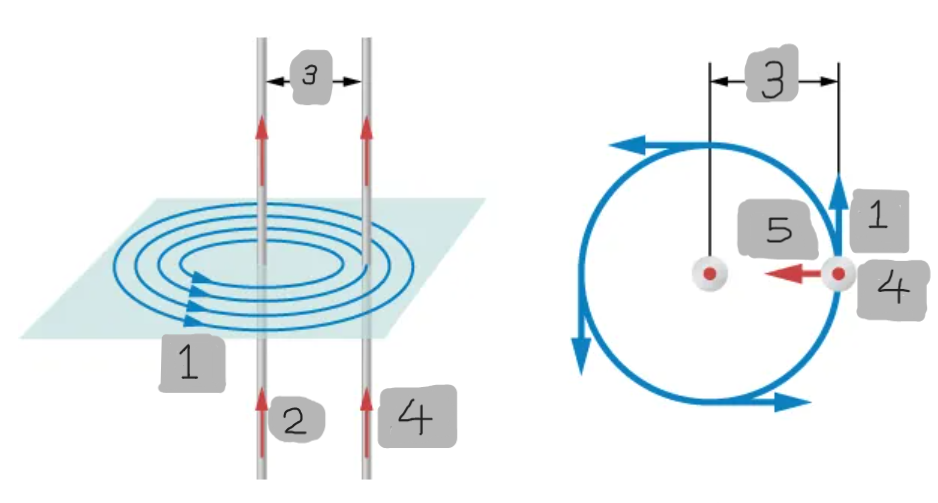
I1
(2)
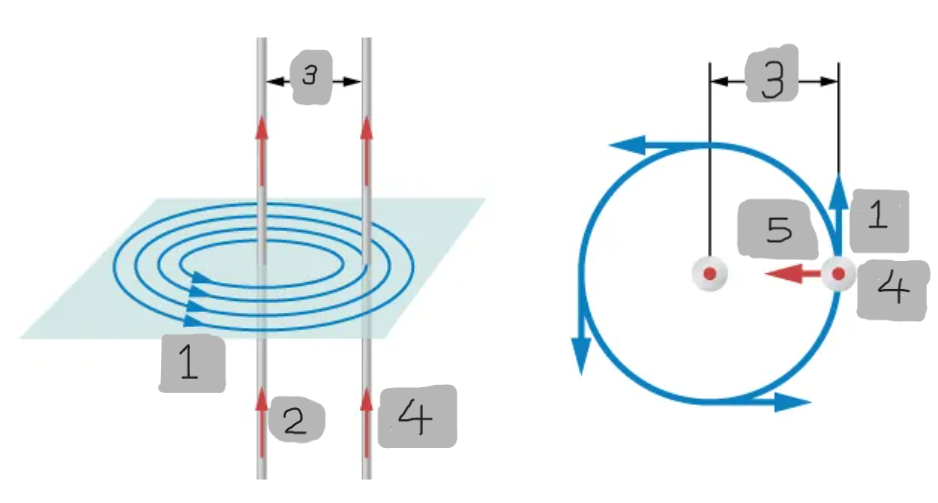
r
(3)
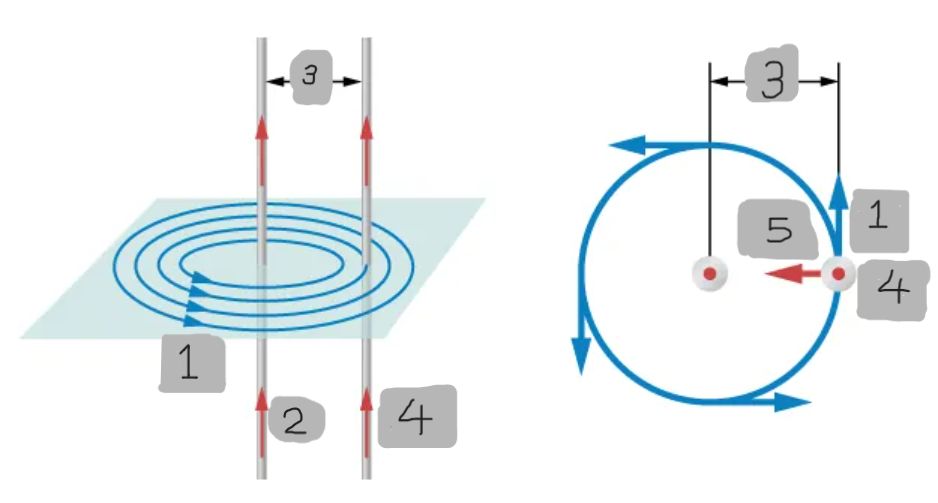
I2
(4)

F2
(5)
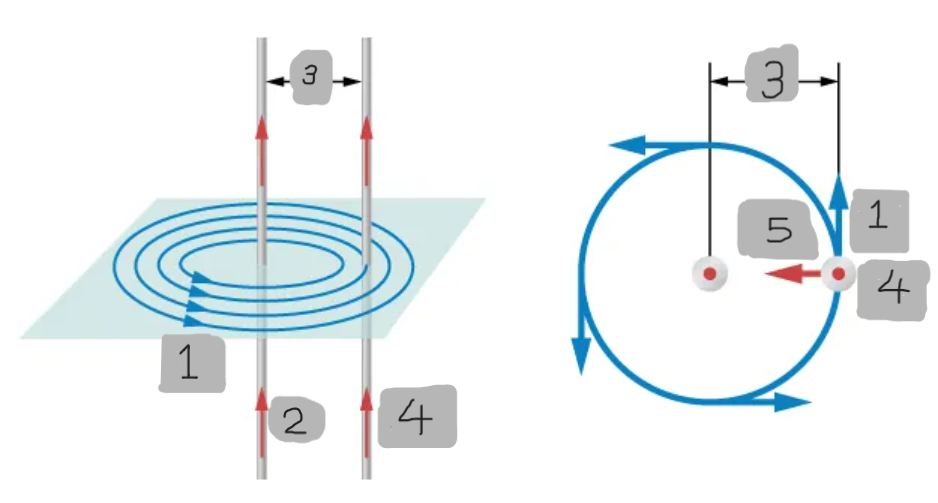
Magnetic Force Between Current-Carrying Wires
Two current-carrying conductors exert magnetic forces on each other due to the magnetic fields produced by their currents.
B1 = ((μ0×I1)/(2πr))
The magnetic field produced by a long straight wire carrying current I1 at a distance r
F = I × l × B × sin(θ)
Mathematical representation of the force experienced by a wire of length l carrying a current of I in a magnetic field B.
sin(θ) = 1
For two parallel wires, the magnetic field is perpendicular to the current, therefore what’s the value of sin(θ)
F = I × l × B × 1
Magnetic Force on a Parallel Wire
F/l = ((μ0×I1×I2)/(2πr))
The magnetic force per unit length between two long, parallel currents I1 and I2 separated by distance r
Direction of Force Between Parallel Currents
Parallel currents in the same direction attract, while parallel currents in opposite directions repel.
Newton’s Third Law for Wire Forces
The magnetic forces that two current-carrying wires exert on each other are equal in magnitude and opposite in direction.
Right-Hand Rule for Wire–Wire Forces
The direction of the force on a wire is determined by applying the right-hand rule to the current direction and the magnetic field produced by the other wire.
Pinch Effect
In high-current arcs, magnetic attraction squeezes the current path, increasing temperature and potentially damaging equipment.
Pinch Effect in Electric Arcs
In high-current arcs, magnetic attraction squeezes the current path, increasing temperature and potentially damaging equipment.
Pinch Effect in Plasma Physics
Magnetic forces shape jets of ionized material, such as solar flares, by compressing plasma along current paths.
Role of Charge Neutrality in Magnetic Forces
Magnetic attraction dominates only when the net charge density is zero; otherwise, electric (Coulomb) repulsion overwhelms it.
Definition of the Ampere (Classical)
The ampere is defined based on the magnetic force between two long, parallel conductors carrying equal currents.
Standard Ampere Definition Condition
Two parallel wires separated by 1 meter
each carrying 1 ampere
experience a force per unit length of:
F/l = 2 × 10^-7 N/m
1T = 1 N/(A⋅m)
Relationship Between Tesla and Newton
Practical Measurement of Current
In practice, current is measured using a current balance that detects the magnetic force between nearby conductors
1C = 1 A⋅s
Definition of the Coulomb
Force Direction in Same-Direction Currents
When two wires carry current in the same direction, each wire is pulled toward the other.
Force Direction in Opposite-Direction Currents
When two wires carry current in opposite directions, the wires push away from each other.
Distance Dependence of Wire–Wire Force
The magnetic force per unit length decreases inversely with separation distance r.
Vector Nature of Magnetic Force Between Wires
The force has both magnitude and direction and must be expressed as a vector when wires are not collinear.
Geometry Dependence of Wire Forces
The magnitude and direction of the force depend on the relative positions of the wires, not just current magnitude.