Topic 3 : Voice of the Genome
 Call Kai
 Learn
Learn Practice Test
 Spaced Repetition
 Match
Match Flashcards
 Knowt Play
1/32

There's no tags or description
Looks like no tags are added yet.
Name | Mastery | Learn | Test | Matching | Spaced | Call with Kai | Chat |
|---|
No analytics yet
Send a link to your students to track their progress
33 Terms
State the differences between eukaryotic and prokaryotic cells ( include their structures, names of cells and type of cell division )
Eukaryotic: (plant, animal and fungi cells)
have membrane bound organelles
DNA is enclosed in a nucleus and linear and also found in mitochondria
cell division : mitosis / meiosis
Prokaryotic: (bacterial cells and all other cells)
have no membrane bound organelles
DNA is circular and found in plasmids
cell division : binary fission
Prokaryotic cells are much smaller
State where can cell wall, mitochondria, ribosomes, cell surface membrane centrioles, amyloplasts, smooth endoplastic reticulum can be found (with plant, animal or bacterial cell)
mitochondria : plant and animal cells
ribosomes : plant, animal and bacterial cells
cell surface membrane : plant, animal and bacterial cells
centrioles : plant and animal cells
amyloplasts: plant cells only
SER : plant and animal cells
State the structures found in eukaryotic cells
Plant and Animal only:
nucleus
nucleolus
rough endoplasmic reticulum
smooth endoplasmic reticulum
golgi apparatus
mitochondria
lysosomes
centrioles
plasma membrane
vesicle
Plant only
cell wall
vacuole
chloroplast
Draw and label the structure of an animal cell

State the structure of the nucleus and it’s function
structure : suurounded by a double membrane nucelar envelope with pores
function : contains DNA which is the genetic material of the cell / control gene expression + cell activity
State the structure of the nucleolus and it’s function
structure : dense region in nucleus with no membrane / made of proteins + RNA
function : produce ribosomes
Draw and label the structures of the nucelus

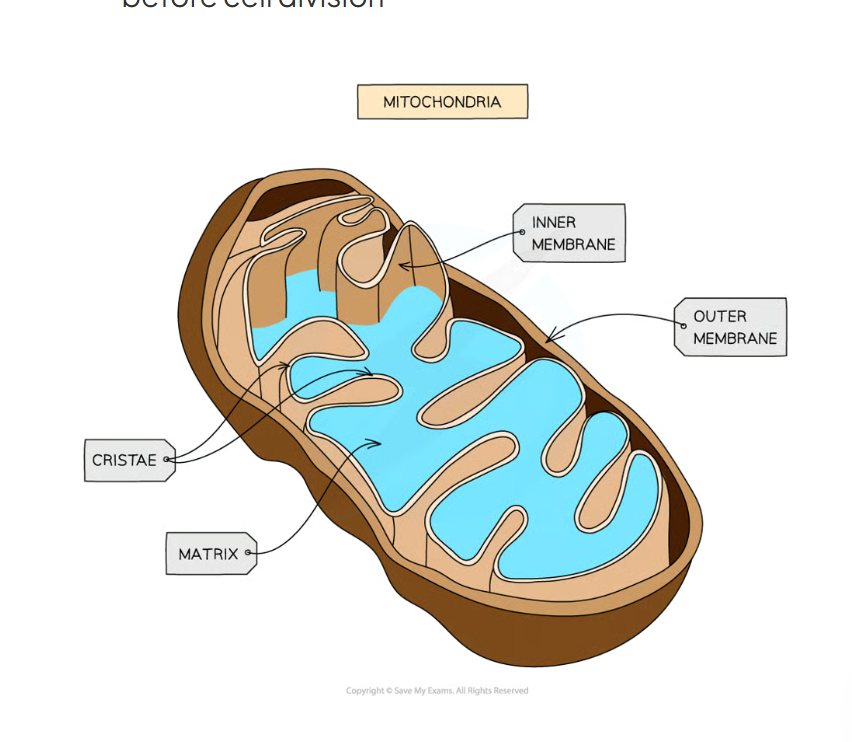
State the structure of mitochondria and it’s function
structure : surrounded by a double-membrane / inner membrane folded into structures called cristae / contains a matrix (containing enzymes needed for aerobic respiration, producing ATP) / has it’s own circular DNA
function : site of aerobic respiration which produces ATP
Draw and label the structure of mitochondria
State the structure and function of the golgi apparatus
structure: consists of flattened sacs of membrane known as cisternae
function : modifies + packages proteins and lipids into vesciles (after synthesis from RER/SER) / produces lysosomes
State the structure and function of lysosmes
structure: membrane bound vesicles containing hydrolytic/ digestive enzymes
function : digest waste material such as worn out organelles / destroys pathogens, known as phagocytosis
Draw and label the structure of the golgi apparatus

State the structure and function of the rough endoplasmic reticulum
structure : network of flattened membrane-bound sacs covered with lots of ribosomes attached which make a rough surface
function : synthesises and transpots proteins for secretion
State the structure and function of the smooth endoplasmic reticulum
structure : network of membrane-bound sacs with no ribosomes on it’s surface
function : synthesises lipids + steroids / detoxifies drugs + poisons
Draw an image of the SER vs the RER

State the structure and function of ribosomes
structure : made of proteins and RNA with a large subunit and a small subunit / no membrane / 80s ribosomes found in eukaryotic cells 70s ribosomes found in prokaryotic cells
function : where proteins are made free in the cytoplasm and are attached to RER
State the structure and function of centrioles
structure : pairs of cylindrical microtubes / found at right angles to each other
function : forms spindle fibres in cell division
States the function and structure of the plasma membrane
structure : a partially permeable membrane
function : to regulate the movement of substance into and out of the location of receptors (chemical response)
States the structure and function of vesciles
structure: a small fluid-filled sac in the cytoplasm surrounded by a membrane
function : transports substances in and out of the cell (via the plasma membrane) and between organelles
Draw and label the structure of a plant cell

State the structure and function of the cell wall and state the function of the plasmodesmata
structure : made of cellulose in plants + made of chitin in fungi
function : supports plant cells
plasmodesmata function : exchanging substances between adjacent cells
State the structure and function of the vacuole
structure : compartment that contains cell sap / tonoplasr surrounds the vacuole
function : helps maintain water balance
States the structure and function of chloroplast
structure : double membrane
function : site of photosynthesis
State which organelles are membrane bound and which are not
Non- membrane bound organelles: ribosomes and centrioles
membrane bound organelles : SER, RER, nucelus, mitochondria, lysosomes, golgi apparatus
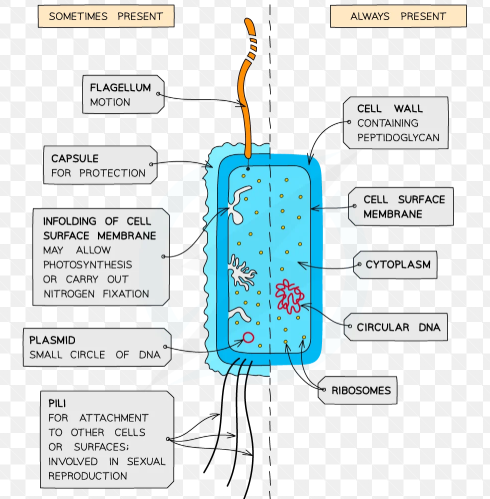
State the structures found in prokaryotic cells
plasmids
circular DNA
ribosomes
pili
capsule
flagella
cell wall
no membrane-bound organelles
State the structure and function of the cell wall
structure: made of peptidoglycan/ murein
function: provides rigidity + prevents osmotic lysis
State the structure and function of the capsule
structure: thick polysaccharide layer outside cell wall
function: help adhesion to surfaces / prevents dessication / shields from immune detection
State the structure and function of plasmids
structure: circular double-stranded DNA
function: contains genes that can pass between prokaryotes / carries antibiotic resistant genes
State the structure and function of ribosomes
structure: 70s ribosomes are smaller than 80s ribosomes + free in the cytoplasm
function: site of rpotein synthesis (translation of mRNA)
State the structure and function of flagella
structure: long rotating filament attached to cell wall
function: provides motility - chemotaxis
State the structure and function of pili
structure: thin protein tubes extending from cell surface
function: attach to host cells / some involved in DNA transfer
Draw and label a prokaryotic cell