Gases, Solutions, Chemical Kinetics PROBLEMS
 Call Kai
 Learn
Learn Practice Test
 Spaced Repetition
 Match
Match Flashcards
 Knowt Play
1/63

There's no tags or description
Looks like no tags are added yet.
Name | Mastery | Learn | Test | Matching | Spaced | Call with Kai | Chat |
|---|
No analytics yet
Send a link to your students to track their progress
64 Terms
The altimeter reading in an airplane is 19.00 in Hg. This pressure is equal to __________ mm Hg
483
To what temperature must a balloon, initially at 25°C and 2.00 L, be heated in order to have a volume of 6.00 L?
894 K
A large balloon is initially filled to a volume of 25.0 L at 353 K and a pressure of 2575 mm Hg. What volume of gas will the balloon contain at 1.35 atm and 253 K?
45.0 L
What mass of NO2 is contained in a 13.0 L tank at 4.58 atm and 385 K?
86.7 g
What is the volume of 5.60 g of O2 at 7.78 atm and 415 K?
0.766 L
A 0.334 g sample of an unknown halogen occupies 109 mL at 398 K and 1.41 atm. What is the identity of the halogen?
Cl2
A mixture of 10.0 g of Ne and 10.0 g Ar have a total pressure of 1.6 atm. What is the partial pressure of Ne?
1.1 atm
Convert 2.00 atm to torr.
1520 torr
Convert 2.00 atm to mm Hg.
1520 mm Hg
The atmospheric pressure is 715 mm Hg. What is the pressure in inches of Hg?
28.1 in Hg
A sample of 0.400 moles of nitrogen occupies 0.800 L. Under the same conditions, what number of moles occupies 1.200 L?
0.600 moles
A fixed amount of gas at 25.0°C occupies a volume of 10.0 L when the pressure is 751 torr. Use Boyle's law to calculate the pressure (torr) when the volume is reduced to 9.25 L at a constant temperature of 25.0°C.
812 torr
What volume (in mL) will a sample of F2 gas occupy in a syringe at 5.5 atm, if the F2 has a volume of 30.0 mL at 1.2 atm?
6.5 mL
If a sample of 0.29 moles of Ar occupies 4.2 L under certain conditions, what volume will 0.66 moles occupy under the same conditions?
9.6 L
A basketball is inflated to a pressure of 1.80 atm in a 23.0°C garage. What is the pressure of the basketball outside where the temperature is -2.00°C?
1.65 atm
What pressure (in atm) will 0.44 moles of Br2 exert in a 2.6 L container at 25°C?
4.1 atm
How many moles of CO are contained in a 5.00 L tank at 155°C and 2.80 atm?
0.399 moles
What is the volume of 9.783 × 10²³ atoms of He at 9.25 atm and 512K?
7.38 L
A gas bottle contains 0.450 mol of gas at 730 mm Hg pressure. If the final pressure is 1.15 atm, how many moles of gas were added to the bottle?
0.539 mol
What volume will 5.11 × 10²² atoms of Ne occupy at STP?
1.90 L
A steel bottle contains nitrogen gas at STP. What is the final pressure if the temperature is changed to 155°C?
1.57 atm
The density of krypton gas at 1.35 atm and 54.1°C is ________ g/L.
4.21
Which of the following would have a density of 0.172 g/L at 7.0°C and 0.987 atm?
He
The density of chlorine gas at 0.866 atm and 39.9°C is ________ g/L.
2.39
A mixture of Ar, H2 and SO2 has a pressure of 7.85 atm. If the Ar has a mole fraction of 0.47 and H2 has a mole fraction of 0.23, what is the partial pressure of SO2?
0.998 atm
In the laboratory, hydrogen gas is usually made by the following reaction:
Zn(s) + 2 HCl(aq) → H2(g) + ZnCl2(aq)
How many liters of H2 gas, collected over water at an atmospheric pressure of 752 mm Hg and a temperature of 21.0°C, can be made from 1.566 g of Zn and excess HCl? The partial pressure of water vapor is 18.65 mm Hg at 21.0°C.
0.599 L
How much energy is required to vaporize 98.6 g of ethanol (C2H5OH) at its boiling point, if its ΔHvap is 40.5 kJ/mol?
86.7 kJ
Determine the normal boiling point of a substance whose vapor pressure is 55.1 mm Hg at 35°C and has a ΔHvap of 32.1 kJ/mol.
390 K
Determine the vapor pressure (in torr) of a substance at 36°C, whose normal boiling point is 84°C and has a ΔHvap of 22.1 kJ/mol.
239 torr
Choose the pair of substances that are most likely to form a homogeneous solution.
C6H14 and C10H20
Which is expected to have the largest dispersion forces?
C9H20
Place the following compounds in order of increasing strength of intermolecular forces.
CH4 CH3(CH2)3CH3 CH3CH3
CH4 < CH3CH3 < CH3(CH2)3CH3
Choose the substance with the lowest surface tension.
CH3CH2CH2CH3
Choose the substance with the highest viscosity.
HOCH2CH2CH2CH2OH
Which of the following substances would you predict to have the highest ΔHvap?
HOCH2CH2OH
Identify the place which has the lowest boiling point of water.
Lhasa, Tibet, 11,975 feet
Which substance below has the strongest intermolecular forces?
A2X, ΔHvap= 39.6 kJ/mol
Place the following substances in order of increasing boiling point.
CH3CH2CH2CH2OH Ar CH3OCH3
Ar < CH3OCH3 < CH3CH2OH
How much energy is required to vaporize 178 g of butane (C4H10) at its boiling point, if its ΔHvap is 24.3 kJ/mol?
74.6 kJ
Calculate the molality of a solution formed by dissolving 27.8 g of Lil in 500 mL of water
0.415 M
What mass (in g) of NH3 must be dissolved in 4775 g of methanol to make a 0.250 m solution?
2.02 g
How many moles of KF are contained in 347 g of water in a 0.175 m KF solution?
6.07 × 10^-2 mol KF
Determine the molality of a solution prepared by dissolving 0.500 moles of CaF2 in 11.5 moles H2O
2.41 mol/L
A solution is prepared by dissolving 98.6 g of NaCl in enough water to form 875 mL of the solution. Calculate the mass % of the solution if the density of the solution is 1.06 g/mL
10.6%
What mass of CuCl2 is contained in 75.85 g of a 22.4% by mass solution CuCl2 in water?
17.0g
Calculate the mole fraction of total ions in an aqueous solution prepared by dissolving 0.400 moles of MgCl2 in 850.0 g of water
0.0270
Place the following aqueous solutions of nonvolatile, nonionic compounds in order of decreasing osmotic pressure
I. 0.011 M sucrose II. 0.00095 M glucose III. 0.0060 M glycerin
I > III > II
A compound is found to have a molar mass of 598 g/mol. If 35.8 mg of the compound is dissolved in enough water to make 175 mL of solution at 25 C, what is the osmotic pressure of the resulting solution?
6.36 torr
What is the mole fraction of ethanol in a solution made by dissolving 29.2 g of ethanol, C2H5OH, in 53.6 g of water
0.176
A solution is 2.25% by weight NaHCO3. How many grams of NaHCO3 are in 150.0 g solution
3.38 g
Determine the vapor pressure of a solution at 55 C that contains 34.2 g NaCl in 375 mL of water. The vapor pressure of pure water at 55 C is 118.1 torr
112 torr
Determine the freezing point depression of a solution that contains 30.7g glycerin, (C3H8O3, molar mass = 92.09 g/mol) in 376 mL of water. Some possibly useful constants for water are Kf= 1.86 C/m and Kb= 0.512 C/m
1.65 C
need chemical kinetics
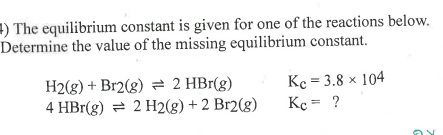
6.9 × 10^-10

K = 1/[O2]³
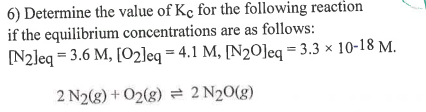
2.0 × 10^-37
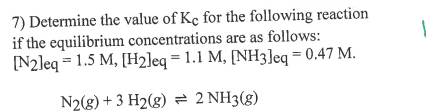
0.11
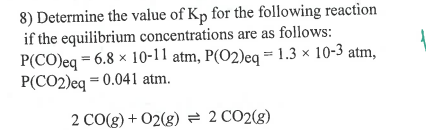
2.8 × 10^ 20
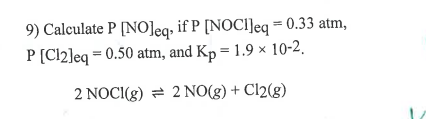
0.064 atm