BIOL-540 M4 Protein-Ligand Interactions
 Call Kai
 Learn
Learn Practice Test
 Spaced Repetition
 Match
Match Flashcards
 Knowt Play
1/66

There's no tags or description
Looks like no tags are added yet.
Name | Mastery | Learn | Test | Matching | Spaced | Call with Kai | Chat |
|---|
No analytics yet
Send a link to your students to track their progress
67 Terms
2 types of interactions of proteins?
- protein acting as a reaction catalyst, or enzyme, alters the chemical configuration or composition of a bound molecule
- neither the chemical configuration nor the composition of the bound molecule is changed
protein function usually involves ____ binding to ligands.
noncovalent (weak), reversible
what allows an organism to respond rapidly and reversibly to changing conditions?
transient nature of protein-ligand interactions
binding sites are complementary to size, shape, charge, and hydrophobic/philic character of ____.
ligand
true or false: protein interactions are nonspecific.
false; specific ligand
true or false: proteins selectively bind only one or a few types of molecules.
true; specific ligand
how can some proteins bind to different ligands?
separate binding sites
how is flexibility of a protein important in protein-ligand interactions?
protein-ligand interactions are often coupled to conformational changes; a more complementary binding site allows tighter binding, induced fit
in multi-subunit proteins, a conformational change in one subunit often leads to...
conformation change in other subunits
how are protein-ligand interactions regulated?
conformational changes
oxygen can bind to a ____ group.
heme prosthetic
oxygen is ____ soluble in aqueous solutions.
poorly; therefore, its diffusion through tissues is ineffective over large distances
what caused the evolution of O2 transporters?
multicellularity; O cannot diffuse effectively by itself
____ have a strong tendency to bind oxygen.
transition metals (Fe, Cu)
how are free transition metals in reduced form harmful?
reduced metals give away electrons and O is electronegative, so harmful O species form (free radicals)
how can we prevent transition metals like Fe from reaching reduced state?
incorporate Fe into heme, a protein-bound prosthetic group that is permanently associated with protein

true or false: heme is present in all types of -globins.
true; each -globin protein has a single heme
heme consists of a complex organic ring structure called ____ that contains the bound Fe2+ atom.
protoporphyrin
6 bonds that keep Fe in place in heme?
- 4 to N atoms in the flat porphyrin ring
- 2 perpendicular to porphyrin
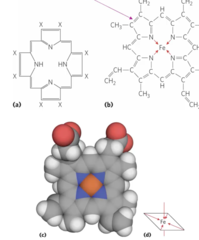
2 perpendicular Fe coordination bonds?

true or false: Fe3+ binds O2.
false; Fe2+ binds O2 reversibly
coordinating N bonds have electron-donating character to prevent conversion of Fe2+ to ____.
Fe3+
leghemoglobin, a plant O-binding protein, and myoglobin, an O-binding protein found in muscle tissue, are monomeric proteins. hemoglobin, which carries O in blood, is tetrameric (4 -globins). which have tertiary structure and which have quarternary structure?
all have 3º, only hemoglobin has 4º
you are studying proteins that bind to ligand L. based on Ka values, which protein has the highest affinity?
the one with the highest Ka OR lowest Kd
as Ka increases, Kd ____.
decreases (Kd = dissociation constant)
widespread protein family that function in O2 transport
globin

globins have highly-conserved __º structure of 8 ⍺-helical segments connected by bends (globin fold).
3

globins are composed of entirely ____ (2º structure?).
⍺-helical segments
histidine that binds to Fe in globins
proximal histidine (His F8)

4 types of globins in humans and other mammals?
- myoglobin (monomeric)
- hemoglobin (tetrameric)
- neuroglobin (monomeric)
- cytoglobin (monomeric)
globin that facilitates O2 diffusion in muscle tissue
myoglobin
globin that is responsible for O2 transport in the bloodstream
hemoglobin
globin that is expressed largely in neurons to protect the brain from low O2 or restricted blood supply
neuroglobin
globin that regulates levels of nitric oxide, a localized signal for muscle relaxation
cytoglobin
myoglobin consists of 153 residues + __ molecule(s) of heme.
1

equilibrium expression for reversible binding of protein (P) to ligand (L)
where ka = rate constant for forward (binding)
kd = rate constant for backward (releasing)
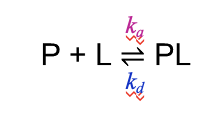
ratio of the rates of the forward (association) and the reverse (dissociation) reactions that form the PL complex
association constant (Ka)
as Ka increases, affinity ____.
increases (forward rxn favored)
as Ka decreases, affinity ____.
decreases (reverse rxn favored)
Ka is a measure of net ____.
binding
when [L] ____ [ligand-binding sites], the binding of the ligand by the protein does not appreciably change [L].
> (basically, assume excess L)
at equilibrium, individual proteins are constantly binding and releasing ligands; ratio of bound to free proteins (Y) is ____.
constant, where Y = fraction of ligand binding sites bound

true or false: we can measure Ymax.
true; though Ymax is never reached experimentally, we can find 1/2 Ymax point
equilibrium constant for the release of ligand; inverse of association constant
dissociation constant (Kd) = 1/Ka
as Kd decreases, ____ ligand is needed to bind.
less (small Kd = higher affinity)
when [L] = Kd,...
half of the ligand binding site are occupied
protein A has Ka = 6.0 uM-1 and protein B has Kd = 4.0 uM for binding L. which has higher affinity for L?
A

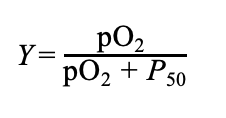
____ of oxygen is the oxygen in the air above the solution which is used because it's easier to measure (value should be the same if air and solution are given time to equilibrate).
partial pressure (pO2)
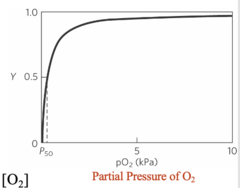
when pO2 = P50 myoglobin, what is Y?
0
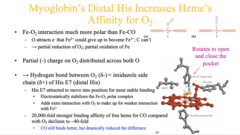
____ binds free heme more than 20,000 times better than does O2.
carbon monoxide (CO)

myoglobin's distal histidine increases heme's affinity for ____.
O2 (watch video on this idk what's going on)
which interaction is more polar: Fe-O2 or Fe-CO?
Fe-O2; O attracts electrons that Fe2+ can give up to become Fe3+, C cannot (partial reduction of O2, partial oxidation of Fe)
after distal His rotates down, HB between O2 (partial -) and imidazole side chain (partial +) of His E7 (distal His)
idfk on this whole slide
red blood cells, transport O2
erythrocytes
erythrocytes are formed from precursor stem cells called ____.
hemocytoblasts
true or false: erythrocytes have organelles and a nucleus.
false; no organelles or nucleus
main function of erythrocytes?
carry oxygenated hemoglobin to tissues distal to lungs
erythrocytes are ____ of globin subunits.
tetramers

true or false: arterial blood is more O2-saturated than venous blood.
true; arteries (96% saturated) carry oxygen-rich blood from the lungs to the body's tissues, while veins (64% saturated) return oxygen-poor blood
main difference between myoglobin and hemoglobin?
myoglobin: monomeric (1 heme), only responsive to large changes in O2, primarily used for O2 storage
hemoglobin is tetrameric (4 heme), sensitive to small changes in O2, used for O2 transport
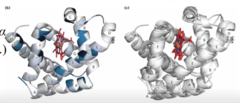
- low sequence similarity, high structural similarity
2 globin types in adult hemoglobin?
2 ⍺ chains and 2 β chains
what would happen if we used myoglobin rather than hemoglobin for transport?
its high affinity for O would prevent it from ever giving it up
how do we get hemoglobin to release O as we get further from lungs?
high affinity in lungs, lower affinity as we travel away from lungs
myoglobin and hemoglobin have low ____ similarity and high ____ similarity.
sequence, structural
black = same AA (proximal and distal AA)
blue = similar AA
white = different AA
quarternary structure of hemoglobin results from strong interactions like:
- hydrophobic effect
- hydrogen bonds
- ion pairs (salt bridges)
the ⍺1β1 and ⍺2β2 interfaces each involve more than __ residues.
30
the ⍺1β2 and ⍺2β1 interfaces each involve more than __ residues.
19