Civil War Causes: Sectionalism, Slavery, and Constitutional Disputes
 Call Kai
 Learn
Learn Practice Test
 Spaced Repetition
 Match
Match Flashcards
 Knowt Play
1/70

There's no tags or description
Looks like no tags are added yet.
Name | Mastery | Learn | Test | Matching | Spaced | Call with Kai | Chat |
|---|
No analytics yet
Send a link to your students to track their progress
71 Terms
What was the most divisive conflict in American history?
The Civil War
What are the two categories of causes for the Civil War?
Long-term causes and short-term causes
What do long-term causes refer to?
Economic, social, cultural, and political factors that make an event likely.
What do short-term causes usually consist of?
A specific problem or crisis and how it is handled.
Name three long-term causes of the Civil War.
Sectionalism, slavery, and disagreements over the interpretation of the Constitution.
What does sectionalism refer to?
Greater loyalty to one's region (North, South, or West) than to the country as a whole.
What economic system characterized the South before the Civil War?
The continuation of slavery, known as its 'peculiar institution.'
What invention led to the expansion of slavery in the South?
The cotton gin
By 1860, what percentage of the Southern population were African-American slaves?
About one-third
What was the primary economic activity in the Northeast during the early 1850s?
Manufacturing (textiles, ironwares, and machinery)
What was the primary economic activity in the Northwest during the early 1850s?
Family farms producing wheat, corn, oats, and livestock.
What was the Southern economy primarily based on?
Profits gained through the use of slave labor.
What was the stance of Northerners regarding tariffs?
They wanted high tariffs to protect manufactured goods.
What was the Southern stance on tariffs?
They opposed high tariffs because they sold raw cotton.
Who were abolitionists?
Reformers who saw slavery as a great moral evil that ought to be abolished.
What inspired American abolitionists in their fight against slavery?
The abolition of slavery in the British Empire in 1833 and the efforts of former slaves.
Name a notable publication that helped create moral outrage against slavery.
The Liberator by William Lloyd Garrison.
What was the impact of Harriet Beecher Stowe's book, Uncle Tom's Cabin?
It helped to create a sense of moral outrage against slavery in the North.
What argument did pro-slavery Southerners use to justify slavery?
They claimed that African Americans were inferior and better off as slaves.
What was the population of the South in 1850, including slaves?
9 million, including about 3.5 million slaves.
What were the leading economic activities in the South?
Large plantations using slave labor to grow cash crops like cotton, tobacco, rice, and sugar.
What was the position of the Northeast regarding federal financing of roads and canals?
They supported federal financing.
What was the position of the South regarding the extension of slavery to new territories?
They supported the extension of slavery.
What was the population of the Northwest in 1850?
5 million
What argument did proponents of slavery make regarding the treatment of slaves compared to factory workers?
They claimed that Southern slaves were better treated than factory workers in the North because slaves were fed, clothed, and housed by their masters.
What was one fear regarding the emancipation of slaves?
They feared that emancipating millions of slaves might lead to social disorder and violence against whites.
What was the main reason Southern states seceded from the Union?
They believed their system of slavery was threatened.
Did the Civil War initially start over the question of slavery?
No, it started over the issue of whether individual states had the right to secede from the Union.
What was the significance of the border states during the Civil War?
Several slave-holding border states, such as Missouri, refused to secede, and Northern leaders did not want to drive them away by threatening an end to slavery.
What impact did westward expansion have on tensions between the North and South?
It created the problem of determining whether new territories would adopt slavery or free labor.
What was Lincoln's Republican Party's stance on slavery in the territories?
They opposed the extension of slavery to new territories but did not oppose its existence in the South.
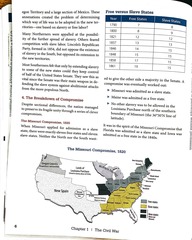
What was the Missouri Compromise of 1820?
Missouri was admitted as a slave state, Maine as a free state, and no slavery was allowed in the Louisiana Purchase north of the 36°30'N line.
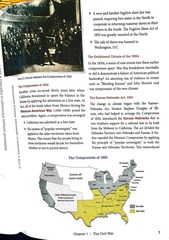
What was the Compromise of 1850?
California was admitted as a free state, popular sovereignty was applied to other territories, a harsher fugitive slave law was enacted, and the sale of slaves was banned in Washington, D.C.
What was the Kansas-Nebraska Act of 1854?
It divided the Nebraska Territory into Nebraska and Kansas and applied popular sovereignty, repealing the Missouri Compromise.
What was the impact of 'Bleeding Kansas' on the political climate of the 1850s?
It was symptomatic of the rising violence and tensions that tore earlier compromises apart.
What was the role of the Senate in the balance of power regarding free and slave states?
Neither the North nor the South wanted to give the other side a majority in the Senate.
How did the acquisition of new lands in the West affect the debate over slavery?
It intensified the debate over whether to allow slavery or free labor in the new territories.
What was the Fugitive Slave Act of 1850?
It required free states in the North to cooperate in returning runaway slaves to their owners in the South.
What was the significance of the term 'popular sovereignty' in the context of the Compromise of 1850?
It allowed the people living in the territories taken from Mexico to decide for themselves whether or not to permit slavery.
What were the implications of the Missouri Compromise for future state admissions?
It established a precedent for balancing free and slave states in the Union.
What was the main concern of Northerners regarding the spread of slavery?
Many were appalled at the possibility of the further spread of slavery and feared competition with slave labor.
What did Southern leaders believe about extending slavery to new states?
They felt it was vital to maintain control of the Senate and defend the slave system against abolitionist attacks.
How did the political climate in the 1850s reflect the breakdown of compromises?
An alarming rise in violence and events like 'Bleeding Kansas' indicated a failure of American political leadership.
What was the main purpose of the Compromise of 1850?
To address the tensions arising from California's admission as a free state and the status of territories acquired from Mexico.
What did the Missouri Compromise aim to achieve?
To maintain a balance between free and slave states in the Senate.
What was the outcome of the Kansas-Nebraska Act?
It led to increased conflict over the issue of slavery in the new territories.
What was the significance of the Kansas-Nebraska Act?
It allowed for popular sovereignty, leading to conflict over the extension of slavery into new territories.
What political party was formed in response to the Kansas-Nebraska Act?
The Republican Party was formed in 1854 to oppose the extension of slavery.
What was the Ostend Manifesto?
A report by U.S. diplomats scheming to annex Cuba as a new slave state.
What was 'Bleeding Kansas'?
A series of violent confrontations in Kansas between pro-slavery and anti-slavery settlers from 1855 to 1856.
What event escalated tensions in the U.S. Senate in May 1856?
Senator Charles Sumner was assaulted by Senator Butler's nephew after denouncing Butler's pro-slavery stance.
What was the Dred Scott Decision?
A Supreme Court ruling that stated Dred Scott, an African American, was not a U.S. citizen and that Congress could not prohibit slavery in territories.
Who was Chief Justice during the Dred Scott case?
Chief Justice Roger Taney.
What was the impact of the Dred Scott Decision on the North?
It raised a storm of protest and increased tensions over slavery.
What was the Freeport Doctrine?
Stephen Douglas's assertion that residents of a territory could still ban slavery through local laws.
What was John Brown's objective in 1859?
To launch slave revolts across the South by capturing a federal arsenal.
What happened during John Brown's raid at Harpers Ferry?
Brown's force was overwhelmed by U.S. troops, and no slaves joined his uprising.
What did Southerners believe about states' rights?
They believed states had the power to nullify federal laws and withdraw from the Union.
Who was John C. Calhoun?
A Senator from South Carolina who argued for states' rights and nullification.
What did South Carolina do in 1832 regarding federal tariffs?
South Carolina nullified the federal tariff, claiming it was unconstitutional.
What was President Andrew Jackson's response to South Carolina's nullification?
He threatened to use force against South Carolina, which ultimately backed down.
How did Northerners view the Constitution in contrast to Southerners?
Northerners saw it as a collective document of the American people, while Southerners viewed it as a compact of individual states.
What was the outcome of the Dred Scott case for Dred Scott himself?
He was freed by his owners two months after the Supreme Court's decision.
What was the main argument of the Dred Scott decision regarding slavery?
The Court held that slaves were property and Congress could not limit property rights.
What was the effect of John Brown's raid on Southern whites?
It created a wave of fear among Southern whites regarding slave revolts.
What did the term 'popular sovereignty' refer to?
The idea that the residents of a territory should decide whether to allow slavery.
What was the Missouri Compromise?
An agreement that prohibited slavery in certain territories, which was later deemed unconstitutional by the Dred Scott decision.
What did the Supreme Court declare about African Americans in the Dred Scott case?
They declared that African Americans had no rights that white men were bound to respect.
What was the main cause of conflict during 'Bleeding Kansas'?
The struggle between pro-slavery and anti-slavery factions to control the territory.
What was the significance of the term 'nullify' in the context of states' rights?
It referred to the ability of states to cancel federal laws they deemed unconstitutional.
What did the Dred Scott decision imply about Congress's power?
It implied that Congress had no power to prohibit slavery in federal territories.