Chem always forget A
 Call Kai
 Learn
Learn Practice Test
 Spaced Repetition
 Match
Match Flashcards
 Knowt Play
1/27

There's no tags or description
Looks like no tags are added yet.
Name | Mastery | Learn | Test | Matching | Spaced | Call with Kai | Chat |
|---|
No analytics yet
Send a link to your students to track their progress
28 Terms
Why is the starch indicator added only towards the end of titration when the iodine solution is pale yellow, instead of right at the start?
Starch forms a blue-black water-soluble complex with iodine in which the iodine is trapped within the starch molecules
Hence, starch should not be added at the beginning of the titration when there is a high concentration of iodine since some iodine may remain trapped in the spiral starch molecules -> release of iodine from starch molecules is slow -> even when sufficient _ is added, some iodine is not fully released and mixture still appears blue -> by the time blue colouration disappeared, excess solution has been added to the conical flask -> higher tire values -> inaccurate results
Define subshell
Describes distribution and energy of electrons within each electron shell
Electronic configuration 3 rules
Electronic configuration: Aufbau principle -> Pauli exclusion principle -> Hund’s Rule of Multiplicity
Why is anion larger than parent atom
Anion has more electrons -> electron-electron repulsion increases -> electrostatic attraction between nucleus and valence electron decrease -> increase in size of electron cloud
Explain why there is an increase in ionic radius from the cationic to anionic series
One more quantum shell of electrons than the cations -> distance between nucleus and valence electrons increase -> electrostatic attraction decrease -> increase in electron cloud
Principal quantum number (i think you forgot this existed)
Define lattice
Lattice (Def.) : Refers to a regular, repeating three-dimensional arrangement of particles (atoms, ions, or molecules) that form a crystalline solid. In a lattice, the particles are arranged in a way that maximises stability by minimising energy, often following a symmetrical and ordered pattern
Define simple molecular structure
Simple molecular structure (Def.) : A simple molecular structure consists of simple discrete molecules held together by weak intermolecular forces. These molecules consist of a small number of atoms joined by covalent bonds within the molecule itself
Define polar molecule
Polar molecule (Def.) : is a molecule that has an uneven distribution of electron density, resulting in regions with partial positive (δ+) and partial negative (δ−) charges. This occurs when the molecule contains polar bonds (bonds with unequal sharing of electrons) and has a geometry that does not cancel out the bond dipoles
Define dipole
Dipole (Def.): Def. : A dipole refers to a separation of positive and negative charges within a molecule or atom caused by uneven distribution of electrons resulting in a region with a partial positive charge (δ+) and a region with partial negative charge (δ−) leading to formation of a polar molecule
State factors of covalent bonds
Bond length
Multiplicity of bond
Polarity of bond
Proximity of lone pair electrons
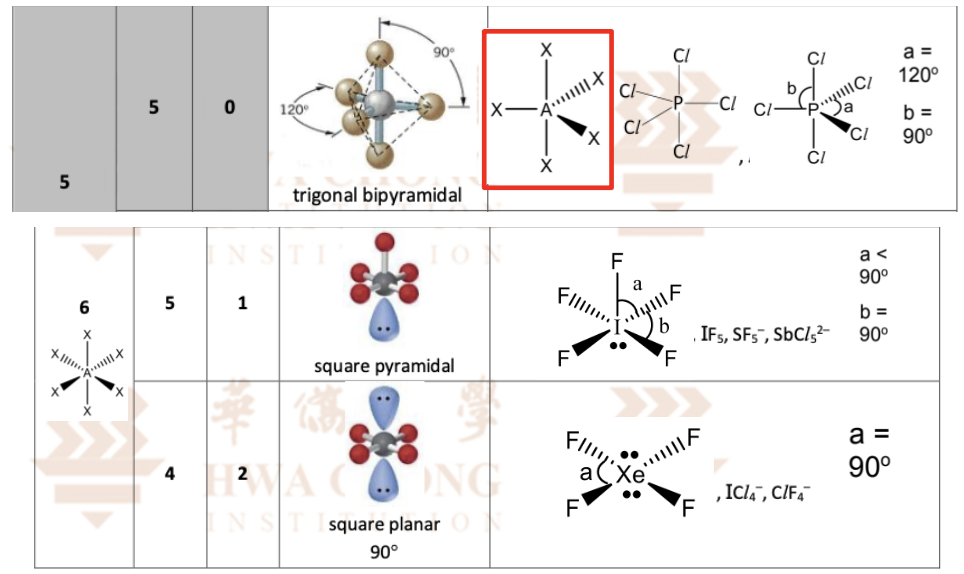
VSEPR 5 0, 5 1, 4 2
Why branched structure has lower density than linear
A branched structure usually has bulky side chains that introduce steric hindrance, leading to a less compact packing arrangement
Branched structures create more empty spaces in the solid or liquid phase, leading to a larger molecular volume -> lower density
Define bond energy and reaction mechanism
Bond energy (Def.): Average energy absorbed when 1 mole of covalent bonds between 2 atoms in a gaseous molecule are broken
Reaction mechanism (Def.): Is a sequence of elementary steps that adds up to the overall reaction
Exothermic:
Heat is released from the system to the surroundings -> enthalpy of the system decreased -> energetically, the system is stabilised
Solubility:
Since r– is very small, lattice energy is sensitive to a change in r+
Thus lattice energy becomes less exothermic with increasing cationic radius down the group
This effect is largely masked by the large magnitude of the Hhyd (anion), since OH− has a very small r− as compared to the cations
Thus, the sum [Hhyd (cation) + Hhyd (anion)] is relatively constant
Water present in excess -> the concentration of water is effectively constant, and the rate depends on the concentration of ester
Adsorption theory
Reactant molecules diffuse towards the catalyst surface
Reactant molecules become chemically adsorbed through formation of weak temporary bonds with neighbouring active sites
This increases the surface concentration of reactants and weakens the covalent bonds in the molecules -> lower Ea
Eventually, the molecules dissociate, forming highly reactive intermediates which then combine to form the product
After reaction, the product molecules break free from the surface and diffuse away from the surface
The vacant active sites are now available for adsorbing other reactant molecules
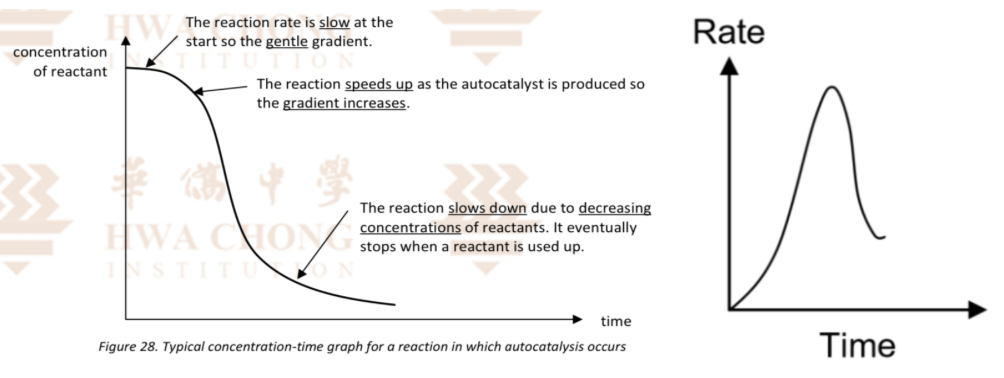
Autocatalysis concentration of reactant time and rate time graph
State the 4 gas laws
Boyles’: V and P
Charles’: V and T
Gay-Lussac’s: P and T
Daltons’: Total pressure is sum of individual partial pressure
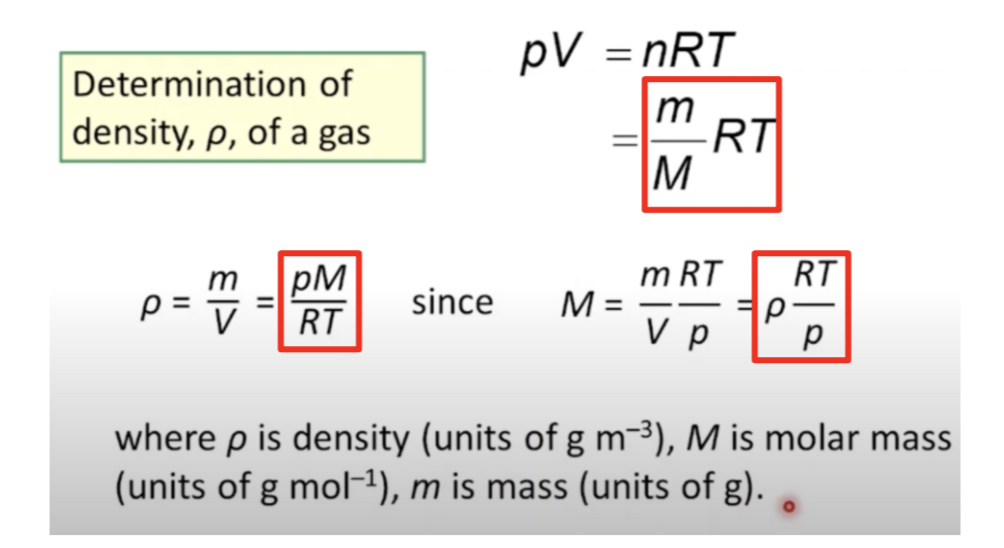
Density + ideal gas equations
Define Le Chateliers and weak bronsted-lawry acid
Le Chatelier’s principle (Def.): system will reduce (NOT remove) the disturbance by..
Weak Bronsted-Lawry acid (Def.): A weak Bronsted-Lowry acid undergoes partial dissociation to form ions and is a H+ (proton) donor
Explain why a weak acid, CH3COOH and a strong acid HCI produces the same volume of H2 when reacted with excess Zn
The amount of CH3COOH and HCI is the same. HCI is a strong acid, while CH3COOH is a weak acid
As H+ in (2) reacts with Zn, by Le Chatelier’s Principle, the system will counteract decrease in [H+] by favouring forward reaction in (2) and POE shifts right, until eventually all CH3COOH dissociates and reacts with Zn
Same amount of H+ from CH3COOH and HCI will react with Zn, hence same volume of H2 is evolved
H2O (I) + H2O (I) ⇌ H3O+ (aq) + OH- (aq), Kw = [H3O+][OH-]
If the concentration of acid < 1.0 x 10^-7 mol dm^-3 -> include H+ (aq) from water too!
A salt will undergo hydrolysis (reaction with water) if:
Anion is a conjugate base of the weak acid (Eg. CH3CO2- + H2O ⇌ CH3CO2H + OH-)
Cation that is a conjugate acid of the weak base (Eg. NH4+)
Cation has high charge density (Eg. Ai3+, Cr3+)
Identify one conjugate acid-base pair
OH– (strong base) and H2O (conjugate acid) (Do NOT include Na+ spectator ions!)
Describe relationship between Kw and temp
H2O (I) + H2O (I) ⇌ H3O+ (aq) + OH- (aq), Kw = [H3O+][OH-]
Dissociation of water is endothermic
As temperature increases, POE shift right -> [H+], [OH] and Kw will increase
NOTE: At 50°C, pH of water is 6.63 -> water is NOT acidic -> at a higher temperature (above 25°C), the pH for neutrality is not 7 but at a lower pH
At higher temperatures, water still remains neutral, since [H+] is still equal to [OH-]
At 50C, pH of water is 6.8, pKw = 6.8 x 2 = 13.6
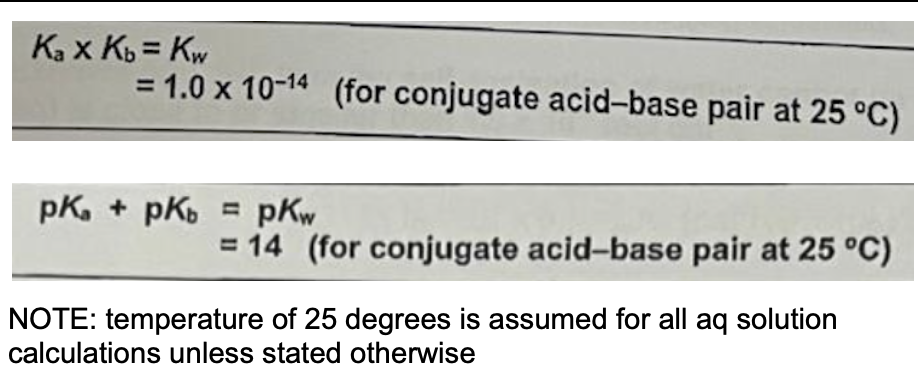
Describe relationship between Kw, Ka, Kb