Lecture 12: Continuation of Bacterial & Intro to "Other" Causes of Neurological Disease in Ruminants
 Call Kai
 Learn
Learn Practice Test
 Spaced Repetition
 Match
Match Flashcards
 Knowt Play
1/26

There's no tags or description
Looks like no tags are added yet.
Name | Mastery | Learn | Test | Matching | Spaced | Call with Kai | Chat |
|---|
No analytics yet
Send a link to your students to track their progress
27 Terms
What is the prognosis of a brain abscess?
very poor without surgical drainiage and long term antibiotics
What are the clinical signs of a brain abscess?
Vital signs normal, slow onset, asymmetric
CSF/CBC: inflammatory to normal
Adults to young adults; other pyogenic process
Dehorning/sinusitis/inner ear infections, nasal foreign bodies are risk factors
Trueperella pyogenes
Signs due to compression rather than due to inflammation
What is the common etiologic agent of pituitary abscesses in ruminants?
Trueperella pyogenes
What are the clinical signs of pituitary abscesses?
acute signs progress rapidly over 7-10 day period
general: ataxia, head and neck extension, inappetence, depression, bradycardia
neurologic: base-wide stance, ataxia, head-pressing, asymmetric CN deficits with dysphagia, blindness, anisocoria, lack of papillary light reflexes, mydriasis, lack of tongue tone, nystagmus, facial paralysis, ventrolateral strabismus, and head tilt
eventually recumbency, coma, and death
What might predispose an animal to a pituitary abscess?
plant foreign bodies
What are the clinical signs of tetanus?
• Initially stiff, “airplane ears”, sawhorse stance, hypertonia, retracted lips, trismus (“lockjaw”)
• Lateral recumbency & muscular rigidity that becomes worse with auditory, ocular, or tactile stimuli
• Eventual respiratory paralysis and death
How is tetanus diagnosed?
Limbs & head resistant to passive flexion
History...castration, parturition, tail docking
No reliable clinicopathological tests
Necropsy: no characteristic lesions
Culture suspected site of entry
What is the treatment for tetanus?
eliminate toxin - remove existing and future toxin → debride the affected area and infuse penicillin around wound margins
tetanus antitoxin: binds free tetanus toxin only
tetanus toxoid: no natural exposure immune response, give at a distant site to the tetanus antitoxin
Muscle relaxation, antibiotics, TLC, and consider rumenostomy (temporary)
How is tetanus spread?
sporadically in the soil and feces
incubation period is 2 week and 1 month
entry via the uterus is common in dairy cattle
What is the toxin responsible for tetanus and what is its pathogenesis?
tetanospasmin: binds to nerves and transported to CNS → at spinal cord, crosses synaptic cleft to presynaptic inhibitory interneurons → inhibits release of glycine and GABA from Renshaw cell → results in disinhibition of gamma motor neurons and hypertonia and muscular spasms
What does tetanolysin do?
promotes spread by increasing local tissue necrosis
What organism causes progressive muscular hypotonia from the rear to the front, but has no effect on peripheral sensory nerves and CNS?
clostridium botulinum
What is the treatment for botulism?
antitoxin effective early + TLC
healing is based on the decay of bound botulism toxin at the nerve → can take weeks to months to form new synapses
What are common signs of botulism in cattle?
flaccid tongue and other cranial nerve deficits (no blink)
Explain the relationship between botulinum toxin and SNARE protein?
• SNAp REceptor: Aids in fusion of vesicles of neurotransmitters
• Botulinum toxin: Cleaves SNARE proteins and prevents fusion of vesicle
Cannot release neurotransmitter
What organism commonly causes otitis media and how is it spread?
mycoplasma bovis
source is thought to be contaminated milk/colostrum
What is the treatment of otitis media?
Appropriate antimicrobial: Florfenicol, tulathromycin; Consider mycoplasma coverage
+/- Myringotomy
+/- TBO
What diffuse cerebral disease causes aggression, convulsions, central blindness, wandering, head pressing, opisthotonos, odontoprisis, bellowing, and eventual death?
lead poisoning
What clinical pathologic sign is characteristic of lead poisoning?
CBC: basophilic stippling and nucleated RBCs
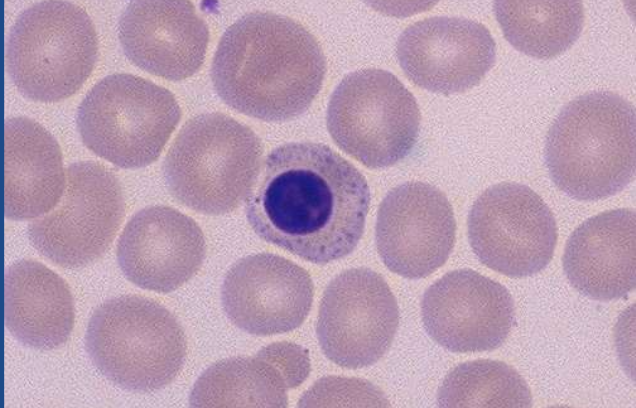
What is the therapy for lead poisoning?
• Urinary lead excretion following Ca EDTA, D-Penicillamine, or succime treatment
• Treat with thiamine as well
• Magnesium sulfate laxatives help form insoluble lead sulfides
What toxin is contained in locoweed and what effect does it have?
toxin is swainsonine
Leads to a storage disease similar to mannosidosis
Swainsonine inhibits alpha- mannosidase → Accumulation of materials and vacuolation of the neurons
Quick removal of the toxin can be reversible
However, chronic exposure is irreversible
What can locoweed ingestion cause at high altitudes?
congestive heart failure
What is the pathogenesis of organophosphates?
inhibit the recycling of inhibitory acetylcholinesterase
You are called to examine a neurologic and recumbent pig in January. You notice the water source is frozen. What is your top differential
salt poisoning (overload of salt or lack of water intake)
What is the treatment for salt poisoning?
Slowly!!! Decrease the sodium levels → Quick/fast administration of significantly less osmolar substances will lead to water intake into nervous tissue → Cells burst
Infrequent PO offering of water
Calculating and IV administration of slightly less osmolar fluids
What are the clinical signs of vitamin A deficiency?
• Reduced feed intake and growth
• Rough hair coat
• Blindness
• Night blindness
• Edema
• Diarrhea
• Seizures
• Decreased reproductive and growth performances
What neurologic effect does vitamin A deficiency have?
central blindness: abnormal bone development constricts optic nerve (prominent blindness not reversible)