Forces Chapter 5 concepts
 Call Kai
 Learn
Learn Practice Test
 Spaced Repetition
 Match
Match Flashcards
 Knowt Play
1/3

There's no tags or description
Looks like no tags are added yet.
Name | Mastery | Learn | Test | Matching | Spaced | Call with Kai | Chat |
|---|
No analytics yet
Send a link to your students to track their progress
4 Terms
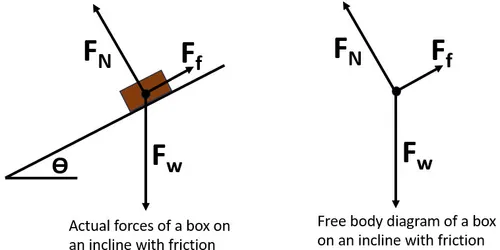
Gravity Components
If box is in an inclined plane:
F Normal = mg*cos theta
F frictoin = mg*sin theta
Friction and normal are responses to gravity, not components of it
(Rmemeber that box slides down “horizontlaly” so Ff is close to the y-axis in that sense).
Net Force 1 - with tension
Principle: In closed mechanical systems, all forces and energy transfers must be accounted for. This reflects the broader physical law that no quantity (mass, force, energy) disappears or appears without cause — often referred to as conservation of energy and Newton’s laws of motion.
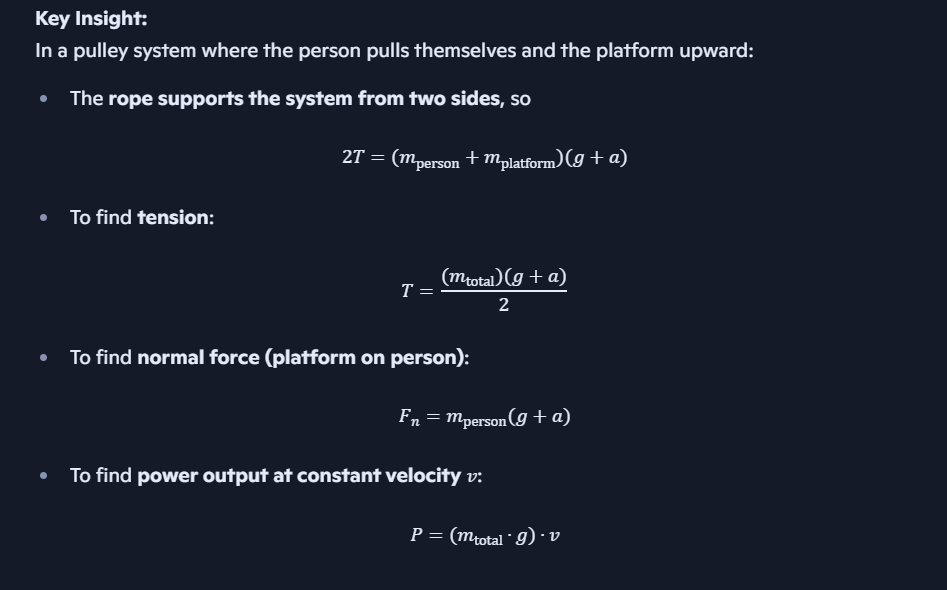
Key Insight:
In any force-based scenario — elevators, pulleys, tension systems — the total input (effort, tension, normal force) must match the required output (weight, acceleration, resistance). No force or energy is “lost”; it is redistributed, transformed, or balanced.
Applications:
Elevator scale readings change with acceleration, but total gravitational force remains constant.
Pulley systems split tension across rope segments, but total lifting force equals the system’s weight plus acceleration.
Normal forces reflect how surfaces respond to net motion — they don’t vanish, they adjust to maintain equilibrium or enable acceleration.
Power calculations at constant velocity reflect steady energy transfer, not spontaneous force.
General Rule:
Always begin with Newton’s Second Law:
Fnet=∑F=ma
Then apply conservation logic: every force must have a source, a target, and a measurable effect.
Equations and force diagrams depend on who or what is being observed. The same system can yield different equations depending on whether you analyze:
The entire system (e.g., person + platform)
A single object within the system (e.g., just the person)
An external observer vs. an internal participant
Always define your frame of reference before applying equations. Conservation laws hold universally, but the distribution of forces and energy depends on what part of the system you’re analyzing.
Ramp Components
Perpendicular components _|_
to ramp become horizontal components of object in respect to the ramp…
Parallel components ||
to ramp become vertical components of object in respect to the ramp…..
The reverse can also be said as the ramp as a reference point is subjective
a
a