Cell : The Unit Of Life
0.0(0)
Studied by 2 people Note
Note Call Kai
 Learn
Learn Practice Test
 Spaced Repetition
 Match
Match Flashcards
 Knowt Play
Card Sorting
1/183

Last updated 10:36 AM on 9/25/22
Name | Mastery | Learn | Test | Matching | Spaced | Call with Kai | Chat |
|---|
No analytics yet
Send a link to your students to track their progress
184 Terms
1
New cards
unicellular
having or consisting of a single cell
2
New cards
multicellular
consisting of many cells
3
New cards
(i)independent existence and
(ii) performing the essential functions of life
(ii) performing the essential functions of life
Unicellular organisms are capable of
4
New cards
Independent living
Anything less than a complete
structure of a cell does not ensure
structure of a cell does not ensure
5
New cards
cell
which is the fundamental structural and functional unit of all living organism ?
6
New cards
Anton Von Leeuwenhoek
first saw and described a live cell
7
New cards
Robert Brown
discovered the nucleus
8
New cards
Robert Hooke
First observed dead cork cell
9
New cards
Matthias Schleiden, a German botanist
examined a large number of plants and observed that all plants are composed of different kinds of cells which form the tissues of the plant
10
New cards
Theodore Schwann (1839), a British Zoologist
studied different types of animal cell
11
New cards
Theodore Schwann
reported that cells had a thin outer layer which is today known as the
‘plasma membrane’.
‘plasma membrane’.
12
New cards
Theodore Schwann
The presence of cell wall is a unique character of the plant
cells.
cells.
13
New cards
Theodore Schwann
proposed the hypothesis that the bodies of animals and plants are composed of cells and products of cell
14
New cards
Schleiden and Schwann
formulated the cell theory
15
New cards
Rudolf Virchow
first explained that cells divided and new cells are formed from pre-existing cells (Omnis cellula-e cellula)
16
New cards
Rudolf Virchow
modified the hypothesis of Schleiden and Schwann to give the cell theory a final shape
17
New cards
(i) all living organisms are composed of cells and products of cells.
(ii) all cells arise from pre-existing cells
(ii) all cells arise from pre-existing cells
Cell Theory
18
New cards
Chromosomes ----> Chromatids ----> DNA
Genetic heirarchy
19
New cards
cytoplasm
the protoplasm of a cell excluding the nucleus;
is full of proteins that control cell metabolism;
semi-fluid matrix; main arena of cellular activity
is full of proteins that control cell metabolism;
semi-fluid matrix; main arena of cellular activity
20
New cards
prokaryotic cells
having cells that lack membrane-bound nuclei
21
New cards
ribosome
an organelle in the cytoplasm of a living cell both eukaryotic and prokaryotic;
they attach to mRNA and move down it one codon at a time and then stop until tRNA brings the required amino acid;
non-membrane bound
they attach to mRNA and move down it one codon at a time and then stop until tRNA brings the required amino acid;
non-membrane bound
22
New cards
mycoplasma
smallest cell 0.3μm in length;
lack cell walls and can survive without oxygen
lack cell walls and can survive without oxygen
23
New cards
3 to 5μm
Bacteria size
24
New cards
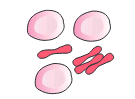
RBC
7.0 μm in diameter
25
New cards
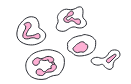
WBC
26
New cards
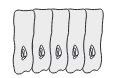
Columnar epithelial cells
27
New cards
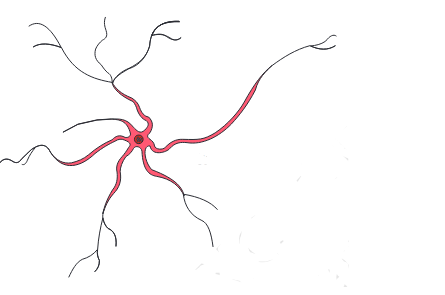
Nerve cell
Some of the longest cells
28
New cards
Traceid
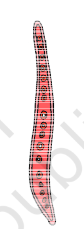
29
New cards
Mesophyll cells
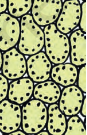
30
New cards
ostrich egg
largest isolated single cell
31
New cards
function they perform
The shape of the cell may vary with the
32
New cards
Bacteria, blue-green algae, mycoplasma and PPLO (Pleuro Pneumonia Like Organisms)
The prokaryotic cells are represented by
33
New cards
bacillus (rod like), coccus (spherical), vibrio (comma
shaped) and spirillum (spiral)
shaped) and spirillum (spiral)
The four basic shapes of bacteria
34
New cards
plasmid
a small cellular inclusion consisting of a ring of DNA that is not in a chromosome but is capable of autonomous replication; senn in prokaryotes
35
New cards
resistance to antibiotics
The plasmid DNA confers certain unique phenotypic characters to such bacteria, One such character is
36
New cards
ribosomes
No organelles except
37
New cards
Mesosome
infoldings of cell membrane
38
New cards
glycocalyx
cell wall
plasma membrane
cell wall
plasma membrane
outermost ____________ followed by the __________ and
then the _____________; act together as a single protective unit.
then the _____________; act together as a single protective unit.
39
New cards
Gram positive
take up the gram stain
40
New cards
Gram negative
do not take up the gram stain
41
New cards
Slime layer
capsule
capsule
Glycocalyx differs in composition and thickness among different
bacteria. It could be a loose sheath called the ____________ in some, while in others it may be thick and tough, called the ___________.
bacteria. It could be a loose sheath called the ____________ in some, while in others it may be thick and tough, called the ___________.
42
New cards
cell wall
a rigid layer of polysaccharides enclosing the membrane of plant and prokaryotic cells; determines the shape of the cell and provides a strong structural support to prevent the bacterium from bursting or collapsing
43
New cards
Mesosome
These extensions are in the form of vesicles, tubules and lamellae . They help in cell wall formation, DNA replication and distribution to daughter cells. They also help in respiration, secretion processes, to increase the surface area of the plasma membrane and enzymatic content.What are they ?
44
New cards
Chromatophores
In some prokaryotes like cyanobacteria, there are other membranous extensions into the cytoplasm called ____________ which contain pigments.
45
New cards
filament, hook and basal body
Bacterial flagellum is composed of three parts –
46
New cards
Pili and Fimbriae
_________ and ______________are also surface structures of the
bacteria but do not play a role in motility
bacteria but do not play a role in motility
47
New cards
pili
The _____ are elongated tubular
structures made of a special protein
structures made of a special protein
48
New cards
fimbriae
The_______ are small bristle like
fibres sprouting out of the cell ; they are known to help
attach the bacteria to rocks in streams and also to the host tissu
fibres sprouting out of the cell ; they are known to help
attach the bacteria to rocks in streams and also to the host tissu
49
New cards
Ribosomal size in prokaryotes
They are about 15 nm by 20 nm in size;
50
New cards
50S and 30S units which when present together form 70S
qRibosomal subunits in prokaryotes
51
New cards
protein synthesis
Ribosomes are the site of
52
New cards
polyribosomes or polysome ;The ribosomes of a polysome translate the mRNA into proteins
Several ribosomes may attach to a single mRNA and form a chain called
53
New cards
inclusion body
Reserve material in prokaryotic cells are stored in
the cytoplasm in the form of.These are not bound by
any membrane system and lie free in the cytoplasm, e.g., phosphate
granules, cyanophycean granules and glycogen granules
the cytoplasm in the form of.These are not bound by
any membrane system and lie free in the cytoplasm, e.g., phosphate
granules, cyanophycean granules and glycogen granules
54
New cards
Gas vacuole
__________are found in blue green and purple and green photosynthetic bacteria.
55
New cards
plant cell
Animal cell
Animal cell
_________ possess cell walls, plastids and a large central vacuole which are absent in__________ cell.
56
New cards
centrioles
Animal cells have _________ which are absent in almost all plant cells
57
New cards
human red blood cells (RBC)
chemical studies on
the cell membrane, especially in ____________ ), enabled
the scientists to deduce the possible structure of plasma membrane`.
the cell membrane, especially in ____________ ), enabled
the scientists to deduce the possible structure of plasma membrane`.
58
New cards
lipids and proteins
studies showed that the cell membrane is mainly composed of
59
New cards
phospholipids
Bilayer
Bilayer
The major lipids are _____________ that are arranged
in a _______
in a _______
60
New cards
polar head
hydrophobic tails
protected from the aqueous environment
hydrophobic tails
protected from the aqueous environment
the lipids are arranged within the membrane with the
__________ towards the outer sides and the ________________ towards
the inner part.his ensures that the nonpolar tail of saturated
hydrocarbons is _________________________
__________ towards the outer sides and the ________________ towards
the inner part.his ensures that the nonpolar tail of saturated
hydrocarbons is _________________________
61
New cards
cholesterol
In addition to phospholipids membrane also contains _______________
62
New cards
52 per cent
40 per cent
40 per cent
the membrane of the
erythrocyte has approximately ______ protein and _______lipids
erythrocyte has approximately ______ protein and _______lipids
63
New cards
Peripheral proteins
integral proteins
integral proteins
___________lie on the surface of membrane while the ____________are partially or totally buried in the membrane.
64
New cards
1.Sugar
2.Peripheral protein
3.Integral protein
4.Phospholopid bilayer
5.Cholesterol
2.Peripheral protein
3.Integral protein
4.Phospholopid bilayer
5.Cholesterol
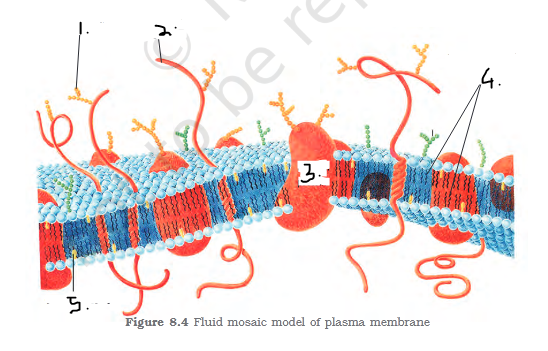
65
New cards
Singer and Nicolson
fluid mosaic model
fluid mosaic model
An improved model of the structure of cell membrane was proposed
by _____________ widely accepted as ________________
by _____________ widely accepted as ________________
66
New cards
lipid
proteins
fluidity
proteins
fluidity
the quasi-fluid nature of _____ enables lateral movement of _______ within the overall bilayer. This ability to move within the membrane is measured as its ______.
67
New cards
cell growth, formation of intercellular junctions,
secretion, endocytosis, cell division
secretion, endocytosis, cell division
The fluid nature of the membrane is also important from the point of
view of functions like
view of functions like
68
New cards
passive transport
transport of a substance across a cell membrane by diffusion; expenditure of energy is not required
69
New cards
osmosis
diffusion of water through a semipermeable membrane from a place of higher concentration to a place of lower concentration until the concentration on both sides is equal
70
New cards
simple diffusion
Neutral solutes may move across the
membrane by the process of _____________ along the concentration
gradient
membrane by the process of _____________ along the concentration
gradient
71
New cards
polar molecules
facilitate their transport
facilitate their transport
the _______________ cannot pass through the nonpolar lipid bilayer, they require a carrier protein of the membrane to _________________ across the membrane
72
New cards
active transport
transport of a substance across a cell membrane against the concentration gradient; A few ions or molecules are transported from lower to the higher concentration. Such a transport is an energy dependent process, in which ATP is utilized and is called _________,e.g., Na+/K+ Pump
73
New cards
non-living
rigid
cell wall
rigid
cell wall
a ________ and __________structure called the ______ forms an outer covering for the plasma membrane of fungi and plant
74
New cards
cellulose, galactans, mannans and minerals like calcium carbonate
cellulose, hemicellulose, pectins and protein
cellulose, hemicellulose, pectins and protein
algae have cell wall, made of _____________________, while
in other plants it consists of ____________________________.
in other plants it consists of ____________________________.
75
New cards
primary wall
secondary wall
secondary wall
The _________________ is capable of growth, which gradually diminishes as the cell matures and the ______________ is
formed on the inner (towards membrane) side of the cell.
formed on the inner (towards membrane) side of the cell.
76
New cards
calcium pectate
The middle lamella is a layer mainly of _______________ which holds
or glues the different neighbouring cells together.
or glues the different neighbouring cells together.
77
New cards
plasmodesmata
The cell wall and middle lamellae may be traversed by _______________ which connect the cytoplasm of neighbouring cells.
78
New cards
their functions are coordinated
any of these are considered together as an endomembrane system
because
because
79
New cards
endoplasmic reticulum (ER), golgi complex, lysosomes and vacuoles
he
endomembrane system include
endomembrane system include
80
New cards
mitochondria, chloroplast and peroxisomes
Since the functions of ______________ , ______________ and ____________ are not coordinated with the above components, these are not considered as part of the endomembrane system.
81
New cards
luminal (inside ER) and extra luminal (cytoplasm) compartments.
ER divides the intracellular
space into two distinct compartments, i.e.,
space into two distinct compartments, i.e.,
82
New cards
rough endoplasmic reticulum (RER)
The endoplasmic reticulun bearing ribosomes on their surface is called _________________________.
83
New cards
smooth endoplasmic reticulum (SER)
In the absence of ribosomes they appear smooth and are called
____________________________.
____________________________.
84
New cards
protein synthesis and secretion
RER is frequently observed in the cells actively involved in
85
New cards
RER
_______________ are extensive and continuous with the outer
membrane of the nucleus.
membrane of the nucleus.
86
New cards
The smooth endoplasmic reticulum
__________________________ is the major site for synthesis of lipid
87
New cards
SER
In animal cells lipid-like steroidal hormones are synthesised in
88
New cards
Golgi apparatus
densely stained reticular structures near the nucleus
89
New cards
cisternae
flat, disc-shaped sacs of golgi apparatus
90
New cards
Cis face
forming face
91
New cards
Trans face
Maturing face
92
New cards
packaging materials, to be delivered either to the intra-cellular targets or secreted outside the cell.
The golgi apparatus principally performs the function of
93
New cards
cis face
the maturing face
the maturing face
Materials to be packaged in the form of vesicles from the ER fuse with the _____________ of the golgi apparatus and move towards
______________. This explains, why the golgi apparatus remains in
close association with the endoplasmic reticulum.
______________. This explains, why the golgi apparatus remains in
close association with the endoplasmic reticulum.
94
New cards
cisternae of the golgi apparatus
trans face
trans face
A number of proteins synthesised by ribosomes on the endoplasmic reticulum are modified in the ____________________ before they are released from its __________________.
95
New cards
Golgi apparatus
__________________ is the important site of formation of
glycoproteins and glycolipids.
glycoproteins and glycolipids.
96
New cards
lysosome
____________ are membrane bound vesicular structures formed by the process of packaging in the golgi apparatus.
97
New cards
hydrolytic enzymes (hydrolases – lipases, proteases, carbohydrases) acidic
digesting carbohydrates, proteins, lipids and nucleic acids.
digesting carbohydrates, proteins, lipids and nucleic acids.
The isolated lysosomal vesicles
have been found to be very rich in almost all types of ________________________________________ optimally
active at the ___________ pH. These enzymes are capable of _______________________________________________.
have been found to be very rich in almost all types of ________________________________________ optimally
active at the ___________ pH. These enzymes are capable of _______________________________________________.
98
New cards
water, sap, excretory product and other materials not useful for the cell
Vacuoles contain
99
New cards
tonoplast
The vacuole is bound by a single membrane called
100
New cards
90 per cent
In plant cells the vacuoles can occupy up to ______________ of the volume of the cell.