magnetism concepts
 Studied by 0 people
 Call Kai
 Learn
Learn Practice Test
 Spaced Repetition
 Match
Match Flashcards
 Knowt Play
1/235

Earn XP
Description and Tags
science section 3
Name | Mastery | Learn | Test | Matching | Spaced | Call with Kai |
|---|
No study sessions yet.
236 Terms
what direction do magnetic fields go
north to south
what are the fundamental units of magnetism
magnetic dipoles with a north pole and south pole
there are no such thing as magnetically charged particles but the magnetic FIELD can exert a force on (blank)
electrically charged particles like protons and electrons
magnetic field are more (blank) than electric fields because you can (blank)
intuitive; directly observe them
you can think of the magnetic field as the (blank) in which a (blank) would point at each location
direction; compass
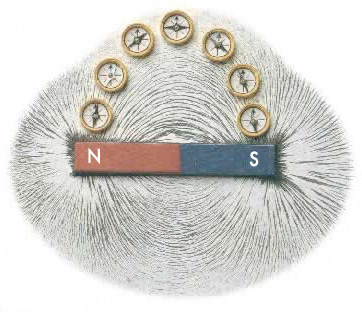
an individual atom itself is a (blank)
magnet
if an object’s atomic magnets are all lined up in the same direction, their magnetic fields would (blank) allowing you to see magnetism at (blank)
add together; larger scales
individual atoms of nonmagnetic objects are (blank), their atomic poles are all pointing in (blank) directions, so they (blank) and therefore you (blank) see a large-scale magnetic field
magnetic; random; cancel each other out; will not
materials like (blank) and (blank) are naturally ferromagnetic
iron and nickel
what is ferromagnetic
when they are exposed to a strong magnetic field, their atoms line up with that field and stay that way for a long time making a permanent magnet
the earliest magnets had to be (blank) from the (blank), having been magnetized by the (blank) itself
scavenged from the ground; earth
nowadays we can use (blank) to create our own magnets
strong electric currents
what is paramagentic
become magnetized as long as there is a surrounding magnetic field. the magnetism goes away when the field goes away —> don't remain as permanent magnet
(blank) fridge magnet stick to a (blank) fridge door
ferromagnetic; paramagnetic
examples of paramagnetic
fridge door, paperclips
when you remove the magnetic from a paramagnetic object, the (blank) causes the atoms to go back to (blank) and the object (blank) its magnetism
random thermal motion; vibrating randomly; loses
what analogy is used to describe paramagnetic objects
classroom full of rowdy students line up in a well-behaved manner as long as the teacher is in the room but becomes random chaos when the teacher leaves
a fridge magnet is a bunch of what
tiny horseshoe magnets lined up so that there are alternating north and south poles along the surface
magnetic fields are produced by (blank) but only when (blank)
electrically charged particles (protons and electrons); they are moving
similarities between electricity and magnetism (3)
1) both fields are produced by electrically charged particles
2) both have opposite charges (protons and electrons; north and south)
3) magnetic fields add up and so do electric fields
differences between electricity and magnetism (3)
1) electricity has monopoles (protons and electrons); magnetism has dipoles
2) electric field points radially away from the charge; magnetic field points perpendicular to the direction in which the charge is moving
3) to create magnetic field the particle must be moving
a stationary electron will produce what field
electric field
a moving electron will produce what field
electric and magnetic
what causes magnetism within atoms
electrons are constantly moving around within atom so the orbital motion generates a magnetic field
how does an electron have its own magnetic field
it spins, generating a magnetic field
a wire with electric current running through it creates what field
electric and magnetic
what did Hans Christian oersted observe and in what year
1820; that a wire with electric current running thru it creates a magnetic field
how did Hans Christian oersted notice that an electric current will generate a magnetic field
he noticed that a wire with current running thru it would deflect a compass
what was the first hint of a deeper connection between electricity and magnetism
the discovery made by hans Christian oersted
there is a common myth about oersted. what is it
that he discovered current will generate a magnetic field on accident, but in reality he had been researching electricity for quite some time
(blank) is required for charged particles to FEEL magnetic forces
motion
compared magnetism for a stationary electron versus a moving electron
stationary electron: no magnetic field, don’t feel magnetic field of others
moving electron: creates magnetic field, influenced by magnetic fields created by other moving charges
current-carrying wires can exert (blank) on (blank) and (blank), attracting/repelling them depending on the (blank) of the current
magnetic forces; particles and wires carrying currents; direction
what direction does the magnetic field generated by a moving charge point to
perpendicular to the direction in which the charge is moving
magnetic field lines always form
closed loops
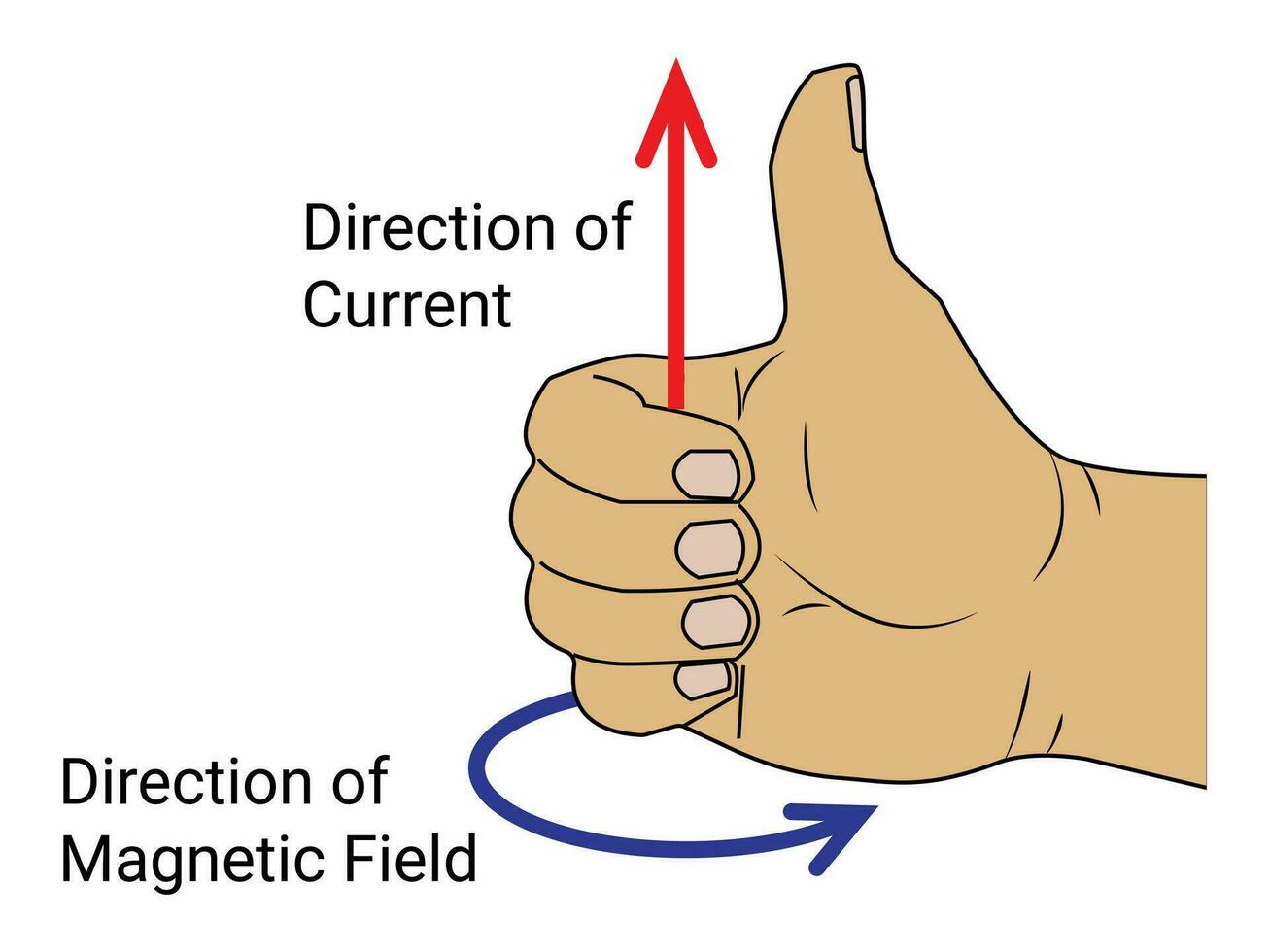
in the right-hand rule which finger represents what
thumb - current
curved fingers - magnetic field
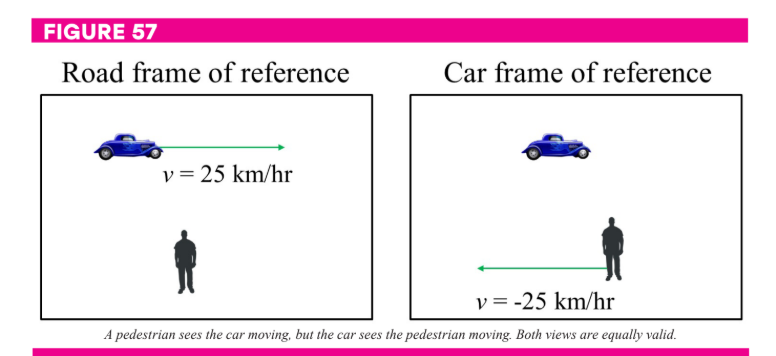
what counts as “moving” depends on what
your pov
physics is an (blank) science
observation-based
if we want to say the train is moving at 40mph, then we have to clarify that the train is moving at 40 mph …
relative to the ground
if a train is going 40mph in one direction and a car is driving in the opposite direction 30mph, the car would see the train go by at (#)mph relative to (blank)
70; them (car)
if a train is going 40mph in one direction and a car is driving in the same direction 50mph, the car would see the train go by at (#)mph (blank) relative to (blank)
10mph backward; them (car)
all speed/motion is (blank)
relative
depending on your (blank), the ground is moving at (blank) of mph around the (blank) of the earth
latitude; hundreds; center
the entire earth is moving at (#) mph relative to the (blank)
70,000; sun
our entire solar system is orbiting the center of the (blank) at over (#) mph
milky way galaxy; 100,000mph
earth rotates on axis
> 1000 km/hr
earth orbits sun
> 100,000 km/hr
solar system moves among stars
~70,000 km/hr
milky way rotates
~800,000 km/hr
movement within local group
~300,000 km/hr
universe expands at
70 km/s/Mpc
in our daily lives, it makes sense to define all motion relative to the (blank).
ground
is the statement “all motion relative to the ground” fundamental why or why not
it’s not fundamental because the ground beneath your feet is in constant motion relative to the rest of the universe
we measure speed relative to the
ground; but there is no law of physics that specifies a particular frame of reference
there is a long straight wire with current rushing to the right (meaning electrons are moving to the left). your friend moves in the same direction and speed as the electrons. to her what will she observe
me and the wire moving; electrons in wire are stationary; no current in the wire —> no magnetic field
what color is Aurora borealis on saturn
blue
why is magnetic field not a fundamental force
the magnetic field does not appear to everyone it depends on the observer
the magnetic force only AFFECTS (blank) charges
moving
if a proton moves thru a magnetic field and another observer moves with the proton, to the observer the proton will be (blank). stationary protons (blank) experience a magnetic force
stationary; will not
forces are relative or not?
not relative; you can disagree on the speed of a train when you watch it pass by vs sitting in it, but you cant disagree on the existence of gravity
the word “magnet” originates from where
coastal district Magnesia in Greece
what was found in magnesia
iron-attracting lodestones
when exactly were the first compasses invented
unknown
compasses were in use in (country) for navigational purposes as far back as the (#th) century
china; 11th
before compasses, navigators could only determine direction using (blank) and (blank)
sun and the stars
what is the advantage of a compass
it points north even on a cloudy day
a typical compass is made of what
small piece of magnetic iron floating in a liquid allowing it to freely rotate
the north pole of the compass is attracted to which pole of earth? what about the south pole of the compass?
north pole of compass attracted to earth’s south pole; south pole of compass attracted to earth’s north pole
what makes the compass needle rotate around its center
one pole is pulled to one direction and the other pole is pulled in the other direction
when a magnet is exposed to another magnetic field what happens
it aligns its poles with the surrounding magnetic field
the earth’s magnetic field points towards earth’s MAGNETIC (blank) pole so the compass aligns itself such that it also points toward earth’s MAGNETIC (blank) pole
south (for both blanks)
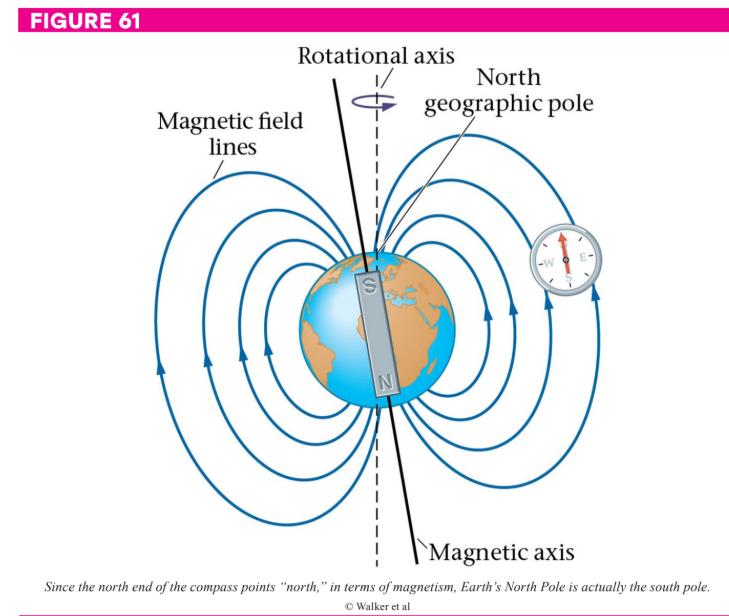
the earth’s GEOGRAPHICAL north pole (arctic) is earth’s MAGNETIC (blank) pole
south
the earth’s GEOGRAPHICAL south pole (antarctic) is earth’s MAGNETIC (blank) pole
north
the magnetic field of the earth is generated where
within earth’s core which is made of molten metal
as the earth spins what does it generate through the molten core
electric currents
what is the dynamo effect
as earth spins, its molten core generates electric currents creating a planet-wide magnetic field
the magnetic poles (do/do not) precisely line up with the roatation poles
dont
the (north/south) magnetic pole slowly wanders year to year
south
does the compass actually point directly north (geographically)? why or why not
no, it points a few degrees away from north because the south magnetic pole slowly wanders
earth’s magnetic field (blank) (blank)
reverses polarity
the magnetic poles are switched every (#) yrs to (#) years with no (blank)
1,000-100,000; pattern
the magnetic north pole is in the (palce) and the magnetic south pole is in the (place)
antarctic; arctic
how do we know earth’ s magnetic poles are switching polairty
when certain rocks are molten, they can become magnetized by a surrounding magnetic field and when solidified it retains the same magnetic polarity
earth’s surface is broken up into
tectonic plates
why do tectonic plates slide next to each other
heat of the earth’s interior
how many years can it take for a tectonic plates to move
over many millions of years
one boundary between the plates stretches across the (blank) and in this area the plates are gradually moving (blank)
atlantic ocean; apart
what happens as the gap widens between tectonic plates
molten rock seeps up, cools, and solidifies to become new ocean floor. as the seafloor spreads, it retains the magnetic field direction of the earth when the rock solidified
most dangerous object in space
sun
sun is a big ball of (blank)
plasma
what is plasma
type of gas so hot that the nuclei cannot hold onto any electrons so it is a gas of a bunch of protons and electrons moving around independently
the elctrficied gas (plasma) results in strong (blank) which in turn make their own (blank)
currents; magnetic fields
as the sun rotates, its magnetic field can get (blank) by the (blank)
twisted; rotating plasma
the rotating plasma causes what
patches of sun’s surface to get cutt off from the rest of the surface and cool off
the cool spots are (darker/lighter) than the rest of the sun which is why they are called (blank)
darker'; sunspots
sun’s magnetic pole switches every (#) years
11
when the sun’s poles are about to switch what happens
a lot of sunspots appear due to magnetic twisting
when the magnetic field gets so twisted what can happen
coronal mass ejections: plasma gets stretched out causing chunks of the sun’s surface to get ejected off the sun entirely
what happened to the hot balls of plasma ejected from the sun’s surface
most fly off into space and don’t hit anything, once in a while it’ll hit earth
one example of a big coronal mass ejection that hit earth
the Carrington event