4: Extinction
 Call Kai
 Learn
Learn Practice Test
 Spaced Repetition
 Match
Match Flashcards
 Knowt Play
1/67

There's no tags or description
Looks like no tags are added yet.
Name | Mastery | Learn | Test | Matching | Spaced | Call with Kai | Chat |
|---|
No analytics yet
Send a link to your students to track their progress
68 Terms
Extinction is forever:
Tasmanian Tiger
Quagga
Tasmanian Tiger:
the last Tasmanian tiger died in Hobart Zoo in Tasmania, Australia on September 7, 1936
When did the last Tasmanian tiger die?
September 7, 1936
Quagga:
targeted by hunters for their unique hide
The last Quagga went extinct in Africa, probably killed in the late 1870s
The species went extinct on August 12, 1883 when the last one died in a zoo in Amsterdam
What were quagga targeted by hunters for?
their unique hide
When did the last Quagga go extinct in Africa?
probably killed in the late 1870s
When did the species quagga go extinct?
August 12, 1883
Extinctions of Islands - some general patterns of island endemics
Limited habitat
Overall small population size
Evolved in isolation
How does Overall small population size affect island endemics?
cannot be easily ‘rescued’ or recolonized by immigration
How does evolving in isolation affect island endemics?
species that often evolve in relative isolation, with limited competitors and predators (parasites and disease), evolve few defenses
How does species evolving in relative isolation, with limited competitors and predators (parasites and disease) affect their survival?
they evolve few defenses
Species-Area Curves
The smaller the island (area), the fewer species (populations) it can support
The smaller the island (area):
the fewer species (populations) it can support
Species on a smaller island have a ________ chance of going extinct
higher
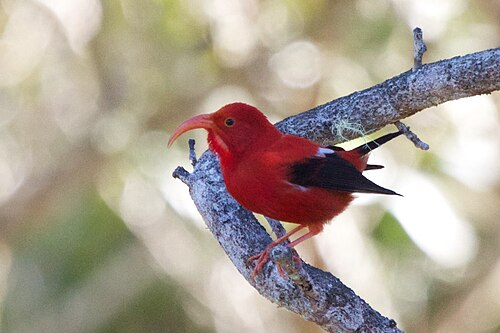
Example of Species-Area Curves: Hawaiian Honeycreepers
Species Radiation
29 species went extinct prehistorically
8 extinct since 1778
Of the 20 remaining species, 14 are federally listed
What is Species Radiation?
After the settlement, the species/descendants of the original species take advantage of the numerous resources available and begin to diverge
One ancestral species of finch gave rise to as many as:
57 different species (known from historical records and fossils)
29 species of finch went extinct prehistorically following what?
Polynesian settlement
What did Polynesian settlement cause
extinction of 29 species of finch
8 species of finch went extinct since 1778 following what?
the historical European settlement
Of the 20 remaining species, how many are federally listed as endangered in modern times?
14
Prehistoric Extinctions on Polynesian Islands
Created a massive society on the islands
Hawaiian Islands were inhabited by Polynesians around 400 AD
At the time Europeans arrived in the late 1700s, the islands were inhabited by 200k people
Hawaiian Islands were inhabited by who?
Polynesians around 400 AD
At the time Europeans arrived in the late 1700s, the islands were inhabited by:
200k people
Causes for prehistoric extinctions on Polynesian islands:
Intense agriculture (most of the islands at lower elevations)
Forest cutting and burning: increases nutrients
Hunting (for finch feathers)
Introduction of pigs, rats, exotic insects, and plants
Not just honeycreepers on the Hawaii Islands
From fossil records, more than half of native bird species present when Polynesians colonized went extinct before Europeans arrived
By European arrival, human-caused extinctions had already decimated native animals on the Hawaiian islands (and many others)
By the time Europeans arrived, the most ‘extinction-prone’ species were already gone
From fossil records, what happened to more than half of native bird species present when Polynesians colonized?
went extinct before Europeans arrived
By European arrival, what had human-caused extinctions done?
already decimated native animals on the Hawaiian islands (and many others)
By the time Europeans arrived, what happened to the most ‘extinction-prone’ species?
they were already gone
Hawaiian Goose
1940s-1950s, wild population had fallen to ~ 30-50 birds (almost extinct)
Issues: introduced mongoose, cats, dogs, pigs, rats (predators)
Captive-breeding, reintroductions, predator controls began in the late 1940s
Listed as Endangered in 1967 under previous legislation
Carried over to ESA 1973
Currently ~ 3800 adults (not that recent)
Downlisted to Threatened in 2019
1940s-1950s, wild Hawaiian Goose population had fallen to?
~30-50 birds (almost extinct)
What Issues did Hawaiian Goose face?
introduced mongoose, cats, dogs, pigs, rats (predators)
What efforts began in the late 1940s to restore Hawaiian Goose?
captive-breeding, reintroductions, predator controls
When was the Hawaiian Goose listed as Endangered?
1967 under previous legislation
When was Hawaiian Goose listing carried over to ESA?
1973
‘Currently’ how many Hawaiian Goose exist?
~ 3800 adults
When were Hawaiian Goose Downlisted to Threatened?
2019
What were the causes of the loss and decline of Hawaiian Native Birds?
Habitat loss and degradation
Predation by introduced mammals, and other exotic species
Competition...
Susceptibility...
What did Hawaiian Native Birds face competition from?
introduced bird species
What were Hawaiian Native Birds susceptible to?
introduced bird species (avian malaria, transmitted by introduced mosquito species)
Human-caused threats to various groups of species in the U.S
Leading causes for species declines in the US
Older data (~2004) but pattern is still relevant
Climate now recognized as drier
What were the leading causes for species declines in the US?
habitat loss/degradation
exotic species
number one factor: humans
What are the two Extinction-Prone Species labels?
Species that require large territories
Species with very limited natural ranges
Species are often extinction prone as:
groups
Species that require large territories factors:
Habitat susceptible to loss, fragmentation, or degradation
Low rates of reproduction
Often limited population sizes
“K-selected” species
What is a “K-selected” species?
species that are at the carrying capacity of their environment, meaning that there is lots of competition and resources are being used up
Species that require large territories factors are often:
larger
Species with very limited natural ranges factors:
Habitat susceptible to loss, fragmentation, or degradation
Often limited population sizes
Island endemics
Species with very limited natural ranges are often limited in?
their natural distribution
What is an example of an avian species that require large territories?
Condors
Condors
huge birds that soar over huge expanses in search of food, as much as 150 miles a day, and are bald and wash themselves
Require large amounts of space
By 1982, there were only 22 California Condors
What are some Threats to California Condors?
Shooting
Powerlines, fences
Contamination: poisons, consumed lead shot
How many California Condors were left by 1982?
only 22
What are Condors?
huge birds that specialize in scavenging large dead animals and require large amounts of space
California Condor Recovery Program
Listed as endangered in 1967, carried over to ESA 1973
California Condor Recovery Program Results:
not really increasing numbers/slow increase
What is an example of a land species that require large territories?
Brown Bear
Brown Bear:
Grizzly Bears
700-780kg (1500-1700lb)
Aggressive
Greater Yellowstone Ecosystem in which bears are managed
Evolved to protect larger animals
Most of the biggest parks and reserves are?
not big enough to protect many of our iconic species
Habitat Fragmentation has two major effects that reduce species survival in an area
Reduction in total habitat area
Redistribution of remaining habitat into fragments or patches
Reduction in total habitat area primarily affects?
population size
Redistribution of remaining habitat into fragments or patches primarily affects?
survival and dispersal
As habitat is fragmented, the smaller the habitat patch:
the fewer individuals (species) can be supported by the patch
derived from the species-area curve
Smaller, more isolated patches did not maintain?
community integrity (species diversity)
Great Basin mountain tops revisited:
Isolated high elevation ranges in the Great Basin
Described as the loss of populations over time, following the last glacial period
Non-equilibrium metapopulation
Non-equilibrium metapopulation:
none of the animals are dispersing between patches, cannot make movement; group of isolated populations
Described as the loss of populations over time, following the last glacial period:
As temperatures warmed up, conditions changed, and species became more isolated