Unit 4 - Sensation and Perception Terms
0.0(0)
Studied by 0 people Call Kai
 Learn
Learn Practice Test
 Spaced Repetition
 Match
Match Flashcards
 Knowt Play
Card Sorting
1/89

Earn XP
Description and Tags
Last updated 1:36 AM on 10/21/22
Name | Mastery | Learn | Test | Matching | Spaced | Call with Kai | Chat |
|---|
No analytics yet
Send a link to your students to track their progress
90 Terms
1
New cards
Sensation
The process of attending to and taking in stimuli from the environment.
2
New cards
Perception
The interpretation and organization of sensory information.
3
New cards
Bottom Up (Processing)
Perceptual processing where the brain pieces together all incoming stimuli, then makes a decision on what it is perceiving.
4
New cards
Top Down (Processing)
Perceptual processing that is based on higher level knowledge, expectation, and memory.
5
New cards
Sensation
*Bottom Up* Processing relies more on _____________________(Sensation/Perception).
6
New cards
Perception
*Top Down* Processing relies more on _____________________(Sensation/Perception).
7
New cards
Perceptual Set
The phenomenon that describes how our *expectations* greatly influence our experience. AKA Perceptual Expectancy.
8
New cards
Top Down
*Perceptual Set* is a major factor in __________ __________ (Top Down/Bottom Up) Processing.
9
New cards
Psychophysics
The study of the links between physical stimuli in the world and the psychological experience of those stimuli.
10
New cards
Smell
All senses are directly routed to the *Thalamus* EXCEPT: ______________.
11
New cards
Transduction
The conversion of one type of energy to another.
12
New cards
Sensory Adaptation
The process of *Receptor Cells* becoming less receptive or responsive after prolonged exposure to a constant stimulus.
13
New cards
Habituation
When the *Brain* stops paying attention to things that don't change. However, as soon as that thing changes, it grabs your attention.
14
New cards
Absolute Threshold
The minimum amount of a stimulus one can detect 50% of the time it's present.
15
New cards
Subliminal Message(s)
Information below the Absolute Threshold of detection that the brain can *Receive* but does not *Perceive*.
16
New cards
Signal Detection (Theory)
A theory that categorizes whether or not people respond to a stimulus.
17
New cards
Difference Threshold
The minimum amount of *difference* between two stimuli that one can detect 50% of the time (AKA Just Noticeable Difference).
18
New cards
Weber's Law
This states that the size of the *Difference Threshold* tends to be a constant *Proportion* and not *Amount* to the initial stimulus.
19
New cards
Cornea
The *Outer Layer* of the eye for *Protection*, which also is the first line of focusing light inwards.
20
New cards
Pupil
The hole in the center of the eye that lets light through.
21
New cards
Iris
The muscle in the eye with a color pigment that shrinks and dilates the pupil.
22
New cards
Lens
The part of the eye that changes shape to focus light on to the Retina.
23
New cards
Cataract(s)
A condition of the lens in the eye that causes it to become cloudy.
24
New cards
Retina
The back of the eye that houses the rods and the cones and is where sensation occurs.
25
New cards
Rods
The *Visual Receptors* that see in *Black and White*.
26
New cards
Cones
The *Visual Receptors* that see in *Color*.
27
New cards
Rod(s)
_______________ Comprise the *Vast Majority* of all *Visual Receptors* on the Retina.
28
New cards
Fovea
The place of greatest clarity and acuity on the Retina.
29
New cards
Cone(s)
Almost *All* of the _______________(Rod/Cone) receptors in the eye are located in the *Fovea*.
30
New cards
Blind Spot
The part of the retina *Devoid of Receptors* where the optic nerve exits the eye.
31
New cards
Bipolar (Cells)
These cells in the Retina *Combine* signals from multiple *Rods and Cones* and send them to *Ganglion Cells*.
32
New cards
Ganglion (Cells)
These cells in the Retina *Combine* signals from multiple *Bipolar Cells* and send them along the *Optic Nerve*.
33
New cards
Optic Nerve
The *Axons* of the Ganglion Cells in the Retina that carry the Visual Neural message to the Thalamus.
34
New cards
(Primary) Visual Cortex
The portion of the brain in the occipital lobe responsible for processing visual information.
35
New cards
Peripheral (Vision)
Vision that extends beyond the central Visual Field outwards towards the ears and cannot sense color well.
36
New cards
(Gestalt Principle of) Closure
This states that the Brain does not like *Gaps in Perception*, so it will *Contextually* fill them in.
37
New cards
Trichromatic (Theory)
A theory that states there are *Three* different types of cones for *Red*, *Green*, and *Blue* (AKA - Young-Helmholz Theory).
38
New cards
Opponent Process (Theory)
A visual theory that states that cones are linked together to form *Opposing Color Pairs* that inhibit each other and, once relieved, can leave an afterimage of the opposing color.
39
New cards
Green
According to the *Opponent Process Theory* of color vision, if you stare at something *Red* for a while, looking at a white surface will leave a ____________(Color) *Afterimage*.
40
New cards
Color Blindness
A visual deficiency where one usually lacks a certain cone receptor and cannot sense one of the three RGB colors.
41
New cards
Gustation
The alternate word to describe the sense of *Taste*.
42
New cards
Olfaction
The alternate word to describe the sense of *Smell*.
43
New cards
Papillae
Clusters of taste receptors (buds) on the tongue.
44
New cards
Umami
The relatively recently discovered taste that can be sensed by humans that is often described as *Savory* and linked with foods with *MSG* and that are rich in *Protein*.
45
New cards
T(rue)
*True/False*: Taste receptor cells regrow if damaged.
46
New cards
Olfactory Bulb
The place where Olfactory Receptors are located (nasal cavity).
47
New cards
Olfactory Nerve
The major neural connection between the Olfactory Receptors and the Olfactory Cortex.
48
New cards
Memory
Smell is thought to be so highly linked to ______________ because the Olfactory System is wired to the brain right near the Limbic System (Hippocampus/Amygdala).
49
New cards
Anosmia
The loss of the sense of smell.
50
New cards
Touch
The sense of __________ involves numerous types of receptors for pressure, pain, temperature, and more located under the skin.
51
New cards
Gate Control (Theory)
The theory that describes how *Fast* "Alerting" nerves of the surrounding inflicted area have the ability to inhibit the *Slow* "Pain Sending" nerves momentary at the *Spinal Gate*.
52
New cards
Selective Attention
The capacity for the brain to, when receiving *Multiple Stimuli*, *Selectively Focus* some attention to one stimulus. The brain is *Still Aware* of the other stimulus (AKA - Divided Attention).
53
New cards
Cocktail Party Effect
The ability to easily attend to one voice in a noisy *Social Setting*. However, if your name is called from across the room, it would instantly grab your attention even though you hadn't been paying direct attention.
54
New cards
Inattentional Blindness
When the brain selectively attends to something in the environment and often *Misses* or is *Blind* to other incoming stimuli.
55
New cards
Change Blindness
A type of *Inattentional Blindness* where the brain fails to notice *Changes* in its environment.
56
New cards
Somatosensory Cortex
The brain area located in the *Parietal Lobe* that processes *Touch* information for different body parts.
57
New cards
Kinesthetic (Sense)
The sense that tells you where your body parts are and whether they are moving and contains receptors in the joints.
58
New cards
Proprioceptor(s)
Specialized Sensory Neurons found in *Joints*, *Tendons*, and *Muscles* that give information regarding the *Position* of individual body parts and *Movement*.
59
New cards
Vestibular (Sense)
The sense that measures balance and whole body positioning in fluid-filled semicircular canals in the inner ear.
60
New cards
Synesthesia
The experience of one sense in terms of another (Ex: Hearing Colors).
61
New cards
Proximity
The *Gestalt Principle* of ________________ states that people tend to group things that are *Close Together*.
62
New cards
Figure Ground (Perception)
Perception where what is focused on is perceived as being set apart from the background.
63
New cards
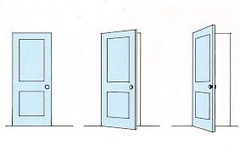
Shape Constancy
The ability to recognize an object for what it is even when its *Shape Changes* when viewed from different angles.
64
New cards
Feature Detector (Cells)
Specialized *Cells* in the visual cortex designed only to respond to *Particular Angles* or lines in the visual field.
65
New cards
Monocular (Depth Perception)
_______________ *Depth Perception* describes depth perception with only *One Eye*.
66
New cards
Binocular (Depth Perception)
_______________ *Depth Perception* describes depth perception with *Two Eyes*.
67
New cards
Interposition
The *Monocular Depth Perception* phenomenon where objects nearer to you appear *In Between* you and objects that are further away.
68
New cards
Motion Parallax
The *Monocular Depth Perception* phenomenon where objects nearer to you move *More Quickly* than objects further away.
69
New cards
Texture Gradient
The *Monocular Depth Perception* phenomenon where objects further away appear *Less Precise* and detailed in their appearance, while closer objects are more distinct.
70
New cards
Closer
In terms of *Monocular Depth Perception*, when viewing two objects that are roughly the *Same Size* you will perceive the *Larger* one as being ______________(Closer/Farther) to/from you.
71
New cards
Convergence
The *Binocular Depth Perception* phenomenon where as an object moves *Closer* to you, your eyes converge on it and you feel the *Tension* in the *Ciliary Muscles* of your eyes.
72
New cards
Retinal Disparity
The *Binocular Depth Perception* phenomenon where your eye perceives *Three Dimensions* based on the slight differences in perspectives between the *Two Eyes*.
73
New cards
Phi Phenomenon
A visual illusion where a series of lights switched on one after another gives the appearance of a single moving light.
74
New cards
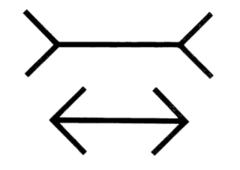
Muller Lyer (Illusion)
An illusion where two lines with *Opposing Arrows* on the ends of them cause you to perceive one line as *Slightly Longer* when they are actually the same length.
75
New cards
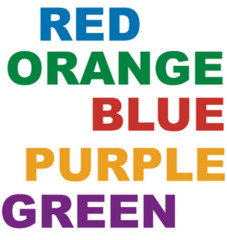
Stroop Effect
A cognitive phenomenon observed with two *Automatic Processes* competing with each other.
76
New cards
Phantom (Pain)
Pain that is experienced in amputated limbs that is merely psychological, and is much more difficult to treat.
77
New cards
Ossicle(s)
Small bones in the inner ear that pass vibrations onto the oval window and into the cochlea.
78
New cards
Hammer
The *First Ossicle* directly after the *Tympanic Membrane*.
79
New cards
Anvil
The *Middle Ossicle* that receives input from an Ossicle, and transmits it to another.
80
New cards
Stirrup
The *Final Ossicle* that transmits vibrations onto the *Oval Window* and *Cochlea*.
81
New cards
Cochlea
A *Fluid Filled Spiral Structure* in the inner ear where *Sound Vibrations* are *Sensed*.
82
New cards
Basilar (Membrane)
The interior *Membrane* of the cochlea that contains the hair receptor cells for hearing.
83
New cards
Auditory Cortex
The portion of the brain in the *Temporal Lobe* responsible for processing *Hearing Input*.
84
New cards
Conduction (Deafness)
*Deafness* resulting from *Blockage* of the *Transmission* of sound waves. Here, information *Never* reaches the otherwise normal Cochlea.
85
New cards
Sensorineural (Deafness)
*Deafness* caused by damage to *Hair Cells* in the Cochlea or the *Auditory Nerve*.
86
New cards
Place (Theory)
An auditory *Theory* that suggests we identify the pitch of sounds based on the *Location* of vibrations on the *Basilar Membrane*.
87
New cards
Frequency (Theory)
An auditory *Theory* that suggests that the brain identifies pitch based on how *Rapidly* nerve impulses fire (measured in Hertz).
88
New cards
Hair (Cells)
The *Receptor* Cells within the Cochlea that take Auditory Vibrations and transduce them into a Nerve Impulse.
89
New cards
(Sound) Localization
The process of using *Both Ears* and the relative *Delay* and *Volume* differences between them to determine *Where a Sound Is Coming From*.
90
New cards
Visual Cliff
A *Depth Perception* experimentation *Apparatus* that tests a baby's ability to perceive depth, and has shown it to take about 8 months for depth perception to develop.