A Dynamic Planet: Diagenesis and Metamorphism (Lecture 11)
 Call Kai
 Learn
Learn Practice Test
 Spaced Repetition
 Match
Match Flashcards
 Knowt Play
1/17

There's no tags or description
Looks like no tags are added yet.
Name | Mastery | Learn | Test | Matching | Spaced | Call with Kai | Chat |
|---|
No analytics yet
Send a link to your students to track their progress
18 Terms
Recall the main processes that occur during diagenesis
Compaction
Cementation
Mineral Replacement/Alteration
Recrystallisation
Describe what occurs during compaction in diagenesis.
Sediments accumulate - the weight of overlying layers compresses the sediments beneath
Reduces pore spaces between grains, resulting in the expulsion of water and air.
Rock volume is the same, pore space is reduced
Describe what occurs during cementation in diagenesis.
Chemical precipitates (new crystals) form in the pores of a sediment or rock and bind the grains together.
Common cements are quartz, and various carbonates (calcite, aragonite, dolomite), and clays.
Reduces primary porosity by filling in the pore spaces between the grains
Describe what occurs during mineral replacement/alteration in diagenesis.
Occurs when a newly formed mineral replaces a pre-existing one in situ.
The new grain may have the same composition, but is a polymorph of it (e.g. replacement of biogenic Aragonite with Calcite)
Complete replacement on a mineral phase with another (e.g. Calcite to Dolomite)
Describe what occurs during recrystallisation in diagenesis.
Reorientation of the same crystal lattices in mineral grains
Occurs because of solution and reprecipitation of the same mineral phase already present.
Define metamorphism
Changes in the mineralogy and texture (shape and size of minerals) that occur in the solid state (strictly no melting) in response to the addition of thermal energy (heat) and mechanical energy (work)
It doesn’t change the bulk chemical composition of the rock
It is a closed system process.
One that involves transfer of energy but not material.
Describe the principal changes that occur during metamorphism
Two things could occur during metamorphism:
Recrystallisation – existing minerals adopt new textures (shapes and sizes).
Some minerals adopt a preferred orientation
Neomineralisation – the formation of new minerals at the expense of existing ones (new formulae and polymorphs).
Involves chemical reactions between minerals (± fluid)
What are the two agents behind metamorphism?
Temperature
Original heat (geothermal gradient)
Local heat from igneous intrusions
Stress
Load pressure/lithostatic stress/confining stress
Deviatoric stress
How does temperature cause metamorphism?
Original heat
The geothermal gradient – from accretionary and differentiation kinetic energy, radioactive decay - is on average 25-30ºC/km.
But it is variable depending on tectonic setting
Cold subduction zone 3-5ºC/km
Mid-Ocean Ridges 50ºC/km
Volcanic areas >100ºC/km
Local heat
Intense local heat source
Disturbs the “normal” geothermal gradient.
Strong, but localised metamorphic effects.
How does stress cause metamorphism?
Load pressure/lithostatic stress/confining stress
Results from the weight of overlying rock.
Stress acts uniformly in every direction
Deviatoric stress
Caused by lateral transmission of horizontal tectonic forces through the solid Earth’s crust (contraction or extension).
Doesn’t cause metamorphism but can influence the texture of the metamorphic rock.
·
What are metamorphic facies?
Sets of mineral assemblages that form under distinct pressure and temperature fields.
Low grade facies form under relatively low temperatures and pressures and are often associated with burial metamorphism
Intermediate grade facies form under moderate temperatures and pressures and are associated with regional metamorphism
High grade facies form under high temperatures and pressures and are typically associated with intense metamorphism in regions of mountain building (orogeny)
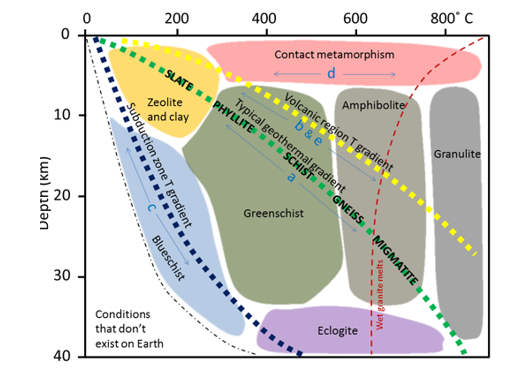
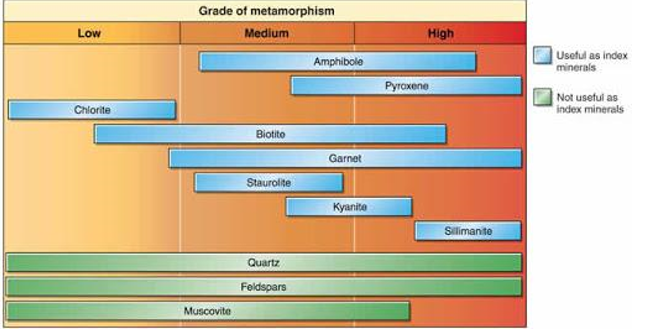
What is metamorphic grade?
Degree or intensity of metamorphism that a rock has undergone; the temperature and pressure at which it forms
What are the 3 types of metamorphism?
Regional metamorphism – temperature and pressure increases
Contact metamorphism – temperature increases, pressure unchanged
Dynamic metamorphism – temperature unchanged, pressure increases
Describe regional metamorphism.
Usually via subduction of one crustal slab beneath another
Ocean-continent or continent-continent collision.
Grainsize increases with increasing temperature and pressure.
Re-metamorphism is almost always associated with deviatoric stresses so development of cleavage to schistosity with increasing temperature and pressure.
Express foliation
Describe contact metamorphism.
Rocks in contact with an intrusion often encounter high temperature, without high pressure
Occur at continental and ocean crust extensional settings, above mantle hotspots, hydrated subducting slabs
Distinct mineral assemblages with increasing temperature
Grainsize increases with increasing temperature.
Produces hornfels
Describe dynamic metamorphism.
Deviatoric stress pressure is applied, but little temperature.
Common along immediate fault zone where stress is focussed and occur from meteor impacts
Produce mylonites which typically develop a distinct foliation and are oriented parallel to orientation of shear
What is the relationship between deviatoric stress and texture?
Influences the texture of the metamorphic rock.
Rotation and regrowth of flaky minerals into parallelism, resulting in the development of cleavage perpendicular to б1
Why don’t minerals retrograde?
Rocks lose energy as they cool - don’t receive the necessary activation energy for the reaction to happen.
Many prograde reactions involve release of volatile
Useful - allows us to reconstruct the processes happening deep in the crust.