A&P III midterm lecture
 Call Kai
 Learn
Learn Practice Test
 Spaced Repetition
 Match
Match Flashcards
 Knowt Play
1/24

There's no tags or description
Looks like no tags are added yet.
Name | Mastery | Learn | Test | Matching | Spaced | Call with Kai | Chat |
|---|
No analytics yet
Send a link to your students to track their progress
25 Terms
The mechanical and chemical receptors that control digestive activity are located ________.
in the walls of the tract organs
Which of the following cannot be sensed by the chemoreceptors?
stretch
Which of the following is not part of the intrinsic nerve controls of the GI system?
CNS
Which of the following is not part of the alimentary tract?
liver
Nutrient-rich venous blood from the digestive viscera is collected by the ________.
hepatic portal vein
When we ingest large molecules such as lipids, carbohydrates, and proteins, they must undergo reactions whereby enzymes split these molecules. This series of reactions is called ________.
chemical digestion
From the esophagus to the anal canal, the walls of every organ of the alimentary canal are made up of the same four basic layers. Arrange them in order from the lumen.
mucosa, submucosa, muscularis externa, and serosa
The sheets of peritoneal membrane that hold the digestive tract in place are called ________.
mesenteries
The mouth is lined with _____________ epithelium.
stratified squamous
Which of the following is true concerning the number and type of permanent teeth?
There are 32 permanent teeth, and the wisdom teeth are the last to emerge.
Tooth structure includes ________.
a thin periodontal ligament that holds the tooth in place
Which of the following participates the formation of gomphosis?
periodontal ligament
The hardest substance in the body is _____________.
enamel
The wall of the mid portion of the esophagus is composed of _____ muscle.
mixture of skeletal and smooth
Which of the following is not true of saliva?
contains enzymes that begin the breakdown of proteins
Salivary amylase
digests starch
Peristaltic waves are ________.
waves of muscular contractions that propel contents from one point to another
Surgical cutting of the lingual frenulum would occur in which part of the body?
oral cavity
What structure closes the entrance into the nasopharynx during deglutition?
soft palate
The position of the tongues is controlled by the ______ muscle of the tongue
extrinsic
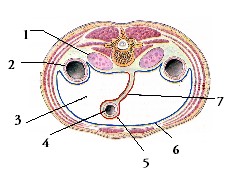
On the image below, arrow 4 marks
intraperitoneal organ
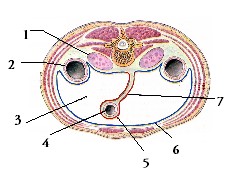
On the image below, arrow 6 marks
parietal peritoneum
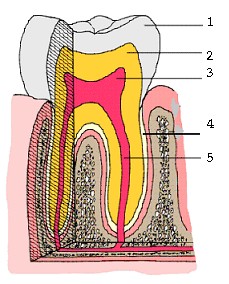
On the image below, arrow 2 marks
dentin
Which of the following can be found in the pulp?
connective tissue, vessels, nerves
Odontoblasts secrete ____.
dentin