25 - Haemostasis and haemocoagulation. Vascular-thrombocyte and coagulation haemostasis. Fibrinolysis and anticoagulation mechanisms. Control of haemostasis.
 Call Kai
 Learn
Learn Practice Test
 Spaced Repetition
 Match
Match Flashcards
 Knowt Play
1/6

There's no tags or description
Looks like no tags are added yet.
Name | Mastery | Learn | Test | Matching | Spaced | Call with Kai | Chat |
|---|
No analytics yet
Send a link to your students to track their progress
7 Terms
section
haemostasis in bleeding
vascular homeostasis
thrombocyte
platelets release prothrombin
fibrinolysis
anticoagulation
haemostasis
Haemostasis is the process of stopping bleeding through the walls of damaged blood vessels, while providing a framework for tissue repair
Involves coagulation- blood turns from liquid to gel.
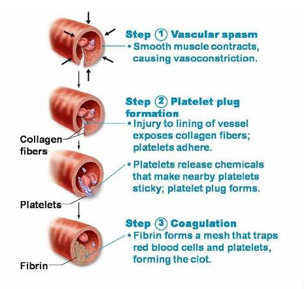
Has 3 main stages- vascular, thrombocyte and coagulation.
vascular haemostasis
Phase 1:Endothelial cells contract exposing underlying basal lamina to the bloodstream.
Phase 2: Endothelial cells secrete chemical factors and local hormones including endothelin. stimulates smooth muscles fibre contractions (vascular spasms). This speeds up the process.
Phase 3: Endothelial cells have sticky ends to close the vessel also facilitates the attachment of platelets.
thrombocyte
Thrombocytes--Platelets aggregate to form plugs, platelets release prothrombin
Coagulation
fibrinogen → insoluble fibrin
As the fibrin network grows, it covers the surface of the platelet plug.
Passing blood cells and platelets become trapped in the fibrous network forming a clot.
This blood clot eventually seals off the damaged vessel
fibrinolysis
the process where a clot gradually dissolves as repairs proceed, so no obstruction in blood flow
This is conducted by the protein- thrombin and tissue plasminogen activator which is produced by damaged tissue at the site of injury
Activated plasminogen enzyme forms plasmin.
Plasmin breaks down the fibrin strands and erodes the foundation of the clot
anticoagulation
Process of preventing blood clots.
Several substances act to deactivate or reverse clotting factors.
Angiothrombin III is an anticoagulant in the blood that inhibits clotting factors such as thrombin.
Heparin accelerates antithrombin III production.
Thrombodulin is released by endothelial cells. It binds with thrombin , this causes it to activate protein C.
Protein C stimulates the formation of plasmin, an enzyme that gradually breaks down fibrin strands.