Orgo I, Ch 8,9,10 Reactions
 Call Kai
 Learn
Learn Practice Test
 Spaced Repetition
 Match
Match Flashcards
 Knowt Play
1/35

There's no tags or description
Looks like no tags are added yet.
Name | Mastery | Learn | Test | Matching | Spaced | Call with Kai | Chat |
|---|
No analytics yet
Send a link to your students to track their progress
36 Terms
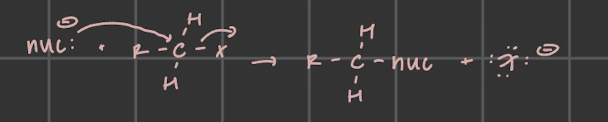
Sn2
strong nucleophile, polar aprotic; concerted; 100% inversion of chiral center; nuc replaces leaving group
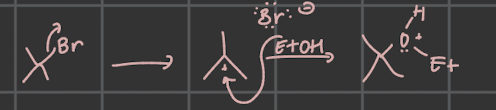
Sn1
weak nuc/base, polar aprotic; stepwise; racemic mixture; nuc replaces leaving group
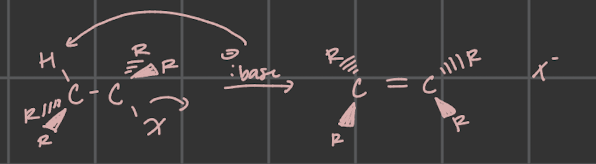
E2
strong base, polar protic; concerted; Zaisev’s product unless the base is sterically hindered; base takes anti-periplanar proton, kicks off leaving group, forms alkene
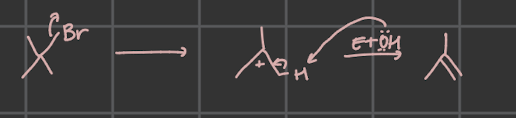
E1
weak base/nuc, polar protic; stepwise; always produces Zaitsev product; LG departs, carbocation intermediate forms (rearrangement), base takes proton, forms alkene
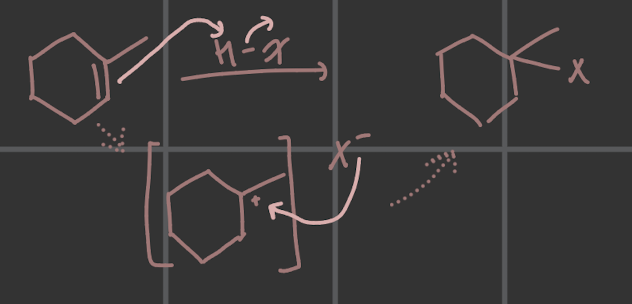
Alkene + HX
Hydrohalogenation; Markovnikov addition of halogen (X) and an H across alkene
Alkene + HBr, ROOR
Hydrohalogenation; non-Markovnikov addition of Br and H across an alkene in the presence of a reducing agent
Alkene + H3O+ (conc. acid, H2O)
Acid-catalyzed Hydration; Markovnikov addition of water as H and OH across an alkene
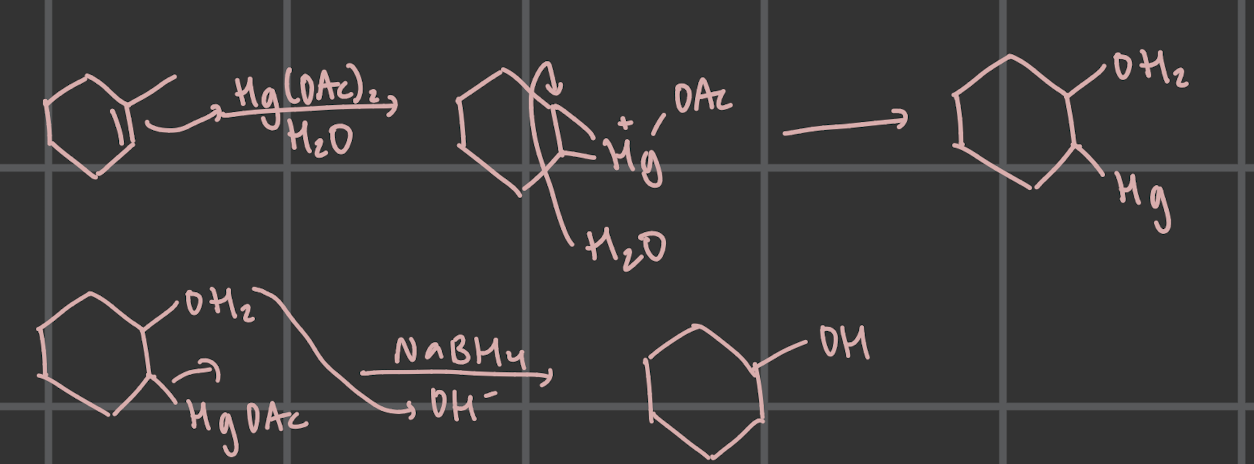
Alkene + 1) Hg(OAc)2, H2O 2) NaBH4
Oxymercuration, Demercuration; adding H2O across an alkene by Hg(AOc)2 forms a mercurinium intermediate which is demercurated by NaBH4 to add OH and H across the bond (Markovnikov)
Alkene + 1) BH3, H2O 2) H2O2, NaOH
Hydroboration-oxidation; anti-Markovnikov addition of OH and H across an alkene; concerted; syn addition (product + enantiomer)
Alkene + H2, Pt
Hydrogenation (metal catalyzed); addition of H2 across an alkene in the presence of a metal catalyst; syn addition (product + enantiomer)
Alkene + Br2
Bromination; addition of Br2 across an alkene; anti addition where the second bromine addition is by Sn2 (backside attack) (product + enantiomer)

Alkene + X2, H2O
Halohydrin formation; addition of Br and OH across an alkene; OH is added anti-Markovnikov (product + enantiomer)

Alkene + RCO3H
Anti Dehydroxylation; adding OH and OH across an alkene; anti addition (product + enantiomer)
Alkene + OsO4, NaSO4
Syn Dehydroxylation; OsO4 added (syn) across the alkene and is treated with NaSO4 to make a diol
Alkene + O3, DMS
Ozonolysis; O3 cleaves pi bond with treated with a reducing agent (cut double bond in half, add =O)
alkene + NBS/ light, CCl4
allylic bromination to make an alkyl halide
alcohol + HX/ ether
alkyl halide formation (SN2)
(primary/ secondary) alcohol + SOCl2/ pyridine
alkyl halide (Cl for OH)
(primary/ secondary) alcohols + PBr3 / ether
alkyl halide (Br for OH)
(primary/ secondary) alcohol + HF/ pyridine
alkyl halide (F for OH)
RX + Mg/ ether
(Grignard reagent formation) R-Mg-X
RX + 2Li/pentane
(Gilman reagent formation) R-Li + Li-X
2R-Li + CuI → R-Cu-R + LiX
Diorganocopper Reaction
R2CuLi + R’-X → (in ether) → R-R’ + RCu + LiX
alkyne + HX (xs)
(Hydrohalogenation) Markovnikov addition of 2 equivalents of X
alkane + NaNH2 (xs) / H2O
Elimination (of geminal or vicinal) alkyl halide to make a terminal alkyne (E2 twice)
alkyne + HgSO4 / H2SO4, H2O
(acid-catalyzed hydration) Markovnikov addition of OH to the alkyne to make an enol which, under acidic conditions, tautomerizes to a ketone
alkyne + R2BH / H2O2, NaOH
(hydroboration, oxidation) Markovnikov addition of OH to the alkyne to make an enol which, under basic conditions, deprotonates to make an enolate anion and tautomerizes to becomes an aldehyde
alkyne + X2 (1 equiv.)/ CCl4
(Halogenation) addition of X-X across the triple bond to make an alkene
alkyne + X2 (xs) / CCl4
(Halogenation) addition of 2 equivalents of X-X across the triple bond to make an alkane
alkyne + O3 / H2O
(Ozonolysis) Cleavage of a triple bond to make a carboxylic acid and a carbon dioxide
alkyne + NaNH2 / RX
(Alkylation) aldehyde is deprotonated by NH2- to form an acetylide anion which reacts wit RCH2Br to add an R group to the less substituted side of the alkyne
(alkylated) alkyne + Na/ NH3 (l)
reduction to a trans alkene
(alkylated) alkyne + H2/ Pd
reduction to an alkane
(alkylated) alkyne + H2/ Lindlar’s Catalyst
reduction to a cis alkene
Friedel-Crafts Alkylation (benzene ring + R-Cl/ AlCl3 → substituted benzene)
a strong electrophile is substituted for a hydrogen atom on an aromatic (benzene) ring; benzene ring + strong electrophile → carbocation intermediation deprotonated by the conjugate base of the electrophile to restore aromaticity (back to sp2)
Friedel-Crafts Acylation (benzene + acyl/ AlCl3 → acyl-substituted benzene)
an acyl group is substituted for a hydrogen atom on an aromatic (benzene) ring; benzene ring + strong electrophile → carbocation intermediation deprotonated by the conjugate base of the electrophile to restore aromaticity (back to sp2)