Lab 1: Anatomical Terms, Histology, Integumentary System
 Call Kai
 Learn
Learn Practice Test
 Spaced Repetition
 Match
Match Flashcards
 Knowt Play
1/86

There's no tags or description
Looks like no tags are added yet.
Name | Mastery | Learn | Test | Matching | Spaced | Call with Kai | Chat |
|---|
No analytics yet
Send a link to your students to track their progress
87 Terms
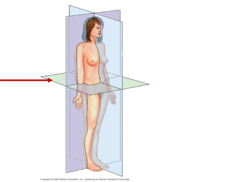
Transverse sectional plane
divides the body into superior and inferior portions
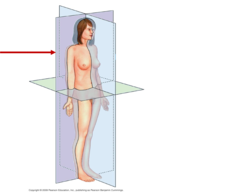
Frontal sectional plane
divides the body into anterior and posterior portions
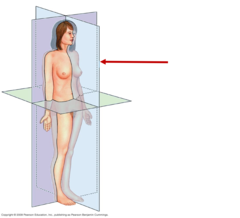
Sagittal sectional plane
divides the body into right and left portions
epithelial, connective, muscle, neural
tissue types
- Protective layer covering surfaces in contact with the outside world
- Lines tubular structures
- Glands are formed by this
- Has apical and basal surfaces
epithelial tissue uses
protection, absorption, secretion
epithelial tissue function
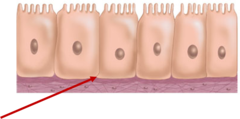
Apical surface
exposed surface of cells

Basal surface
attachment point of cells
Simple squamous epithelium
?

simple cuboidal epithelium
tissue type?

simple columnar epithelium
?
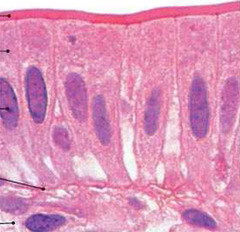
villi
Name this structure
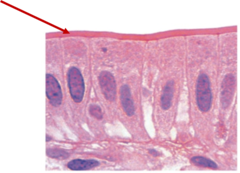
stratified squamous epithelium
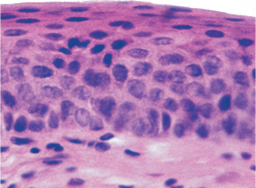
Stratified cuboidal epithelium
tissue type

stratified columnar epithelium
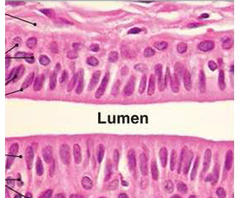
Transitional epithelium non-stretched
?
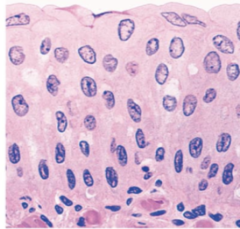
Transitional epithelium stretched
?

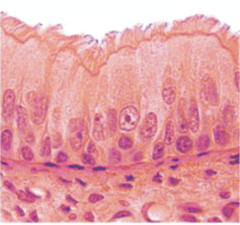
Pseudostratified ciliated columnar epithelium
?
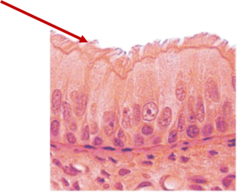
Cillia
Name this structure
Endocrine glands
release products directly into interstitial fluid or bloodstream
Exocrine glands
release products through ducts directly onto epithelial apical surfaces
areolar, adipose, reticular
loose connective tissue types
dense regular, dense irregular, elastic
dense connective tissue types
Areolar connective tissue

adipose connective tissue
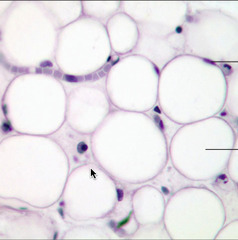
reticular connective tissue
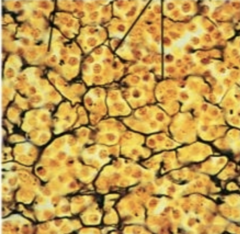
dense regular connective tissue

elastic connective tissue

dense irregular connective tissue
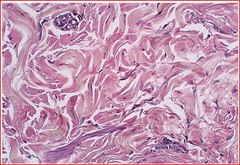
Plasma
the watery matrix of blood made up of blood cells and cell fragments
formed elements
erythrocytes, leukocytes, platelets
Lymph
interstitial fluid that enters the lymphatic vessels

Supporting connective tissue
what type of tissue are bone and cartilage
Chondrocytes
cells in the cartilage matrix
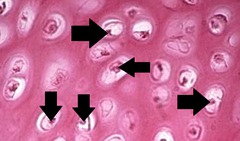
Hyaline cartilage

Elastic cartilage
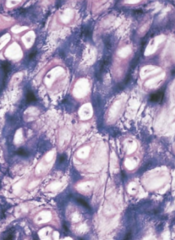
Fibrocartilage cartilage
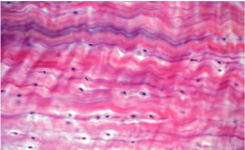
Bone

Osteocytes
bone cells

canaliculi
Passageways connecting osteocytes together
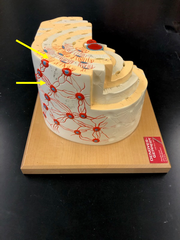
Osteoblasts
bone forming cells
Osteoclasts
Bone-destroying cells
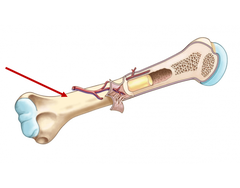
Periosteum
A dense fibrous membrane covering the surface of bones (except at their extremities) and serving as an attachment for tendons and muscles.
Name this layer
Skeletal muscle tissue
tissue type?

Cardiac muscle tissue
tissue type?
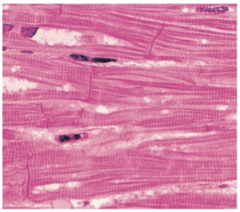
smooth muscle tissue
?

Neuron
cells in the nervous system that act as interconnected information processors, which are essential for all of the tasks of the nervous system
glial cells
cells in the nervous system that support, nourish, and protect neurons
stratum corneum
outermost layer of epidermis

stratum lucidum (epidermis)
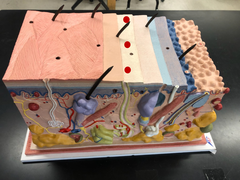
stratum granulosum (epidermis)

Stratum spinosum
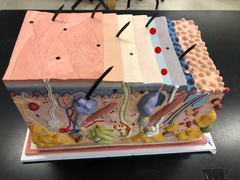
stratum basale
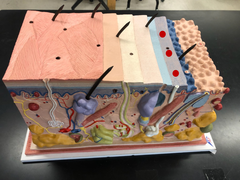
Basal lamina

dermal papillae or papillary layer
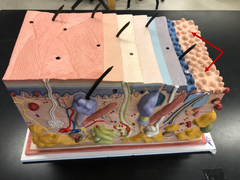
Papillary plexus

tactile corpuscle
?
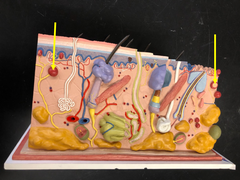
lamellated corpuscle
"watermelon"
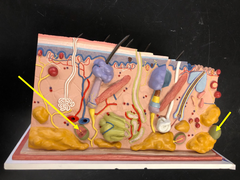
Rufinni corpuscles
?
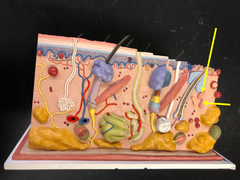
Pore of sweat gland
Name this opening
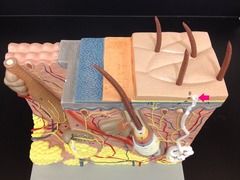
Apocrine sweat glands

merocrine sweat glands
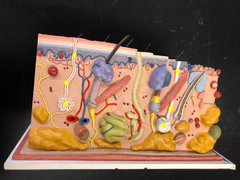
sebaceous glands
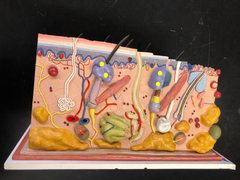
root hair plexus

Arrector pilli muscle
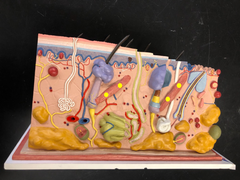
Hair root
everything below the sebaceous gland
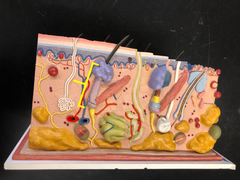
Hair shaft
everything above the sebaceous gland- part that is outside of skin
"Name this structure"

Hair follicle
organ that produces hair
hair bulb
The rounded, club-shaped part of hair located at the end of the hair root
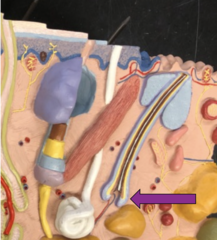
Hair papilla
Name this indentation
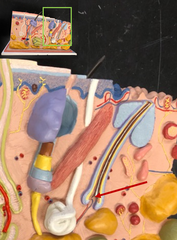
Medulla
White innermost layer of the hair

Cortex
Dark brown 2nd layer from the middle

Cuticle
"Name this layer"
The clear covering layer on the hair shaft

Internal root sheath
Tan layer 3rd from the middle

External root sheath
Yellow layer 4th from the middle
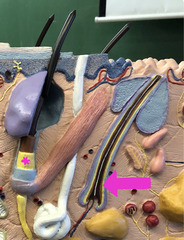
Glassy membrane
Blue 5th layer from the middle

Connective tissue sheath
Purple outermost layer
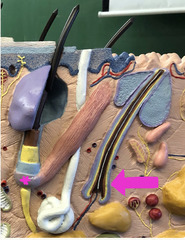
aveoli + capillaries
location of simple squamous
mouth + anus
location of stratified squamous
ducts (ovaries, kidney nephrons)
location of simple cuboidal
glands (thyroid, pituitary)
location of stratified cuboidal
bladder (stretchy!)
location for transitional epithelium?
small intestine
location of simple columnar
trachea (mucus membranes)
pseudostratified ciliated columnar
fluid movement areas-epiglottis, urethra
location of stratified columnar
moist areas → mouth
location of nonkeratinized stratified squamous
skin!
location of keratinized stratified squamous