A & P Chapter 1 and 2 [Directional Terms & Planes of Section]

0.0(0)
Studied by 0 people
call kaiCall Kai
Locked
learnLearn
examPractice Test
spaced repetitionSpaced Repetition
heart puzzleMatch
flashcardsFlashcards
GameKnowt Play
Card Sorting

1/18

encourage image

There's no tags or description

Looks like no tags are added yet.

Last updated 12:42 AM on 9/2/26
Name
Mastery
Learn
Test
Matching
Spaced
Call with Kai
Chat

No analytics yet

Send a link to your students to track their progress

19 Terms

1
New cards

Describe Anatomical Position

Body is standing upright
Feet are shoulder width apart
Upper limbs at the sides of trunk
Head and palms facing forward
Body is always referred to as if it were
in anatomical position, even when it’s in
another position
“Right” and “left” always refers to right
and left sides of body being described,
not our own

<p><span data-name="black_small_square" data-type="emoji">▪</span><span> Body is standing upright<br></span><span data-name="black_small_square" data-type="emoji">▪</span><span> Feet are shoulder width apart<br></span><span data-name="black_small_square" data-type="emoji">▪</span><span> Upper limbs at the sides of trunk<br></span><span data-name="black_small_square" data-type="emoji">▪</span><span> Head and palms facing forward<br></span><span data-name="black_small_square" data-type="emoji">▪</span><span> Body is always referred to as if it were<br>in anatomical position, even when it’s in<br>another position<br></span><span data-name="black_small_square" data-type="emoji">▪</span><span> “Right” and “left” always refers to right<br>and left sides of body being described,<br>not our own</span></p>
2
New cards

Anterior/Posterior | Ventral/Dorsal

anterior (ventral) refers to structures located toward the front of the body, and posterior (dorsal) refers to structures toward the back
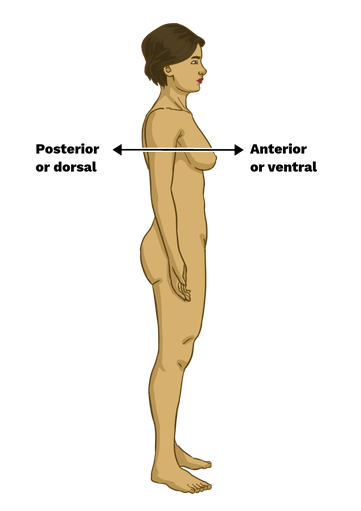
<p><strong>anterior (ventral)</strong><span> refers to structures located toward the front of the body, and </span><strong>posterior (dorsal)</strong><span> refers to structures toward the back</span></p>
3
New cards

Superior/Inferior | Cranial/Caudal

Superior (Cranial) indicates a structure that is closer to the head or upper part of the body, while inferior (Caudal) refers to a structure closer to the feet or lower part of the body
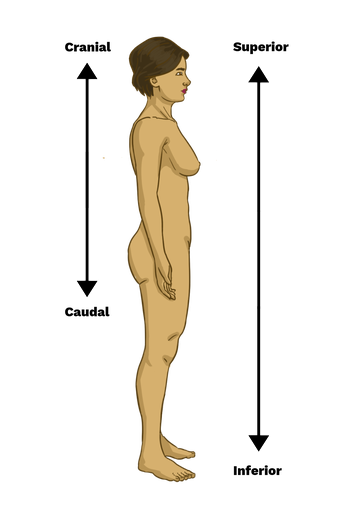
<p><strong>Superior (Cranial)</strong><span> indicates a structure that is </span><mark data-color="red" style="background-color: red; color: inherit;">closer to the head or upper part of the body</mark><span>, while </span><strong>inferior (Caudal) refers to a structure </strong><mark data-color="blue" style="background-color: blue; color: inherit;">closer to the feet or lower part of the body</mark></p>
4
New cards

Proximal/ Distal

proximal refers to a location closer to the axil body, while distal describes a location that is farther from the axil body
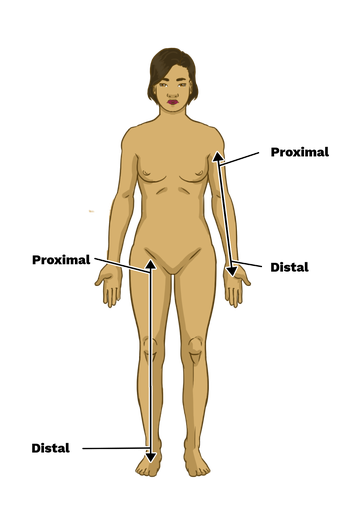
<p><strong>proximal </strong><span>refers to a location <u>closer </u>to the axil body, while <strong>distal </strong>describes a location that is </span><u>farther </u>from the axil body</p>
5
New cards

Medial/ Lateral

Medial refers to structures located toward the midline, while lateral refers to structures located away from the midline, toward the outer side of the body
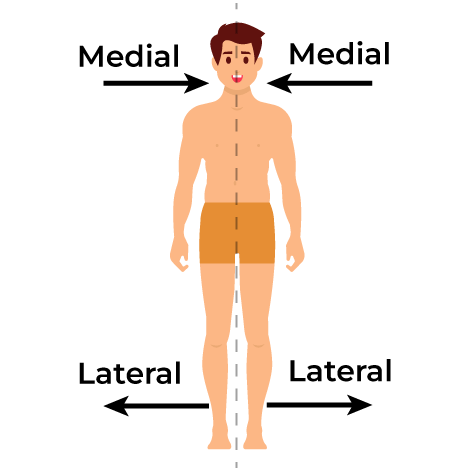
<p><strong>Medial </strong>refers to structures located<mark data-color="yellow" style="background-color: yellow; color: inherit;"> toward the midline</mark>, while <strong>lateral </strong>refers to structures located <mark data-color="green" style="background-color: green; color: inherit;">away from the midline</mark><span>, toward the outer side of the body</span></p>
6
New cards

Superficial/ Deep

superficial describes structures closer to the exterior surface of the body, whereas deep refers to structures located further inside

<p><strong>superficial</strong><span> describes structures closer to the exterior surface of the body, whereas </span><strong>deep</strong><span> refers to structures located further inside</span></p>
7
New cards

Axial Region

head, neck, and trunk

8
New cards

Appendicular Region

upper and lower appendages

9
New cards

Sagittal Plane

divides the body into left and right sections

<p>divides the body into left and right sections</p>
10
New cards

Midsagittal Plane

plane that divides equal left and right sections
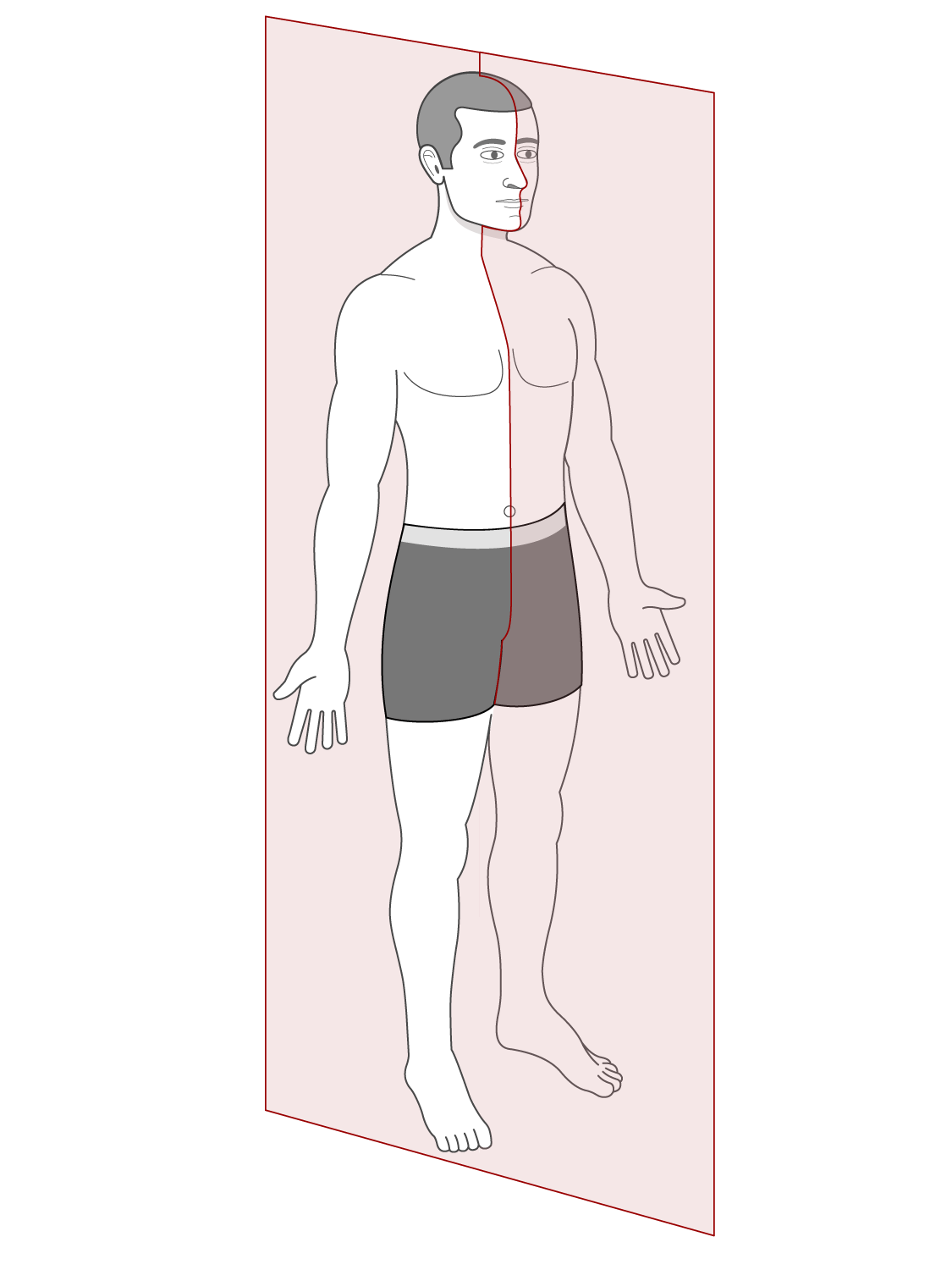
<p>plane that divides <strong>equal </strong>left and right sections</p>
11
New cards

Parasagittal Plane

plane that divides into unequal left and right sections

<p>plane that divides into <strong>unequal </strong>left and right sections</p>
12
New cards

Frontal Plane (Coronal Plane)

divides body into anterior and posterior sections

<p>divides body into anterior and posterior sections</p>
13
New cards

Transverse Plane (also known as horizontal plane or cross section)

divides the body into superior and inferior (basically upper half and lower half sections)

<p>divides the body into superior and inferior (basically upper half and lower half sections) </p>
14
New cards

Posterior Body Cavity consist of..

-Cranial cavity: brain

-Vertebral (spinal) cavity: vertebrae

<p>-Cranial cavity: brain</p><p>-Vertebral (spinal) cavity: vertebrae</p>
15
New cards

Anterior Body Cavity consist of… and is separated into two divisions by what

-Thoracic cavity: heart, lungs

-Abdominopelvic: stomach, liver, kidney, pancreas, spleen, gallbladder, small intestine, large intestine

separated by the diaphragm

<p>-Thoracic cavity: heart, lungs </p><p>-Abdominopelvic: stomach, liver, kidney, pancreas, spleen, gallbladder, small intestine, large intestine</p><p><em>separated by the diaphragm</em></p>
16
New cards

3 parts of the Thoracic Cavity

-Pleural cavities: a fluid filled space that surrounds the lungs

-Mediastinum: the space between these two pleural cavities (not within serous membrane)

-Pericardial Cavity: sack that encloses the heart

<p>-Pleural cavities:<span> a fluid filled space that surrounds the </span>lungs</p><p>-Mediastinum:<span> the space between these two pleural cavities (not within serous membrane)</span></p><p>-Pericardial Cavity: sack that encloses the heart </p>
17
New cards

Abdominopelvic cavity subdivided into two cavities

-Abdominal cavity: upper abdominal region

-Pelvic Cavity: lower pelvic region
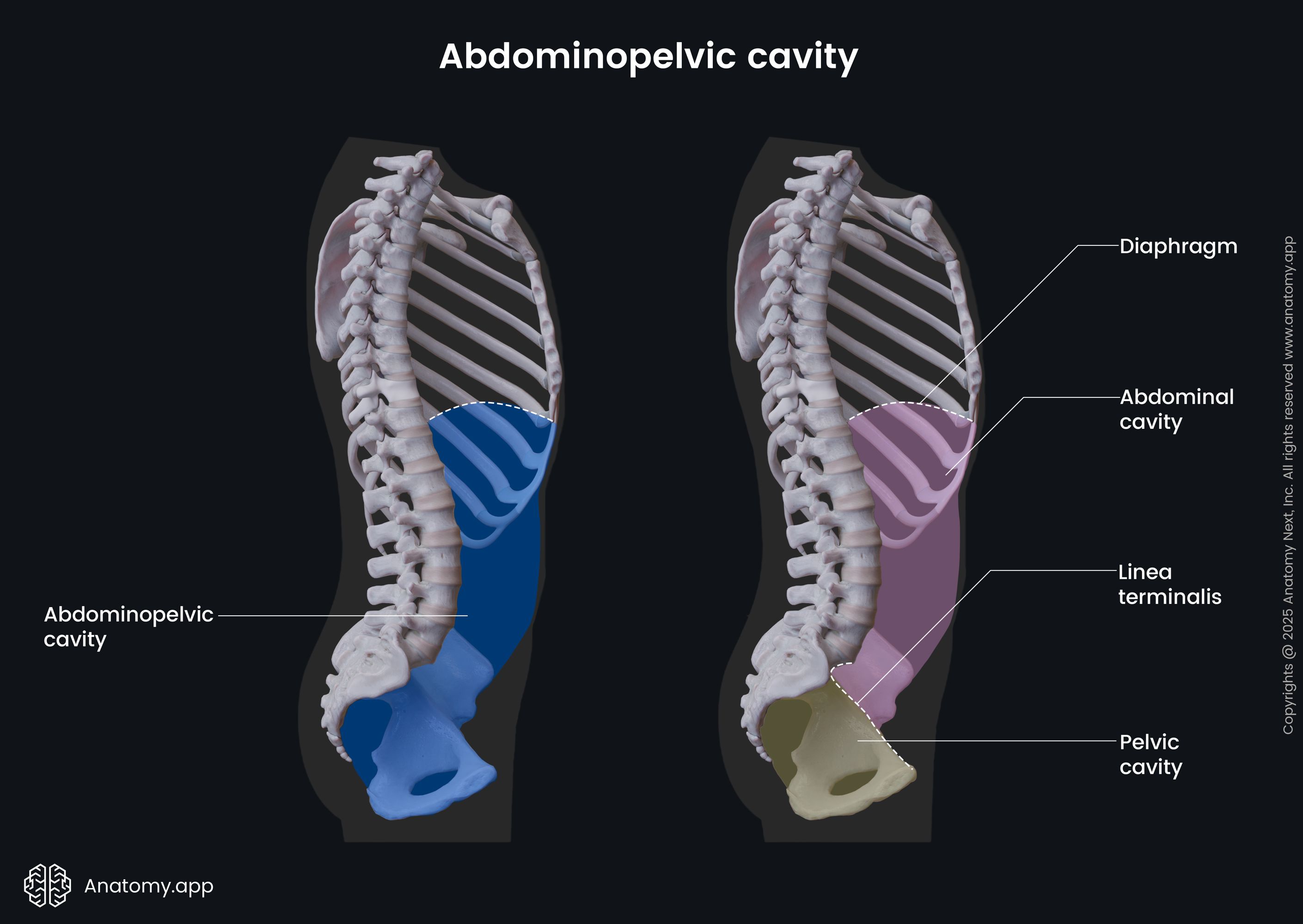
<p>-Abdominal cavity: upper abdominal region</p><p>-Pelvic Cavity: lower pelvic region</p>
18
New cards

Abdominopelvic Quadrants

-Right upper quadrant (RUQ)
-Right lower quadrant (RLQ)
-Left upper quadrant (LUQ)
-Left lower quadrant (LLQ)

<p><span>-Right upper quadrant (RUQ)<br>-Right lower quadrant (RLQ)<br>-Left upper quadrant (LUQ)<br>-Left lower quadrant (LLQ)</span></p>
19
New cards

Abdominopelvic Regions

o Right and left hypochondriac regions
o Epigastric region
o Right and left lumbar regions
o Umbilical region
o Right and left iliac or inguinal regions
o Hypogastric region
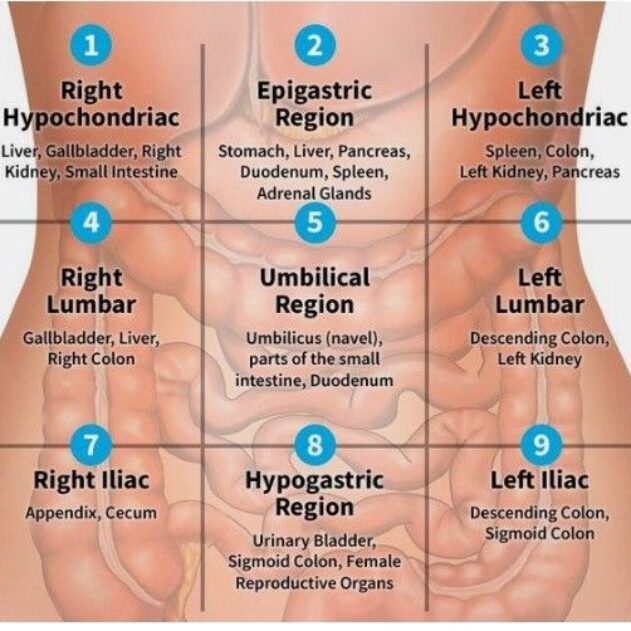
<p><span>o Right and left hypochondriac regions<br>o Epigastric region<br>o Right and left lumbar regions<br>o Umbilical region<br>o Right and left iliac or inguinal regions<br>o Hypogastric region</span></p>



