Natural History of Reptiles
 Call Kai
 Learn
Learn Practice Test
 Spaced Repetition
 Match
Match Flashcards
 Knowt Play
1/25

There's no tags or description
Looks like no tags are added yet.
Name | Mastery | Learn | Test | Matching | Spaced | Call with Kai | Chat |
|---|
No analytics yet
Send a link to your students to track their progress
26 Terms
What kind of reptiles are modern day reptiles descended from?
Synapsids
What were the developments in the synapsid lineage?
-Larger head
-Advanced jaw musculature
-Heterodont dentition
-Ability to chew
What was a key innovations that led to reptiles?
Development of scales, derived from the epidermis (prevented water loss)
3 chamber heart
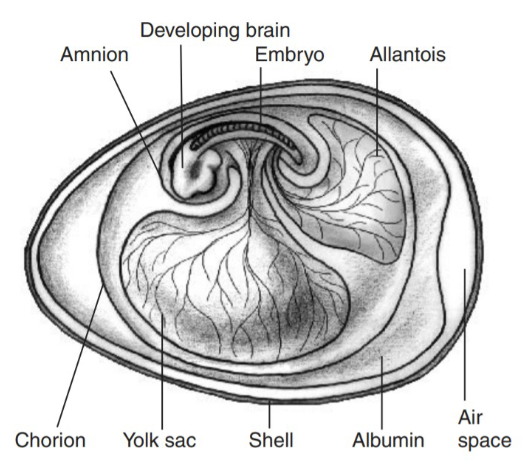
Amniotic Egg
What are the parts of the amniotic egg?
Leathery shell
Chorion (assists in gas exchange)
Amnion (protective environment)
Yolk sac (early circulatory system)
Allantois (respiratory structure)
When did reptiliomorphs emerge?
Carboniferous period (350 mya)
When did modern reptiles emerge?
Triassic period (225 mya)
What are temporal fenestra?
opening above and/or below postorbital and sqamosal bones
What are the 3 types of classification for reptiles?
Anapsid (no opening), Synapsid (one opening), and diapsid (two openings)
What is the cloaca?
outlet for intestinal, urinary, and genital tracts
Contains the hemipenes- paired; squamates
OR penes- unpaired; turtles, crocodilians
What are the 2 ways sex can be determined?
temperature and chromosomes (ZW system)
What is ectothermy versus endothermy?
Endothermy is generates heat from within, ectothermy requires outside source (ex: sun)
What is Homeothermy vs. Poikilothermy?
Homeothermy is body temp is constant, poikilothermy is that it fluctuates with environment
What is the difference between hibernation and brumation?
hibernation is for mainly mammals (endotherms), is a deep sleep, relies on fat deposits (glycogen stores in brumation), and the animal doesn’t eat or drink during hibernation (unlike brumation)
Characteristics of testudines
an Anapsid, most are ectothermic and poikilothermic, are oviparous,, have a beak
What is the shell of a testudines made up of?
carapce and plastron, covered by keratinous scutes
What are lepidosauria?
“scaled reptiles”
Characteristics of order Rhynchocephalia
Includes only the tuatara
Diapsid
Ectothermy/poikilothermic
acrodont
parietal eye
Characteristics of Order squamata
monophyletic
paired copulatory organs
Jacobson’s organ
Egg tooth
some are oviparous and viviparous
What kind of group is lacertilia?
is the lizards and are paraphyletic
What is pleurodont dentition and who mostly has it?
teeth fused to side of jaw bone
some lizards and snakes
Most homodont (single tooth morphology) except venomous snakes
What is proteroglyphous?
front-fanged
What is solenoglyphous?
hinged fangs
What is Opistoglyphous?
rear-fanged
Definition of venom
highly modified saliva containing peptide-based toxins
what are neurotoxins?
disrupt signal transduction which results in muscle paralysis and tetanus
What are hemotoxins?
attack red blood cells and induce coagulation