Electromagnetism
 Call Kai
 Learn
Learn Practice Test
 Spaced Repetition
 Match
Match Flashcards
 Knowt Play
1/30

There's no tags or description
Looks like no tags are added yet.
Name | Mastery | Learn | Test | Matching | Spaced | Call with Kai | Chat |
|---|
No analytics yet
Send a link to your students to track their progress
31 Terms
The magnitude of the field will
increase proportionally w/ the size of the charge
decrease proportionally with the square of the distance
While grav. fields always exert an attractive force → electricity fields always exert an attractive or repulsive force
Electric field at a point →
If FE = FG, the electron will move perfectly horizonatlly
Drawing electric fields
goes from positive to negative
positive out, negative in
Parallel Charges plates
Curve at the end
Electric fields
IN WHICH DIRECTION WOULD A POSITIVE TEST CHARGE EXPERIENCE A FORCE AT THAT POINT?
Uniform electric fields have the same magnitude and direction at all points - e.g. between 2 parallel charged points
in a field, you will experience a force without any contact between two objects
can exert forces of attraction or repulsion
Particles in an electric field
protons experience a force in the same direction as the field
electron experiences a force in the opposite direction
Electric field strength = force applied per coulomb of charge
upward electric force and gravitational force can create net force = zero
force between two charged particles is inversely proportional to the square of the distance between them
Coulomb’s Law
ONE COULOMB IS A HUGE CHARGE
The electric field emanating from a point charge will
be proportional to the size of the charge
be spherically symmetrical
decrease in magnitude w/ increasing distance from the point charge
Defined using the 'ε₀’ permittivity of free space
1/(4πε₀) = 9×10^9 Nm² c^-2
Factors affecting the electric force
proportional to product of the 2 charges
regardless of the charge on each point, the forces on each point in a pair will be the same
Work and Electric Fields
Electric field strength at a particular point = the force per unit charge that acts on a small positive test charge at that point.
E = F/q or v/d
Electric potential energy
a form of energy stored in an electric field
electric potentia at infinity is defined as zero
Work can be done either
by the electric field on a charged object, reducing the electrical PE stored and increasing the KE of the object
on the electric field by forcing the object to move, thereby ⬆ electrical PE
Work done in electric fields
if a charged object moves in the direction that it naturally tends to go within an electric field, work is done by the field.
When a positive point charge is moved in the direction of the electric field, the electric field does work on the point charge
When work is done by a charged object on an electric field, the object is forced to move against its natural direction
work has been done on the field by forcing the object to move
Magnetic field lines
show the direction of force acting on a magnetic north pole
We can draw the magnetic field around an arrangement of magnets by determining the force that would act on a north pole at each point
WHAT WOULD A NORTH MAGNETIC MONO-POLE DO?
goes from North to south
When N meets N → there will be a neutral point
Magnetic field sources
created by a moving charge - even the magnetic field of a magnetic material (e.g. permanent magnet) is created by the motion of electrons w/in the atoms of the material
In most materials, the magnetic fields created by the electrons cancel out such that there is no net magnetic field
Only a few materials have an arrangement that allows for a net magnetic field - called ferromagnetic materials (e.g. iron, cobalt, nickel)
A wire carrying a current will create a magnetic field
Calculating magnitude of the magnetic flux density
permeability of free space = μ₀ = 1.25663706 × 10⁻⁶ m kg s-2 A-2
conventional current = direction of positive charge = positive to negative
from negative to positive over switch → increase in energy
Drawing magnetic fields → modification
you can quickly determine where N is using a ‘modified’ right hand curl rule
if there is a loop of wire, curl fingers in direction of I, then thumb points in direction of N pole
Dipoles
each end of a magnet is a magnetic pole, so when you break apart a magnet, each will form a separate magnet w/ 2 poles
therefore, they are dipolar
a magnetic field is a dipole field
a suspended magnet that is free to move will always orientate itself in a north-south direction
North and South Mag Poles ≠ North and South Pole
Magnetic Field lines
produce fieds and will apply a force to objects made of ferromagnetic materials
Run North to south external to the magnet, South to north inside the magnet/solenoid
magnetic flux density/vector magnitude of mag. field @ a point is denoted by B and has units of T
Perpendicular to current carrying wires
Magnetic fields between parallel wires
If 2 wires are brought close together, their associated mag. fields will interact → resultant field = vector addition of each field
could attract/repel → when current is in the same direction: mag. fields are in opposite directions, reps. unlike poles, therefore wires attract
when current is in opposite direction, mag fields are in same direction and wires repel
3D Fields
Lower density = weaker field
As magnetic fields associated w/ current carrying coils are dependent upon the size of the current, a changing current will produce a changing mag. field
Direction of current creates poles, poles can be reversed by reversing direction of the current
magnetic flux density → can be changed by varying the amount of electric current that flows through it
Solenoids
Many loops placed side by side, fields add together to produce a stronger effect
Direction of a north solenoid can also be determined by using right hand grip rule in reverse. → curl fingers in direction of conventional current in wires, thumb points to north pole
solenoids can be strengthened by wrapping coils around a soft iron core
forces atoms to align to one direction → ind. magnetic fields add together to create a stronger mag. field
Magnetic forces on charged particles
a charged particle moving through a magnetic field will experience a force
particle must be travelling at right angles to the mag. field to maximise the force (angles <90 degrees still create a force)
If a particle is moving in a direction that is perpendicular to the magnetic field, the speed of the particle will not change but its direction will - the particle will experience an acceleration (v. changed since direction has changed)
***for an object undergoing uniform circular motion w/ a radius orbit r, the Fc is present, therefore qvB = mv²/r
Particle Accelerators
a synchrotron is a type of particle accelerator that constrains the motion of charged particles such that they move w/in large ring structures
Charged particles → electrons and protons (therefore mass are charge are known)
Radius of the curvatire → defined by the ring, so the velocity of the charged particles can be changed by changing the strength of the magnetic field
Right hand slap rule
used to determine the direction of the force on a positively charged particle
the force on a negatively charged object will be in the opposite direction to that on a positively charged particle
Conductors in B fields
If a conductor is in a magnetic field, and current is flowing throught the conductor, it will experience a magnetic force
Still consider the direction of I and B
If I and B = parallel, there is no force
Use right hand palm rule to determine direction of force but if force shows electrons, FLIP THUMB
Electric Motors
A current carrying conductor will experience a force in a magnetic field
We can use this principle to cause a coil of wire to notate in a magnetic field
To make it work, we need:
a power source (e.g. battery)
a permanent magnet/electromagnet
a coil of conducting material that can rotate in the B field
Minimum torque will always be zero
Max T → directly from IAnB
Commutators
since current must be reversed at point when it will return to a point of rotational equilibrium
allows direction to get reversed
designed to feed current to the particular coil that is in the position to provide the max. torque
split ring made of copper/another good conductor w/ conducting brushes (normally carbon blocks) rubbing against it
prevents wires from becoming tangled as coils rotate
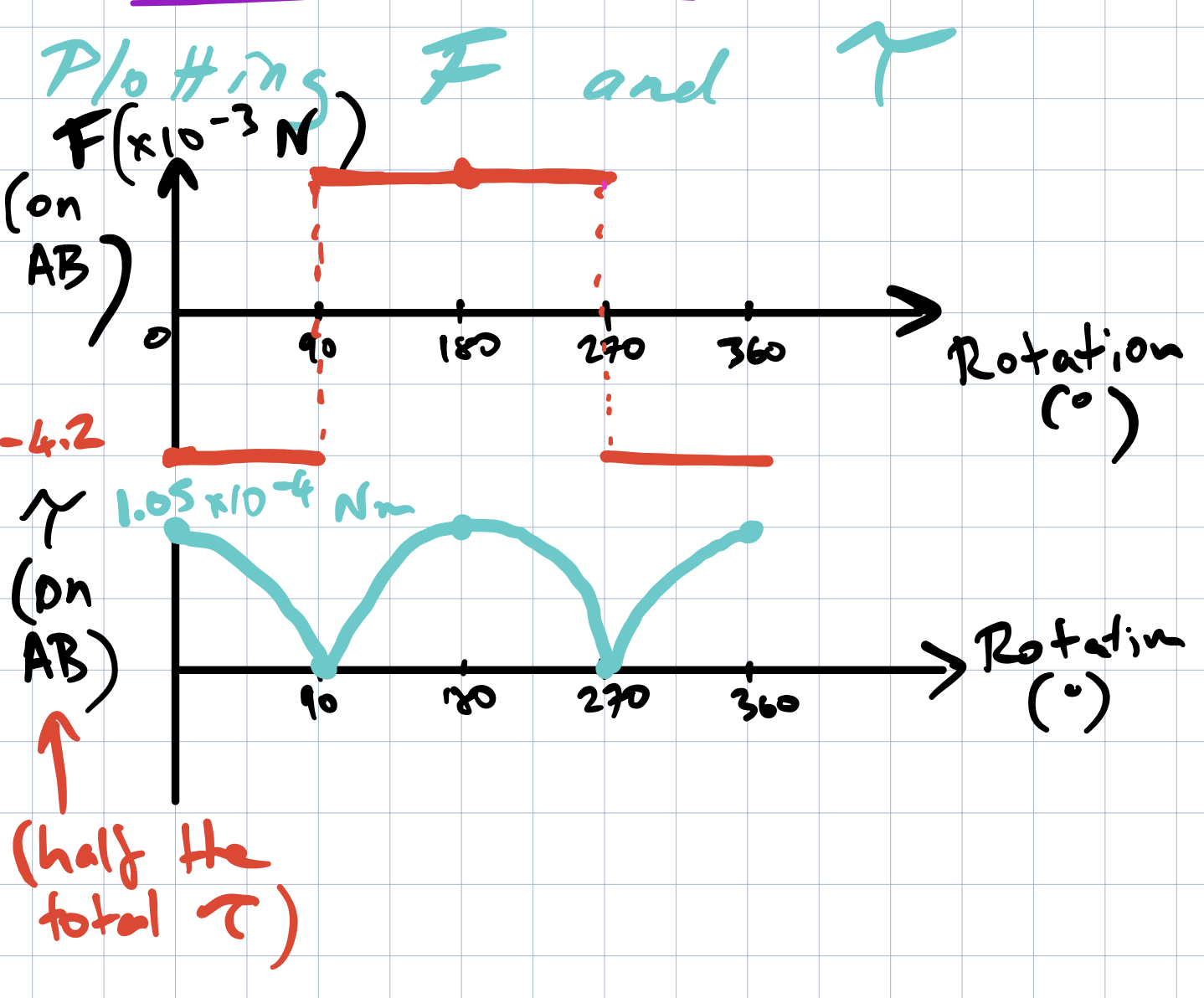
Plotting F and T
Use graphs to plot force and Torque acting on one side of this electric motor
90 degrees typically corresponds to no force due to split ring
Torque
turning force the coil experiences
In a single square (rectangular coil) → total torque applied to coil will be twice acting on one side
forces = opposite but torque in same direction
Armature
whole arrangement of core and coils
Stator
permanent magnets that provide B (often stationary)
Practical motors
have many coils w/ multiple turns
commutators are used
total torque = sum produced by every coil
lithium-ion batteries → most common