Thoracic Physical Exam
 Call Kai
 Learn
Learn Practice Test
 Spaced Repetition
 Match
Match Flashcards
 Knowt Play
1/31

There's no tags or description
Looks like no tags are added yet.
Name | Mastery | Learn | Test | Matching | Spaced | Call with Kai | Chat |
|---|
No analytics yet
Send a link to your students to track their progress
32 Terms
diaphragm
larger side of the stethoscope which is used to hear HIGH frequency sounds
bell
smaller side of the stethoscope which is used to hear LOW frequency sounds
away from
When using a stethoscope, the ear pieces should face __________ (away from/toward) you
owner
When first coming into the exam room, you should interact with the _________________ (owner/dog) first
before
You should record respiratory rate __________ auscultation, ideally when the patient is sleeping or quiet/relaxed
jugular pulses
During your observation (“looking”), look for ____________ which are abnormal if higher than the bottom third of the neck when the head is above the heart
submandibular, prescapular, axillary
During palpation (“feeling”), what three lymph node areas should you feel for enlargements?
apex
During palpation (“feeling”), feel for the ______ beat which is the location you feel the heart beat against the chest wall
femoral, facial, coccygeal
During palpation (“feeling”), you should palpate the arterial pulse, ideally while simultaneously auscultating the heart beat
In small animals, palpate the arterial pulse at the ____________ artery
In horses, palpate the arterial pulse at the ____________ artery (vascular notch)
In cattle, palpate the arterial pulse at the ____________ artery
lung fields
During auscultation (“listening”), you should auscultate the __________. You need them to take a deep breath
rebreathing
What technique can be used to get horses to take a deep breath?
upper
Stridor (high-pitched, harsh breathing) or stertor (low-pitched, snoring) sounds are abnormal sounds of the ______________ airway
lower
Crackles and wheezes are abnormal sounds of the _____________ airway
rate, rhythm
During auscultation of the heart, you should listen to what two traits of the heart beat?
tricuspid
What valve are we listening for at the red dot?

pulmonic
What valve are we listening for at the yellow dot?
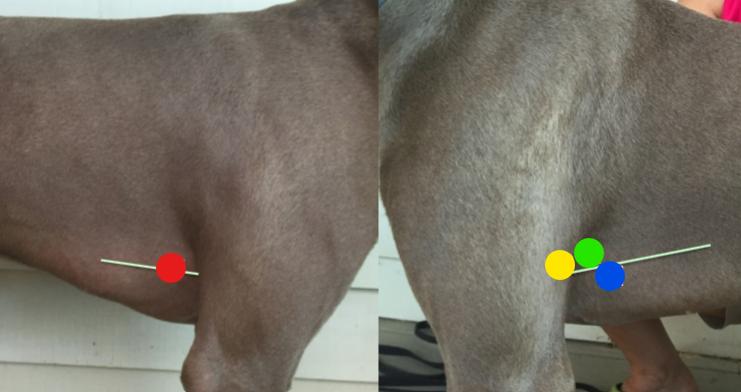
aortic
What valve are we listening for at the green dot?
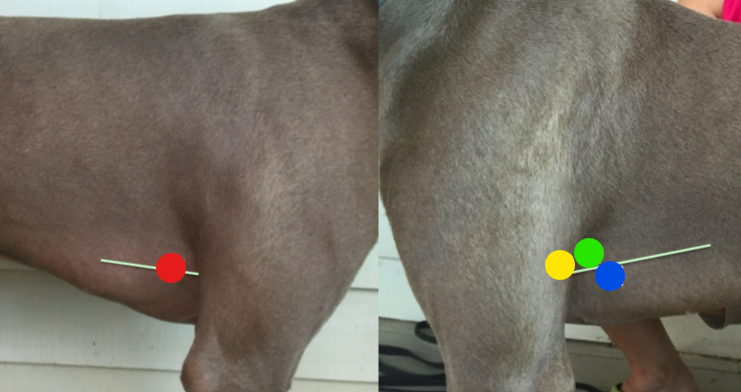
mitral
What valve are we listening for at the blue dot?

costochondral junction
The ___________________ is a good landmark for the line dividing the base and apex of the heart
S1
The “LUB” sound that corresponds to the closing of the AV valves at the start of systole
S2
The “DUB” sound that corresponds to the closing of the semilunar valves at the end of systole
S3
The sound of early rapid ventricular filling during early diastole
S4
The sound of atrial contraction at the end of diastole
S1, S2
What heart sounds are normal in all species?
large animals
S3 and S4 heart sounds can be normal in ________________
auscultation
Heart rate should be taken by _________________ (pulse or auscultation)
tachycardia
Term for an abnormally fast heart rate
bradycardia
Term for an abnormally slow heart rate
relaxed
In animals that are ____________, the heart rhythm should be regular or slow irregular, either is considered normal
vagal (parasympathetic)
Arrhythmias can be heard in normal animals and are associated with high ________ tone which means the parasympathetic nervous system’s influence on the heart is predominating. This will go away with exercise
sinus arrhythmia
In dogs: an ECG/EKG has a normal p, QRS, and T wave with irregular spacing from one R peak to the next, but it follows a cyclical or repeating pattern

second degree AV block
A normal arrhythmia in horses in which the P wave is not followed by the QRS or T peaks
