Chlorofluorocarbons and ozone layer
 Call Kai
 Learn
Learn Practice Test
 Spaced Repetition
 Match
Match Flashcards
 Knowt Play
1/5

Earn XP
Description and Tags
https://www.youtube.com/watch?v=GhH77DcEv9M
Name | Mastery | Learn | Test | Matching | Spaced | Call with Kai | Chat |
|---|
No analytics yet
Send a link to your students to track their progress
6 Terms
What is ozone layer
Found in stratosphere around 20-40 km above earth’s surface
Contains a relatively high concentration of chemical ozone (O3)
The ozone later absorbs a great deal of the UV radiation from the sun
So protects living organisms from excessive UV exposure.
How does ozone layer protect us from UV radiation
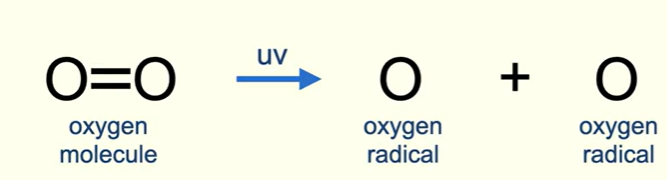
In stratosphere, the UV radiation causes double bond in oxygen molecules to break like this, 2 oxygen radicals are formed (radical is species with an unpaired electron)
The oxygen radical then reacts with an oxygen molecule to form a molecule of ozone.
What are chlorofluorocarbons (CFCS)
They are haloalkanes
Ozone constantly breaks down and forms theoretically, but CFCS are molecule in the air that also cause the breakdown of ozone
CFCS are stable molecules, due to high bond enthalpy of carbon to halogen bonds, also non toxic
What happens when CFCS are in stratosphere
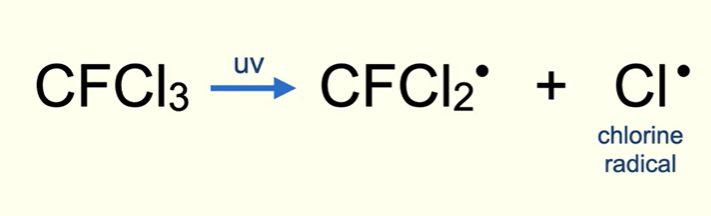
The uv radiation causes a carbon chlorine bond to break, this is called photodissociation, this is homolytic fission and produces a chlorine radical, highly reactive.
What happens in propagation step 1 and 2
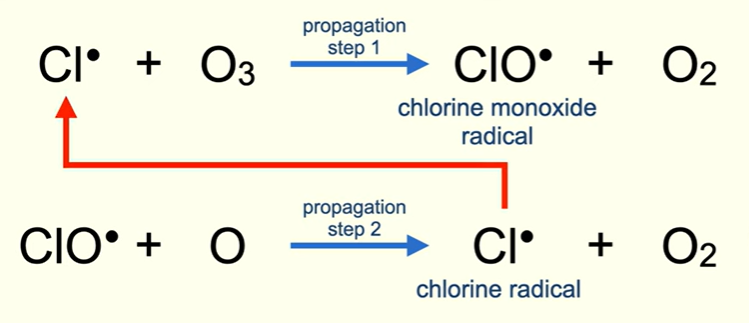
A chlorine radical reacts with molecule of ozone, produces oxygen molecule plus a highly reactive chlorine monoxide radical
In step 2 , the chlorine monoxide radical reacts with oxygen radical
Now chlorine radical from step 2 can go back and trigger step 1 again
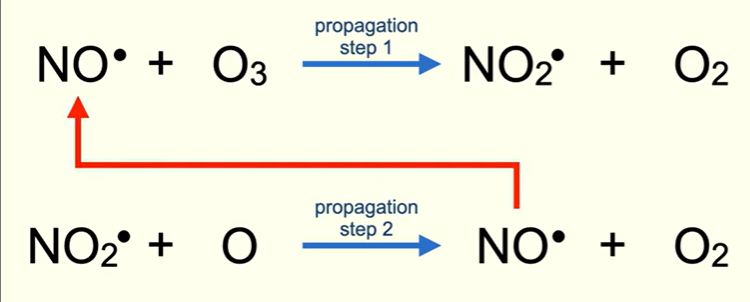
How is ozone destroyed by nitrogen oxide radicals
The nitrogen monoxide radical reacts with ozone to produce the nitrogen dioxide radical plus an oxygen molecule
The nitrogen dioxide radical then reacts with oxygen radical , forms another nitrogen monoxide radical plus an oxygen molecule
This takes place in a cycle.