Vascular System
 Call Kai
 Learn
Learn Practice Test
 Spaced Repetition
 Match
Match Flashcards
 Knowt Play
1/57

Earn XP
Description and Tags
A&P 335 Exam 3
Name | Mastery | Learn | Test | Matching | Spaced | Call with Kai | Chat |
|---|
No analytics yet
Send a link to your students to track their progress
58 Terms
Characteristics of arteries
Thick elastic connective tissue, smooth muscle, endothelium
Large radius, low resistance
Characteristics of arterioles
Thick smooth muscle, endothelium, have greatest resistance to flow
Characteristics of capillaries
Endothelium
Characteristics of venules
Thin connective tissue, endothelium
Characteristics of veins
Thin connective tissue, endothelium, wide and floppy
Explain the dicrotic notch
A result of SL valve closing, a bounce in pressure
Function of arteries
Maintains pressures and continues to push out blood even during diastole
Is a pressure reservoir and keeps pressure high by storing blood in stretched areas of artiers
Due to elastic recoil and compliance
Define compliance
How easy it is to stretch blood vessels
Define elastic recoil
Ability to return to original size after change, can snap back
Pulse pressure formula
= Systolic P - Diastolic P
Mean arterial pressure formulas
= Diastolic P + 1/3 Pulse pressure
= CO x TPR
How does age affect the arteries
The arteries get stiff which decreases…
Compliance - ↑ volume in lumen → ↓ volume stored → ↑ SP
Elasticity - ↓ volume in lumen (not stored → ↓ DP
Explain how sphygmomanometry is used to measure arterial pressure
The cuff compresses the brachial artery to above the systolic pressure, blocking flow (no sound).
As the cuff delates, turbulent sound is heard. First sound = systolic blood pressure
When sound disappears and flow is laminar = diastolic blood pressure
Functions of arterioles
Match blood flow to local tissue/cellular metabolic demand by changing the radius due to the smooth muscle
Maintain mean arterial pressure by determining the total peripheral resistance
Arterioles and resistance
All blood vessels contribute resistance to blood flow but arterioles are the site of greatest vascular resistance and are the main contributors to TPR
Describe conditioning organs
Ex. kidneys, intestines, skin
Receive blood flow in excess of needs
Tolerant of blood flow reduction so can be constricted to protect others
Describe Flow-depending organs
Ex. brain, heart
Critically dependent on blood flow
No tolerance for low blood flow, will constrict other areas so these get blood
What is a local environment with local factors?
Individual arteriole with one capillary bed. Local factors are things that influence arteriole (O2, metab waste, CO2)
Define and list local controls
They match blood flow to demand. Involves metabolites or factors in local ISF surrounding capillaries
Active hyperemia, flow autoregulation, reactive hyperemia
Describe active hyperemia
When metabolic activity ↑ —> ↑ metabolites and ↓ O2 —> arteriolar dilation to allow more O2 into organ —> ↑ blood flow
More metabolic activity leads to more blood flow
Describe flow autoregulation
Maintains blood pressure in specific organs
Will vasoconstrict when there’s greater arterial pressure to protect capillary beds
Involves myogenic response mechanism
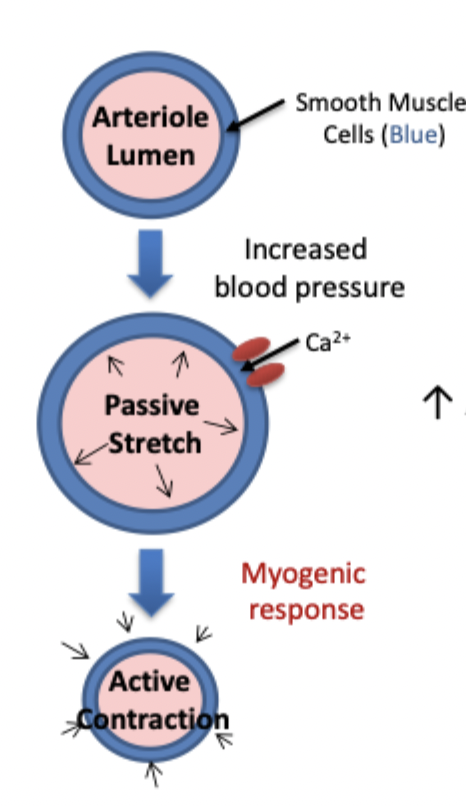
Describe myogenic response
Increase of BP stretches the walls of the arteries → activates stretch-sensitive Ca channels → enter smooth muscles and leads to vasoconstriction
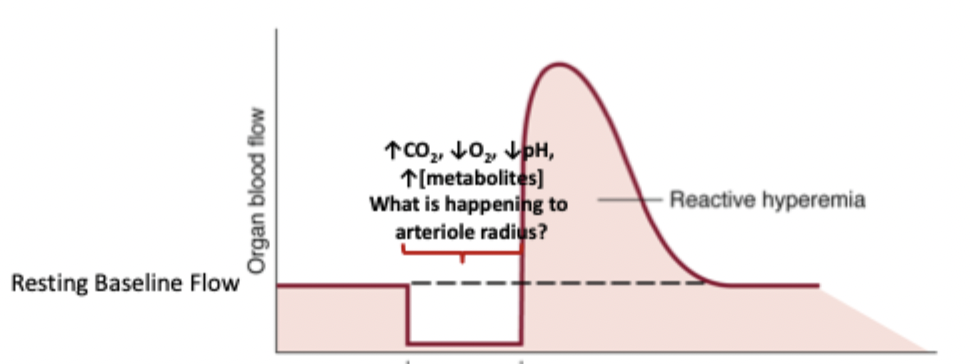
Describe reactive hyperemia
Involves a rebound of high blood flow after a period of deprivation and its metabolic changes
Describe extrinsic controls of arterioles
Purpose is to protect MAP. Involves ONLY the sympathetic
Explain sympathetic controls of arterioles
Sympathetic ganglionic neurons release NE → binds to A1 receptors on smooth muscle → vasoconstriction and decreased blood fow
Adrenal medulla secretes E → binds to B2 (low doses) → vasodilation
With high dose of E → binds to A1 receptors
List neural controls of arterioles
Vasoconstrictors - NE on A1
Vasodilators - nitric oxide
List hormonal controls of arterioles
Vasoconstrictors - E (high), angiotensin II, vasopressin (ADH)
Vasodilators - E (low), atrial natrieuretic peptide (ANP)
Function of capillaries
Exchange of nutrients, oxygen, hormones, signals, removal of metabolic products. Only 5% of total circulating blood is in the capillaries
Describe the structure of capillaries
Thin wall and sizable pores for increased diffusion, no smooth muscle
Single layer of endothelial cells maximizes exchange with RBCs and ISF compartment
Define precapillary sphincters
Bands of smooth muscle where arterioles branch into capillaries, open and close perfusion
Define metartioles
Blood vessels with some smooth muscle that allow blood to bypass capillaries straight form arterioles to venules
What is the continuity of flow principle
Flow rate must remain constant. If cross-sectional area changes, velocity of fluid changes inversely
Capillaries and velocity
Capillaries have the slowest velocity to allow for exchange of substances
Define filtration
Movement of fluid out of the blood
Define absorption
Movement of fluid into the blood
Two ways of moving material in capillaries
Diffusion and bulk flow
Define bulk flow in the capillary
Movement of fluid across the capillary wall due to pressure differences
Explain 4 Starling forces
Hydrostatic pressures - built up pressure that pushes water out
Capillary (Pc) → filtration, interstitial (Pif) → reabsorption
Osmotic force due to protein concentration - proteins draw water to them
Plasma (πP) → reabsorption, interstitial (πif) → filtration
Describe the lymphatic system
The lymphatic system takes up water that comes out of the capillaries and back into CV system
4 L/day of mismatch in lymphatic fluid
Prevents edema/swelling and doesn’t accumulate fluid (no Pif)
4 mechanisms that enhance lymph flow
Increased filtration at capillaries (more filtration → more pressure → more flow)
Smooth muscle contraction
Sympathetic stimulation via NE binding to A1 receptors
Skeletal muscle pump and respiratory pump
Disease states and lymph
Lymph nodes enlarge when fighting infection
Cancer cells can spread through lymph
Blockage of lymph occurs when filaria worms invade body, causes lymphedema
Net filtration pressure formula
Pc + πif - Pif - πC
Function of veins
Return blood to heart by being a big radius, low resistance blood vessel
Act as storage vessels
List the factors that assist in venous return
Sympathetic innervation, skeletal muscle pump, inhalation movements, blood volume
Explain sympathetic innervation in promoting venous return
Releases NE on A1 receptors → contracts veins → increases venous return
Doesn’t change resistance because the veins are so floppy
Explain skeletal muscle pump in promoting venous return
Contracting muscles squeeze large veins, which increases venous return
One-way valves prevents flow from flowing backward, reduces blood pooling due to gravity
Explain inhalation movements in promoting venous return
Inhaling creates lower pressures in thoracic cavity. Blood moves from veins outside thorax w high pressure to veins in thorax with lower pressure
Explain blood volume in promoting venous return
Volume equates with pressure. More volume → more pressure
Explain baroreceptors
Receptors that are sensitive to stretch and monitors MAP
Stretch → sends afferent signals through afferent axons of 9th and 10th cranial nerves → send APs to brainstem nuclei —> change in pressure
Always active, only inactive when dead
Pressure goes up when there’s lots of stretching
Short-term regulation of BP
Describe medullary cardiovascular center
Info is carried to cardiovascular control center, contains these nuclei
APs to parasympathetic are always exitatory, APs to sympathetic are always inhibitory
List the 3 neuronal centers in the medullary cardiovascular center
The cardioinhibitory center (CI), the cardioacceleratory center (CA), and the vasomotor center (VM)
Explain the cardioinhibitory center (CI)
Parasympathetic
Releases ACh onto M-AChR at SA node → lowers HR
Explain the cardioacceleratory center (CA)
Sympathetic
Releases NE + E onto B1 receptors on SA node → increases HR
Releases NE + E onto B1 receptors on contractile cells in ventricles → increases SV
Explain the vasomotor center (VM)
Sympathetic
Releases NE onto A1 receptors on arterioles → decreases radius and increases TPR
Releases NE onto A1 receptors on veins → decreases radius and increases VR and SV
MAP and medullary cardiovascular center response
If MAP ↑, then want ↓ symp and ↑ parasymp
If MAP ↓, then want ↑ symp and ↓ parasymp
What does long term regulation of arterial pressure depend on
Blood volume
Examples of long term regulation of arterial pressure
Regulating kidney function - ↑ arterial pressure → ↓ hormone secretion → ↑ urinary output and filtration → ↑ water, ↓ plasma and blood volume
Peripheral chemoreceptors - near aortic and carotid bodies and detect O2, CO2, and pH
Low O2, high CO2 and lots of acid → vasoconstriction
Explain Cushing’s phenomenon
Elevated intracranial pressure resulting in large increases in systemic MAP.
Head trauma → intracranial bleeding and swelling → pressure and metabolite build up → stimulates central chemoreceptors → constricts arterioles and increases TPR → temporarily fixes it but makes swelling worse by raising MAP