math 22
 Call Kai
 Learn
Learn Practice Test
 Spaced Repetition
 Match
Match Flashcards
 Knowt Play
1/89

There's no tags or description
Looks like no tags are added yet.
Name | Mastery | Learn | Test | Matching | Spaced | Call with Kai | Chat |
|---|
No analytics yet
Send a link to your students to track their progress
90 Terms
Theorum 1 (1.5) Ax = 0 has a non trivial solution if and only if…
the corresponding system has at least 1 free variable
Theorum 4 (1.5)
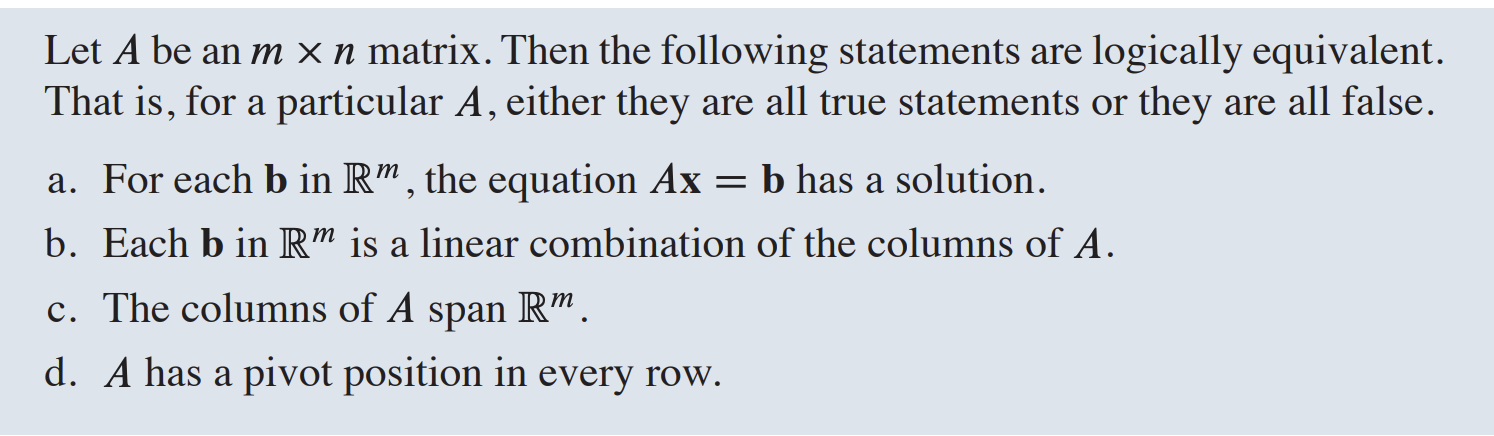
Let A be an m * n matrix.
The following statements are true
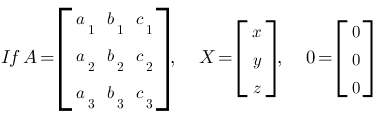
a. Ax = b has a solution for each b∈Rm
b. each b∈Rm is a linear combo of the columns
c. Span {cols of A} = Rm
d. A has a pivot in each row (justifies the rest of these)
homogenous system
the solution for each row is 0
A set S = {v1, v2 … vp} for p >= 2 is linearly dependent if and only if…
at least one of the vectors in S is a linear combination of the others
Theorem 7 (1.7): Any set {v1, v2 … vp} in Rn is linearly dependent if
p > n
there are more vectors than length of the vector
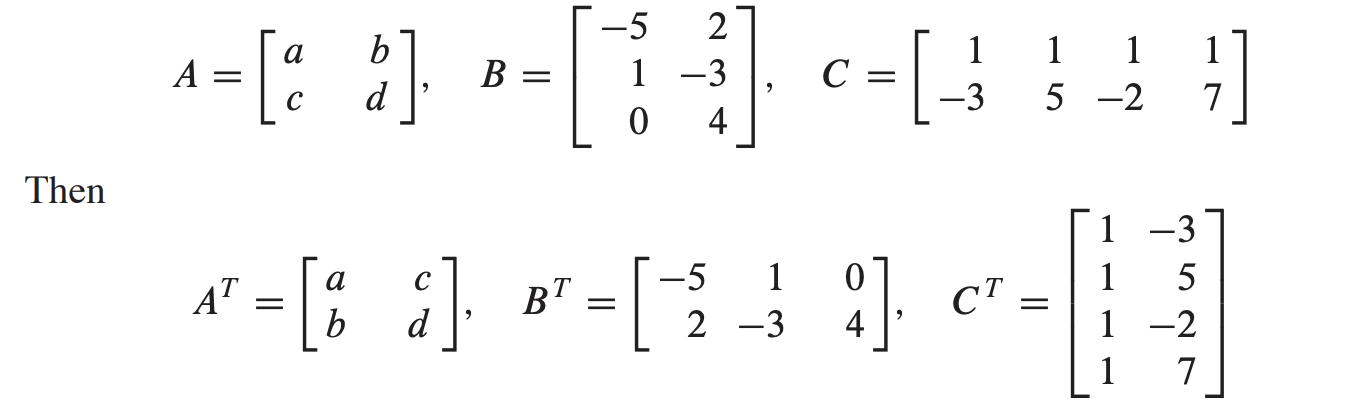
transpose of a matrix
taking the original matrix and flipping it across its main diagonal (the line running from the top-left to the bottom-right)
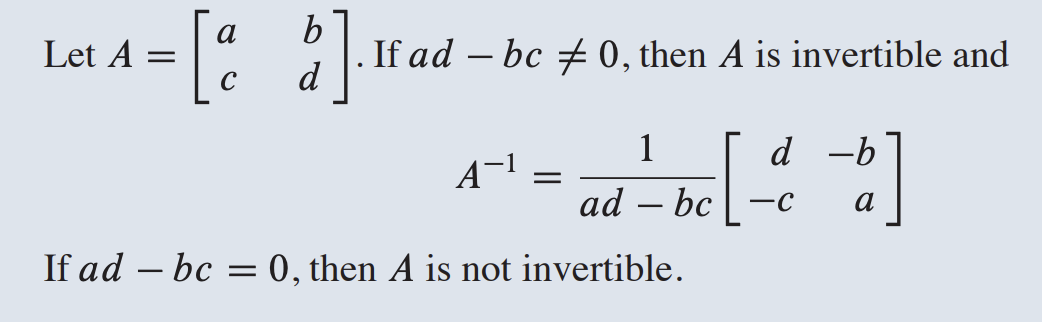
2.2 th 4: how to find inverse of 2 × 2 matrix
2.2 th. 5: If A is an invertible n x n matrix, then ______
for each b in Rn , the equation Ax = b has the unique solution x = A^-1 * b.
2.2 Th 6 a: If A is an invertible matrix, _____
A^-1 is invertible and (A^-1)^-1 = A
2.2 Th 6 b: If A is an invertible matrix, then ____
1) so is AB, and
2) the inverse of AB is the product of the inverses of A and B in the reverse order.
That is, (AB)^-1 = B^-1*A^-1
2.2 Th 6 c: If A is an invertible matrix, then so is A^T, and _____
the inverse of A ^T is the transpose of A ^-1 .
That is, (A^T)^-1 = (A^1)^ T
2.2 Th 7: An n x n matrix A is invertible if and only if ….
A is row equivalent to In, and in this case, any sequence of elementary row operations that reduces A to In also transforms In into A^-1 .

pivot in every row means…
onto/spans
at least one solution/output of system (no 0 0 … 0 | b)
pivot in every column means….
linearly independent (no free vars)
2.1 Th 1: obvious operations about matrices

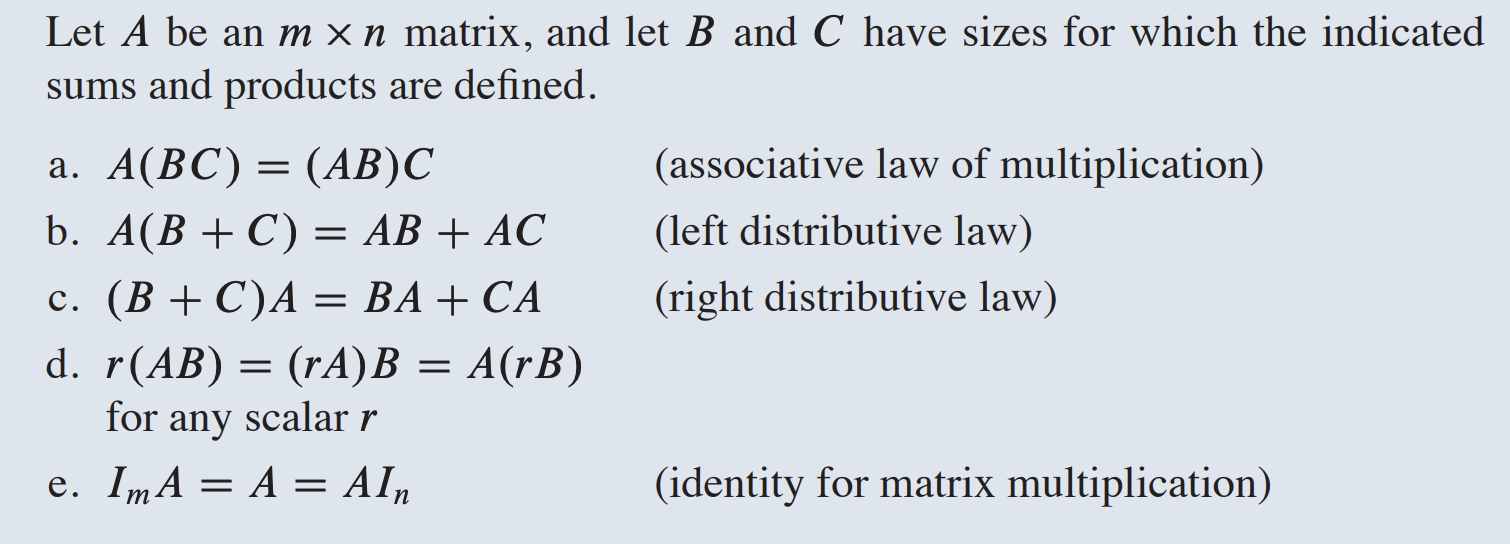
2.1 Th 2: Properties of matrix multiplication
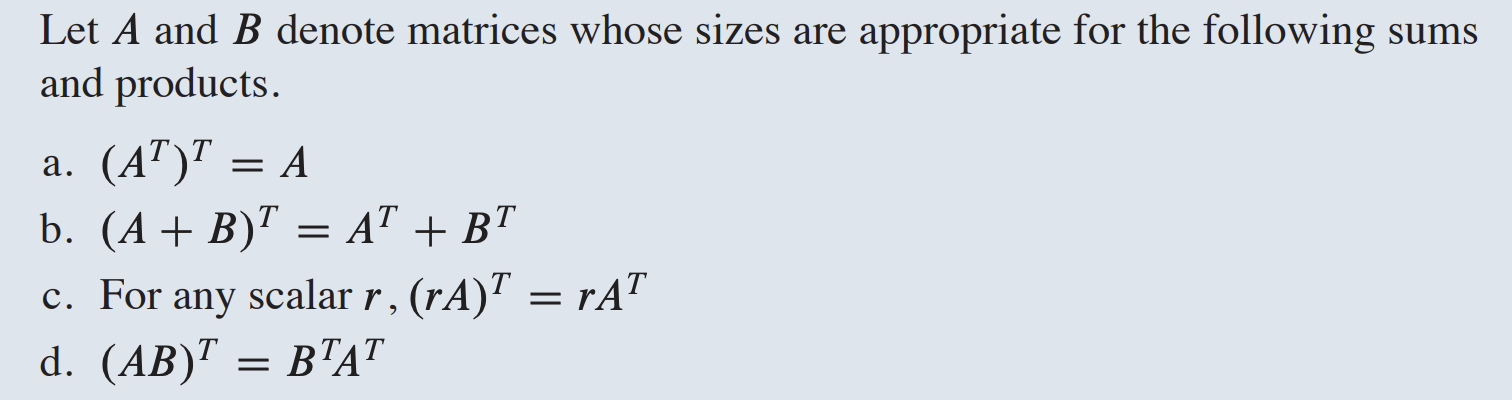
2.1 Th 3: properties of transposition
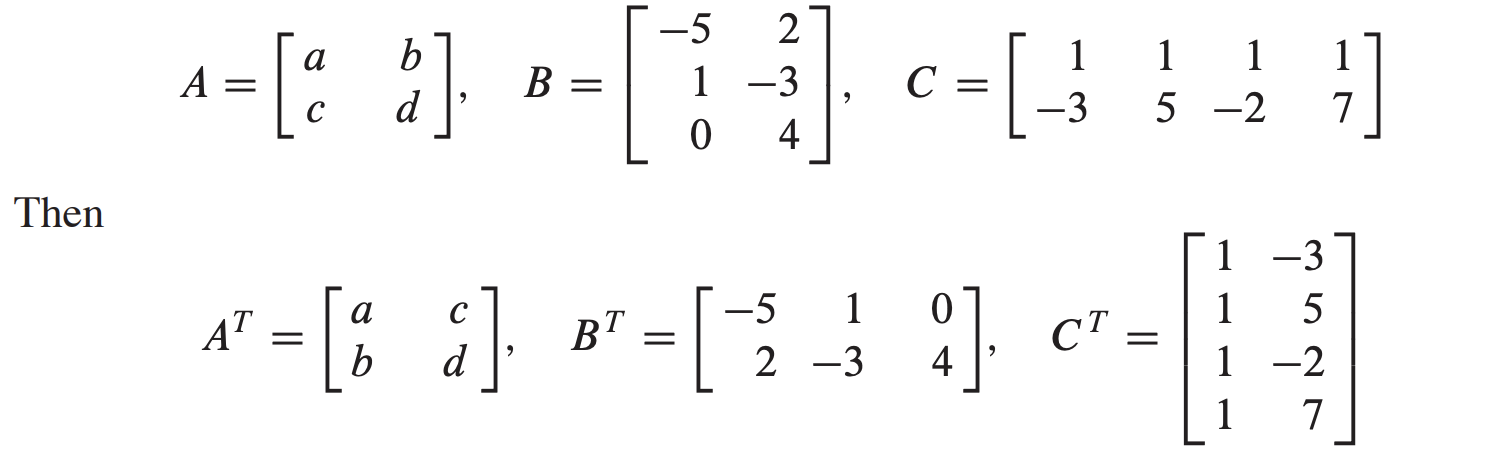
how does transposition work?
r1 becomes c1, r2 becomes c2, r2 becomes c3 etc
4.1 Th 1: A span of any 2 vectors in Rn….
is a subspace of Rn

What are elementary row operations?
1. (Replacement) Replace one row by the sum of itself and a multiple of another row
2. (Interchange) Interchange two rows.
3. (Scaling) Multiply all entries in a row by a nonzero constant.
Checking for uniqueness
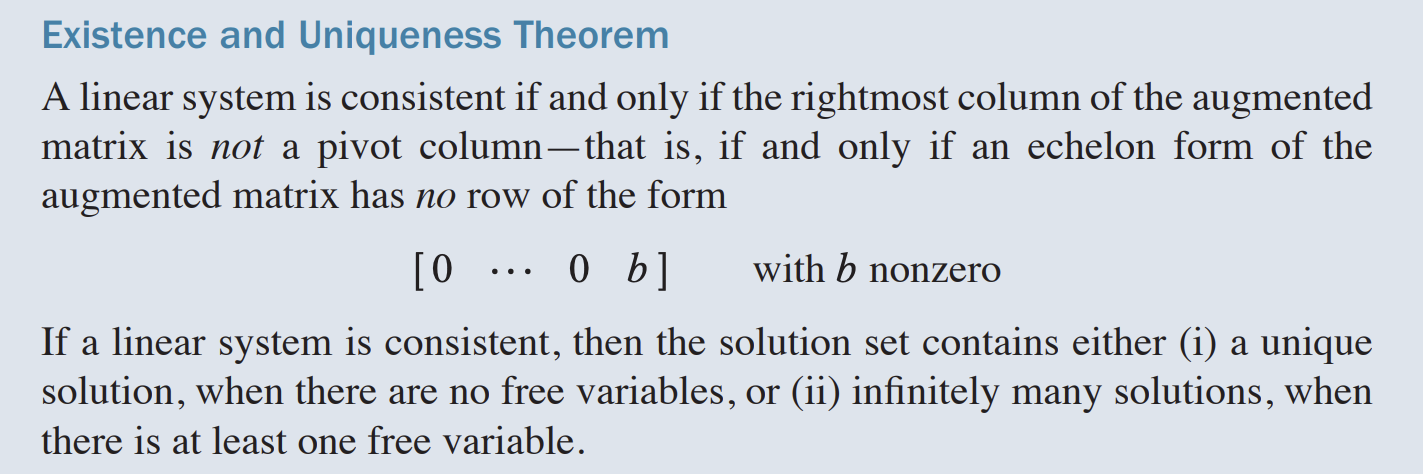
1. Is the system consistent; that is, does at least one solution exist?
2. If a solution exists, is it the only one; that is, is the solution unique?
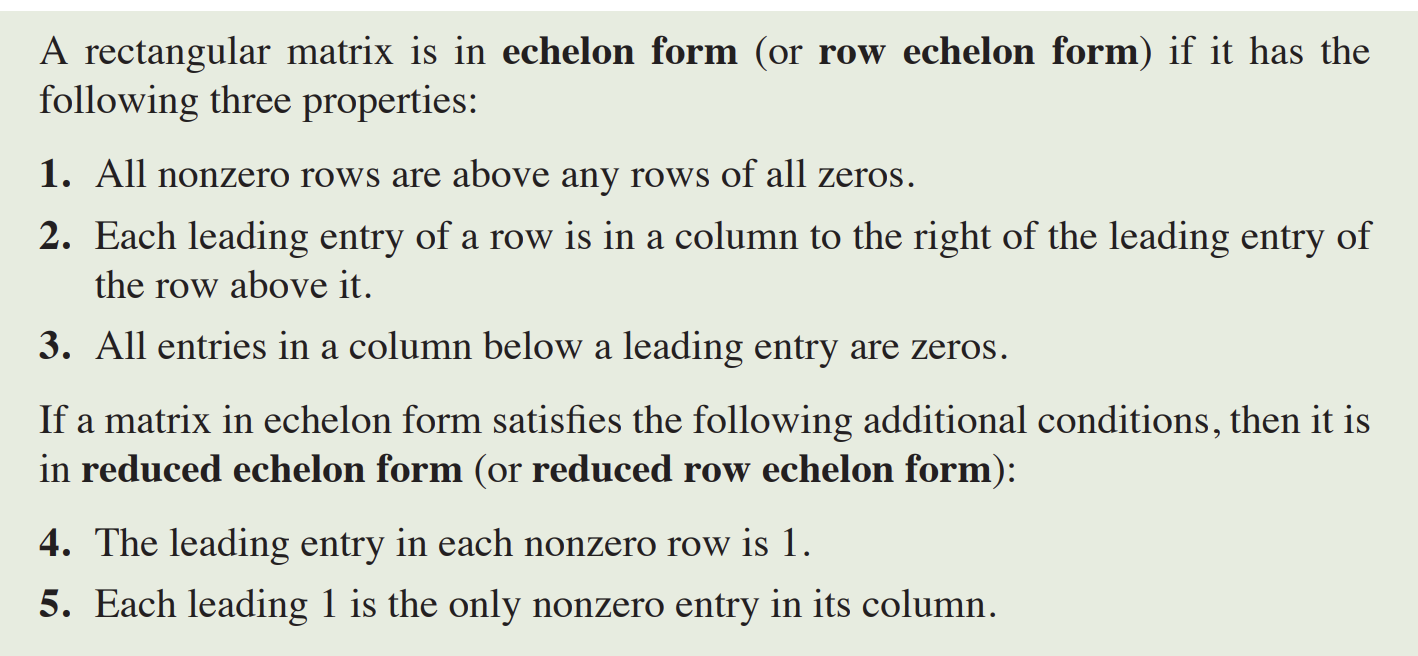
Echelon Form Definition & REF
Chapter 1.2, Theorem 1: Uniqueness of the Reduced Echelon Form
Each matrix is row equivalent to one and only one reduced echelon matrix.
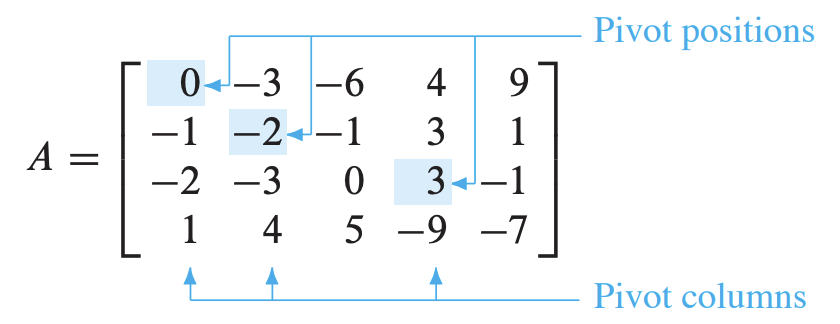
Pivot Position Definition
A pivot position in a matrix A is a location in A that corresponds to a leading 1 in the reduced echelon form of A. A pivot column is a column of A that contains a pivot position.
Chapter 1.2, Theorem 2: Existence and Uniqueness Theorem
Parallelogram Rule for Addition

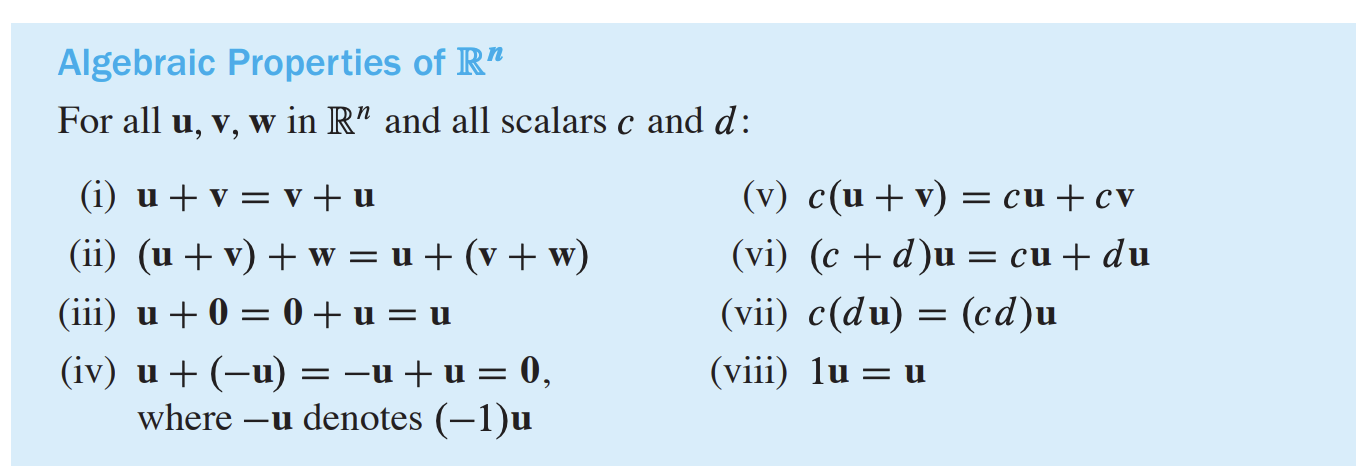
Algebraic Properties of Rn (of real numbers)
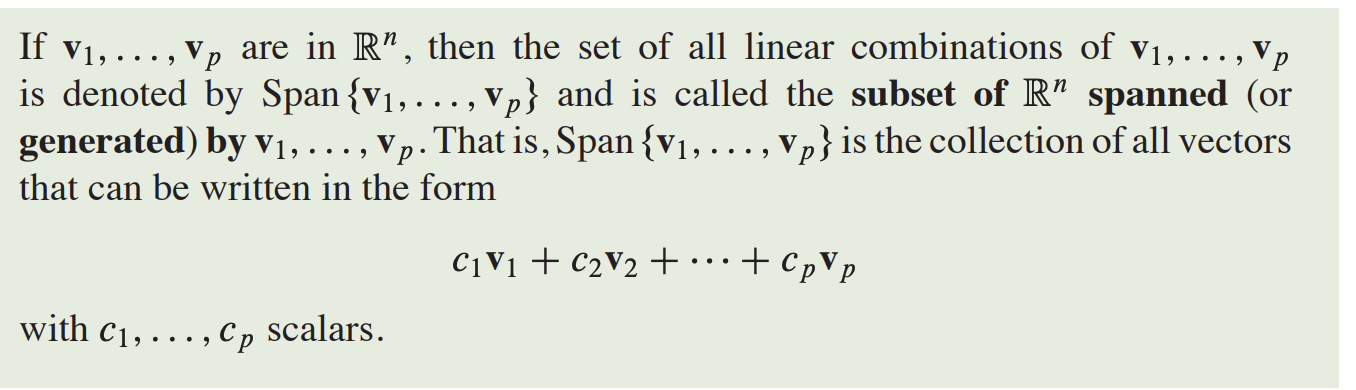
Definition of a Linear Combination
the span of V is all of the vectors that can be made out of linear combinations from a matrix
The matrix equation: product of A and x
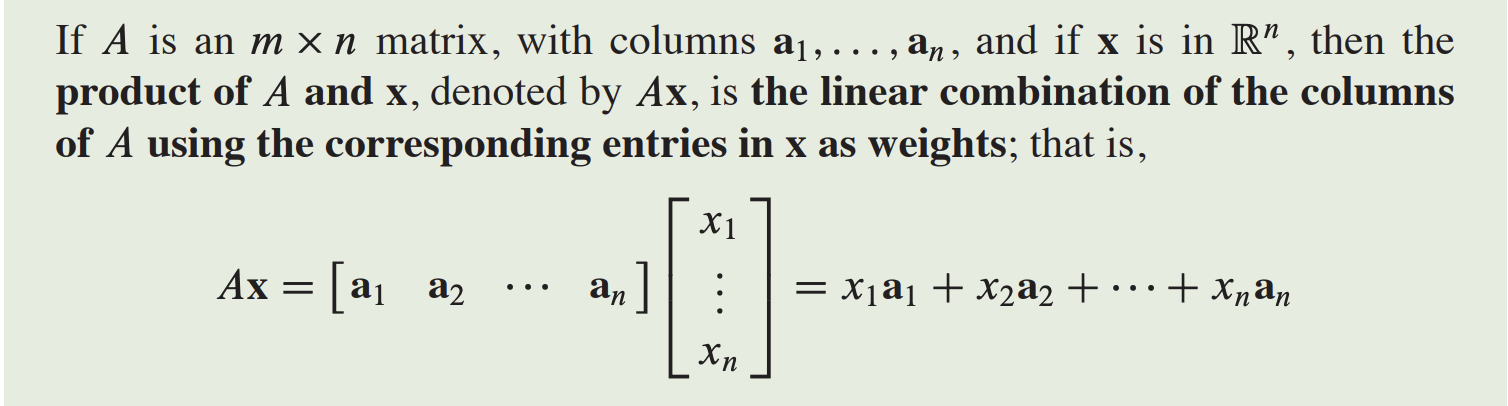
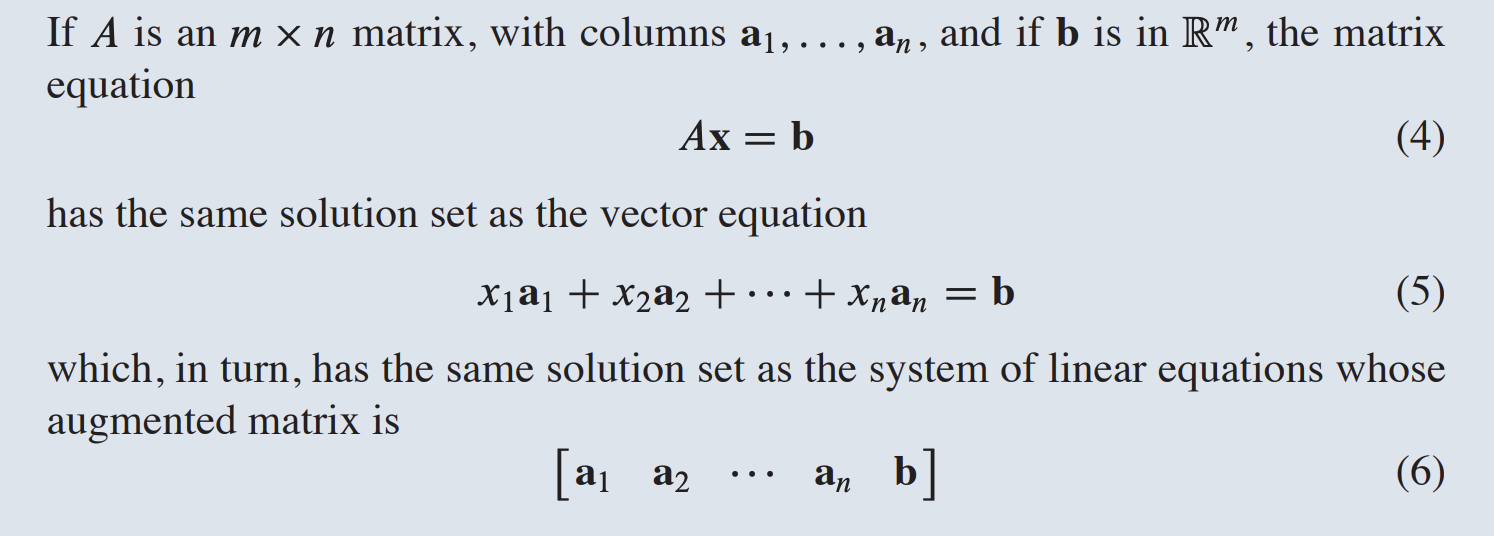
Chapter 1.3 Theorem 3: how to represent system different ways
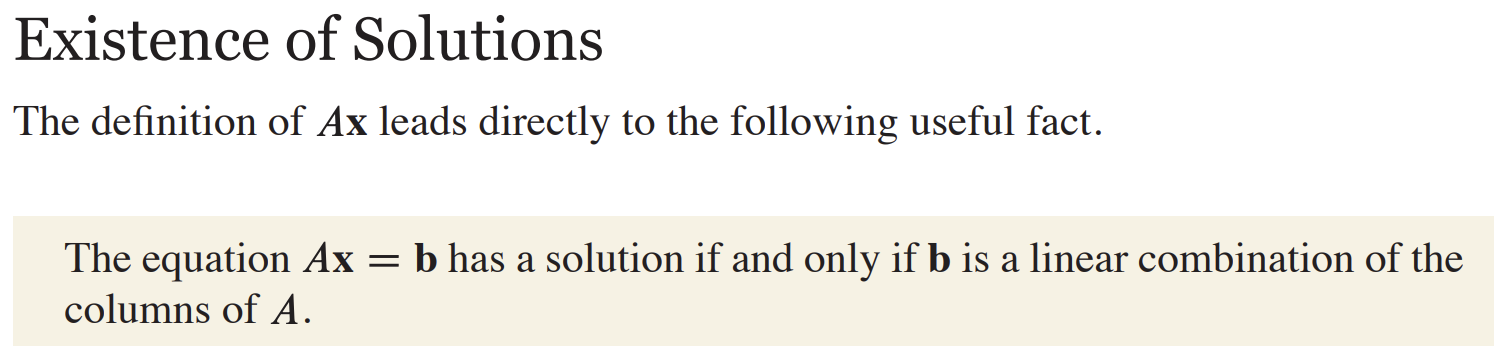
Existence of Solutions as Derived from definition of Ax
aka: matrix is consistent, aka row reducting leads to no 0 0 0 | b row
Chapter 1.4 Theorem 4: m x n matrix statements (what if there’s a pivot in every row)
pivot in every row also implies being onto
Chapter 1.4 Theorem 5: Properties of the Matrix–Vector Product Ax
Distributive and associative properties

Chapter 1.5 Theorem 6: Ax = 0 translated
if Ax = b has a solution, then it’s translated from Ax = 0

Definition of Linear Dependence/Independence
columns of a matrix A are independent if the equation Ax = 0 has ONLY the trivial solution (aka x = (x1 ×2 … xn), the xs are all 0, the scalars are all 0)
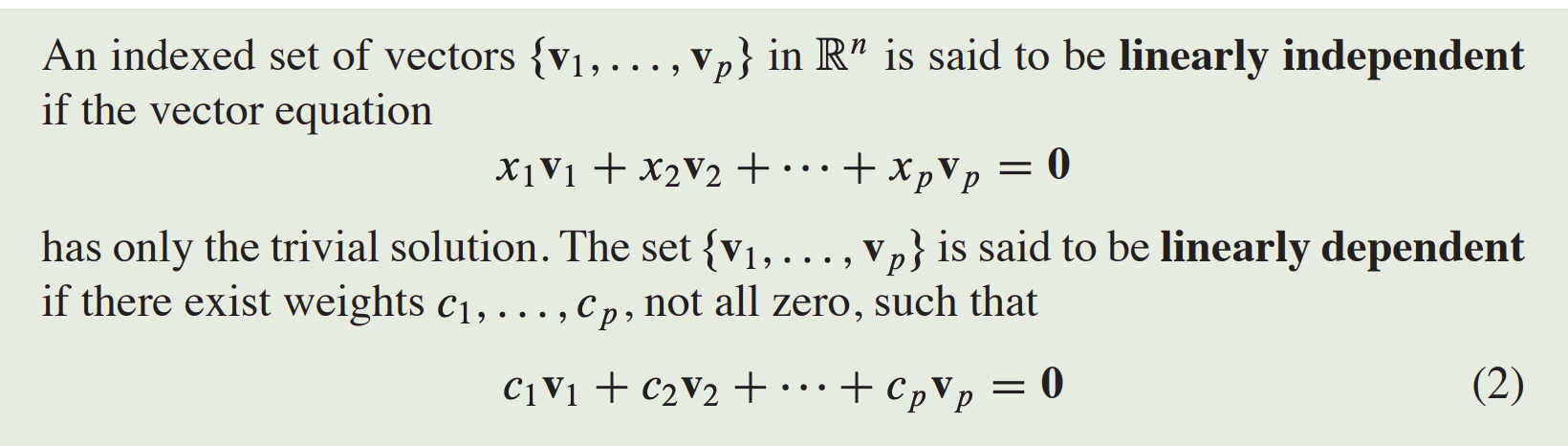
Chapter 1.7 Theorem 7: Characterization of Linearly Dependent Sets
set of vectors is linearly dependent if a vector in the set is a linear combo of the other ones
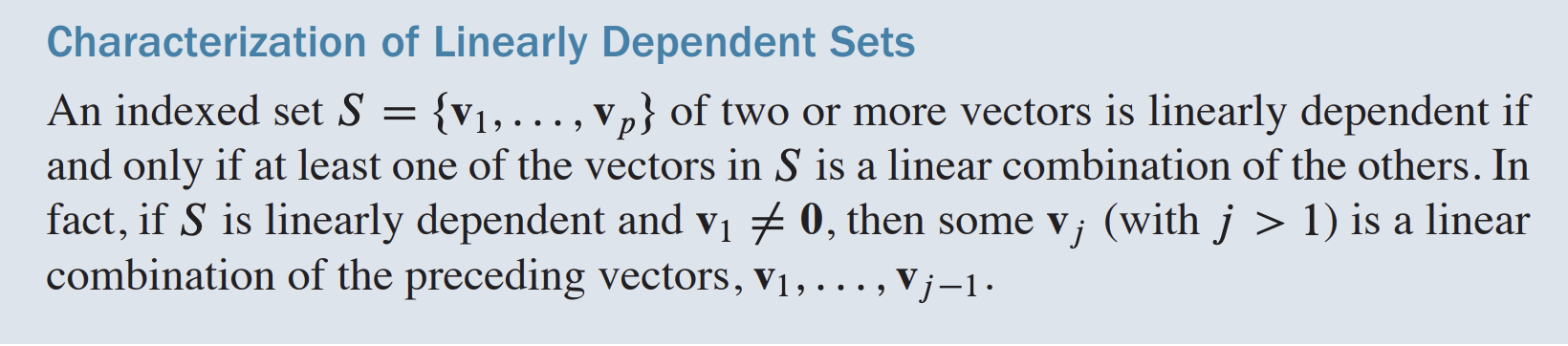
Chapter 1.7 Theorem 8: Characterization of Linearly Dependent Sets p. 2
more wide than tall = dependent

Chapter 1.7 Theorem 9: Characterization of Linearly Dependent Sets p. 3
also is a linear combo of others (scaled by 0)

Definition of Linear Transformation
T(0) = 0
and
T(cu = dv) = cT(u) = cT(v)

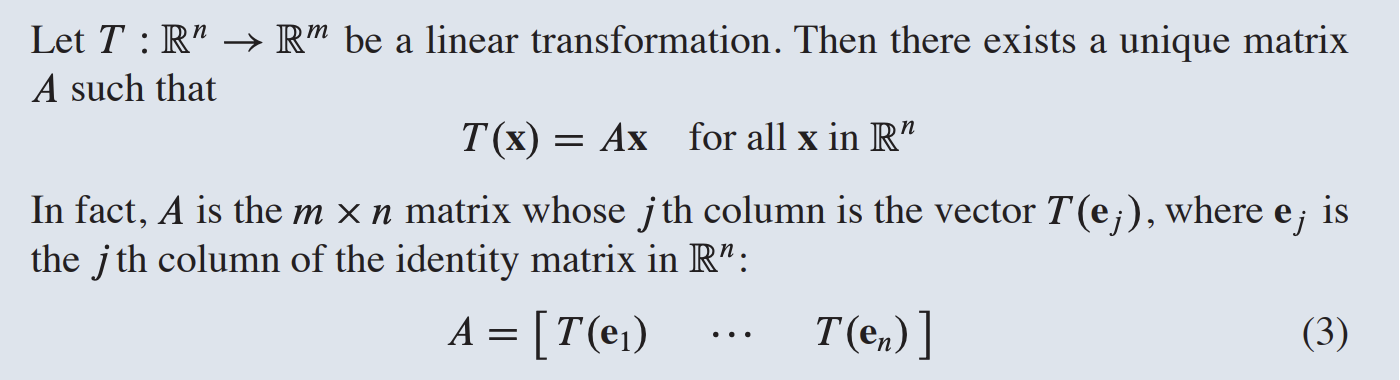
Chapter 1.9 Theorem 10: standard matrix for the linear transformation T
to find the matrix for ANY linear transformation, just see what it does to those two building blocks (represented as I), and stack the results as columns
Definition of onto
means that it is consistent AND each row has a pivot

Chapter 1.9 Theorem 11: one-to-one
T(0) = 0 ; independent
T(u - v) = T(u) - T(v) = b - b = 0
this is impossible as they must map onto different outputs

Chapter 1.9 Theorem 12: one-to-one and span
a. Ax = b must be consistent
b. columns are linearly independent

Definition of matrix multiplication
this is split into columns; basically, multiply the rows of matrix 1 by columns of matrix 2 (corresponding)

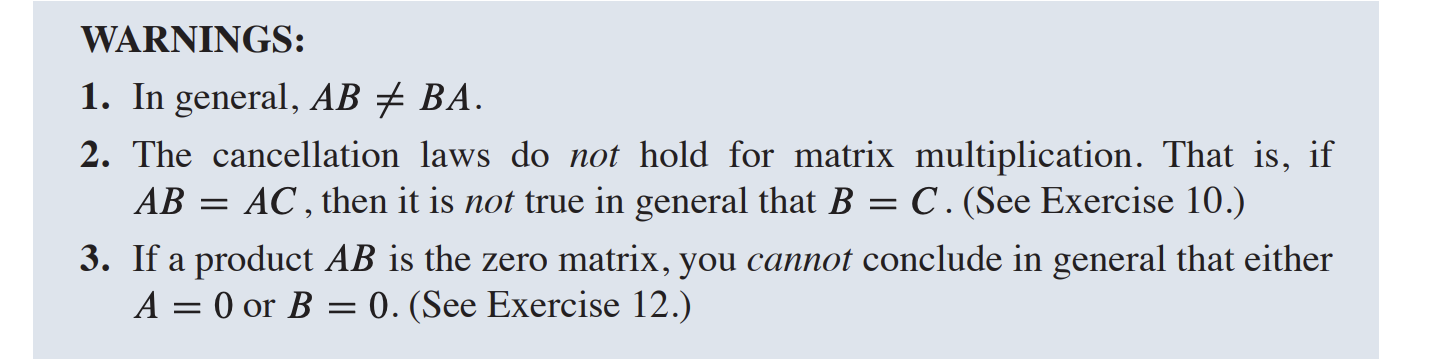
Warnings of matrix multiplication
note: 2 is true if A is invertible
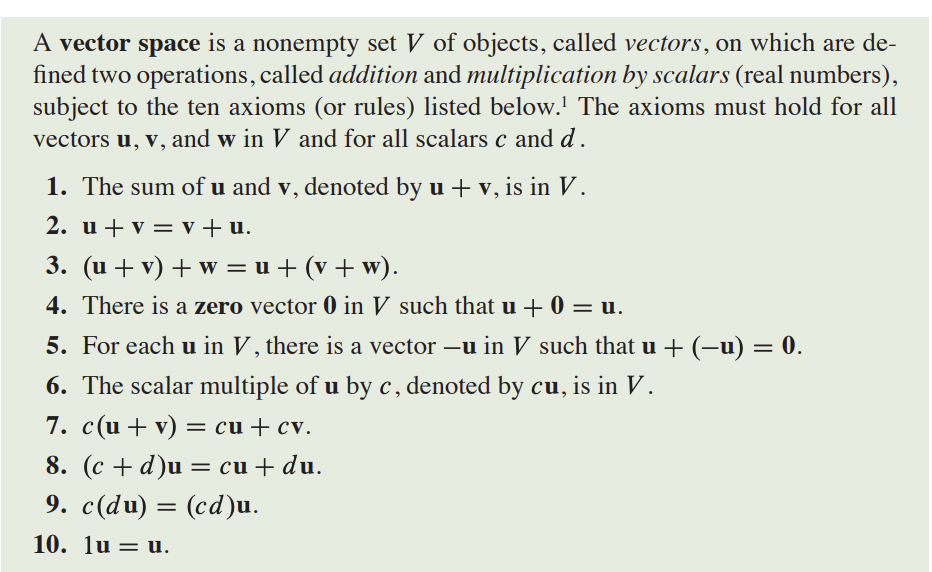
Definition of a vector space
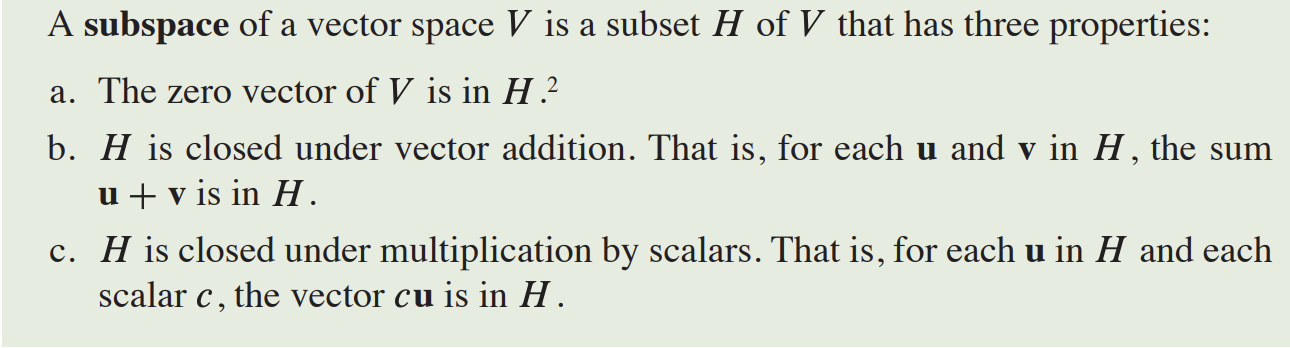
Definition of a subspace
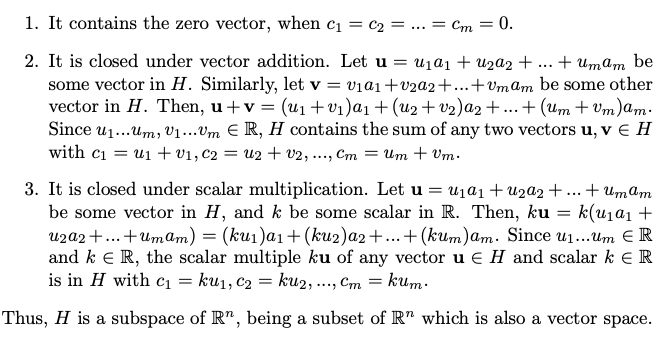
Proof of being a subspace
Null Space Definition

4.2 Theorem 2: null space

Column Space definition

4.2 Theorem 3:

Definition of linear transformation
associative and scalar properties

2.3 Th 8: Invertible Matrix Theorem
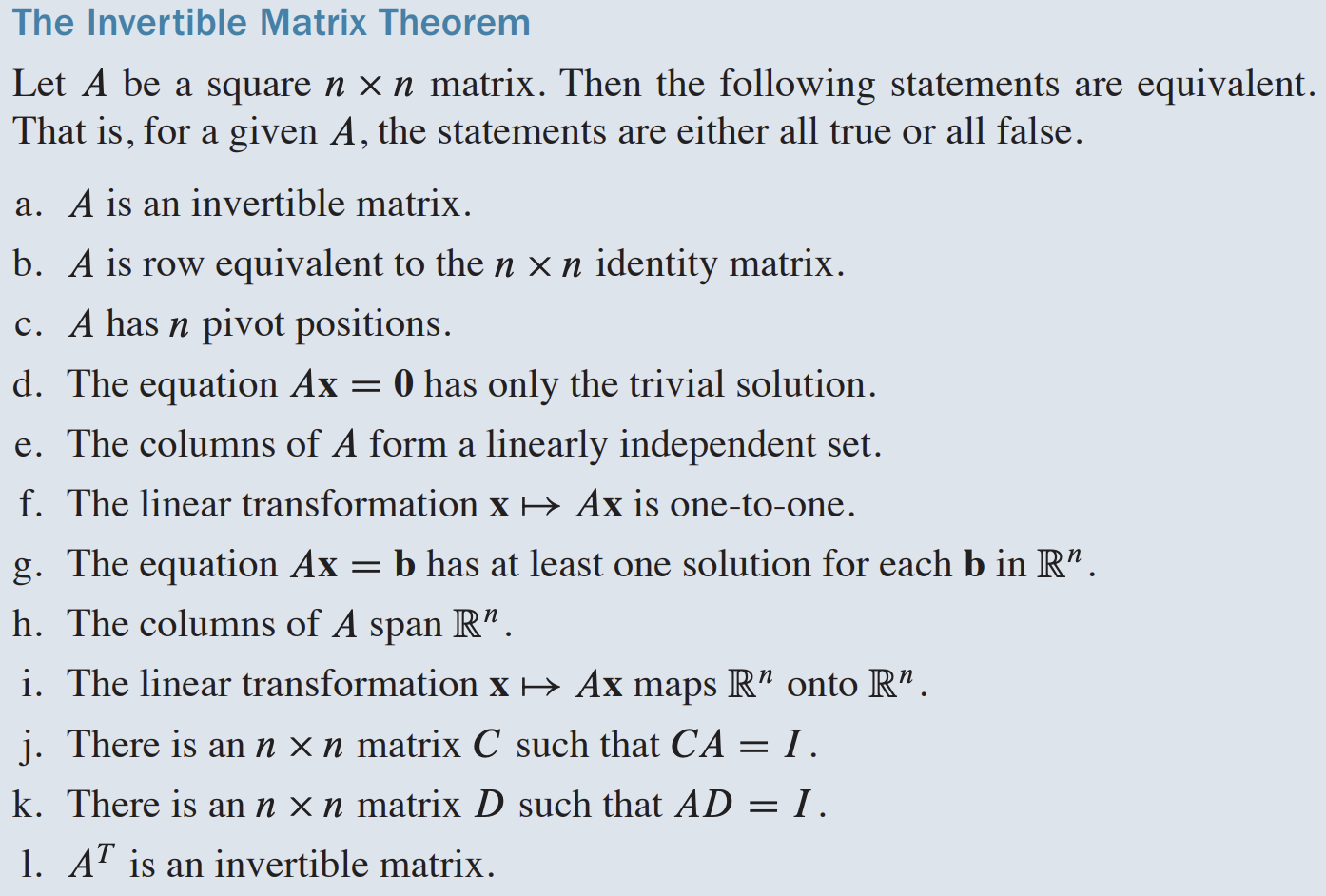
2.3 Th 9: Invertible functions

2.9: Basis Definition
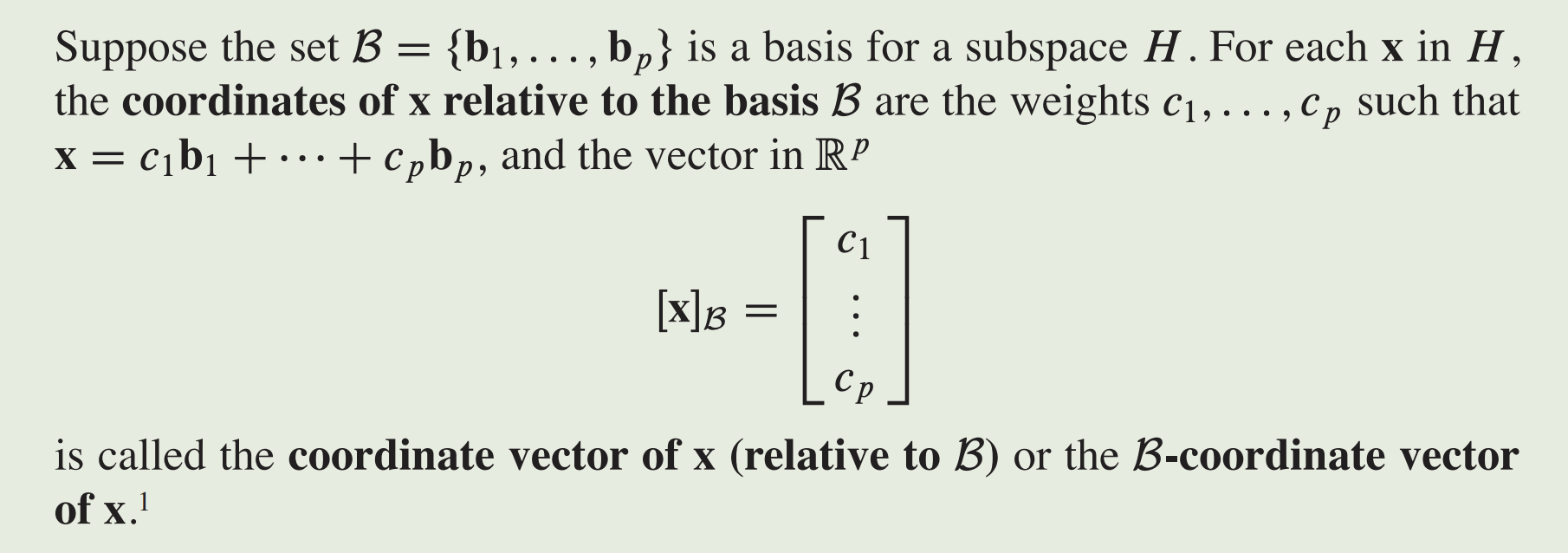
Dimension of a Subspace
to find dimension of Nul A, simply identify and count the number of free variables in Ax = 0.

2.9: Rank definition
number of pivot columns

2.9 Th 14: Rank Theorem
If a matrix A has n columns, then rank A + dim Nul A = n

2.9 Th 15: The Basis Theorem

2.9 Invertible Matrix Theorem Continutes
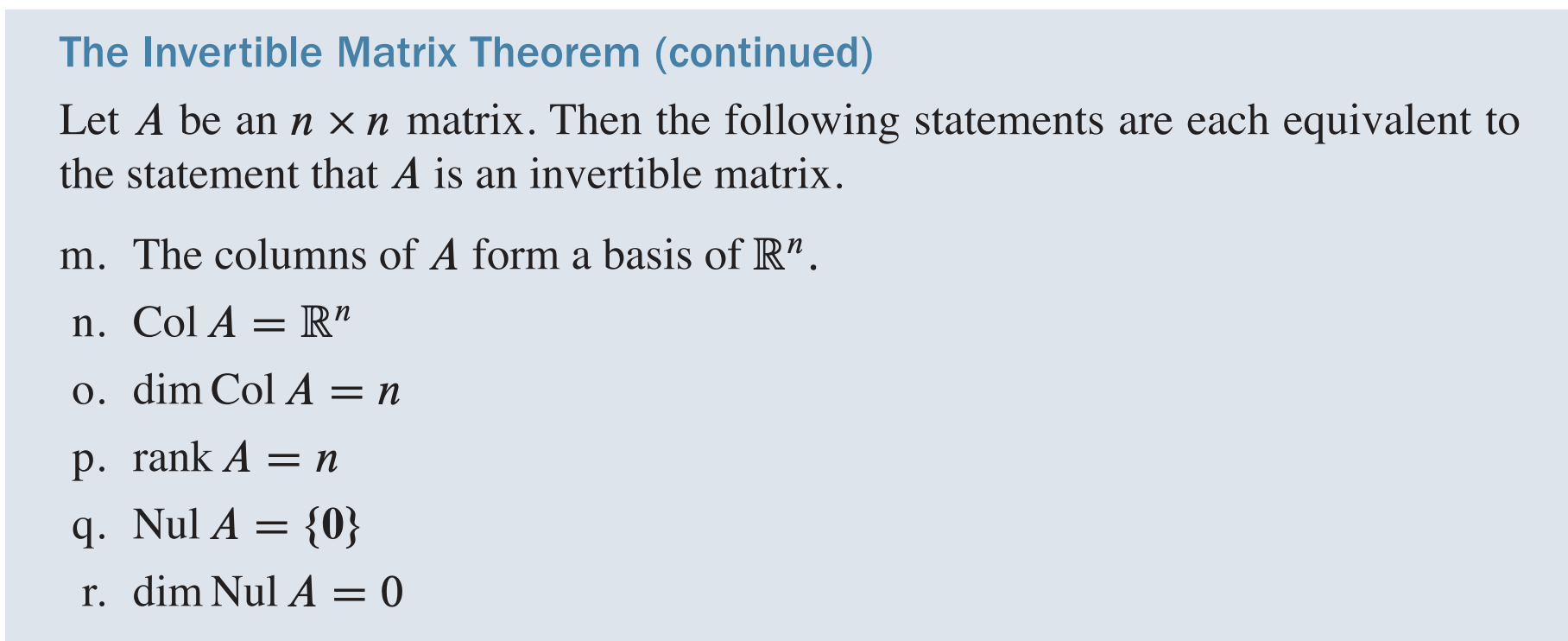
rank A
= number of pivot columns (this IS dim Col A)
dim Nul A
= number of free columns = (total columns) − (pivot columns)
4.3 Theorem 4: dependence of indexed set

4.3: definition of requirements of a basis
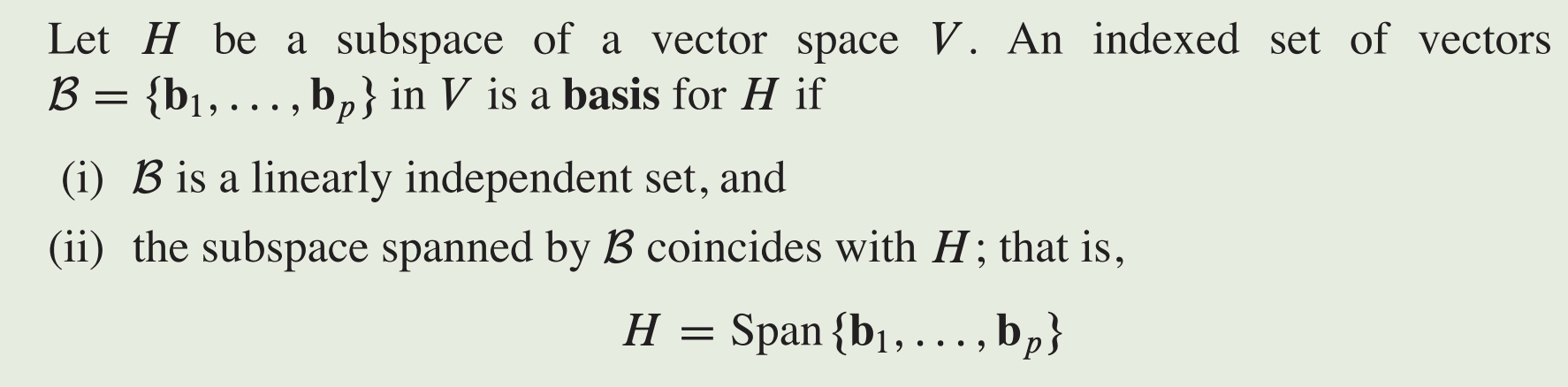
4.3 Theorem 5: Spanning Set Theorem
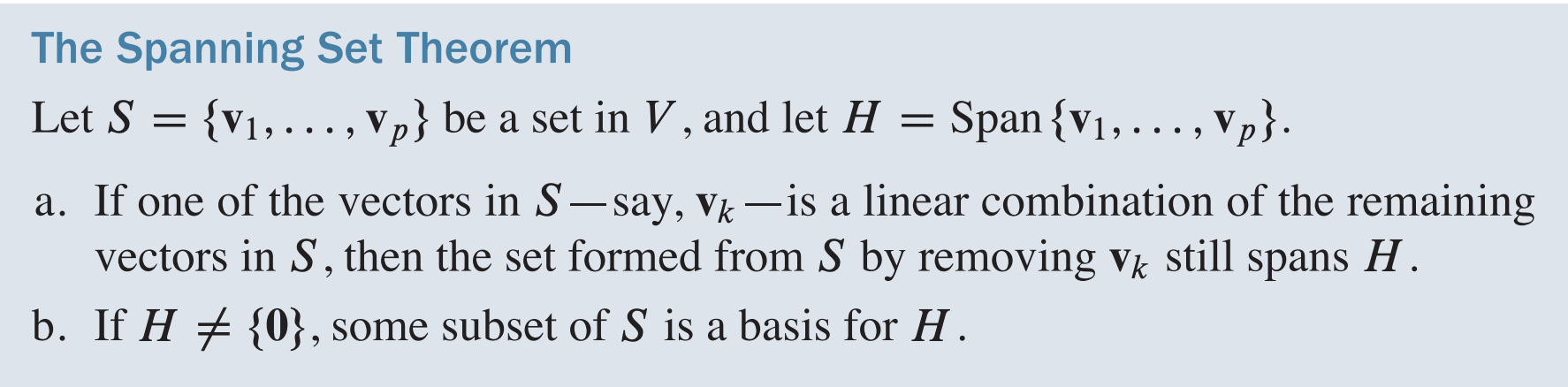
4.3 Theorem 6
The pivot columns of a matrix A form a basis for Col A.
4.3 Theorem 7: The Unique Representation Theorem
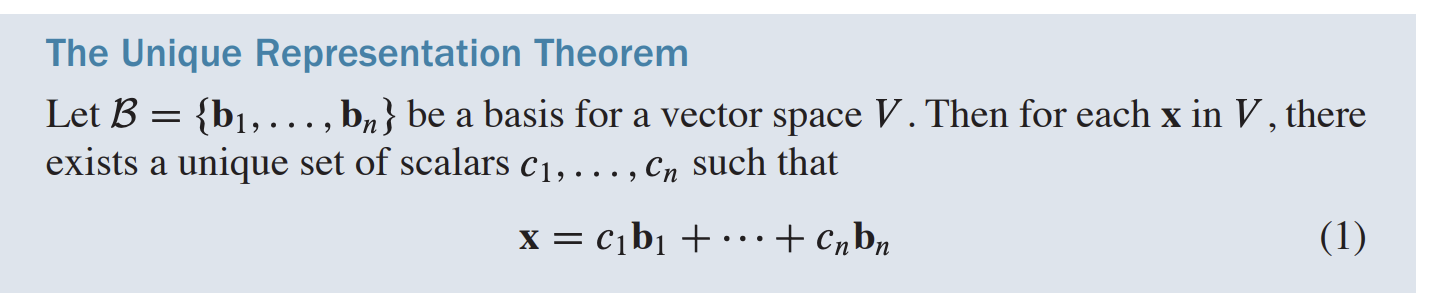
4.4 Definition

4.4 Theorem 8: coordinate mapping

4.7 Theorem 13

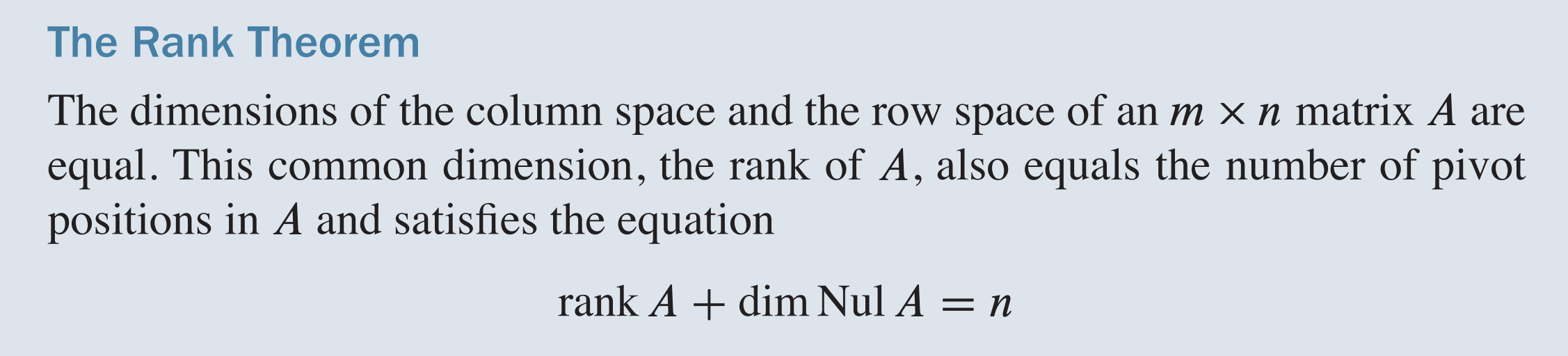
Rank definition
The rank of A is the dimension of the column space of A.
4.6 Theorem 14: The Rank Theorem
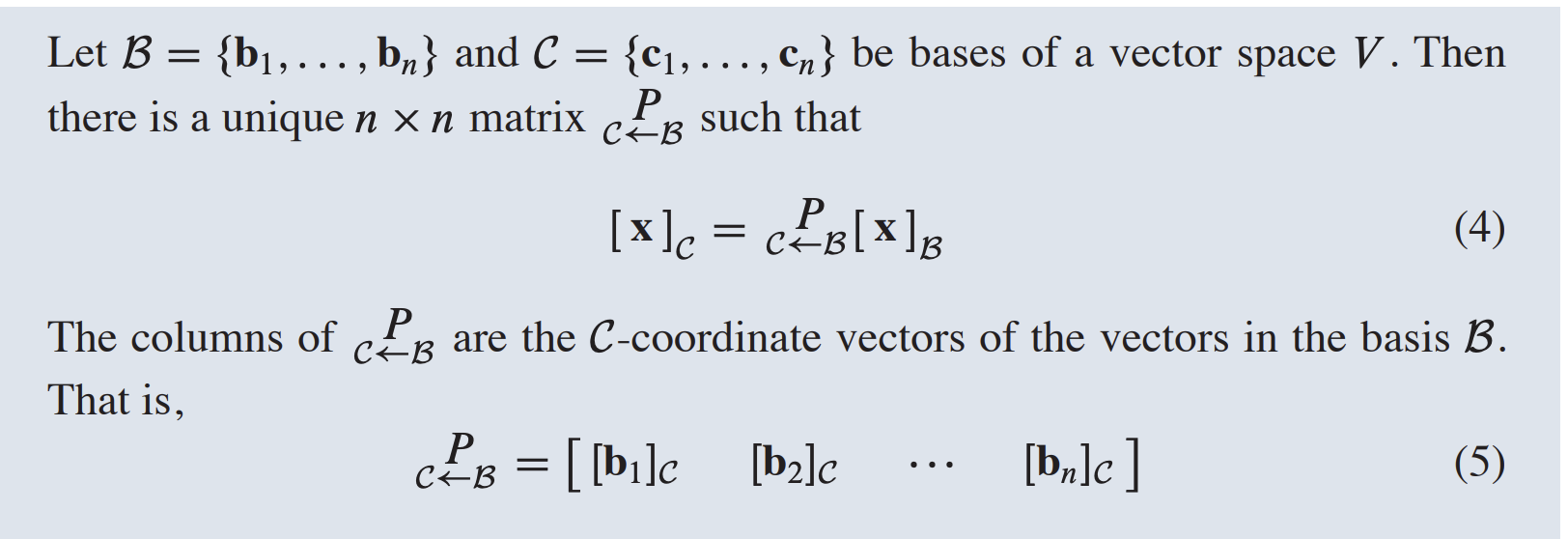
4.7 Theorem 15
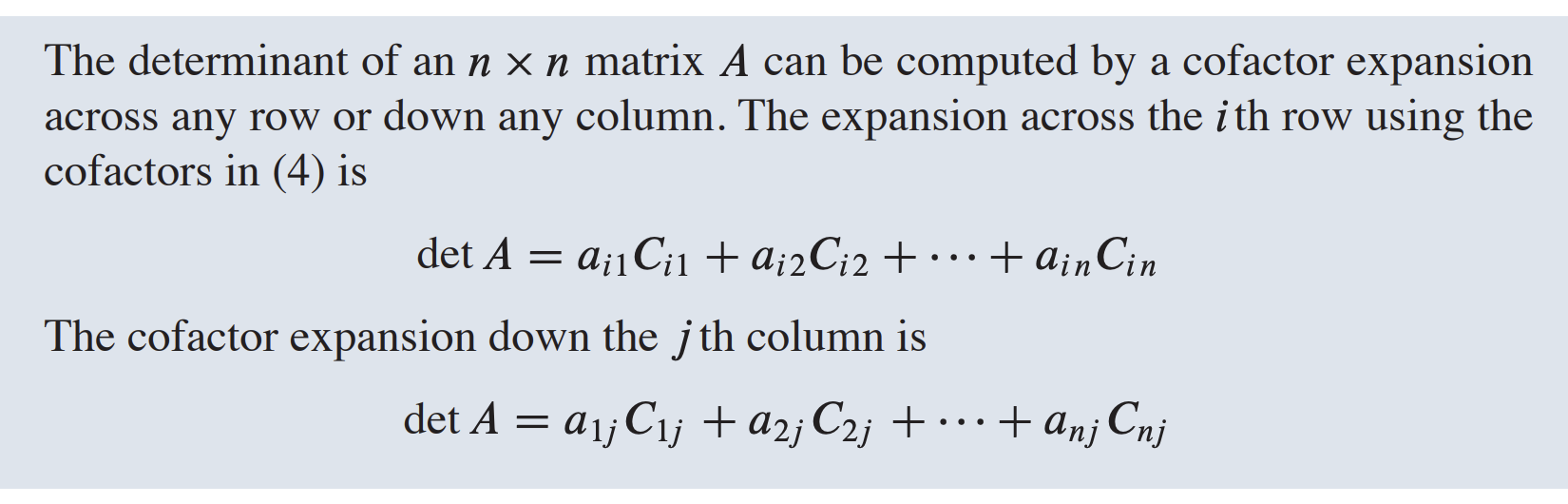
3.1 Definition of determinant
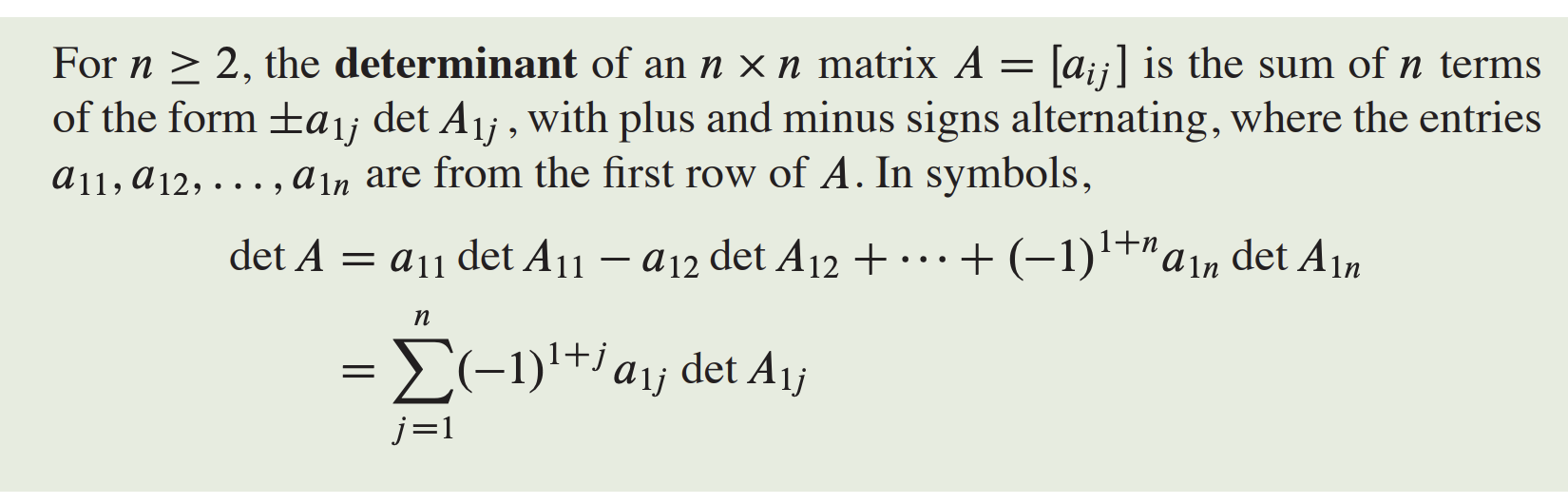
3.1 Theorem 1: how to find n determinant
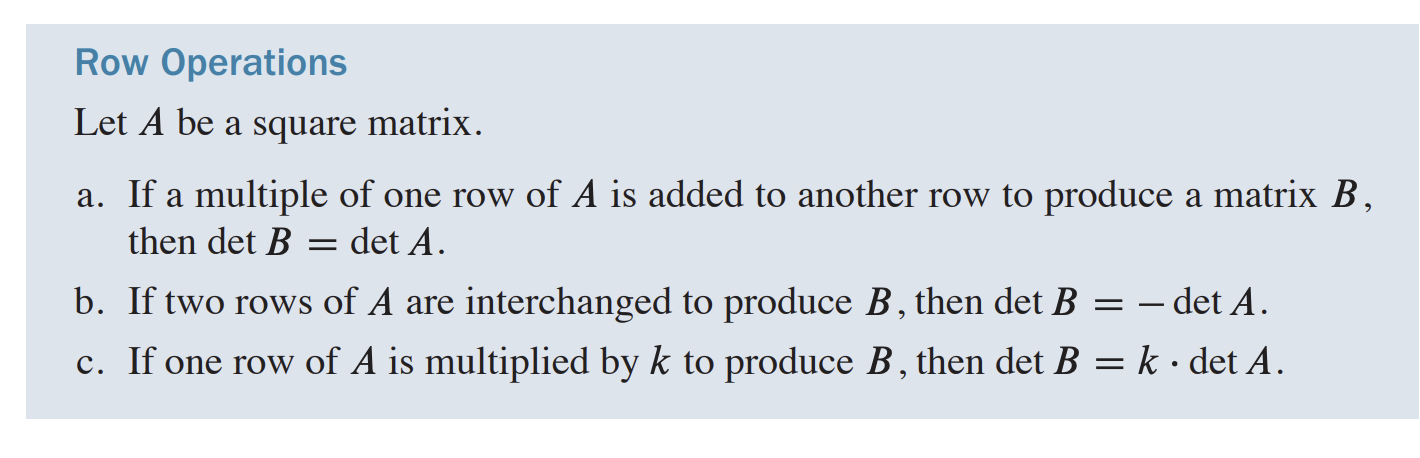
3.2 Theorem 3: Row Operations and determinants
3.2 Theorem 4

3.2 Theorem 5

3.2 Theorem 6

5.1 - Definition of Eigenvector and eigenvalue

5.1 theorem 1
The eigenvalues of a triangular matrix are the entries on its main diagonal.
5.2 Theorem 2

5.2 Theorem 3: Properties of determinants
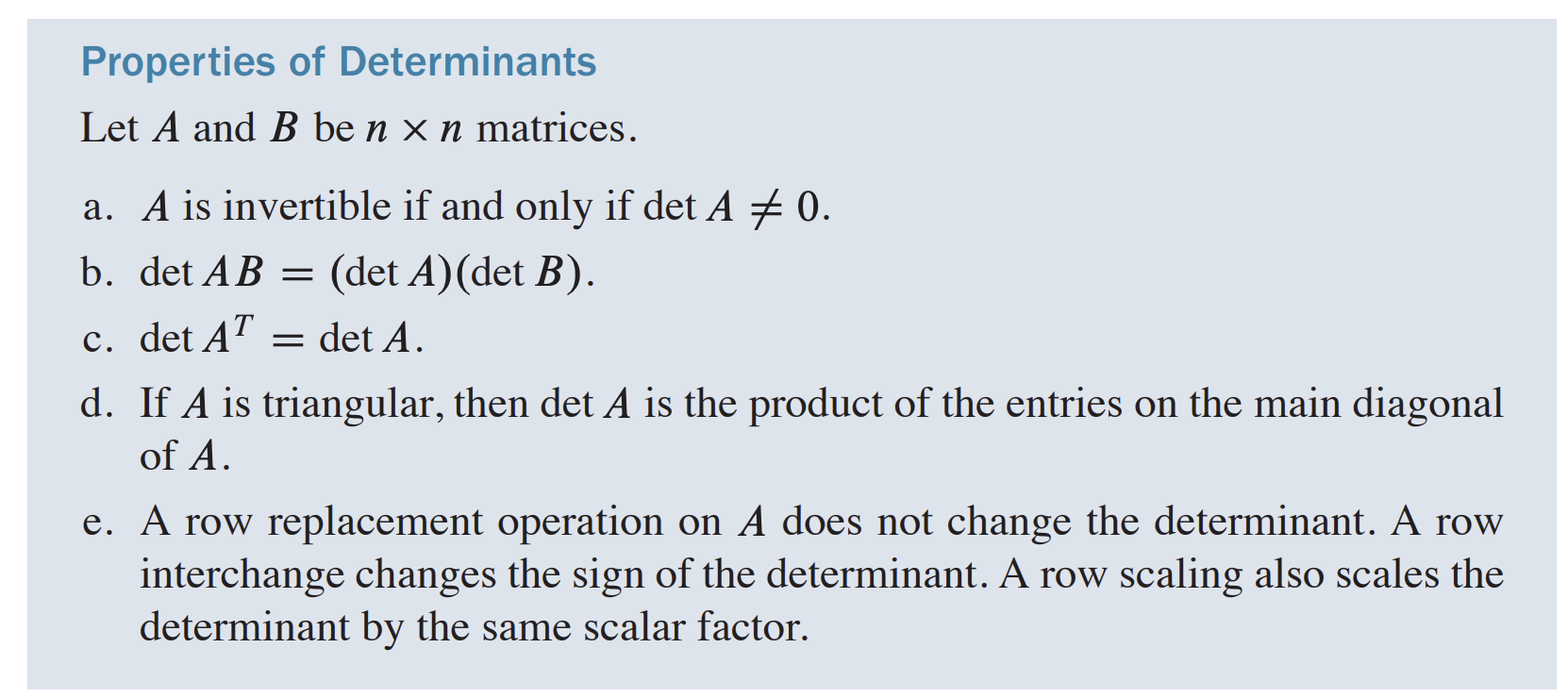
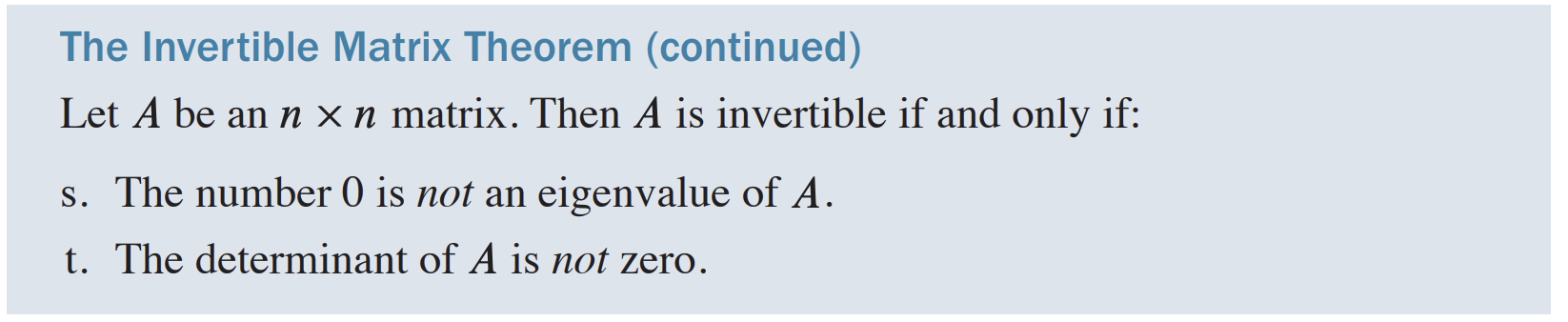
5.2 theorem 2 (?): The Invertible Matrix Theorem (cont)