Week 4: Microbial and Human Microbiome
 Call Kai
 Learn
Learn Practice Test
 Spaced Repetition
 Match
Match Flashcards
 Knowt Play
1/64

There's no tags or description
Looks like no tags are added yet.
Name | Mastery | Learn | Test | Matching | Spaced | Call with Kai | Chat |
|---|
No analytics yet
Send a link to your students to track their progress
65 Terms
What are the 4 steps in binary fission
DNA replication
elongation of cell
bacterium pinches off at the center and forms a septum, forming a wall between the 2 DNA copies
cell separates into 2 new identical daughter cells
Psychrophile bacteria are?
Microorganisms that grow best in cold environments
What temperature range are psychrophiles found?
0°C - 15°C
Mesophile bacteria are?
Microorganisms that grow at moderate temperatures
What temperature range are mesophiles found?
10°C - 47°C
-optimum temp, 37°C
Thermophile bacteria are?
Microorganisms that thrive in hot environments
What temperature range are thermophiles found?
40°C - 70°C
-optimum 55°C - 75°C
Hyperthermophile bacteria are?
microorganisms that grow in extremely hot environments such as deep hydrothermal vents
What temperature range are hyperthermophiles found?
65°C - 110°C
-optimum 80°C
What pH do most bacteria grow?
6.5-7.5
In which pH do molds and yeast grow?
5-6
In which pH do acidophiles grow in?
-pH lower than 4
In which pH do alkaliphiles grow in ?
-pH 7.4 and above
How do chemotrophs acquire energy?
-Obtain energy by oxidizing electron donors
How do phototrophs obtain their energy?
-obtain their energy by capturing photons
How do autotrophs obtain their energy?
synthesize their own organic molecules
How do heterotrophs obtain their energy?
organic compounds from other organisms
Why do all cells need nitrogen?
-for building amino acids, proteins, and nucleic acids
What do cells need sulfur?
-used for synthesis of thiamine and biotin
-used in amino acids
Why do cells need phosphorous?
-used in nucleic acids
-found in membranes
The breakdown of hydrogen peroxide (H2O2) by the enzyme catalase produces?
Water and Oxygen gas
What is quorum sensing?
how bacteria communicate
Generation time is best defined as?
The time required for a cell to divide
Which phases from the bacterial growth curve is described below:
-Period of most rapid growth. Number of bacteria is increasing exponentially and cells are metabolically active
Log Phase
Which phases from the bacterial growth curve is described below:
-Bacteria are metabolically very active, but the numbers are not increasing.
-Lag Phase
Which phases from the bacterial growth curve is described below:
-Population growth has halted. Number of new cells formed balances the number of cells dying. Waste accumulation is occurring and nutrients are depleting
-Stationary Phase
Which phases from the bacterial growth curve is described below:
-Rate of the cell death exceeds the rate at which new cells are being formed. Numbers of cells decline exponentially. Toxic waste build up and nutrients are depleted
-Death Phase
When bacteria are inoculated into a new sterile nutrient broth, their numbers don’t begin to increase immediately. Instead, there is a lag phase that may last for an hour or even several days. Why don’t bacterial numbers increase immediately?
the bacteria must adjust to the nutrient content in the new medium, synthesizing necessary amino acids, growth factors, and enzymes
A chemostat is continuous culture system that is designed to promote and prolong exponential growth and prevent bacteria from entering stationary phase. How might this work?
Chemostats provide a continued source of fresh nutrients and remove wastes and dead bacterial cells
Which method provides the most accurate data for plotting a bacterial growth curve throughout the 4 phases?
Plate count because it provides the number of living cells
What are some abiotic factors for bacteria?
-O2
-pH
-moister
-nutrients
What are some biotic factors for bacteria?
-host immunology
-interactions with other microbes
What can effect the skin microbiome?
-Moisture level
-Host factors (age, location)
-oil
-Disruptions (soap)
Which microbiome is best studied, extremely diverse and dense, and disruptions include diet or anitbiotics?
-Digestive system
What are some functions of the gut microbiome?
-Developments of healthy immune system
-Digestion of food
-Detoxification of poisons
-Metabolization of drugs
-Barrier to harmful bacteria
-Synthesis of Vitamins
How does acetate reduce inflammation?
-Binds to G-protein coupled receptors on immune cells
How does propionic acid help reduce inflammation?
Acts on t-cells to activate the adaptive immune response
How does butyrate help reduce inflammation?
-bacteria ferment dietary fiber to produce butyrate which is the main energy source for colon cels and helps maintain intestinal health
Define: Gnotobiotic
-Means an organism which all microorganisms are known
Why is oxygen important for organims?
-Oxygen allows organisms to perform aerobic respiration, which extracts the maximum amount of energy from glucose
How can oxygen be toxic to organisms?
-Oxygen can form reactive oxygen species (ROS), which some organisms cannot detoxify
In culture tubes, when are oxygen concentrations the highest and lowest?
-oxygen concentration is highest at the top
-oxygen concentration is lowest at the bottom
List the characteristics of obligate aerobes
-require O2 to survive and grow
-only perform aerobic respiration
Which enzyme catalyzes the biochemical reaction:
H2O2 + 2H+ → 2H2O?
Peroxidase
Bacteria that can grow in the presence or absence of oxygen (O2) are called?
Facultative anaerobes

Which tube shows growth pattern for a facultative anaerobe
B
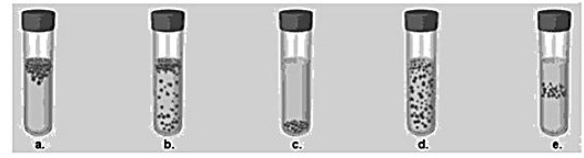
Which tube shows growth for a microaerophile
E
List the characteristics of an obligate anaerobe
-cannot use oxygen, it will harm them
-perform fermentation
In a culture tube, where would obligate anaerobes grow?
-at the bottom
List the characteristics of a facultative anaerobe
-can grow with or without oxygen
-perform aerobic respiration when oxygen is present or fermentation when oxygen is absent
In a tube culture, where would facultative anaerobes grow?
-grow throughout the tube, but mostly at the top because a higher oxygen concentration produces more ATP
List the characteristics of a microaerophile
-requires oxygen, but in small amounts or too much oxygen will be toxic
In a culture tube, where would microaerophiles grow?
-In the middle region
List the characteristics of Aerotolerant Anaerobes
-don’t use oxygen and don’t perform aerobic respiration
-can tolerate oxygen because it can detoxify ROS
In a culture tube, where would aerotolerant anaerobes be found?
-even growth throughout the tube
How does quorum sensing work?
when population is low, signals diffuse away
when population increase
-signal concentration rises
-cells detect the signals
-gene express is simultaneously activated
Which enzyme converts superoxide into hydrogen peroxide?
-Superoxide Dismutase
When is superoxide produced?
During respiration

Which tube shows growth for obligate aerobes
A

which tube shows growth for obligate anaerobes
C

Which tube shows growth for aerotolerant anaerobes
D
How do salts and sugars work to preserve foods?
-Salts and sugars create a hypertonic environment. Salt and sugar draw water out of microorganisms through osmosis, creating conditions that inhibit their growth

In the figure, which line best depicts a psychrotroph incubated at 0°C?
C

In the figure, which line best depicts an obligate anaerobe in the presence of O2?
C
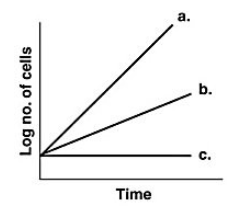
In the figure, which line best illustrates the growth of a facultative anaerobe incubated aerobically?
A