Lecture 6 and 7 Transcription and RNA
 Call Kai
 Learn
Learn Practice Test
 Spaced Repetition
 Match
Match Flashcards
 Knowt Play
1/145

There's no tags or description
Looks like no tags are added yet.
Name | Mastery | Learn | Test | Matching | Spaced | Call with Kai | Chat |
|---|
No analytics yet
Send a link to your students to track their progress
146 Terms
Genetic information directs synthesis of
protein
the flow of genetic information in cells from DNA to RNA is so fundamental that it has been termed the
central dogma of molecular biology
the central dogma of molecular biology was first articulated in 1958 by
Francis Crick
what is transcription
copy nucleotide sequence of DNA into RNA
what is translation
information in RNA to make protein
central dogma slide

what does the central dogma describe
the flow of genetic info
genes can be expressed with different
efficiencies
efficiencies of gene expression slide

___% of genome is coding for protein but not expression all at the same time
1-2%
we are roughly expressing _ genes at any time
10-15,000
diff __ types express diff genes
cell
the chemical structure of RNA _ from DNA
differs
what is the sugar difference between RNA and DNA
RNA uses ribose but DNA uses deoxyribose

base differences between uracil and thymine
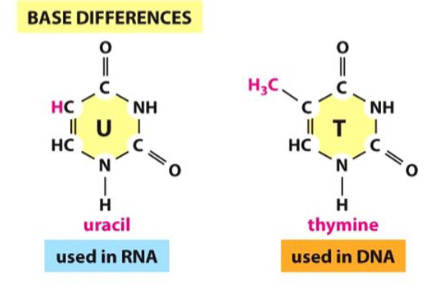
is chemical bonds in RNA the same as DNA
yes
Chemical structure of RNA differs from DNA

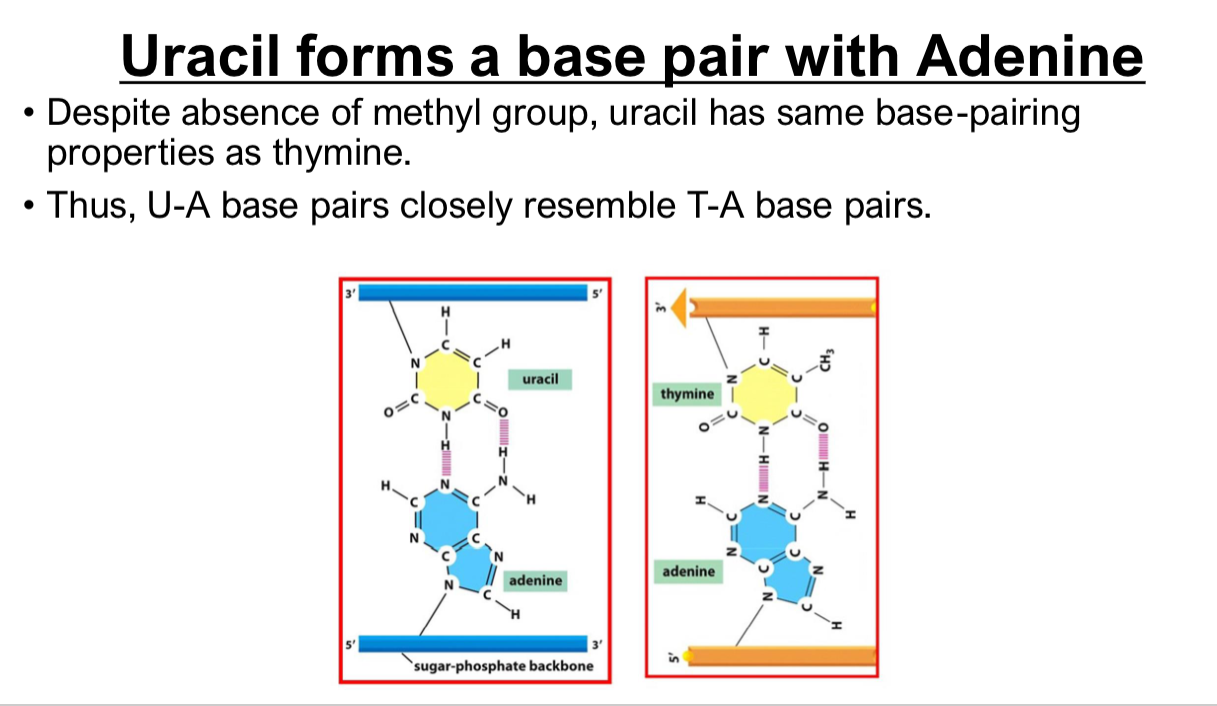
uracil forms a base pair with
adenine
do U-A base pairs closely resemble T-A base pairs
yes
how many bonds does uracil form with adenine
2 bonds
uracil forms a base pair with adenine
RNA molecules can form intramolecular
base pairs and fold into specific structures
RNA is ___ but it is often contains stretches of nucleotides that can basepair with complementary sequences found elsewhere on same molecule
single-stranded
RNA folding on itself slide

some RNAs can have halflifes as little as
20 minutes
RNA often times has some _ structures
secondary
Non-template strand of DNA is sometimes called
coding strand because sequence is equivalent to RNA product
The RNA chain produced by transcription is called _ and has nucleotide sequence exactly complementary to template strand
transcript
transcription produces an RNA complement to one strand of DNA

DNA is transcribed by the enzyme
RNA polymerase
what does RNA polymerase do
it catalyzes formation of phosphodiester bonds linking nucleotides together, forming sugar-phosphate backbone of RNA chain
RNA pol moves along the _ doing what
DNA, unwinding the DNA helix in front of it
Using an exposed DNA as a template polymerase does what
adds nucleotides one by one to RNA chain at polymerization site
as it moves along the DNA template, polymerase displaces ___
formed RNA, allowing the two strands of DNA behind the polymerase to rewind
a short region of hybrid DNA/RNA helix forms transiently causing a ‘___
‘Window‘ of DNA/RNA helix to move along DNA with polymerase
RNA transcription slide

visualizing transcription slide

when talking about translating RNA to proteins what RNA are we talking about
mRNAs
types of RNA produced in cells slide

__ in sequence of a gene determine where bacterial RNA polymerase starts and stops transcription
signals
bacterial RNA pol contains a subunit called _ that recognizes the —- on the DNA
sigma factor, promoter region
once transcription begins ___ is released and polymerase continues synthesizing RNA
sigma facor
chain elongation continues until
polymerase encounters a termination signal (terminator or stop site) in the DNA
when RNA pol reaches a stop what happens
the enzyme halts and releases both DNA template and newly made mRNA
after the enzyme halts and releases both DNA template and newly made mRNA polymerase reassociates with a
free sigma factor and searchers for another promoter to begin process again
RNA pol associating with DNA and dissociating slide

bacterial _ and - have specific sequences that are recognized by RNA pol
promoters and terminators
first nucleotide is designated as
+1
terminator is a _ for trasncription
stop signal
the asymmetry of the promoter with conserved -35 sequence located upstream of -10 sequence _
orients RNA pol and determines direction of transcription
specific sequences slide

some genes are transcribed using _
one DNA strand as a template, others are transcribed using other DNA strand
the direction of transcription is determined by
orientation of promoter at beginning of each gene
direction of transcription slide

how any eukaryotic RNA pols are there
3
what are the names of the 3 RNA pols
I, II, III
RNA pol 1 is for
most rRNA genes
RNA pol II is for
all protein coding genes, miRNA, plus genes for other noncoding RNAs
RNA pol III is for
tRNA, 5S rRNA gene, genes for many other small RNAs
prokaryotic RNA pol (along with its sigma subunit) can initiate _
transcription on its own whereas eukaryotic RNA pol requires the assistance of a large set of accessory proteins
eukaryotic RNA pol requires the assistance of a large set of accessory proteins, principle among these are
general transcription factors, which must assemble at each promoter along with polymerase before transcription can begin
three eukaryotic RNA pols slide

RNA pol is the star for all protein coding genes
RNA pol II
Eukaryotic RNA pol 2 requires _ for tarsncription initiation
general transcription factors
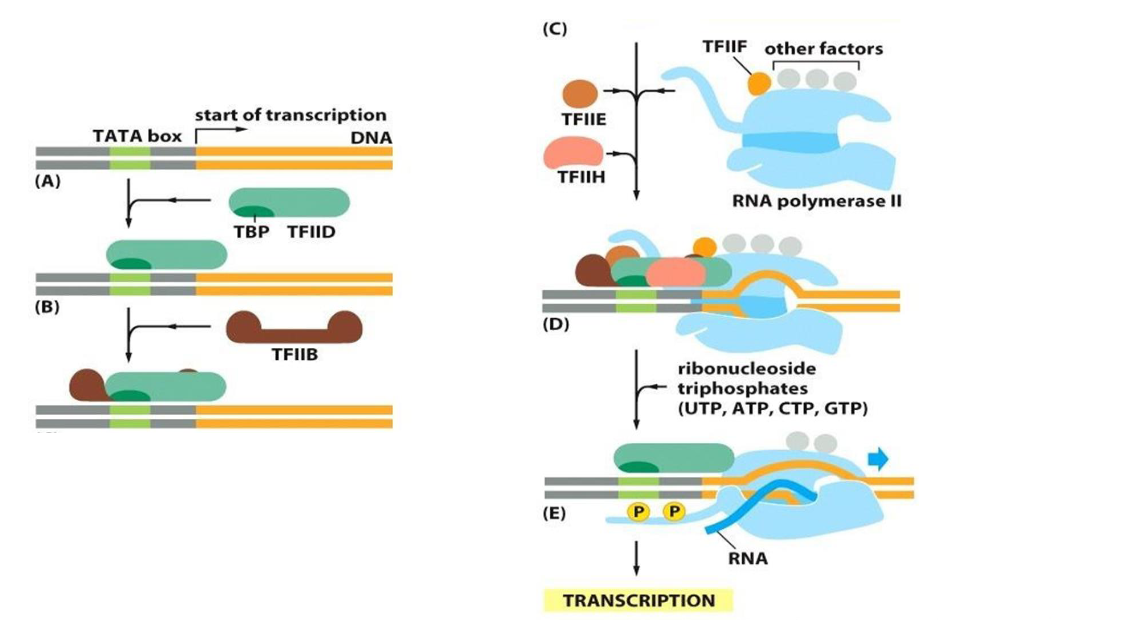
many promoters for RNA pol II contain DNA sequence called _
TATA box
TATA box is _
recognized and bound by general transcription factor TFIID through one of its subunits called TATA binding protein
After TFIID, TATA box-binding of TFIID then enables the adjacent binding of
TFIIB, a general transcription factor
The rest of the general transcription factors including - and - assemble at
TFIIH and RNA pol, promoter to form a complete transcription initiation complex
what dos TFIIH do
pries apart double helix of DNA at transcription start point, using energy of ATP hydrolysis, allowing template strand to be exposed
TFIIH does what
phosphorylates long polypeptide “tail“ of RNA pol II
TFIIH phosphorylates long polypeptide “tail“ of RNA pol II which _
releases it from general transcription factors so it can begin the elongation phase of transcription
eukaryote RNA pol transcription factor slide

transcription initiation flow slide
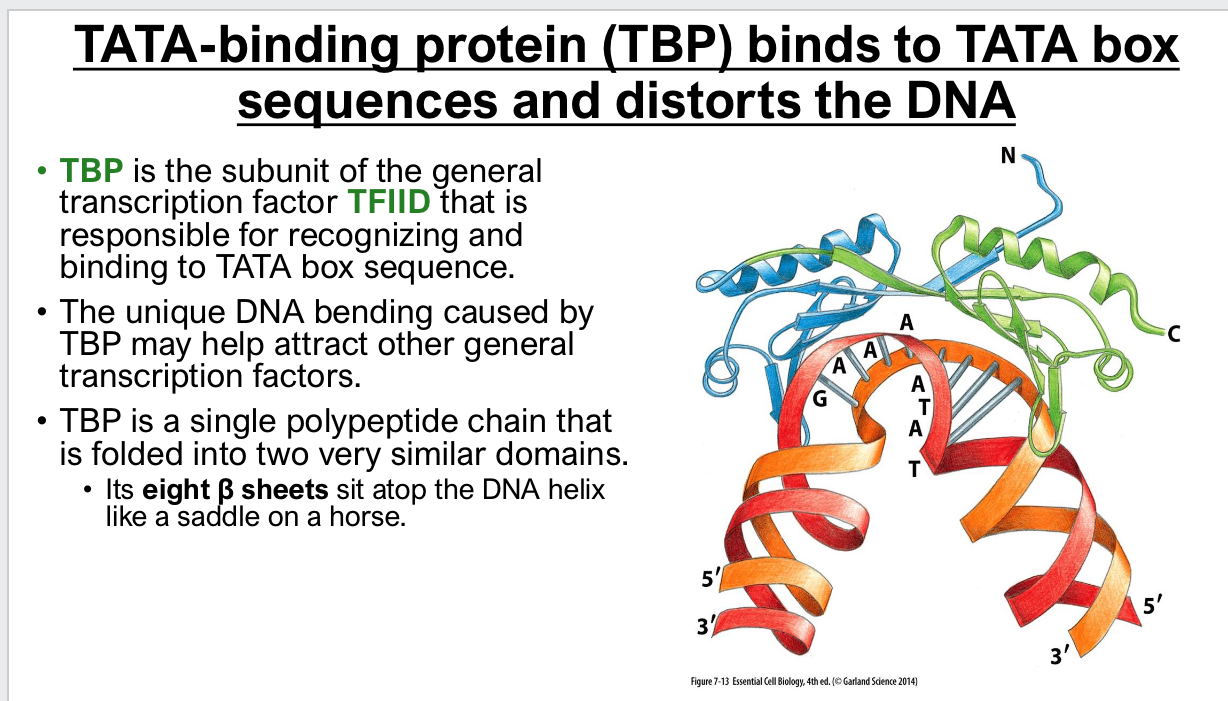
TATA binding protein (TBP) does what
binds to TATA box sequences and distorts the DNA
TBP is the subunit of the general transcription factor __
TF2D
TBP is the subunit of the general transcription factor TFIID that is responsible for
recognizing and binding to TATA box sequence
The unique DNA bending caused by TBP may help
attarct other general tarnscription factors
TBP is a
single polynucleotide chain that is folded into two very similar domains
what part of TBP sits atop the DNA helix
its eight beta sheets sit atop the DNA helix like a saddle on a horse
TBP slide
what do we need to add to mRNA to get it out of the nucleus
5’ cap and 3’ poly-A tail
Phosphorylation of RNA polymerase II allows
RNA-processing proteins to assemble on its tail
when is phosphorylation of RNA pol tail happening
as elongation is occurring
phosphorylation helps _
recruit important enzymes for RNA processing
eukaryotic RNAs are — and —- simultaneously in the nucleus
transcribed and processed
what does phosphorylation mean
covalently attaching phosphate group in order to signal to other enzymes that something is happening
— and — are modifications made to RNA during processing
capping at the 5’ ends with a guanine polyadenylation at the 3’ ends with poly-A tail and splicing are modifications made to RNA during processing
need wait until _ in order for poly-A-tail to be added to 3’ end
transcription is complete
phosphorylation of RNA pol II slide

eukaryotic mRNA molecules ar emodified by
capping and polyadenylation
what is the 5’ cap
7-methyl gauanine
what is the poly-A-tail
series of repeated adenine nucletides to the cut end
5’ cap and poly-A tail slide

how is the 7-methyl guanine attached to the RNA
through a 5’-5’ linkage
5’ cap slide

are eukaryotic and bacterial genes organized the same
no
the bacterial gene consists of
a single stretch of uninterrupted nucleotide sequence that encodes amino acid sequence of a protein
prokaryote genes are _ and -
small and efficient
which has a greater percentage of coding DNA in their genes prokaryotes and eukaryotes
prokaryotes
prokaryotic gene is called an
operon