Ch 3: Consolidated Financial Statements Subsequent to the Date of Acquisition
 Call Kai
 Learn
Learn Practice Test
 Spaced Repetition
 Match
Match Flashcards
 Knowt Play
1/21

There's no tags or description
Looks like no tags are added yet.
Name | Mastery | Learn | Test | Matching | Spaced | Call with Kai | Chat |
|---|
No analytics yet
Send a link to your students to track their progress
22 Terms
Review of Equity Method of Accounting
Goal: replace equity investment with the assets and liab of the subsidiary
ex. Assumptions:
Parent purchases for $1,500,000 of a subsidiary with a BV of SE of $1,000,000
Parent issues 50,000 shares of $1 CS with MV of $30/s w the subsidiary’s Stockholders for all the subsidiary’s voting shares they own
JE to Record the acquisition of the sibsidiary: DR Equity Investment 1500000 CR CS 50000 APIC 1450000
The equity investment on the acquisition date has two components: $1000000 BV of the sub’s SE and $500,000 AAP assets relating to the undervalued PPE, the unrecorded patent asset, and the goodwill asset
Assume that during the 1st yr following the acquisition the sub earns a profit of 210,000 during the yr, pays a dividends of 31,500 to the parent, the parent records amort of the AAP in the amnt of 27,500
Parent JE:
a. To record the recognition of equity earnings: DR Equity Investment CR Equity income 210000
b. To record the receipt of dividends: DR Cash CR Equity Investment 31500
c: To record the 10000 depr of the PPE asset and the 17500 amort of the patent asset: DR Equity Income CR Equity Investment 27500
LO2 Describe the consolidation process subsequent to the date of acquisition when the parent uses the equity method to account for its Equity Investment.
Three New Consolidation JE
C: the elimination of the changes in the Equity Investment account during the accounting period
D: to recognize the current period AAP depreciation and amort of the AAP in the consolidated IS
I: to eliminate the intercompany transaction during the period and balances remaining at the end of the period
The entries correspond to activities of the subsidiary during the period

LO2 Describe the consolidation process subsequent to the date of acquisition when the parent uses the equity method to account for its Equity Investment.
EOY Consolidation Ex Continued
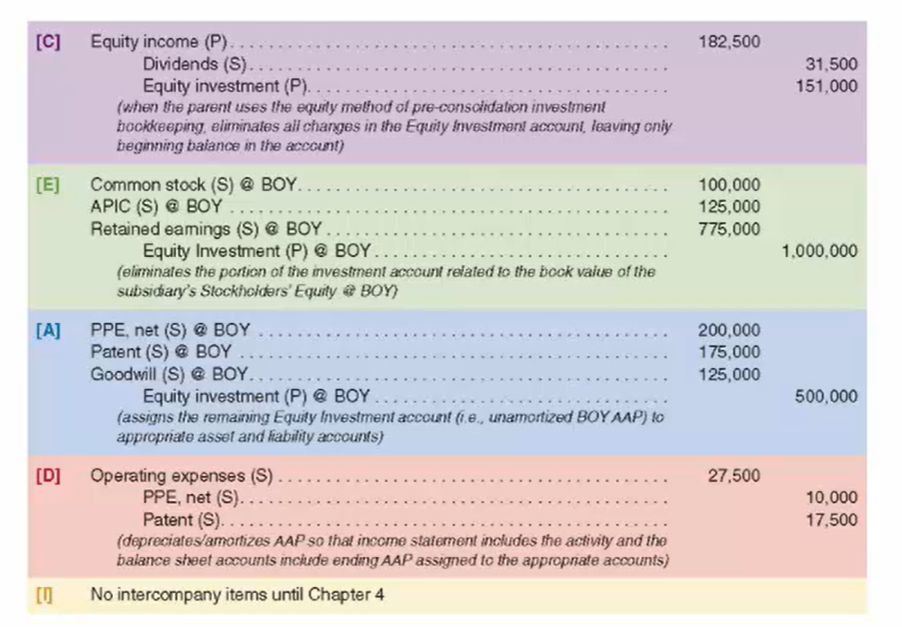
Recap: $1,500,000 acquisition, subsid earns profit during yr of $210,000, pays div of $31,500 to the parent, parent records amort of the aap in amnt of $27500
Parent JE: a. To record the recognition of equity earnings: DR Equity Investment CR Equity income 210000; b. To record the receipt of dividends: DR Cash CR Equity Investment 31500; c: To record the 10000 depr of the PPE asset and the 17500 amort of the patent asset: DR Equity Income CR Equity Investment 27500
Consolidation Entries: Eliminate the changes in Eq Inv account during the period (C), Eliminate the beg bal of the Equity Inv account (E) and (A) and Record the depr &/ amort of the AAP (D)
the consolidation JE are made only in our spreadsheet. They do NOT affect the accounting records of either the parent of the sub
LO2 Describe the consolidation process subsequent to the date of acquisition when the parent uses the equity method to account for its Equity Investment.
Consolidation at the End of Second Yr following the Acquisition
Consolidated Statement of Cash Flows: Not the sum of the statement of cash flows of the indiv comps in the consolidated group
prepared from the consolidated IS and a comparative consolidated BS
add back the noncash exp relating to the depr and amort of the aap
In the yr of acquisition: the net cash paid for an acquisition is recorded in the investing section and the changes in working capital accounts are computed based on amounts excluding the effects of the acquisition
Required footnote disclosures: name and descrip of the acquiree, the acq date, the percentage of voting equity interest acquired, the primary reasons for the business combo and how the acquirer obtained control of the acquiree

LO2 Describe the consolidation process subsequent to the date of acquisition when the parent uses the equity method to account for its Equity Investment.
Summary of Post-Acquisition Consolidation: Parent uses the Equity Method of investment Bookkeeping

LO3 Describe the consolidation process subsequent to the date of acquisition when the parent uses the cost method to account for its Equity Investment
Post-Acquisition Consideration Parent Uses the Cost Method
The consolidated fin st will look the same, regardless of the pre-consolidation method of equity investment bookkeeping applied by the parent company
bc the parent comps pre consolidation fin st will be different under the cost method vs the equity, the consolidation entries will be different
the equity investment balance always remains unchanged at the og acquisition date amnt
any dividend received by the parent is dividend income
LO3 Describe the consolidation process subsequent to the date of acquisition when the parent uses the cost method to account for its Equity Investment
Cost Method Vs Equity Method
Assumptions:
the parent purchases the sub for $500,000 on jan 1 2016 (recorded as inc to Equity Inv under cost and equity)
All three of these reflected in equity method but not cost
the sub reports $100,000 of NI during 2016
the sub pays $20,000 of dividends to the parent during 2016
the parent’s investment in the sub includes AAP. during 2016, aap amort is $5,000
Equity Method Equity Income: 100,000 - 5000 = 95000
Cost Method Dividend Income: 20000
LO3 Describe the consolidation process subsequent to the date of acquisition when the parent uses the cost method to account for its Equity Investment
Consolidations: Cost Method: The ADJ Entry
New: ADJ: E A D, and I entries are identical to the equity method consolidation entries. Bc of the ADJ entry causes the parents Equity investment and retained earnings account to equal their beg period balances as if the parent comp always used the equity method. then perform consolidation like normal
C entry will change since the parent has recognized dividend income in place of equity income. But the concept to back out that income is the same
DR Dividend Income (Parent) Cr Dividends (Subsid)
The ADJ entry backs out the cumulative cost method activity that has been recorded in the parents RE account since acquisition and inserts the cumulative RE activity that would have been recorded if the parent comp used the equity method

LO3 Describe the consolidation process subsequent to the date of acquisition when the parent uses the cost method to account for its Equity Investment
The ADJ Example
assume Jan 1, 2011: parent comp purchased a subsidiary for $1,000,000 and recognized AAP of $40,000 w a UL of 10 yrs
each yr btwn Jan 1, 2011 and Dec 31, 2015 the sub reported NI of $20,000 and paid div of $10,000
Picture: diff btwn the income that the parent has recognized and what it would have recognized if it used the equity method all along
the cumulative diff is what we would need to adjust the cost method equity investment account by to bring it to the bal that would have been reported if the parent has always used the equity method
Adjusting Entry: DR Equity Investment CR RE (parent) 30,000 (brings equity inv up to 80

LO4 Describe the accounting for Goodwill and Bargain Acquisition Gains.
Accounting for Goodwill
Goodwill: an asset that must meet the conceptual def of an asset in order to be recognized on the BS
Does the parent comp control the Goodwill asset?
Will the Goodwill asset provide future benefits?
The second question must be answered each yr
Goodwill must be tested annually for impairment and written down if impaired
LO4 Describe the accounting for Goodwill and Bargain Acquisition Gains.
Amortization of Goodwill depends on two factors:
Amortization of Goodwill depends on two factors:
whether the aquiring company qualifies as a “private company” (entities that are not public, not for profit, or employee benefit plans)
whether the acquiring (private) comp elects to adopt the Goodwill amort exception available to private comps
If the acquiring comp satisfies both of these conditions, then the acquiring comp is req to amortize the goodwill on a straight line basis over 10 yrs or less than 10 if the entity demonstrates that another UL is more appropriate
if a private comp attempts to transition to being a public business entity then the comp will be req to retroactively restate its fin st w/o the private comp exeption included in the fin st
LO4 Describe the accounting for Goodwill and Bargain Acquisition Gains.
Test of Goodwill Impairment
for public comps, goodwill is not amortized like most identifiable intang assets
Along w goodwill, all indefinite lived intangible assets must be evaluated, at least annually, for impairment
companies must conduct this annual evaluation during the same time of year
Impairment: the condition that exists when the carrying amnt of a long lived asset exceeds its FV
If its impaired: DR Equity Income CR Equity Investment To write down the BV of Goodwill
LO4 Describe the accounting for Goodwill and Bargain Acquisition Gains.
Reporting Units
If a Private comp chooses to adopt the goodwill amort exception then the comp must make a policy election of whether to test Goodwill for impairment at the entire company level or at the reporting unit level
for all public comps (and private that do not adopt the goodwill amort exception) all goodwill impairment tests are performed at the reporting unit level
For the purposes of testing goodwill for impairment, acquired assets and assumed liab must be assigned to indiv reporting units as of the acquisition date if both:
the asset will be employed in or the liab related to the operations of a reporting unit
the asset or liab will be considered in determining the FV of the reporting unit
after the identifiable assets and liab are assigned to the reporting unit, then the acquiring comp must calculate the amnt of goodwill assigned to each reporting unit
LO4 Describe the accounting for Goodwill and Bargain Acquisition Gains.
The Annual Evaluation of Goodwill Impairment
if after evaluating, a comp determines that it is more likely than not that the FV of a reporting unit is greater than its carrying amnt, then no further evaluation is needed
if a cmp determines that it is more likely than not that the FV of a reporting unit is less than its carrying amnt then the comp is req to proceed thru the quantitative impairment test
LO4 Describe the accounting for Goodwill and Bargain Acquisition Gains.
Goodwill Impairment Testing and Measurement
comps are req to estimate the FV of each of its reporting units in which goodwill has been recorded
The comp compares the est FV of each reporting unit to the recorded CV of each reporting unit (including goodwill)
CV > FV: goodwill in the reporting unit is IMPAIRED
CV <= FV: Goodwill in the reporting unit is NOT impaired
the amnt of the recorded goodwill impairment is the amnt by which the FV of the entire reporting unit is less than the carrying value of the entire reporting unit
for each reporting unit, the recorded goodwill impairment for a given reporting unit cannot be greater than the current carrying value of the goodwill asset in that reporting unit. Excess impairment over the current CV is ignored

LO4 Describe the accounting for Goodwill and Bargain Acquisition Gains.
Goodwill Impairment Example
Assume: the CV of the equity investment: $1,848,053; CV of Goodwill: $125,000; FV of reporting unit (the subsidiary): 1,700,000
the potential impairment is the 148,053 diff btwn the FV of the reporting unit and its CV
The goodwill balance is only 125,000, so the impairment is capped at that amount
Goodwill must be written down to a zero balance:
DR Equity Income CR Equity Investment 125,000 Made by parent comp on its books bc they are reporting the goodwill asset
LO4 Describe the accounting for Goodwill and Bargain Acquisition Gains.
When should Goodwill be Evaluated for Impairment?
Comps are req to test goodwill for impairment every yr
goodwill must be tested btwn the annual eval dates if an event occurs or circumstances change that would more likely than not reduce the FV of a reporting unit below its CV (macrecon factors, industry considerations, cost factors)
LO4 Describe the accounting for Goodwill and Bargain Acquisition Gains.
Accounting for Bargain Acquisition
a bargain acquisition occurs if the total FV of the investee comp is less than the acquisition date amnts of the identifiable assets acquired and the liabs assumed (the amount computed for goodwill is neg)
investor recognized neg goodwill as an ordinary gain in its IS on the acquisition date
Ex: Assume purch price for subsidiary is 200 and FV of subs net assets is 250
200- 250 = (50) unexplained negative residual (bargain purch gain)
DR Equity Investment 250 CR Cash 200 CR Gain on bargain purchase 50
Consolidation Entries:
E: DR SE of Subsidiary 100 CR Equity Investment 100
A: DR Net Assets (broken out into indiv A&L account) CR Equity Investment 150
the net result is that the gain on the bargain acquisition is recognized in the consolidation IS immediately upon acquisition
Completed
Appendix 3A: Complete Listing of Required Disclosures
Required Disclosures
the name and description of the acquiree
the acquisition date
the % of voting equity interests acquired
the primary reasons for the business combo and a description of how the acquirer obtained control of the business
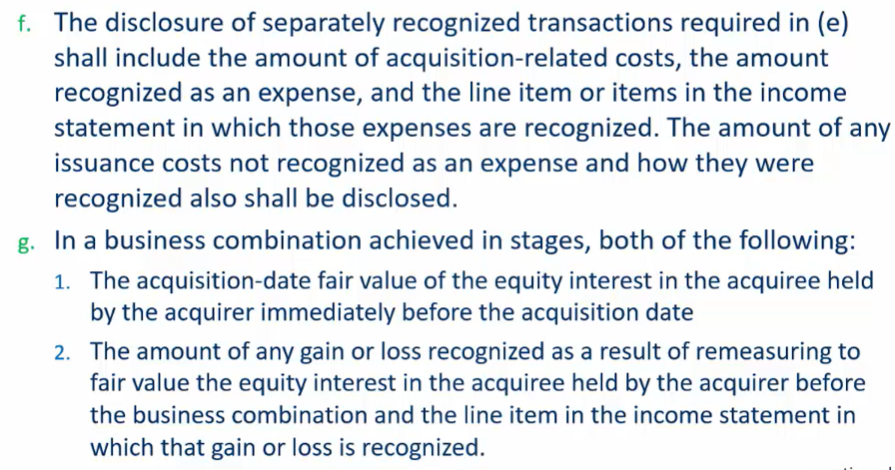
for transactions that are recognized separately from the acquisition of assets and assumptions of liab in the business combo all of the following:
a description of each transaction, how the acquirer accounted for each transaction, the amnts recognized for each transaction and the line item in the fin st in which each amnt is recognized, if the transaction is the effective settlement of a preexisting relationship the method used to determine the settlement amount
if the
LO5 Describe the accounting for common control business combinations and the pooling-of-interests method
Pooling of interest method: NOT USED
REQATCH IF IN PPT