D3.1 Plant reproduction
 Call Kai
 Learn
Learn Practice Test
 Spaced Repetition
 Match
Match Flashcards
 Knowt Play
1/13

There's no tags or description
Looks like no tags are added yet.
Name | Mastery | Learn | Test | Matching | Spaced | Call with Kai | Chat |
|---|
No analytics yet
Send a link to your students to track their progress
14 Terms
How are insect pollinated plants adapted to aid cross pollination?
Large bright flowers, guide insect to male and female parts of flower.
Scent is secreted from the petals.
Pollen grains are large and spiky to stick to insects.
Female parts (stigma) is large and sticky to collect pollen from visiting insects.
Glands called nectaries secrete nectar that is an energy source for pollinators.
Nectaries are positioned deep in the flower so the insects have to brush passed the male and female parts of flower.
Plant Structures
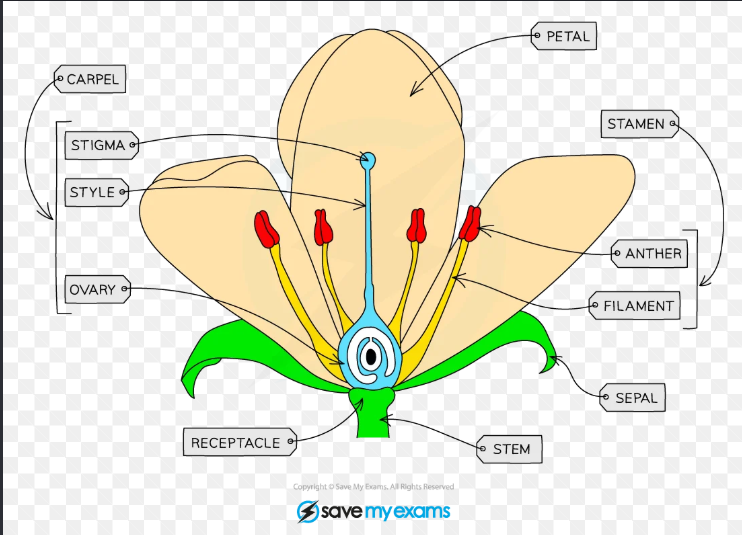
Filament
holds anthers in a position where they are likely to brush pollen onto visiting insects
Nectary
produces nectar
Petal
large and brightly coloured
Ovule
hold the female gamete and develop into seed after fertilisation
Anther
produces pollen (male gamete)
Ovary
contains ovules until fertilisation and then develops into a seed containing fruit
Sepal
protect the floral organ during development
Style
positions the stigma where insects brush past
Stigma
captures pollen from visiting insects
Male reproduction system
Sexual reproduction involves the fusion of male and female gametes to form a zygote.
Stamen = male reproductive part → anther + filament.
Pollen mother cells in the anther are diploid (2n).
They undergo meiosis → 4 haploid (n) cells.
Each haploid cell develops into a pollen grain.
Pollen grain development:
Nucleus divides → tube nucleus + generative nucleus.
Generative nucleus divides → 2 male gamete nuclei.
Therefore, mature pollen grain contains 3 nuclei:
1 tube nucleus → controls pollen tube growth.
2 male gamete nuclei → involved in fertilisation.
Pollen grains have a thick, protective wall, often with a distinctive pattern.
Female reproductive system
Carpels: female part of flower formed from the ovary and stigma.
The ovary contains one or more ovules, which are multicellular structures.
Within each ovule, a diploid megaspore mother cell develops and undergoes meiosis to produce four haploid megaspores.
Three of these megaspores usually degenerate, while one survives.
The surviving megaspore undergoes three rounds of mitosis, producing eight haploid nuclei.
The mature embryo sac contains:
1 egg cell (female gamete)
2 polar nuclei in the central cell
3 antipodal cells providing nourishment
2 synergid cells that help guide the pollen tube to the egg
Fertilization
Fertilization happens inside the ovule, in the ovary. From each pollen grain on the stigma, one of the male nuclei develops into a pollen tube down the style to the ovary. The pollen tube carries the male gamete near the growing tip.
Once inside the ovary, the pollen tube grows towards one ovule, and into one end of it. When the pollen tube reaches the centre of the ovule where the female gamete is located, the male gametes are released and fertilisation occurs.
Product of fertilization is a zygote.
