5.3 Forces & Elasticity
 Call Kai
 Learn
Learn Practice Test
 Spaced Repetition
 Match
Match Flashcards
 Knowt Play
1/14

There's no tags or description
Looks like no tags are added yet.
Name | Mastery | Learn | Test | Matching | Spaced | Call with Kai | Chat |
|---|
No analytics yet
Send a link to your students to track their progress
15 Terms
What are the three ways to change the shape of an object?
Stretching
Bending
Compressing
Why do at least two forces need to be acting on a stationary object to deform it?
If only one force was acting on the object it would just move.
What is elastic deformation?
The deformation is reversible — the object returns to its original shape or length when the force has been removed.
What are elastic objects?
Objects that can be elastically deformed.
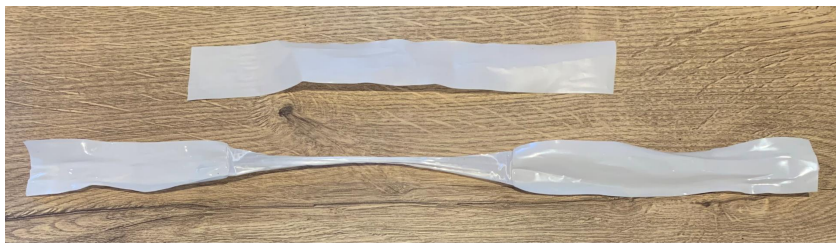
What is inelastic deformation?
The deformation is not reversible — the object does not return to its original shape or length when the force has been removed.
Hooke's Law:
The extension of an elastic object, such as a spring, is ___________ __________ to the force applied, provided that the ______ __ _____________ is not exceeded.
directly proportional
limit of proportionality
What is the equation for Hooke's Law?
F = ke
What is spring constant measured in?
Newtons per metre (N/m)
A force that stretches (or compresses) a spring does ______ and __________ __________ ________ is stored in the spring. Provided the spring is not ____________ __________, the ______ _____ on the spring and the ___________ _________ ________ stored are equal.
work
elastic potential energy
inelastically deformed
work done
elastic potential energy
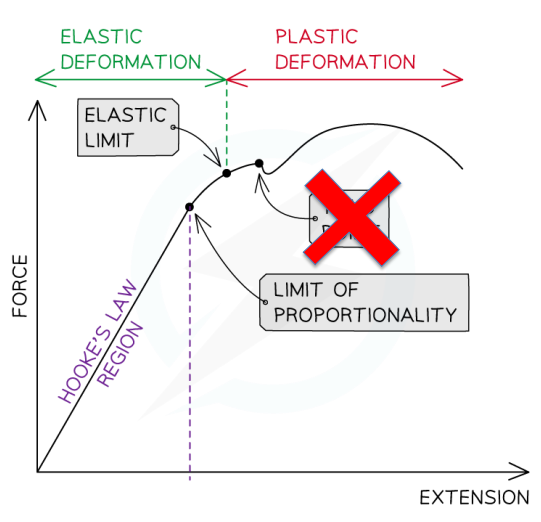
What is the limit of proportionality?
The point on a stress-strain curve where the linear, elastic deformation region transitions into a non-linear, plastic deformation.
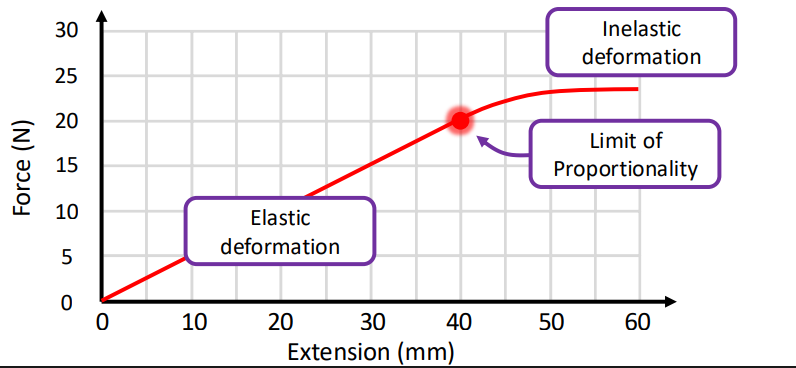
Before the limit of proportionality, elastic deformation is occurring and the relationship between force and extension is _______.
linear
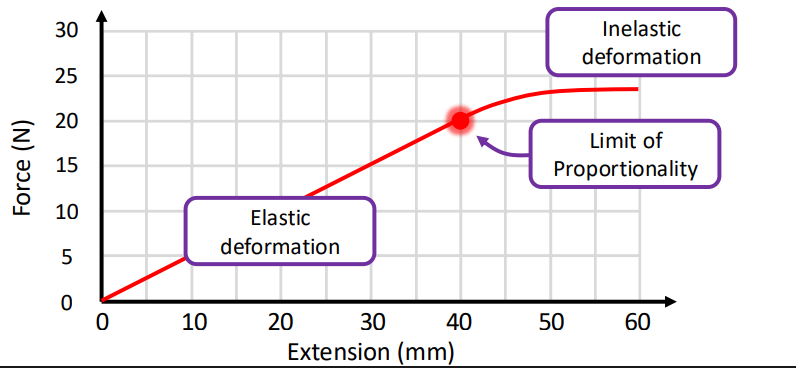
After the limit of proportionality inelastic deformation is occurring and the relationship between force and extension is __________.
non-linear
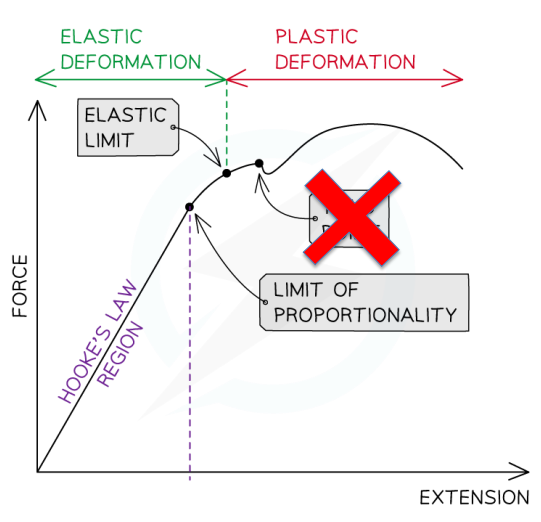
What is the elastic limit?
The maximum extent to which a solid may be stretched without permanent alteration of size or shape.
What is the equation for elastic potential energy?
Ee = ½ ke2
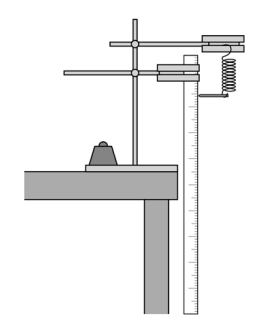
RP 6 — Force & Extension:
Set up your apparatus as in the diagram making sure that:
the ruler is ________. The zero on the scale needs to be at the ______ ________ as the top of the spring.
the splint is attached securely to the bottom of the spring. Make sure that the splint is __________ and that it rests against the scale of the ruler.
Take a reading on the ruler – this is the length of the _____________ spring.
Carefully hook the base of the weight stack onto the _________ of the spring. This weighs 1.0 newton (1.0 N). Don’t forget that the mass added will have to be converted to newtons.
Take a reading on the ruler – this is the length of the spring when a force of 1.0 N is applied to it.
Add further weights. Measure and record the length of the spring each time.
Calculate the __________ for each weight.
vertical
same height
horizontal
unstretched
bottom
extension