Mark 201 Chapter 15: Strategic Marketing Planning
 Studied by 0 people
 Call Kai
 Learn
Learn Practice Test
 Spaced Repetition
 Match
Match Flashcards
 Knowt Play
1/15

There's no tags or description
Looks like no tags are added yet.
Name | Mastery | Learn | Test | Matching | Spaced |
|---|
No study sessions yet.
16 Terms
Marketing and the Three Organizational Levels
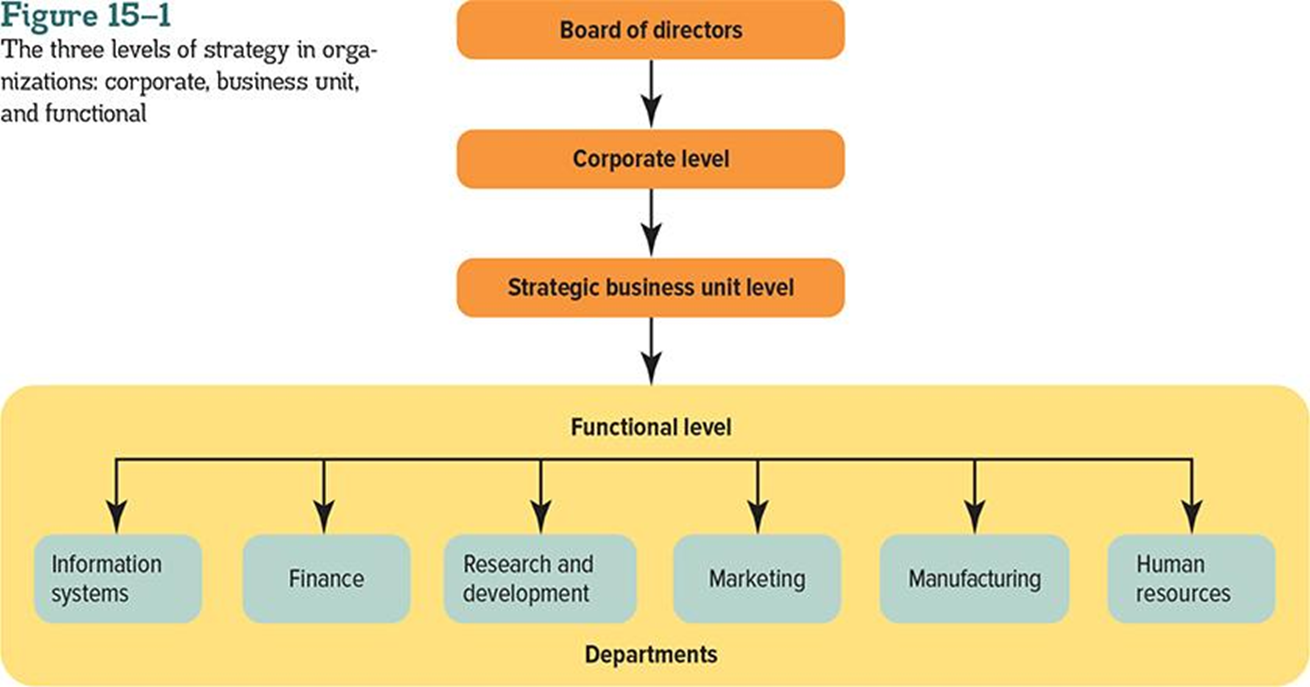
at the corporate level, top management directs overall strategy for the entire organization
the business unit level has business unit managers who set the direction for individual products and markets; specific direction is more specific at the business unti level of an organization
at the functional level, each business unit has marketing and other specialized activities such as finance, manufacturing, or human resources - the strategic direction becomes very specific and focused
the name of a department generally refers to its specialized function
Strategy Issues in Organizations (3)
Strategy
Marketing Budgets and Financials
Goals or objectives
Strategy Issues in Organizations- Strategy
– organization’s long-term course of action that delivers a unique customer experience while achieving its goals
the amount of long-term varies
customer experience and goals both need to be fulfilled, how do we design a strategy around this customer experience to achieve our goals?
Strategy Issues in Organizations- Marketing Budgets and Financials
Marketing plans need to generate sales forecasts to determine a company’s cash flow
⭐Consider realistic (expected), optimistic (best-case), and pessimistic (worst-case) forecasts
one of the reasons we do this is because this a “plan” so we need to be able to deal with any scenario (understand potential options for each), in the simulation, everyone started at 0, so we need to utilize the ‘product life cycle’, ‘funnel’, etc.
Review past sales, upcoming contracts, and market predictions on emerging trends
Aligning marketing objectives and financial objectives of a company is important since discrepancies between chief marketing officer and chief financial officer activities can have a negative impact on financial results
Strategy Issues in Organizations- Goals or Objectives
–translates a mission into targeted levels of performance to be achieved within a specific timeframe
“What do we want to achieve?”, idea of long-term planning comes in
Keep organizations focused and achieving goals help companies grow
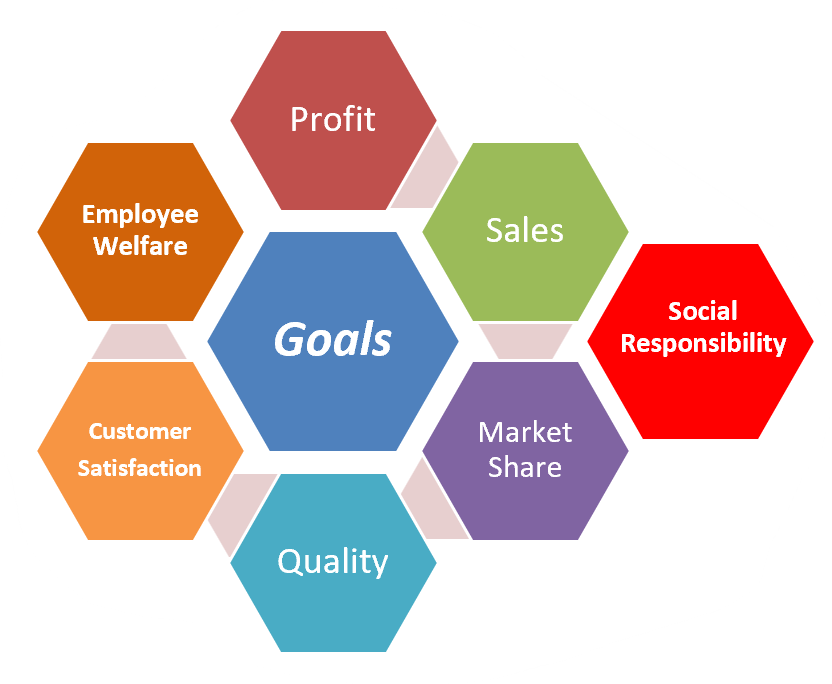
•Profit: Most firms seek to maximize profits—to get as high a financial return on investment (ROI) as possible.
•Sales: A firm may elect to maintain or increase its sales level even though profitability may not be maximized.
^need to find a sweet spot inbetween price and consumer demand/sales
increased price = increased value = increased margin (price) = increased profit = decreased sales
increased sales = decreased margin = increased margin (volume of sales)
based on a target market
•Market share: A firm may choose to maintain or increase its market share, sometimes at the expense of greater profits if industry status or prestige is a desired goal.
Market share is the ratio of sales revenue of the firm to the total sales revenue of all firms in the industry, including the firm itself.
•Quality: A firm may target the highest quality, as Rolex does with its luxury wristwatches.
•Customer satisfaction: Customers are the key to an organization’s success, so their perceptions and actions are of vital importance. Their satisfaction can be measured directly with surveys.
•Employee welfare: A firm may recognize the critical importance of its employees by having an explicit goal stating its commitment to good employment opportunities and working conditions.
•Social responsibility: A firm may seek to balance conflicting goals of stakeholders to promote overall welfare, even at the expense of profits
^ some of these are internal, marketing is just one part of an organization
Setting Strategic Directions
Involves answering challenging questions:
–Where are we now (situation analysis)?
•examine customers, competencies, competitors; includes SWOT analysis and environmental scanning
–Where do we want to go (growth strategies)?
•examine opportunities, business portfolio analysis, market-product analysis,
–How will we get there?
•examine resource allocation, action plans, results/deviations
Does a market opportunity exist?
•Can communicate benefits (of that particular change) convincingly?
if we match “this is where we’re going…” to “this is where the customer is going…” that is ideal
can we do this better than the competition? most organizations/people will play to their strengths (this is what we’re good at… this is how it fits into who we are…)
•Can locate and reach market cost effectively?
trade channels, communcation strategies, etc.
•Possess or can access required capabilities and resources?
we need to deliver on those benefits
if you are doing well, you havea higher budget therefore can implement things that the competitors cannot (how can we use that advantage?)
•Rate of return meets or exceeds requirement? - financial aspect
look at marketing expenditure; increased risk = increased return; need to justify the expense based on current value of return
Growth Strategies: Where do we want to go? GROWTH-SHARE MATRIX
Business Portfolio Analysis
not necessarily about an indidivual product (about a whole portfolio)
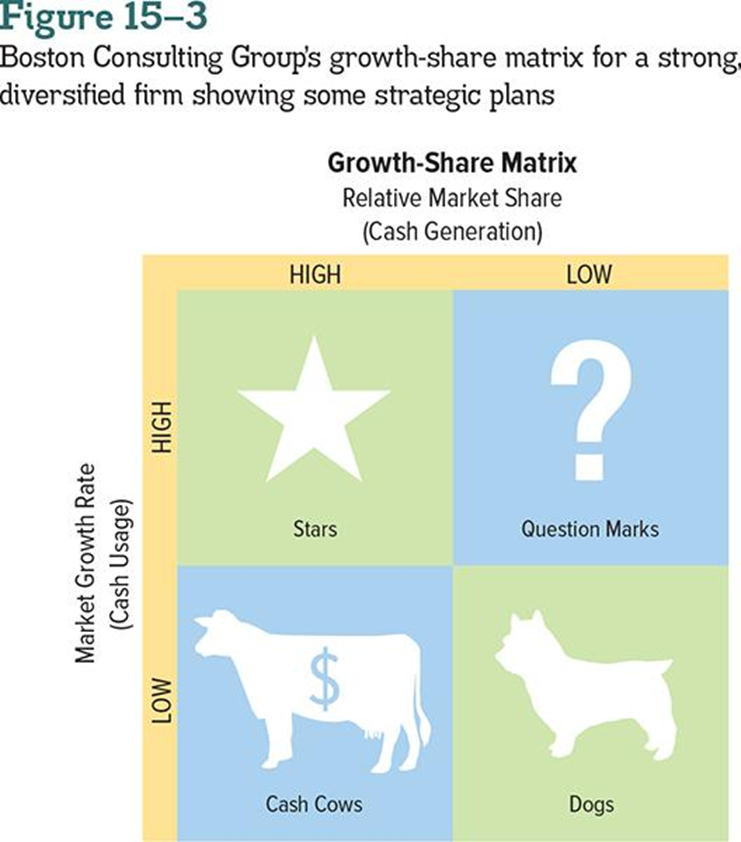
Growth-Share Matrix: growth rate of the market is receptive (are you 10x bigger/smaller than competitor?)
Stars: demand is very strong (selling like crazy), high equity, need alot of cash to do this, “star performers”
Question Marks: these are the products that CREATE the others (essential), “Is this going to work?”, alot of questions, need to do more marketing research or talk to potential customers, etc.
Cash Cows: these are the products we really count on to generate cash that finances all of the other things, doesn’t use alot of cash, ex. for Apple it’s the iPhone, *every organization needs these!
Dogs: products in maturity, etc., ex. “flag-ship brand”, doesn’t matter they aren’t important
Growth Strategies: Where do we want to go? FOUR MARKET-PRODUCT STRATEGIES
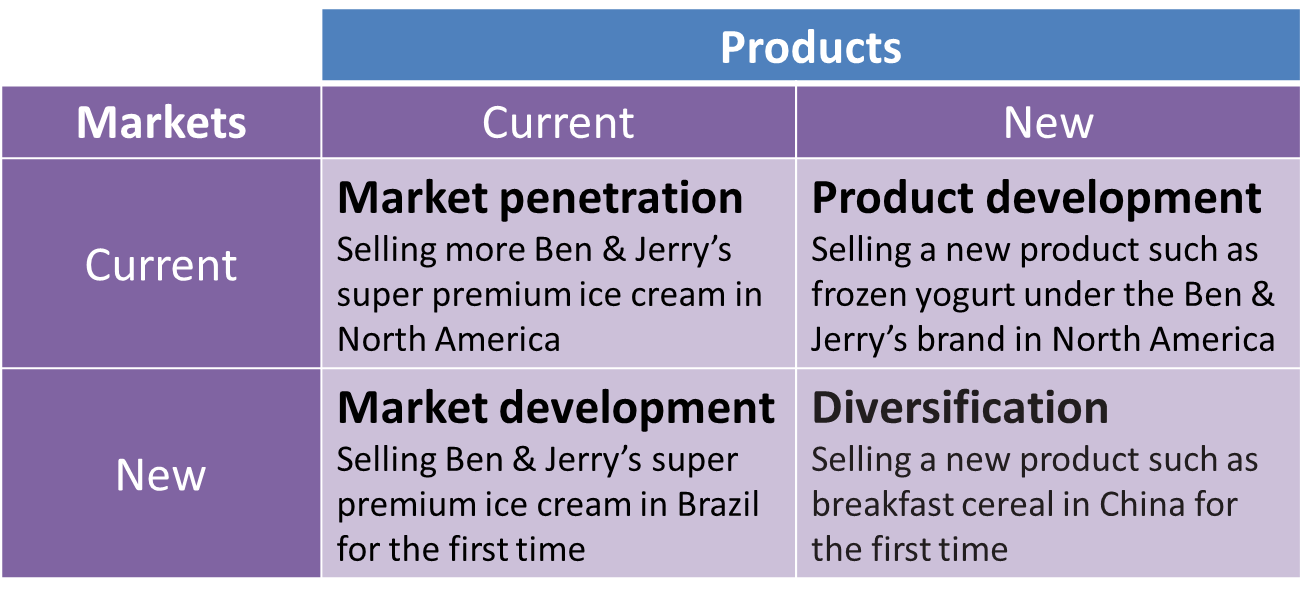
4 quadrants
The Marketing Plan (strategy, 3 phases)

Phase 1: planning phase: critical thinking/’brain power’ is needed from the beginning (‘laser focused’, don’t want to waste time and resources)
Step 1: situation analysis: look at competition, your company’s strengths, etc.; assess ‘fit’ (buyer/seller, product/market)
Step 2: market-product focus and goal setting: ensure fit is correct/ideal
Step 3: marketing program
Phase 2: implementation phase: “How much money is this going to take and when are we going to do this?”
Phase 3: evaluation phase (for internal purposes)
Phase 1: The Planning Phase Step 1
Situational Analysis
SWOT analysis
Industry analysis
Competitor analysis
Company analysis
Customer analysis

Phase 1: The Planning Phase Step 2
Market-Product Focus and Goal Setting
•Set market and product goals
•Select target markets
•Determine competitive advantages
–characteristics of a product or service that make it superior to competing substitutes
•Position the product
Phase 1: The Planning Phase Step 3
Marketing Program
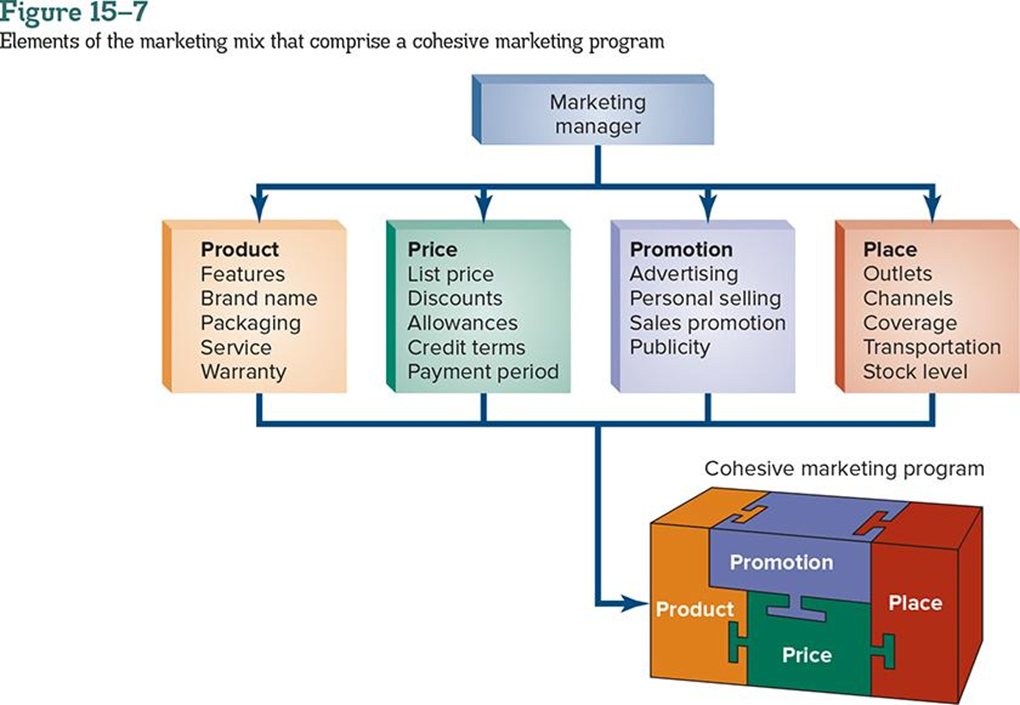
Similar to a Rubik’s cube
doesn’t have stuff coming out the top or botoom, etc. only have a certain amount to work with and figure out and you have to make it fit
ex. budget: need to put together in a cohesive way; IMC
promotion: what’s our promotional strategy?
price: what are we going to change?
Phase 2: The Implementation Phase
•Obtaining resources
•Designing the Marketing Organization

•Developing schedules
•Executing the marketing program
•Marketing Strategy – to achieve a goal, a marketing program to reach a specific market
•Marketing Tactics – detailed day-to-day operational decisions
•An organization needs to invest time and resources into the planning phase of the marketing plan, but just as is important is the implementation phase.
•The implementation phase is the part of the process that executes the individual tactics that support the marketing strategy.
Tracking Strategic Performance
Marketing Dashboards – visual computer display of the essential information related to achieving a marketing objective
Often computer-based display with real-time information and active hyperlinks
Dashboard designers take great care to show graphs and tables in easy-to-understand formats to enable clear interpretation at a glance
Marketing metric - a measure of the quantitative value or trend of a marketing activity or result
Phase 3: The Evaluation Phase
•Identifying Deviations
Marketing dashboards and metrics are used to compare goals with actual results, identify reasons for differences, and analyze what drives success. If results fall short (a planning gap), companies revise their marketing programs and possibly their goals to close the gap
–actual vs planned
•Acting on Deviations
Marketing results often differ from plans, so managers must correct negative deviations when performance falls short and exploit positive deviations when results exceed expectations. As markets and technology change, organizations must continuously adapt their strategies and marketing plans using timely performance data.
–Correcting a negative
–Exploiting a positive