week 10 (Animal diversity), week 11 (Animal Form and Function), week 12 (pop. ecology), week 13 (mutalistic interactions)
 Call Kai
 Learn
Learn Practice Test
 Spaced Repetition
 Match
Match Flashcards
 Knowt Play
1/154

Earn XP
Description and Tags
Name | Mastery | Learn | Test | Matching | Spaced | Call with Kai | Chat |
|---|
No analytics yet
Send a link to your students to track their progress
155 Terms
basic animal characteristics
heterotrophic lifestyle, flexible cell membranes, glycogen, and neuromuscular tissue
Heterotrophic lifestyle
deriving nutrition by consuming other life forms.
Flexible cell membranes
(like plant cells, but unlike them in that plant cells are surrounded by a cell wall made rigid by cellulose) and associated Extracellular matrix (ECM).
glycogen
a carbohydrate energy storage product (comparable to starch in plants).
neuromuscular tissue
associated w/ movement. The vast majority of animals show locomotion, at least in their larval stages (in Chordates, only the adult sea squirts are attached to their substrate).
choanoflagellate protists
closest living relative of animals
phylum porifera
most ancient animal phylum w/ living representatives.
micro-feeders
“Flagellated collar cells” that show a phylogenetic connection between protists and animals and support the belief that these specialized cells evolved when the smallest suspended organisms were avaliable as food (bacteria). No animals otehr than sponges can capture such small food istems.
fundamental traits used to define major animal groups
no primary germ layer
diploblastic- two major germ layers form, from which the ectoderm (inner-layer) and endoderm (outer-layer).
triploblastic- three major germ layers: ectoderm, endoderm, and the mesoderm (middle-layer).
cephalized
development of head
asymmetry
the animal cannot be subdivided into equal, but opposite, halves (sponges).
radial symmetry
condition in which many planes will divide an organism into equal, but opposite halves so long as the plane goes through the center of the animal. These animals have a circular body with equally effective action/response in all directions (jellyfish).
Bilateral symmetry
condition in which only one plane will subdivide the animal into equal halves (mammals).
Acoelomate
No body cavity exists (e.g., flatworms).
Pseudocoelomate
Animal has a body cavity without a mesodermal lining of organs, allowing better diffusion of substances inside the organism and better maneuverability. However, a certain amount of rubbing between the organs and body wall occurs in these animals (nematodes).
Eucoelomate
animal has a body cavity and internal organs covered with a membrane derived from mesoderm. this form provides the best protection from rubbing and foreign antigens entering from the coelom from a wound. This condition is found in most higher organisms.
Protosomes (w/in triploblastic organisms)
Those that have the blastopore resulting in a mouth.
Deuterostomes (w/in triploblastic organisms)
Those that have the blastopore resulting in an anus.
Asymmetric animals without germ layers- phylum: porifera (sponges)
The sponges represent a dead-end phylum (that is they did not give rise to any other existing phyla) are benthic, sessile filter feeders with variable body sizes and complex water canals throughout their bodies. Sponges had very few competitors in early seas (see micro-feeding above), but had the need for defenses against predators, using both chemical and physical (sharp spicules) defenses. The commercial sponge trade has been replaced by the invention of synthetic sponges.
The radiates – diploblastic animals with radial symmetry- Phylum: CNIDARIA (animals containing cnidocyte cells – e.g. coral, anemones, and jellyfish)
These animals evolved when macroscopic protists were abundant, well after sponges evolved. These animals were sessile or slow-moving hunters that used attached paralyzing harpoons (nematocysts in cnidocyte cells) to capture prey or for defense. Sessile forms (e.g., coral) supplement energy with a mutualistic algae. Most cnidarians have a multipurpose, blind, gastrovascular cavity, extending to most of the body tissues for nutrient delivery.
Lophotrochozoan protostomes
Triploblastic animals with bilateral symmetry, a blastopore becoming a mouth, and showing growth by incremental additions to the body (without having to shed to grow).
Phylum: PLATYHELMINTHES (flatworms)
This phylum includes free-living flatworms and parasitic flukes and tapeworms. The most primitive groups include bilateral symmetry, cephalization, and typical tube-within-a-tube design. The flat body maximizes surface area for diffusion of gasses (they have no respiratory system). This group represents the first bottom-dwelling, flat, slow-moving scavengers, also including well-developed chemoreceptors for localizing food.
Phylum: ANNELIDA (segmented worms)
This group likely evolved from a free-living flatworm and includes earthworms, predatory marine worms, and leeches. Marine worms were the first annelids (and majority of existing annelids today). Later annelids radiated into freshwater and onto land. Annelids have a hydrostatic (liquid-inflated) skeleton and gripping setae, both of which assist in burrowing through substrate. Annelids have repetition of body parts along the body axis (segmentation) allowing independence of body parts. Earthworms are important in cycling nutrients in ecosystems.
Phylum: MOLLUSCA (chitons, snails, clams, squid, octopus and others)
The mollusks are the second largest phylum (first is Arthropoda) and extremely diverse, and are likely to have evolved from an annelid ancestor. Adaptive radiation is due to several innovations, including a mantle, protective shell, muscular foot, and a scraping radula, all allowing the early mollusks to feed on suspended and attached algae near shore. Only snails moved onto land. Many of the species are used for food. Some, like the Zebra Mussel, are problematic.
Ecdysozoan protostomes
Triploblastic animals with bilateral symmetry, a blastopore becoming a mouth, and showing growth via repeated shedding of the outer body exoskeleton (ecdysis).
Phylum: NEMATODA (nematodes or roundworms)
Members of this phylum occur in most habitats, including other organisms, and likely evolved from a flatworm ancestor. The number of individual nematodes is much greater than the number of all other animals combined. Nematodes are tolerant of a variety of extreme conditions, including drought (>39 years), freezing and boiling, O2 depletion, and low pH. Primary among their adaptations is the evolution of a cuticle (protective, dehydration-resistant body covering that is shed to permit growth. Nematodes play an active role in nutrient cycling. They are the most abundant multicellular organism that feeds on bacteria and fungi in decaying plants and animals. Nematodes are also a concern to animals, causing diseases like Trichinosis and Elephantiasis.
Phylum: ARTHROPODA (insects, crustaceans (crabs, lobster, shrimp, etc.), and spiders (mites, ticks, scorpions, etc.))
The arthropods dominate our landscape in abundance and numbers of species (80% of all known animal species – 70%of all animal species are beetles). Arthropods evolved from an annelid ancestor (arthropids have segmentally arranged appendages/bodies). The chitinous external skeleton (exoskeleton) was the innovation that met all the criteria for moving out of the water and onto land. The mollusks had heavy shells. The marine worms were segmented for flexibility, but movement with parapodia didn’t allow for speed on land. The arthropod’s exoskeleton has strength, is economical, and allows for speed of movement. Later arthropods evolved a tracheae system (small breathing tubes to the inner body parts) and a compound eye (for spotting food from a distance, rather than just bumping into it.
Deuterostome Phyla – Deuterostomata
“second mouth”; the mouth is the second opening to develop during embryonic growth, the anus being the first. In the Protostomes (= “first mouth”), the mouth is the first opening to develop, the anus being the second. Early embryological differences like these reveal the early divergence of two fundamentally different evolutionary lines of animal phyla, the protostomes and deuterostomes. Animals in the deuterostome phyla have bilateral symmetry, triploblastic germ layers, and eucoelomate body cavities.
Phylum: ECHINODERMATA (starfish (sea stars), sea urchins, and sea cucumbers)
Echinoderms represent the closest non-chordate relative to the chordates, based on genetic information and larval type. However, a common ancestor between echinoderms and the chordates is unknown. Overall, echinoderms are slow-moving, omni-directional, heterotrophs, with spines for protection. They have arms with gripping suction cups for locomotion and predation.
Phylum: CHORDATA (all with a notochord or more)
This phylum is comprised of progressively more mobile, more rigid-bodied heterotrophs. In addition to an increase in cephalization, there are 4 key chordate characteristics.
i. Notochord – fibrous support rod along the back appearing at least during early development (replaced by a vertebral column in the adult in later evolved chordates.
ii. Pharyngeal gill slits – initially used in filtering food suspended in water, but later just for respiration.
iii. Dorsal hollow nerve cord – a single dorsal nerve for rapid sensory processing.
iv. Post-anal tail – a portion of a tail extends posteriorly past the anus (effective for locomotion in early evolution).
3 chordate subphyla: Urochordata, Cephalochordata, and Vertebrata. Within the Vertebrata there are 6 major classes:
i. Chondrichthyes – cartilaginous fishes (sharks and rays) – first chordates with jaws.
ii. Osteichthyes – bony fishes – includes all feeding modes (mostly carnivorous, but also algivores, suspension feeders, and scavengers.
iii. Amphibia – frogs, toads, and salamanders – first chordates to invade land, but have to stay close to water.
iv. Reptilia – Lizards, snakes, turtles, and crocodiles – dry, keratinized skin allowed reptiles to be fully terrestrial. Became the ruling terrestrial vertebrates in the Mesozoic Era (Age of Reptiles).
v. Aves – birds – first chordates adapted for flight
vi. Mammalia – mammals – 3 major groups: Monotremes (egg-laying mammals), Marsupials (pouched mammals), and Placentals (those with a placenta).
Designs have plasticity (flexibility) within certain limits. What is plasticity?
Plasticity is the ability for trait to change based on environmental conditions.
EX 1: Amphibians like frogs and toads grow throughout their whole lives. The rate at which they grow is dependent upon many factors including resource availability and space. However, even with infinite resources, time, and space, a frog could only ever get to be about the size of a dinner plate. This is because…
they have no supporting structures on their ventral side. If they were to become too large, they could not support their own internal organs.
“Giraffes have very long legs and necks which help them reach the tops of trees, avoid predation, and large necks are selected for in males to win fights against other males. However, these long necks require specialized vein systems in order to keep them alive while they drink, and even so they have to put themselves in an extremely vulnerable position to do so. Large males will often get on their knees in order to drink, making it much harder to get away should a predator approach.” Explain this example.
There’s never just one selective pressure; as you get better at one thing, you often have to sacrifice something else. Everything is based on compromise.
Environmental variability
Different environments demand different suites of adaptations, e.g. an animal can’t master terrestrial life without compromising aquatic life.
Becoming larger to escape predation or to increase one’s competitive edge against other species requires …
multicellularity, cell specialization, and organ systems for transporting nutrients, water, energy sources and waste products between the outer and inner environment of the organism
Specialist example: Hummingbirds, like the sparkling violetear, live exclusively in North and South America and almost entirely in the tropics, with many being endemic to only small and particular habitats. Hummingbirds are known for their unique bills which mirror the flowers from which they get their food…
As a result, hummingbirds rarely have to compete for nectar with other animals because they are specifically suited to their local flowers. Even within hummingbirds, some species specialize in specific flowers that only they can get nectar from.
Generalist example: Corvids such as the jungle crow are opportunistic omnivores capable of eating a wide range of foods including fruits, insects, and human garbage. As such, they are widespread and can be found in most habitats across the globe, except for South America.
Crows are in constant competition with other animals, many of which are better at getting specific food items than they are, but since they have so many options they can always find something to eat.
Digestive System
Breakdown of larger compounds into smaller, useable ones – digestive systems of carnivores are simpler than those of herbivores.
Energy source variability
Different energy sources demand different, mostly incompatible adaptations to access them, e.g. evolutionary designs of plants vs. animals: no animal is able to photosynthesize, and no plants eat other organisms. Carnivorous plants kill insects but do so for a nitrogen supplement rather than a calorie source. Plants have systems for accessing the glucose from photosynthesis, but they have no mechanism for eating and internally digesting other organisms to obtain glucose.
Storing energy: camel example- “Dromedary camels are large mammals that live in harsh environments where energy is hard to come by. As such, they have adaptations which allow them to store as much energy as possible over long periods of time.” Explain their adaptations and how they’re useful.
The hump on a camel is actually filled with fat stores; a well-fed camel will have a large hump which it can use for energy when food is harder to find. They can also drink up to 20 gallons of water at a time, and their urine is extremely thick so as not to waste any more water than necessary.
Endothermy
an animal that is dependent on or capable of the internal generation of heat; a warm-blooded animal. Endothermic animals (e.g. mammals/ birds) have much higher energy lifestyles.
Ectothermy
an animal that is dependent on external sources of body heat. Ectothermic animals (e.g. snake) have a much lower energy lifestyles.
Respiratory System
Brings in O2, releases CO2. Endotherms have more complex lungs for greater oxygen usage.
Cardiovascular System
Transports nutrients, wastes and gases throughout body. Most complex in endotherms.
Using Energy: Octopi ex: Octopi generally have a “Live fast die young” life history, the longest-lived octopus is the Giant Pacific Octopus and they have a lifespan of only 3-5 years. In that short period of time they can reach up to 33 lbs. and develop levels of intelligence and problem-solving skills on par with primates. They also use chromatophores in their skin to change the color and texture for camouflage and attracting mates.
They only breed once before they die. All of these things take energy to develop and maintain, and they have to do it within a very short time, so they are using energy constantly.
Using Energy: Galapagos giant tortoises ex: are among the longest lived species on the planet, regularly reaching over 100 years old. While they do become very large, it takes them between 40 and 50 years before they reach their full size.
They devote most of their energy to developing those large, thick, shells which keep them safe from predators.
Winter in seasonal environments: How different animals adapt to the same problem examples: Woodchucks, arctic terns, and coyotes.
Woodchucks will dig a deep burrow and hibernate for most of the winter, allowing their body temperature to decrease drastically so they do not have to forage for food.
Arctic terns spend half the year in Antarctica and half the year in the Arctic. They do this so that they never actually have to experience winter at all - when summer in the northern hemisphere ends, they fly to the southern hemisphere where spring is just beginning. This way there are always plenty of small fish for them to eat, which in turn allows them to make such an extreme migration.
Coyotes don’t migrate or hibernate, but instead grow a thick fur coat and hunt for small mammals and birds which are also toughing out the winter.
Explain surface to volume ratio (S:V)
Something can’t get larger w/o reducing the S:V ratio. For cells/animals depending on the diffusion of oxygen across their surface to supply their internal cell organelles/tissues, there would be a lot less oxygen available per unit volume of cell/body mass with an increase in size. Animals can evolve to be larger but very flat, as did amoebas and flatworms. However, that adjustment increases the distances between different parts of the body, which, if there is division of labor between these parts, eventually causes resource distribution problems as well.
What other things change with increases in size (decreases in S:V ratio)?
Heat loss rate decreases
Dehydration rate decreases
Number of predators decreases
The number of shelter options decrease, but because of 1, 2 & 3, the need for shelter decreases (an elephant doesn’t need much shelter, but a mouse does).
The absolute amount of food and water needed by a larger individual increases
In addition to lowering your rate of heat loss, being large means that the ultimate number of …Animals such as sea turtles combine both of these: an adult loggerhead sea turtle can get up to 3.5 ft in length and weigh 375 lbs.
different predators that can kill/eat you decreases. This may also be accomplished by being armored.
Some animals are unpalatable (unpleasant to taste), nausea-inducing or even toxic when eaten. Many of these exhibit …
aposematic coloration, which acts as a warning to predators. Aposematic coloration is often bright (e.g. poison dart frogs) and aimed at making prey stand out (e.g. reverse countershading in skunks). Distasteful species which may or may not be related often use similar coloration, which is known as Müllerian mimicry.
Species that are not unpalatable can exploit the warning signals of other species to make them appear dangerous in what is known as …
Batesian mimicry. For example, cockroaches in the genus Prosoplecta mimic ladybugs, which are toxic to many animals. This kind of mimicry is negative frequency-dependent and relies on having a small amount of the mimic. If there are too many mimics, predators will learn that most animals with that particular appearance are not toxic, and the coloration will no longer be an effective signal.
Animals can avoid predators by … Populations of the oldfield mouse (Peromyscus polionotus), for example, have been selected to match the background of their location. Mice that live closer to the beach have lighter coat pigmentation, while mice that live further away and closer inland have darker pigmentation.
blending into their environment and becoming cryptic (camouflaged), reducing their chances of detection.
Not all predators hunt by sight, so some animals have … Gulf toadfish are preyed upon by bottlenose dolphins, which orient towards the “boat-whistle” sound produced by male toadfish during the breeding season. Dolphins produce a variety of sounds when foraging, including low-frequency “pops” which are easy for toadfish to hear. Toadfish exposed to “pop” sounds will reduce their call rate by 50% and maintain their reduced call for around 5 minutes.
learned to be quiet.
Fleeing may seem to be a relatively simple solution, but animals may have evolved such that it will make it easier or more difficult for them to do so. The flight initiation distance, or how close a predator can approach before prey flee, can be affected by any of the following factors:
Prey condition: body size, reproductive state, sex, age, temperature, group size, crypsis, hunger, morphological defenses
Predator condition: speed, size, directness of attack, predator type, starting distance, number of predators, predator intent
Refuge: distance to refuge, light, time of day, habitat type, patch quality
For an animal to have offspring, it (usually) must first find and secure a mate. This tends to require a form of signalling, which in addition to indicating an animal’s availability may also indicate their quality as a mate. Some examples of signalling in courtship:
Visual: Male bowerbirds build a structure to attract females, decorated with sticks and brightly colored objects. These objects sometimes have a theme such as a single color.
Auditory: Birdsong has many functions including attracting and securing mates. Male songbirds often have not one but many different songs, and the size of their repertoire (how many different songs they can produce) has been correlated with mating success.
Chemical: Pheromones are chemical substances produced and released into the environment by animals and often used for the purpose of finding mates. Male silk moths, for example, can detect them with their antennae and use them to find unmated females.
Tactile: Water striders produce ripples on the surface of the water in different patterns including specific signals for calling mates, courtship, copulation and postcopulation.
monogamous
mate with only one male/female
polygamous
mating with more than one female
polyandrous
mating with more than one male
Animals are evolved to maximize reproductive success, i.e. …
the number of reproducing offspring they have within their lifetimes. This means there is often a trade-off of quality vs. quantity in offspring production.
Organisms that devote a great deal of energy to producing a large number of offspring will have ______ energy available to allocate resources to each individual offspring. They also have ______ energy available to devote to traits that would increase their own survival, e.g. growth, their immune system.
less, less
Trait evolution involves good compromises, not perfection. Explain the red-tailed hawk example.
a red-tailed hawk lays two eggs at different times, resulting in one hatchling beginning development before the other and therefore being larger. When food supplies are low or normal, the first born chick will claim all the food brought back to the nest (insuring its survival), and the smaller chick will get little to eat and die. But, when food supplies are plentiful, the older chick eats all it can, but not all of it, leaving enough for the smaller chick to survive. This results in two offspring produced instead of one. So, the trait for laying two eggs is imperfect: there is waste much of the time in order to produce two offspring every now and then.
Population ecology
the study of how and why population size changes over time and the effects that population change has on the population.
Population genetics
how populations change genetically over time, and how new populations may get started.
How are Population genetics and Population ecology different?
The two fields are often linked in discussions, but populations may get larger or smaller without genetic change, and genetic change may occur without population size changes.
What might conservation biologists monitor?
the changes of specific elements of a population (e.g., numbers, ages, sex ratio, etc.) over time, keeping track of the factors that affect these elements, and making predictions about and studying outcomes of population changes.
Explain the example of the Case Study of Caribou on Pribilof Islands
The Caribou pop. on St. Paul’s island maxed out at 2000 individuals in 1941 then crashed by the 1950s. The pop. on St. George’s island kept a steady rate, hitting a small maximum but never going extinct. There was probably more resources avaliable on St. Paul’s, but the food supply that was quickly eaten by the growing population could not be replenished quickly enough. Diseases also spread more easily b/c of pop. density and probably the introduction of predators.
Rate of growth (r) and the rate of population growth (rN)
Instantaneous rate of growth per individual (or per capita) is b-d, (birthrate minus death rate) which is typically known as r. Rate of growth (r) = b - d (typically considered as a maximum r or rmax).
If the population size = N, then the rate of population growth = rN
Exponential Growth Equation
(ΔN/Δt) = rN
Explain the exponential growth equation ( (ΔN/Δt) = rN)
the change in population size per change in time (rate of growth) equals the rate of population growth for the individual multiplied by the number of individuals in the population.
Logistic or Sigmoid growth involves three stages:
Initial exponential growth.
Decelerating growth rates.
Fluctuations around some “average” population size, often called K or carrying capacity of the environment.
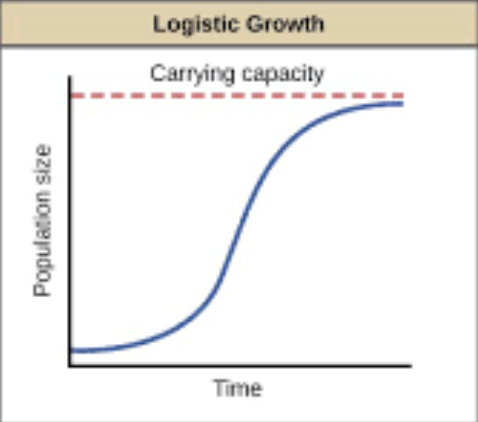
Logistic equation: (equation and graph don’t neccesarily match up)
(ΔN/Δt) = rN((K-N)/K)
N = current pop. size
K = the highest value that N can take or the “carrying capacity” of the environment
Watch out for r. r here is relative (rrel). How an individual can reproduce relative to the influence population size has on the individual.
Why is the logistic model better at predicting real populations than the exponential model is?
The exponential model doesn’t take into account the limit that resources place on populations.
How else can Carrying Capacity (K) be defined?
can be defined as the point at which the population size is in equilibrium with resources; the number of individuals of a species that the environment can support; the number of individuals that can survive in the environment. K is not constant!
Using the logistic model, explain the outcomes of each scenario:
If N > K:
If N < K:
If N = K:
if pop. size > resources avaliable, then the pop. will decrease.
if pop. size < resources avaliable, then pop. will increase.
if pop. size = resources avaliable, then pop. will reach equilibrium and the pop. will be maintained.
explain the example Case Study of Gray Wolf populations in Wisconsin
A gov. agency created a chart to predict the rate at which the grey wolf pop. would increase. Mostly accurate (models for management).
What are some of the problems with these models?
Can be slightly inaccurate due to unpredicted environmental changes.
Demography is…
the study of factors that determine the size and structure of a population over time.
Demography involves the… in an effort to better understand how a population… and, maybe more importantly, to better predict how
age classes, sex ratio, rates of immigration and emigration, survivorship, mortality, and fecundity of a population
changes
a population will change in the future
Life tables summarize the probabilities that
an individual age class will survive and reproduce in any given year over the individual’s lifetime.
All the individuals that are born at the same time, and are thus represented by an age class, are called a
cohort
Life tables are based on survivorship (survivorship until reproduction, if you want to link this concept to nat. sel.) per age class. The typical life table has several variables listed in it (consider the life table of the gray squirrel):
x is the …
n is the …
lx is …
dx is …
… year in consideration. It can also be considered an age class. The term “age class” is often used for those organisms that do not count their ages in years (e.g., bacteria).
… the number of the cohort remaining in the population. nx is the number remaining for a particular age class (x).
… survivorship. It represents the percentage of the original cohort to survive into a particular age class (x).
… mortality. It represents the percent of the original cohort that dies in each year (essentially, lx – lx+1 = dx).
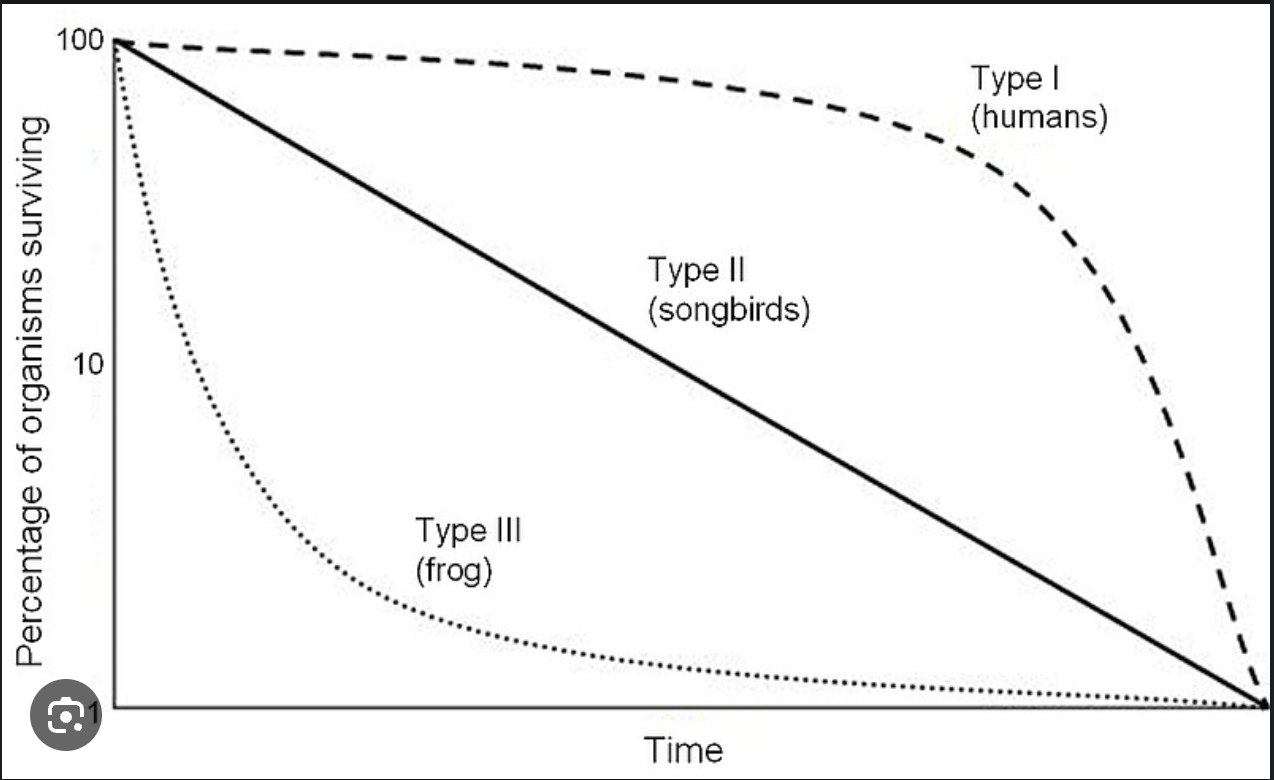
Type I survivorship curve:
has a large percentage of survivors throughout much of the individual’s life time, which is followed by a rapid decline in individuals within the cohort. Examples include: humans, and some plants.
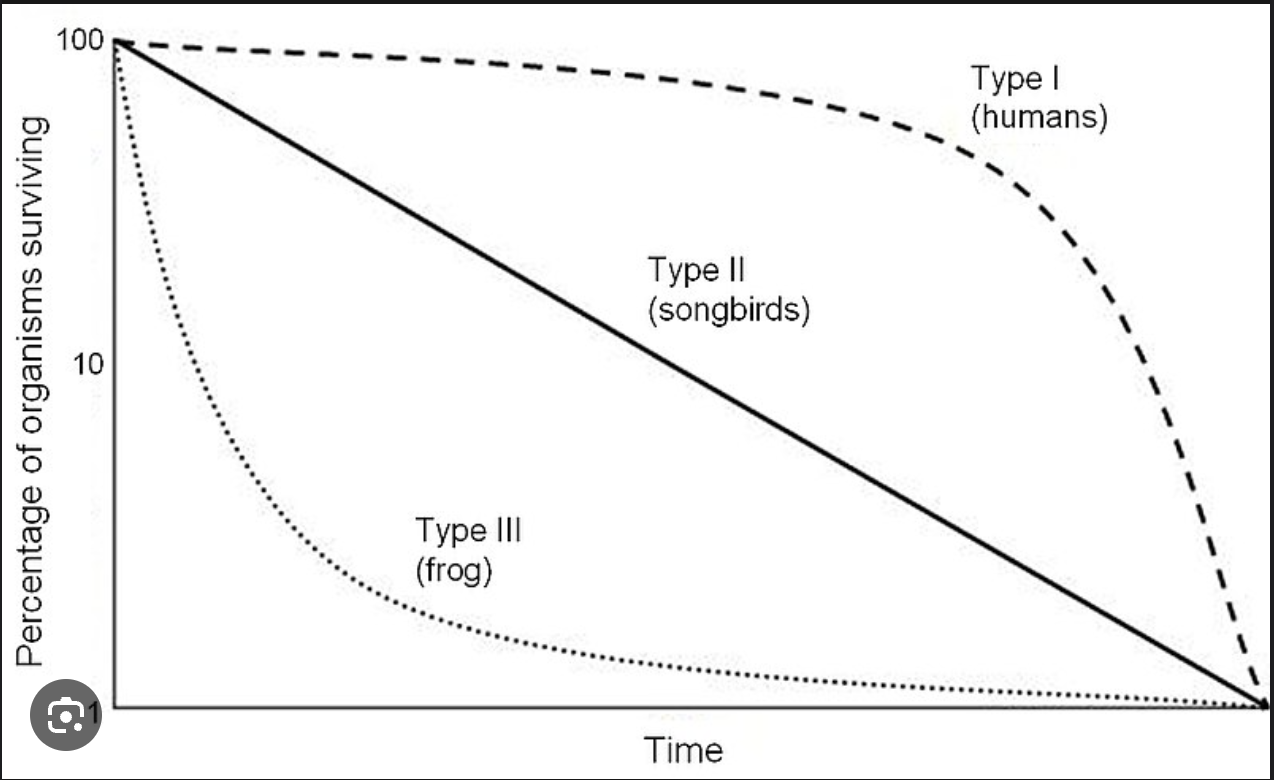
Type II survivorship curve
a relatively constant decline in survivorship throughout the life of the species. Examples include: independent birds (although your book just says “birds”), and many perennial plants.
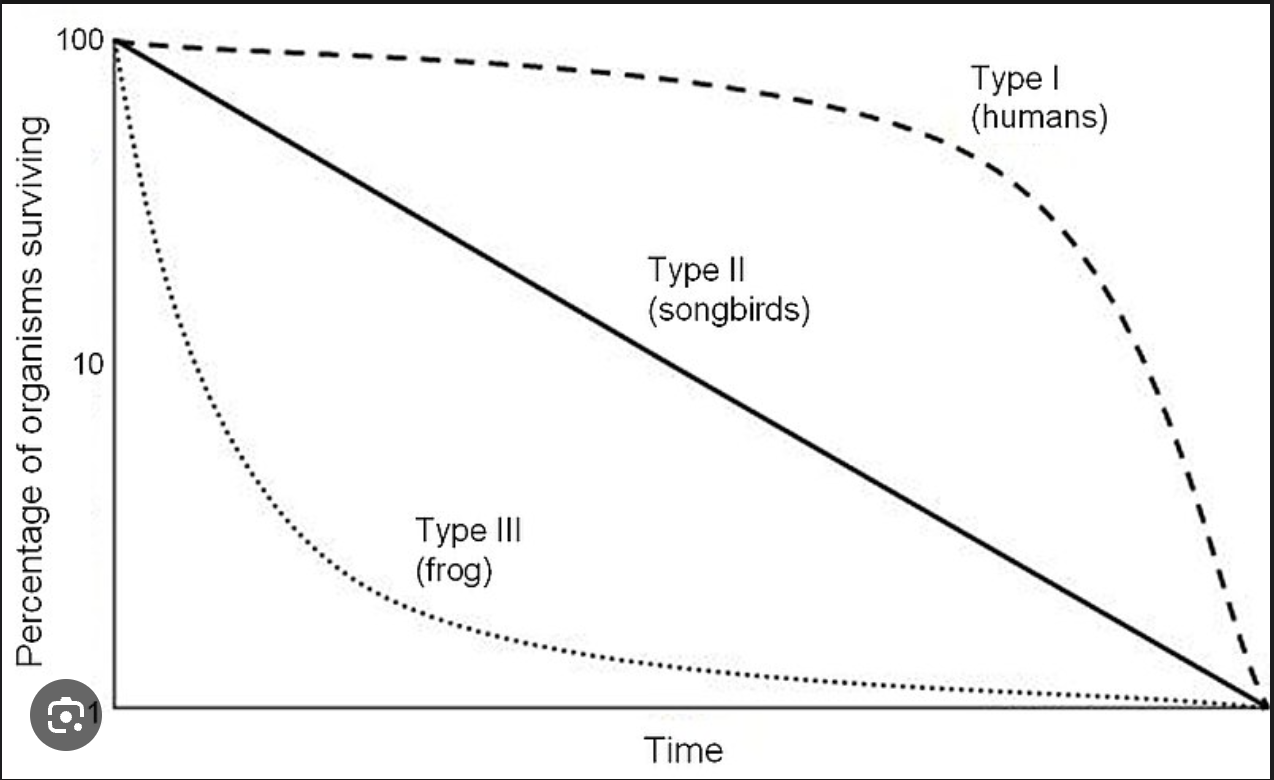
Type III survivorship curve
has a low survivorship (high mortality) early in the life of the organism, followed by a fairly high survivorship throughout the remainder of the lifespan. Examples include: many annual plants, and most invertebrates.
Fecundity
the number of offspring an individual can have in its lifetime. Fecundity and fitness are theoretically the same.
difference between fecundity and fitness?
fecundity represents an actual value, where fitness is typically referred to in relative terms, like those found in discussions about evolution.
What does fecundity typically refer to?
the number of female offspring a female can have in her lifetime, since the females are the ones producing offspring and are considered the high-investment sex.
Net reproductive rate of any one age-class is calculated by …
multiplying Survivorship x Fecundity. If these numbers are added together across all age classes, you get a net reproductive rate for the entire population (Keep in mind, this ignores immigration and emigration.).
life history is…
How an organism allocates energy and effort into these processes of growing, reproducing, and body maintenance.
The balancing act between living and growing and reproducing is referred to as a…
life history trade-off, because these functions cannot occur at the same time.
the cost of reproduction is higher mortality, which means …
that the more offspring you have, the shorter your life is.
Explain the example of the common lizard:
The greater the number of eggs laid by female lizards, the less time she has to live. This is because there is low survivorship associated w/ high fecundity.
Explain the connection between fecundity and survivorship.
Those individuals (populations and species too) with high fecundity, generally have low survivorship (example: mustard plant). Lower fecundity is associated with higher survivorship (example coconut palm).
Competition
individuals interacting where both sustain some cost (or potential cost). That is, it is a - / - interaction.
Intraspecific
W/in the species competition
Interspecific
between species competition
Why is intraspecies competition fiercer than interspecies competition?
B/c in interspecies comp., individuals from different species are only competing w/ one another for a resource that only makes up a small part of one’s total requirements for survival, whereas in intraspecies comp., individuals from the same species are competing w/ each other for the exact same resources (they also don’t do things for the benefit of their species, just themselves).
Explain the spongy moth example:
There was an explosion in the population of spongy moth caterpillars being born because of the raised fitness of spongy moths. Because of this, there weren’t enough resources to feed the caterpillars, and only a few survived. This was a dramatic example of how competition among members of one species for a finite resource — in this case, food — caused a sharp drop in population size. The effect was clearly density-dependent. In comparison, the lower population densities of the previous summer had permitted most of the animals to complete their life cycle.