Microbio Test 1
 Call Kai
 Learn
Learn Practice Test
 Spaced Repetition
 Match
Match Flashcards
 Knowt Play
1/82

There's no tags or description
Looks like no tags are added yet.
Name | Mastery | Learn | Test | Matching | Spaced | Call with Kai | Chat |
|---|
No analytics yet
Send a link to your students to track their progress
83 Terms
what is a microbe/ microorganism?
small organism, can’t be seen with naked eye, usually unicellular
when was the earliest evidence of life?
a rock that is 3.8B years old showed earliest evidence
how old is the earth?
4.5B years old
stelly pool formations
australia, cell lumens had carbonaceous walls enriched with nitrogen
why are the strelley pool formations important?
scientists were arguing that other evidence of life in early rocks could be replicated through geothermal processes
eukaryotes
membrane bound nucleus, predators for existing biomass(prokarytotes)
prokaryotes
no membrane bound nucleus, specialists for rapid growth and maximizing nutrients for increasing mass
common misconception about eukaryotes vs, prokaryotes
both eukaryotes and prokaryotes can have membrane bound organelles, so when differentiating them, the only real difference is the membrane bound nucleus
microbiota
microbial taxa associated with microflora
microbiome
microbiota+ surrounding environmental conditions
metagenome
collection of ONLY genes/genome
examples of things that can change your microbiome
colorectal cancer, ptsd, artificial sweeteners, age, IBS

tree of life
almost entirely microbial
one of the biggest driving forces for diversity
prokaryotes and their ability to inhabit an immense range of habitats
prokaryotes can catalyze…?
transformation of chemical compounds, essential to sustainability of life
reactions catalyzed by prokaryotes that are generally absent from eukaryotes
denitrification of N2, fixation of N2 into organic nitrogen
why is nitrogen so important?
present in every single amino acid, as well as all nucleic acids
what are microbes mostly composed of?
water, ~70%
dry weight of microbes mostly consists of..?
macromolecules + lipids
macromolecules
very large, polymeric structure
lipids
much smaller than macromolecules, not polymeric, hydrophobic
proteins
largest and most diverse category of macromolecules
cytoplasm
dense suspension of ribosomes
small molecules of a cell
constantly changing, being used/regenerated
average e.coli
has 2-4 million proteins, can divide in ~20 mins.
microbio was founded on 2 principles
microscopy and pure culture technique
“seeing is believing”
range of microbial morphology depends on improvements of microscope design
leeuwenhoek
credited with seeing living things under simple single lens microscope, discovered microbes
simple microscopes
offered higher quality images due to less distortion
advances in light microscopy…?
largely confined to improving methods of enhancing contrast
advances made to light microscopy in 20th century
phase contrast microscopy, darkfield microscopy
most significant advance in 20th century
development of electron microscopy
where did people think life came from for most of history?
sexual + asexual processes, and from non-living matter (spontaneous generation)
Francesco Redi
experiment: meat-n-maggots
open jar- flies could come in freely, maggits appeared
closed jar- no flies/air could enter, no maggots appeared
jar w/ gauze: air can pass, no maggots but fly eggs on gauze

what did francesco redi’s experiment challenge?
planted 1st seed of doubt against spontaneous generation

John Needham
experiment: “life gravy”
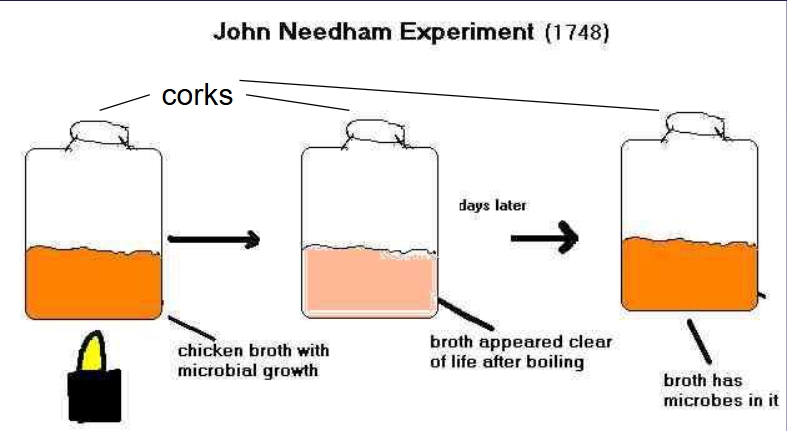
briefly boiled a broth, thinking this killed all life forms, covered with corks, let sit for days and observed that broth became cloudy with microbes
conclusion of John needhams experiment
there must be a life force that causes inanimate objects to come to life

Lazzaro Spallazani
repeated needhams experiment, boiled for one hour, sealed jar tight by melting openings
Lazzaro Spallazanis conclusions
Needham didnt boil long enough/ used poorly sealed jars, microorganisms exist in air, SG does not appear to be inherent to ‘matter’
why did critics fault Spallazani’s work?
argued that lack of air and/or boiling killed ‘life force’
Louis Pasteur
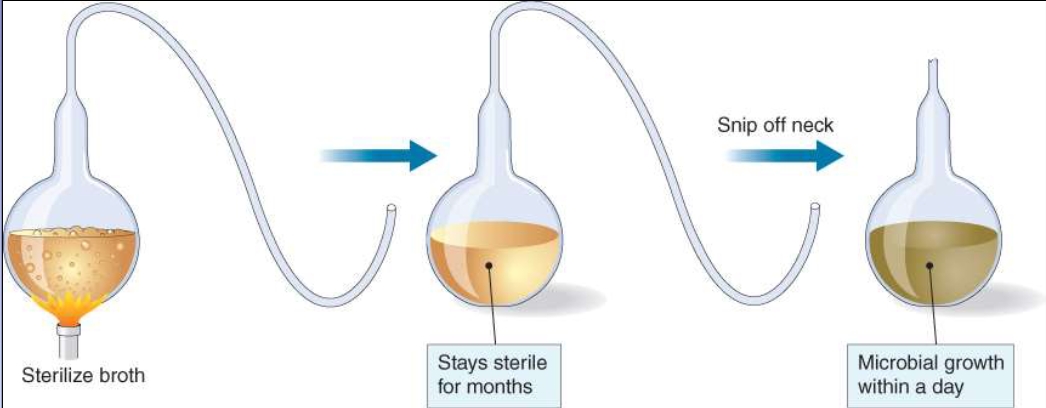
experiment: swan-necked flasks
convinced scientific community SG was incorrect
controversy over spontaneous generation
required development of sterilization methods
John Tyndall
discovered heat resistance of spores, kill them through repeated boiling
What did Pasteur also develop?
first rabies vaccine
3 forms of anthrax
cutaneous, inhalation, GI
cutaneous anthrax
most common, w/o treatment 20% fatality, if treated almost all survive
inhalation anthrax
w/o treatment almost always fatal, if treated ~55% survival rate
GI anthrax
w/o treatment ½ die, w/ treatment 60% survive
hydroscopic
loves/attracts water
Robert Koch
drop of blood from sheep with anthrax into a mouse → mouse dies next day
what is pure culture technique necessary for?
show that different diseases were caused by different microbes
Koch was likely first to realize that…?
solid media (agar) could be used to separate different kinds of microbes, can produce localized growth (colonies)
Koch’s postulates
define what is logically necessary and sufficient to prove microbial etiology of a disease
Koch’s first postulate
microbe must be present wherever disease is, but absent from healthy organisms
Koch’s second postulate
microbe must be isolated from the diseased host organism and obtained in a pure culture
Koch’s third postulate
microbe must be inoculated back into a healthy susceptible host, which must then become ill with same disease
Koch’s fourth postulate
same microbe must be found in the experimentally infected and diseased host
exceptions to Koch’s postulates
asymptomatic carriers, inability to grow pathogens in pure culture (viruses, causative agent of leprosy), single pathogen can cause multiple diseases (GAS, varicella zoster virus)
enrichment culture
allows isolation of microbes that are present in the source material in very low numbers
model systems for study of cell bio, molecular genetics/development
Escherichia coli, Bacillus subtilis, Caulobacter crescentus, Saccharomyces cerevisiae
resolution
smallest distance between2 separate points that can be distinguished a 2 separate objects
limit of resolution(distance) is related to:
wavelength of light being used
numerical aperture of the objective lens
d= 0.5(λ) / NA
numerical aperture
range of angles over which a system can accept/emit light
working aperture
sum of aperture angles of the objective and condenser
oil immersion lenses
oil helps the light not bend as much, lowers amount of refraction so more light can enter objective lens
what is bright field microscopy used for?
observing stained cells
dark field microscopy
can resolve very small objects, lights scatters against a dark backgrounds
iris diaphragm
limits light scattering that enters the objective, can make it easier to see clear samples like live cells
Phase contrast is routinely used for….?
observing live microbial cells, deals with light rays out of phase
what differentiates a phase contrast microscope from a regular one?
phase plate and a darkstop
downside of phase contrast
can add a halo to images, which can get too thick and hide details
Differentiation Interference Contrast AKA Nomarski Microscopy
reference light is polarized, useful for transparent samples, sharper images
what does it mean when light is polarized?
any light rays not going in a specific direction are blocked
why use PC?
cheaper, halo artifact, limitation of sample thickness
why use DIC?
doesn't work with plastic, some natural substances interfere w/ contrast, much more costly
fluorescent microscopy
can locate specific molecules within cells
fluorescence
electrons jump up an energy/orbital level then go back down, and during that process, energy and light is emitted
fluorophore
fluorescent chemical compound that can re-emit light when excited by a specific wavelength of light
what are most fluorescence microscopes constructed around?
filters and a dichroic mirror
confucal microscopy
takes a picture w green/blue/red fluorescence, theyre stacked together to make a high quality sharp image
mitosis
nuclear division
electron microscope
uses electromagnetic lenses to bend a beam of electrons
how does an x-ray work?
bone slows x-rays down, rays can travel easier through soft tissue