Vertebrates (L18)
 Call Kai
 Learn
Learn Practice Test
 Spaced Repetition
 Match
Match Flashcards
 Knowt Play
1/101

There's no tags or description
Looks like no tags are added yet.
Name | Mastery | Learn | Test | Matching | Spaced | Call with Kai | Chat |
|---|
No analytics yet
Send a link to your students to track their progress
102 Terms
Temporal fenestrae
opening in the temporal region of the skull of some amniotes (involved in muscle attachment)
Vertebrates (Craniates)
clade within Chordates
Tunicates
sister group to the Vertebrates
Vertebrates (groups)
Agnathans and Gnathostomata
Shared Chordate traits (seen at least in some points of life)
dorsal notochord, dorsal nerve cord, muscular post-anal tail, pharyngeal slits, elements of the GI system
Notochord
rod-like structure located under the nerve chord derived from mesoderm
Vertebrate traits
vertebral column, cranium, complex genomes, eyes
The vertebral column replaces
the notochord during development (supports nerve cord)
Cranium
bony, cartilaginous structure surrounding the brain
Complex genomes in vertebrates are due to
two whole genome duplication events
Myllokunmingia
earliest vertebrate (530MYA - early Cambrian)
Myllokunmingia (characters)
agnathan, small tapered animal, pharyngeal arches, notochord, rudimentary vertebrae, lobate extension to head (brain)
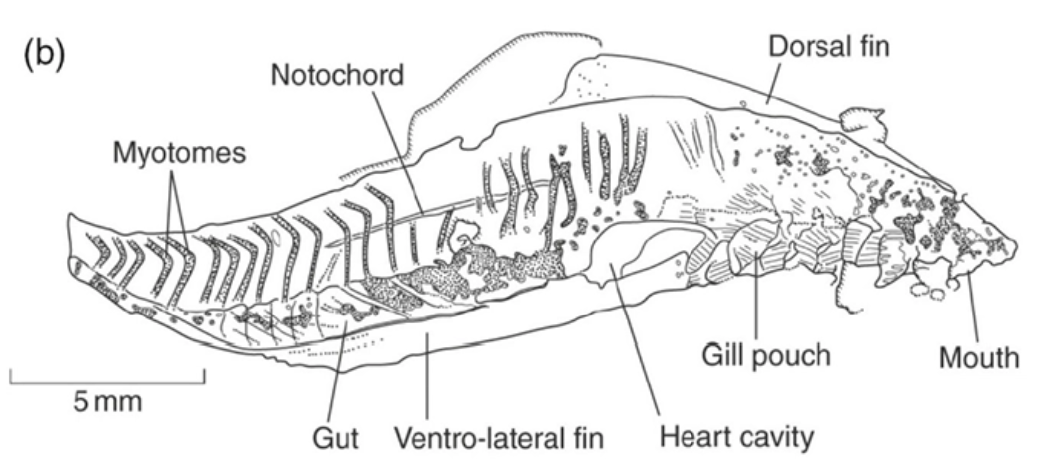
Myllokunmingia (possible characters)
optic capsules (eyes), nasal sacs
Agnathan
paraphyletic group of (mostly extinct) fish that lack true bony jaws and teeth
Agnathan species
Hagfish, Lamprey, Conodonts, Ostracoderms
Agnathan peak diversity
Devonian (400 MYA)
Hagfish
Myxiniformes (Latin name)
Lampreys (Latin name)
Petromyzontida
Hagfish
deep sea carrion feeders
Lampreys
marine parasitic fish that feed on blood and tissue fluids of other fish
Hagfish have a single
nasal opening connecting to pharynx
Hagfish inner ear
one semi-circular canal
Hagfish eyes
are reduced and often completely covered in thick skin and muscle
Hagfish slime glands
along body produce mucus
Hagfish tie themselves
in a knot using slime to escape predators and help when feeding
Lampreys attach to prey
using a sucker disc
Lampreys have large
eyes and good colour vision
Lampreys’ internal skeleton
notochord, vertebra-like structure, cartilaginous skull, gill arches, fin rays
Lampreys inner ear
2 vertical semi-circular canal
Conodonts
form apatite fossils (Ca3(PO4)2) only present in vertebrates
Conodont fins
caudal fins with radial supports
Ostracoderms
Paraphyletic group of fish with head shields made of dermal bone
The dermal bone makes
the skull and clavicle in humans
Ostracoderm (groups)
astraspida, anaspida, osteostraci
Astraspida
tubercles on head shield made of dentine covered in enameloid (~human teeth)
Anaspida
(Silurian) paired pectoral fins
Osteostraci (group of Ostracoderms - Agnathans)
(Mid-Silurian to Devonian) paired pectoral fins
Gnathostomata (groups)
Chondrichthyes, Osteichthyes
Chondrichthyes
cartilaginous fishes
Osteichthyes
bony fishes
Osteichthyes (groups)
Actinopterygii, Sarcopterygii
Actinopterygii
ray-finned fishes
Sarcopterygii
lobe-finned fishes
Sarcopterygii (groups)
Coelacanths, Rhipdistia
Sarcopterygii to Amniota
Rhipdistia - Tetrapoda - (Lissamphibia +) Amniota
Dipnoi
Lungfish, part of Rhipdistia
Chondrichthyes (groups)
sharks, rays, skates, sawfish
Earliest accepted shark (~360MYA)
Cladoselache
Chondrichthyan-like fossil record consists of
mostly teeth and scales
Lissamphibia
caecilians, frogs, salamanders
Placoderms
extinct group of jawed fishes
Best known species of Placoderm
Dunkelosteus
Dunkelosteus
dermal bone and mobile head shield, paired pectoral and pelvic fins, caudal and anal fins
Acanthodians
extinct group of shark-like jawed fishes
Acanthodian characters (extinct group of Osteichthyes)
asymmetrical caudal fin, dentine scales (similar to sharks)
Heterocercal
Asymmetrical
Most fish with head armour
went extinct at the end of the Devonian
Ray fins are supported by
narrow bony rods - radials
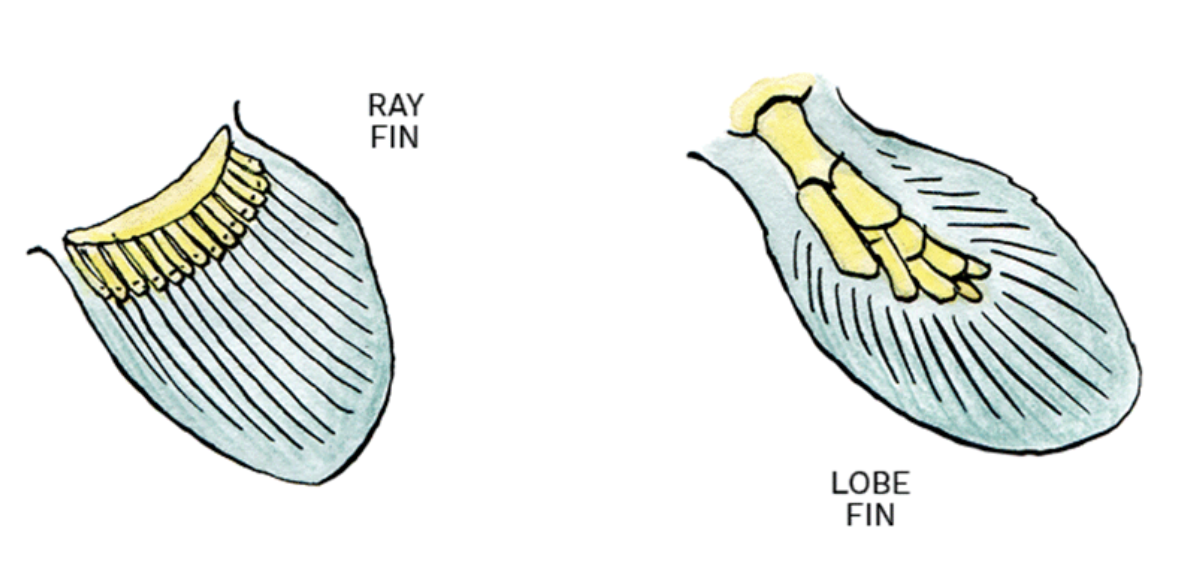
Actinopterygii are the
dominant fishes found today
Actinopterygii skull
kinetic skull - can shoot out its jaw to catch prey
Actinopterygii have tooth-bearing
maxilla, pre-maxilla, dentary
Earliest Actinopterygii fossil and sister group
Cheirolepis
Fleshy lobe fins are
supported by a single basal bone with muscles to modify the posture of the fin
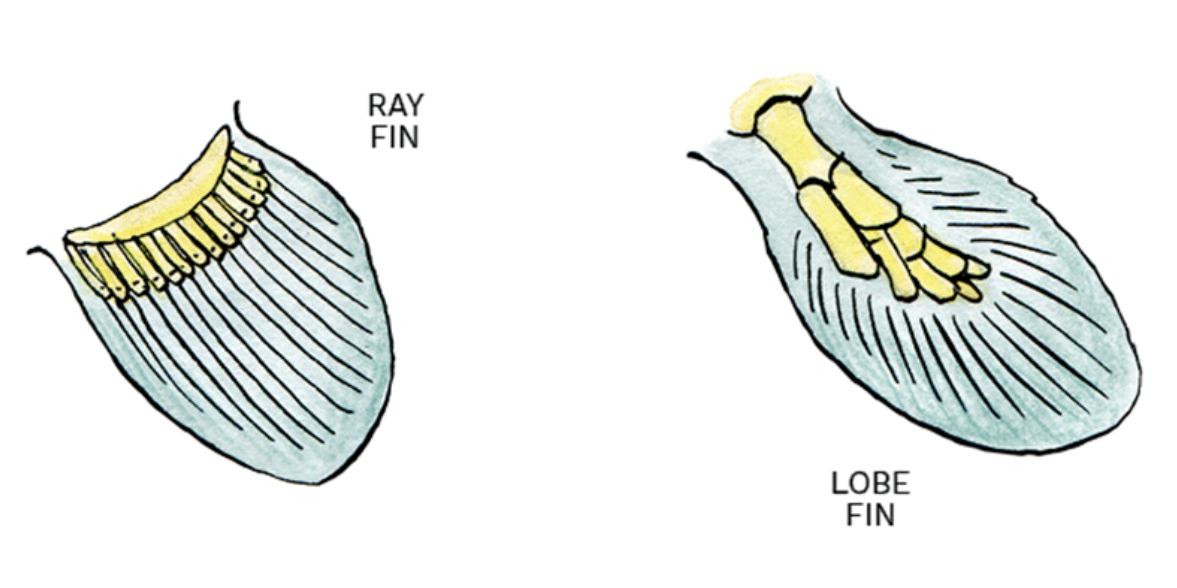
Coelocanths (living Sarcopterygian group)
Actinistia
Earliest Sarcopterygii fossil leading to Dipnoi lineage
Youngolepis
Gill Arch Hypothesis
all arches were gill-bearing and at some point front arches decoupled from respiration and evolved into jaws
Gill Arch Hypothesis (drawbacks)
no fossil found in which all arches are gill bearing
Arches (jaw development)
premandibular arch, mandibular arch, hyoid arch, vagal arch
Mandibular Confinement Hypothesis
jaw evolved via spatial confinement of the mandibular arch
Ancestral mandibular arch domain is
involved in respiration and sensory activity
Mandibular region was initially
extensive and distinct among pharyngeal arches but acquired common pharyngeal pattern at origin of jaw due to spatial confinement
Mandibular confinement occurred by
shift of domain boundary which restricted space for mesenchymal cells in the mandibular arch
Mesenchymal cells
precursor to adult bone marrow stem cells
Mesenchymal population no longer needed to
differentiate to feeding and ventilation structures so remodelled into the jaw
Embryological evidence shows
mandibular arch must be spatially confined for jaw to develop
Mandibular region is supported by the
hyoid arch
Mandibular region is used to provide
structure to the lower lip and the region of the head posterior to the mouth
Hind limbs
a developmental repetition of forelimbs
Actinopterygian fin [1]
fin rays covered in lepidotrichia, scapula
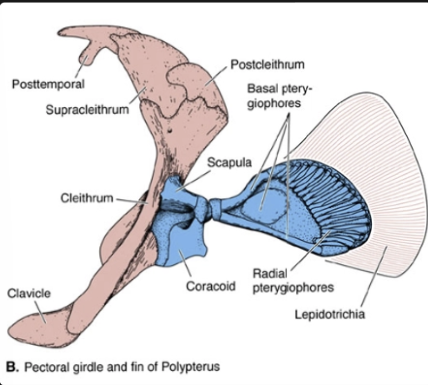
Lungfish fin [2]
scapula, humerus, series of pterygiophores
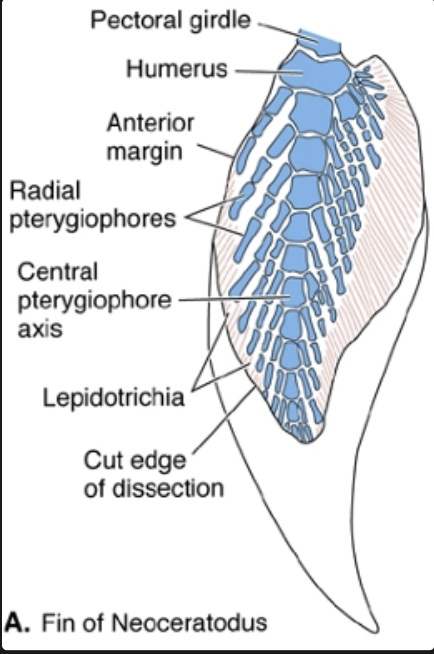
Lepidotrichia
jointed dermal bones
Pterygiophores
bone that supports the dorsal fin in fish
Eusthenopteron fin [3]
scapula, humerus, small pterygiophores, paired elements
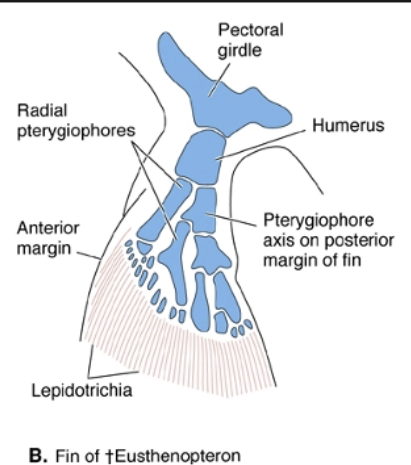
Paired elements in Eusthenopteron fin are
precursors to ulna/radius and fibula/tibia
Structure is not considered a limb until
it possesses digits
Early tetrapods had [digits]
between 3 to 8 digits
All extant tetrapods have [digits]
5 digits (more derived forms have fewer digits)
Tetrapods have
fewer bones in the skull
Opercular covering of the gills is
first detached then lost (evolution over time)
Sea → Land evolution
dorsal-ventral flattening of skull; more robust ribs; loss of caudal, dorsal and anal fin rays; vertebral column becomes more rigid (zygapophysis)
Non-tetrapod Osteichthyes
Tiktaalik
Tiktaalik
transition fossil; longer snout, larger ribs, bony gill cover gone
Longer snout in Tiktaalik suggests
shift from sucking up to snapping up prey
Early tetrapods used limbs
to prop themselves up in shallow water and scuttle onto marshy areas
Lissamphibia
frogs, salamanders, caecilians
Biphasic
aquatic larvae and terrestrial adults
Genera of extinct salamander-like animals
Albanerpetids
Lissamphibia characters
humid/tropical environments, water-dependent reproduction, four digits, adults retain juvenile features
Temnospondyls
early amphibians from which extant amphibians arose
Early amphibians
Temnospondyls