AP Psych 2025 4.1, 4.4, 4.5 , 4.6
 AP Practice
 Call Kai
1/57

Earn XP
Name | Mastery | Learn | Test | Matching | Spaced | Call with Kai |
|---|
No analytics yet
Send a link to your students to track their progress
58 Terms
Attribution theory
Explains WHY behaviors happen
Explanatory style
How we describe why those behaviors happen
Dispositional Factors
Internal in nature and relatively unchanging
Situational Factors
External in nature and relatively temporary
Fundamental attribution error
Overestimating the effect of dispositional factors in an individual’s behavior. Minimizes he effect of situational fctors
Optimistic explanatory style
Explains behavior guided by external causes that are relatively temporary. Those causes tend to be very specific
Pessimistic explanatory style
Explains behavior guided by personal causes that are relatively permanent. Those causes tend to be more pervasive (general)
Cognitive Biases
Influence the way we attribute our behaviors and thoughts. (ex heuristics, confirmation biases, etc)
Availability heuristics
These distorts estimates of how likely something is to occur.
Locus of Control
The amount of control people perceive they have over events or conditions in their lives
Internal Locus of Control
Believing that life events or conditions are the result of one’s own efforts and abilities. One has control over what happens to them
External Locus of control
Life events or conditions result from things outside of one’s control. Things happen and there is not much that can be done about it
Mere exposure effect
Frequency → Familiarity → Positivity
Self-fulfilling Prophecy
This contributes to familiarity in the mere exposure effect. False belief about a situation could bring out a new behavior making the false belief become true.
Social comparison
Comparing oneself with others for self-evaluation.
Personality
Patterns of thinking, feeling, and acting. A way to describe who you are to others in your life
What are the theories that help us understand our enduring characteristics?
psychodynamic, humanistic, trait and social cognitive theories
Psychoanalytic theory
Sigmund Freud - There are 4 things that dictate your personality : childhood, unconscious, sexual + aggressive impulses, and anxiety driven defense mechanisms
Psychodynamic theory
Carl Jung, Alfred Adler, Karen Horney - 3 things dictate your personality: childhood, unconscious, and anxiety driven defense mechanisms
Iceberg analogy
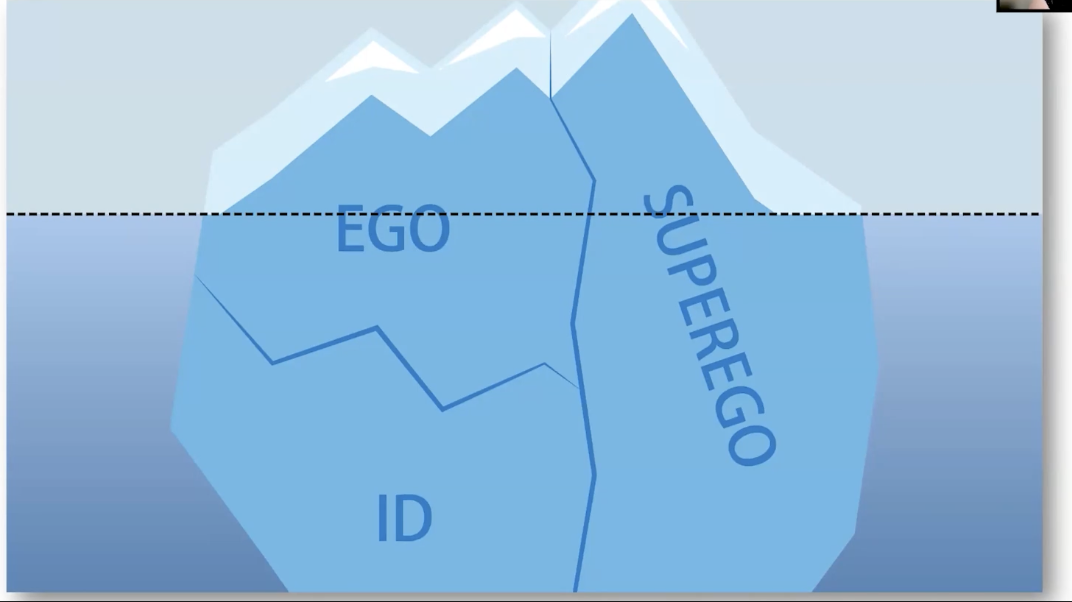
Three parts to our personality that work together to control impulses and make decisions (according to freud)
ID, Superego, Ego
Id
The earliest part of our personality to develop. It seeks immediate gratification and will do anything to satisfy needs and desires. Located entirely in the unconscious mind and operates on the pleasure principle
Ego
Develops in early childhood, acts as a reality check. Mostly in the conscious mind, Operates on the reality principle, mediator of id, superego, and reality. Wants to realistically bring pleasure over pain
Superego
Develops around the age of 5 and is the voice of our conscience. Strives for perfection and wants you to be proud. It is present in both the conscious and unconscious mind, driven by a moral compass, focuses on how we should behave
Denial
Refusing ti believe a painful reality
Displacement
Shifting tension to a less threatening target
Projection
Attributing unacceptable impulses onto someone else
Rationalization
Giving a logical reason to justify unacceptable behavior
Reaction formation
Unacceptable impulses are replaced with their opposites
Regression
Resorting to an earlier stage of development
Repression
Pushing unwanted memories into the unconscious
Sublimation
Agressive drives are channeled into something acceptable
Projection tests
Symmetrical ink blots are presented to an individual who is asked what they represent. Personality is assessed by looking for trends in answers.
Abraham Maslow
Wants us to ask ourselves how we go about reaching our full potential
Carl Rogers
Wants us to live up to our ideal self and understand we are basically good
Maslow’s Self Actualization
We continue to grow into the person we want to become, and we want to reach your full potential. This takes time. People who have reached self actualization can easily answer the question “who am I"
Rogers and Unconditional Positive Regard
We look for unconditional positive regard in trusted relationships. We want to feel that we will not be negatively judged for anything. When we have gained this, we can let our guard down and be true to ourselves. Leads to a person-centered perspective in personality
Psychodynamic vs humanistic approaches
Psychodynamic focuses on childhood and urges while Humanistic focuses on growth an potential
Reciprocal determinism
Albert Bandura - states that a person's behavior both influences and is influenced by personal factors and the social environment.
Self esteem
Your feelings of self woth
Self efficacy
Your belief in your ability
Self concept
Thoughts and feelings that answer who am I
Factors making up reciprocal determinism
Behaviors + environmental factors + internal cognitions
Traits
Enduring characteristics. These are consistent, predictable, and stable
The big 5 personality traits
Extraversion, agreeableness, openness to experience, neuroticism, conscientiousness (OCEAN/CANOE)
Trait theory of personality
Everyone has different levels of the same 5 traits.
Drive reduction theory of motivation
Generally, we are only motivated because we don’t have what we want (in a state of imbalance) Think of it as homeostasis
Optimal Arousal Theory
We have a just right point for arousal (think of Goldilocks) Graph of this is an inverted parabola
Yerkes-Dodson Theory
The more aroused we are, the dumber we are (say dumb things in arguments, mind goes blank while giving a presentation)
Fixed action patterns
Certain behavior patterns are innate, bred into animals through eons of evolution
Intrinsic motivation
Motivation that comes from within. Its not empirical and cant be easily measured, usually emotional
Extrinsic motivation
Motivation that comes from outside factors (ex money), emperical and can be easily measured, can be primary/secondary reinforcers
Lewin’s Motivational Conflicts theory
Approach-approach conflict, Approach avoidance conflict, avoidance conflict
Approach-Approach Conflict
Wanting two things but only being able to have one. You have to miss out on something
Approach-Avoidance Conflict
Wanting something but alos not wanting it or not wanting a part of it
Avoidance-Avoidance Conflict
Not wanting either choice, having to pick the lesser of two evils
Ghrelin
Associated with being hungry, released by the stomach to stimulate appetite. Ghrelin makes your stomach go ghrrr
Leptin
Associated with being full, released by the intestine and seems to stop hunger