PNB CHP 1
 Call Kai
 Learn
Learn Practice Test
 Spaced Repetition
 Match
Match Flashcards
 Knowt Play
1/72

There's no tags or description
Looks like no tags are added yet.
Name | Mastery | Learn | Test | Matching | Spaced | Call with Kai | Chat |
|---|
No analytics yet
Send a link to your students to track their progress
73 Terms
anatomy
to cut apart
physiology
study of nature
sarcomere
functional unit of muscle
sarx
flesh
meros
component/unit
cytology
study of cells
kytos
container/cell
-ology
study

right/left
R-L
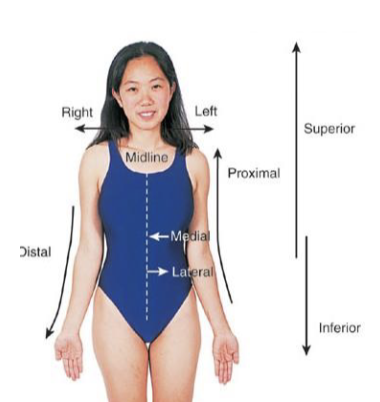
inferior/superior
I-S
What does inferior mean in anatomy?
Below or toward the feet.
superior
Above another body part or toward the head.
Why is the mouth inferior to the nose?
The mouth is inferior to the nose because the mouth is below the nose
Why is the heart superior to the stomach?
The heart is superior to the stomach because the heart is above the stomach.
Where is the liver located?
The liver is mostly on the right side of the body.
Where is the spleen located?
The spleen is on the left side of the body.
What does rostral mean?
Toward the nose or front of the head.
What does caudal mean?
Toward the tail or lower end of the body.

anterior(ventral)/posterior(dorsal)
AV-PD
What does anterior mean?
Toward the front of the body.
What does posterior mean?
Toward the back of the body.
Why is the spine posterior to the chest?
The spine is posterior to the chest because the spine is behind the chest.
Why is the sternum anterior to the heart?
The sternum is anterior to the heart because the sternum is in front of the heart.

medial/lateral
M-L
What does medial mean?
Toward the midline of the body.
What does lateral mean?
Away from the midline of the body.
Why is the nose medial to the eyes?
The nose is medial to the eyes because the nose is closer to the body's midline.
Why are the arms lateral to the chest?
The arms are lateral to the chest because they are farther from the body's midline.

distal/proximal
D-L
What does proximal mean?
Closer to the point of attachment or origin.
What does distal mean?
Farther from the point of attachment or origin.
Why is the elbow proximal to the wrist?
The elbow is proximal to the wrist because it is closer to the shoulder, where the arm attaches to the body.
Why are the fingers distal to the elbow?
The fingers are distal to the elbow because they are farther from where the arm attaches to the body.
What does superficial mean?
Closer to or at the body’s surface.
What does deep mean?
Farther away from the body’s surface.
Why is the skin superficial to the muscles?
The skin is superficial to the muscles because it is closer to the body’s surface
Why are the lungs deep to the ribs?
The lungs are deep to the ribs because they are farther from the body’s surface.

coronal (frontal) plane
divides the body into anterior (front) and posterior (back) parts
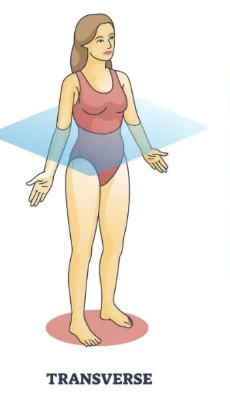
transverse (horizontal) plane
divides the body into superior (upper) and inferior(lower) parts

midsagittal (median) plane
divides the body into equal left and right halves
levels of organization in the human body. (MCTOO)
molecules cells tissues organs organ systems organism
MCTOO
my cat takes our old oranges
What are the 3 major components of homeostatic control?
Input → Controller → Output
What receives information from the sensor?
Integrating center
What does the integrating center do?
Compares the change to the set point.
what is an integrating center?
a core component of a homeostatic control mechanism in physiology that receives signals from sensors (receptors), processes that information, compares it against a normal set point, and orchestrates an appropriate response through effector organs
What carries the input signal toward the integrating center?
afferent neuron
What can carry the output signal?
A hormone or neuron.
What receives the output and performs the action?
Target/Effector
What are common effectors?
Muscles and glands.
what is an effector in the nervous system?
muscles and glands that produce a physical or chemical response when they receive signals from the brain or spinal cord
What does the integrator look for?
error signals
What does the integrator do when it detects an error?
Controls the effector to correct the error
What is the integrator for body temperature?
Hypothalamus
What can happen during acclimatization to altitude?
Red blood cell count increases.
What organ acts as the integrator in the altitude example?
kidney
What two major hormones regulate blood glucose?
Insulin and glucagon.
What does insulin do to blood glucose?
lowers it
What does glucagon do to blood glucose?
Raises it.
What is local control?
A change occurs in a few cells/tissue and the response acts locally.
What is reflex control?
Long-distance signaling.
What systems commonly perform reflex control?
Nervous and endocrine systems
Normal arterial pH?
7.35–7.45
Normal sodium?
135–145 mEq/L
Normal bicarbonate?
24–28 mEq/L
Normal calcium from this lecture?
4.5–5.5 mEq/L
Normal glucose from this lecture?
75–110 mg/100 mL.
fun fact about nuclei
Nucleus can mean the middle of something like ur brain or ur cell
flux
the amount of something that moves across a surface or membrane over a certain amount of time.
temp up
flux up
temp down
flux down
What is transcellular transport?
Movement through a cell.
What is paracellular transport?
Movement between cells.