Nucleic acids
 Call Kai
 Learn
Learn Practice Test
 Spaced Repetition
 Match
Match Flashcards
 Knowt Play
1/18

There's no tags or description
Looks like no tags are added yet.
Name | Mastery | Learn | Test | Matching | Spaced | Call with Kai | Chat |
|---|
No analytics yet
Send a link to your students to track their progress
19 Terms
What are the three components of a nucleotide?
pentose sugar (5 carbons)
phosphate group
nitrogen containing organic base (A, T, C, G, U)
What reaction are these joined by?
Condensation reaction
What are the names of the bases?
A = adenine
C = cytosine
T = thymine
G = guanine
U = uracil
What bond are two mononucleotides joined by?
phosphodiester - forms dinucleotide
RNA structure (ribonucleic acid)
single, short chain
ribose sugar
bases are A, G, C, U
three types of RNA
Structure of DNA
deoxyribose sugar
bases are A, T, G, C
two strands of nucleotides
long strands
joined by H bonds
bases paired
Base pairing
A—T
C—G
complementory bases
Stability of DNA
phosphodiester backbone - protects chemically reactive organic bases inside double helix
hydrogen bonds - link organic bases
3 H bonds between C & G - more C—G = more stable DNA molecule
Function and adaptation of DNA
passes on genetic information from cell to cell and generation to generation
stable structure - persistent mutation rare
strands joined with hydrogen bonds so can separate during DNA replication/protein synthesis
large = carries lots of info
info protected
base pairing leads to DNA being able to replicate and translate info as mRNA
What are the two stages of cell division?
nuclear division - mitosis and meiosis
cytokinesis - the process by which the whole cell divides
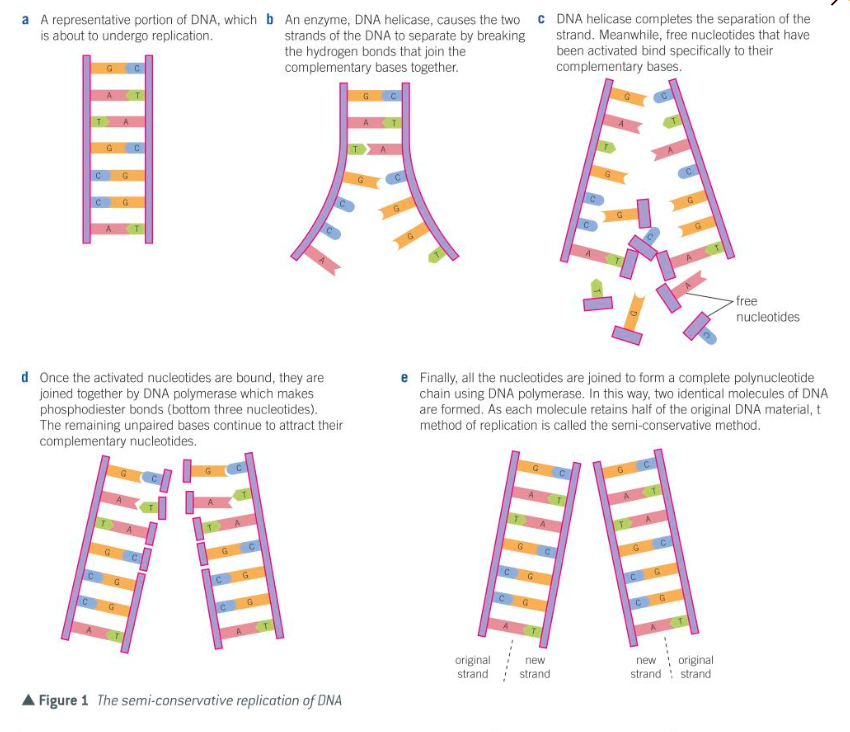
Process of semi-conservative replication
DNA helicase breaks hydrogen bonds linking base pairs of DNA
double helix separates & unwinds
each exposed polynucleotide strand acts as a template - complementary free nucleotides bind by specific base pairing
nucleotides joined in condensation reactions by DNA polymerase
each of the new DNA molecules contains one of the og DNA strands - ‘semi conservative’
Structure of ATP
adenine - nitrogen containing organic base
ribose - sugar with 5 carbon ring structure (backbone)
phosphates - chain of three phosphate groups
Synthesis of ATP
ATP —> ADP + Pi (reversible reaction)
ADP + Pi —> ATP = catalysed by ATP synthase
condensation reaction
Why is ATP a better immediate energy store than glucose?
ATP molecules release less energy than glucose molecules
energy released in smaller, more manageable quanitites
hydrolysis of ATP to ADP is a single reaction that releases energy whereas breakdown of glucose is a long series of reactions and therefore takes longer
What processes is ATP used in?
metabolic processes - build macromolecules from their basic units e.g. starch from glucose
movement - energy for muscle contraction
active transport - provides energy to change shape of carrier proteins
secretion - ATP needed to form lysosomes necessary for secretion of cell products
activation of molecules
Water and hydrogen bonding
hydrogen bonds between molecules - sticks molecules together
Properties of water
is a metabolite in many metabolic reactions, including condensation and hydrolysis reactions
is an important solvent in which metabolic reactions occur
has a relatively high heat capacity, buffering changes in temperature
has a relatively large latent heat of vaporisation, providing a cooling effect with little loss of water through evaporation
strong cohesion between water molecules; this supports columns of water in the tube-like transport cells of plants and produces surface tension where water meets air.
Inorganic ions
found in organisms where they occur in solution in the cytoplasm of cells and in body fluids as well as part of larger molecules
may be in concentrations that range from very high to very low
Roles of inorganic ions
iron ions - in haemoglobin - play role in transport of oxygen
phosphate ions - structural component in DNA
hydrogen ions - important in determining the pH of solutions
sodium ions - important in co-transport of glucose and amino acids