EDUC 525 Quiz 1
 Call Kai
 Learn
Learn Practice Test
 Spaced Repetition
 Match
Match Flashcards
 Knowt Play
1/121

There's no tags or description
Looks like no tags are added yet.
Name | Mastery | Learn | Test | Matching | Spaced | Call with Kai | Chat |
|---|
No analytics yet
Send a link to your students to track their progress
122 Terms
what is the purpose of laws
tro carry out socila policies, in additon to protecting collective and individual rights and freedoms to ensure a peaceful society, such as providing benefits when workers are injured, loans to students and health care
public laws
public law- rules for relationship between individual and society. when somebody breaks a criminal law, it is seen as a wrong against society.
types of public laws
criminal law- deals with crime and punishment
constitutional law- defines relationship between gov. branches, limits gov power, and protects individual rights and freedoms
admin law- deals with actions and operations of gov
what are public laws based off of
rules of precedent- guides judges in making future decisions based on past ones- not written in legislation, and is adaptable to changing circumstances
private law
rules between individuals- settles disputes among groups of people and compensates individuals
what is another name for private laws
civil law
where are rules for private law contained
contained in civil codes whioch have comprehensive sets of rules. unlike common law courts, civil law courts look to a civil code, then to previous decidions if they are inconsistent
how do we settle private law disputes
civil cases
talk about the breakdown of legislation in canada
democratic countries have legislation/parliment, with the powerr to make new laws ort change old ones. canada is a federations, sop ti has a federal parklimant that makes laws for the whole of canafda, and then legislateure in each of the provinces/tewrriorites that deals with laws in their areas. laws at either level are called statutes, legislation, ro acts.
what are regulations
regulations- specific laws that carry out the purposes of the genneral laws or expand on them
what is the process of something becoming a law
gov ministers/public servants examine a problem, and suggest ways in which, under federal jurisdiction, a law can solve the problem
they draft a proposed law
law is approved by cabinet (members of parliment chosen by the PM)
this version is presented to parliment as a bill to bedebated
bill becomes law if it is approved by a majorty in both house of commons and senaate- it also needs to be assented by the gov general in the name of the queen. all laws need royal assent
aboriginal justice strategy
way to divert low risk and nonviolent offenders from mainsteam justice to restorative justive- criminals dont get a record, and can make amends to their community and funds and resources are freed up to deal with more serious offences
goals of aboriginal justice strategy
goals are to give indg greater role in admin justice in communities
dec rates of victiminzation, crime and imprisonment
provide better and more timely info about community justive programs
reflect and include indg values within the justice system
what is the constitution- what does it do (and talk about the queens power)
constitution- supreme law of canaa- reaffirms canadas dual legal system and incl. indg rights and treaty rights
defines branches of gov (executive, legislative, judiciary)
queenn has executive power- but her powers are exercised by constitutional conention on advice of ministers who have confidence from the house of commons
when we talk abot government we are usually talking about the executive branch
what is parliment and who is in it
the legislative branch of the federal gov
consists of the queen, represented by the gov general, the senate and the house of commons
bills are debated on and passed by the senate and the house of commons . gov general must also give royal assent to a bill to pass it into law (by constitutional conention, royal assennt is always giveen to bills passed by the senate and house of commons))
what can parliment make laws about and for
parliment can make alws for all of canada, byt only about matters the constiution assigns to it
provincial or terriotorial legislature can only make laws about info withitin the provinces borders
what are some things parliment deals with
parliment deals with things lik epostal services, trade between provinces, national and criminal defence and law, and the three territories (NWT, yukon, nunavut)- allows terriotiries to elect cooincils with powers like those of the provincial legislations
what are some things the provinces make laws for
provinces have authority to make laws about education, property, civil rights, justice admin, hosptials, etc.
what are some things municipal govs make laws for
there are also local/municipal govs- they are created under provincial laws and make bylaws that regulate a variety of local matters like smoking, business regulations, pesticide use and parking
what act gives indg things like control over reserve land
the indian act
what does sct 35 of the constitution do
sct. 35 regocnizes and affirms aboriginal rihts which are related to the hostirical occupancy and use of land by indg
specifically recognizes and affirms treaty rights
who is aboriginal/indigenous
first nations, metis, inuit
bijurnalism
canada has both civil and common law systems
most private laws in quebec are governed by civil law, while common law applies in the other provincices
legal concepts must be expressed in french and english
problems with the swiss cheese model and siloing elements of the justice system
it neglects the interactions between elements and how bias cascades and snowballs- the different elements are not independent; they are coordinated and mutually support and bias each other, creating and enabling hidden bias cascade and bias snowball effects. Hence, minimizing bias requires not only taking measures to reduce bias in each of the elements but also a wider perspective that addresses bias cascade and bias snowball effects.
what elements of the judtice system does bias impact
both subjective and objective
explicit and intentional bias
the worst form
the dirty harry problem/noble causes corruption
soometimes seen when people feel so justified in their goals that they will take unethical paths to achieve it- ie. the end justifies the means, the greater good, immoral actions are needed to achiee moral goals, etc.
alarming when scientific, unbiased and objective things show this bias- ie. signal detection analysis shows that forensic science experts in firears evidence deliverately do not report elimination conclusions- this deprives innocent suspects of the evidence needed to proe their innocence
t or f- cog bias is less of a concern than expllicit/intentional? why?
cognitie bias is potentially an even bigger concern than explicit and intentional bias because…
it is widespread- explicit intentional bias exists, but is less common and widespread- the former is exhibited by some people, but cognitive bias is ubiquitious that imapcts everybody duue to the top down nature of human cognition
it is harder to detect- explicit intentional bias is easier to detect than implicit and hidden cognitive bias
often not onlyy is cogntiive bias implicit, but it is unconscious
minimizing and countering cogntive bias is not easy or straightforward
define cog bias
cogntiive bias- a by product of peoples cogntive architeture and how the brain processes information. within the justice and legal syystems, cognitive bias has been defined as the class of effects thorugh which an individuals pre existing beliefs, expectations, etc. influuence the collection, perception and interpretation of evidence during the course of a criminal case
top down vs bottom up- which does the brain use
human cogntiion relies on top down info like what we expect, past experinces, etc.p-p as info arrives in the brain, the bottom up info, the top down process guides it and impacts how we interpret that ifnormation.
top down brain cogntiive processes imapct not only our judgements, but whhat we see, such as with selective attention
we must distinguish between random noise and systematic biases created by toop down infleunces like expectations, motivation, etc.
top down processes are needed for human congition- they dec the computational demands placed on the cogntiive system
t or f- cognitive bias is an ethical issue of personal integrity or imcompetence
cogntiive bias impacts all people and is a natural and innate part of cognition
t or f- expertist and experinece reduce and protect us from the effects of cotniive bias
often people in the justice/legal system claim they are not biased de to their vast and extensive experince, but experince does not reduce bias and can actually inc. or create it because it enhances the prevelance, power and impact of top down processes
with expertise, base rate bias is likely to inc. experts in the justice and legal systems are just as susceptible to bias and novices
t or f- the use of tech and ai protects from bias-
not true as we have already seenn tech and ai have their own biases within the software
t or f- belief that people can eliminate their biases via mere will power
this is not true, and in gfact intentional efforts to minimize bias can actually inc the impact of bias due to ironic and rebound processing
3 categories of bias, with 8 sources of total (talk about the pyramid)
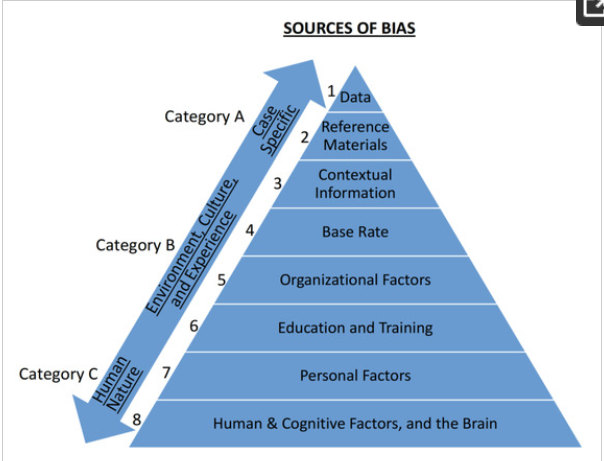
category a of bias
category a- something about a specific case triggers the bias
data- evidence creates empathy and synpathy, dislike or anger- ie. we develop bias against a child predator over disgust for their actions
reference materials- ie. description of suspect, fingerprint, dna profile, etc
ie. when non eyewitnesses identify a suspect, it can be based on their prior familiarity with the person, not evidence presented in the case
ie. if we show somebody a video and ask if they can identify person x, as opposed to asking if they can identify anybody, since they will already be primed to look for person x and this creates a cognitive bias
these types of bias are de to the forensic degrees of freedom- forensic exminers have latitude for discretion and judegement
as there are more deggrees of freedom, bias has more opportunity to impact the decision making process.
ie. expectatinos and previoous beliefs/experinces regarding things like shaken baby sydrome, murderers, etc. create cogntiive biases that taint and investigation
contextual information
ie. when a fingerprinting aalyst is exposed to info about a individuals criminal history before analyzing their fingerprinting, tainting their judgements
ie. an interviewer asking a suspect leading questions that cause a false confession
studies have shown that fingerprint analysts can reach different condlusions when exposed to different, biased info about the suspect
category b of bias
relates to the person handling the case, not the case itself
base rate- different experinces of people in the justice and legal system can lead to bias from the prevelance effect, or the phenomena where people are more likely to miss and not see things that have a lower prevelance base rate
ie. a pathologist who experinced that children who died in the care of a parent moe frequently diagnose deaths as homicides
orgganizational factors- emerge from organizational pressures and cultures
lawyers reach to work condlcusions that satisfy the party who hired them
training and education- police offers can be trained to suspect somebody is guilty, which creates evidence like false confessions and wrongful convictions
personal factors- jurors can be swayed by the suspects attractiveness, race, etc.
can impact people in the legal/justice system who ahve been victims of a crime- ie. if a prosecutor was a victim of sexual assault, tey may be more lieklly to see a suspect as guilty
category c of bias
the source of bias is not the specific case or specific person doing the work, but human nature
personal factors, human and cogntiive factors, and the brain
ie. confirmation bias, need for closure, slective attention, etc.
what do each of these pictures represent

An adaptation of the Swiss cheese model (Reason, 1990). Top panel: although bias exists in the various elements within the justice and legal systems (the black holes in the Figure), it rarely impacts the final outcome because a bias has to be aligned through all the different layers. E.g., ‘A-1’ in the top panel has been able to go through two layers but becomes stuck and is stopped at the third layer; similarly, ‘B-1’ gets stuck and ends at the fourth layer. As the justice and legal systems have many elements before someone is convicted (many checks and balances even before it goes to court), it would rarely happen that a bias could penetrate and align through all the various elements. However, this all hinges on and assumes that the different elements are relatively independent from each other. As illustrated in the bottom panel, the reality is that supposedly independent elements (that should constrain one another) actually work in concert, influencing and biasing each other, creating bias cascade and bias snowball effects (which are not mutually exclusive). ‘A-2’ is able to go through all the layers (in contrast to ‘A-1’) because the bias cascade has moved the hole in layer three to align with the holes in layers 1 and 2. ‘B-2’ illustrates bias snowball in which multiple biases upport and feed each other, creating a bigger and bigger bias so powerful that it can penetrate and go through the last layer.
when does the swiss cheese model work, and why doesnt it work
swiss cheese model works if all elements are independent, but in reality they are interdependent- ie. the judge works with and communicates with the police, and may therefore be unable to be an unbiased check and balance.
describe the bias cascade
occurs when a bias that is introduced to an element in the justice and legal systems does not only impact that element. The bias cascades and thus also has an impact on other elements in the justice and legal systems. Consider, for example, that a Crime Scene Investigator (CSI) learns that the suspect is black or that they have a criminal record; this irrelevant contextual information creates a bias that impacts their work, e.g., the samples that they collect at the crime scene (Eeden et al., 2019; Lange et al., 2018). Bias cascade occurs when this biasing information does not only impact the CSI work but when the biasing information is cascaded to bias other elements in the justice and legal systems. For example, they share irrelevant information about the suspect’s past criminal record with the fingerprint examiner, witnesses, and others. Thus, this bias not only impacts the CSI but the bias cascades across the justice and legal systems.
talk about the bias cascade vs bias snowball with pics
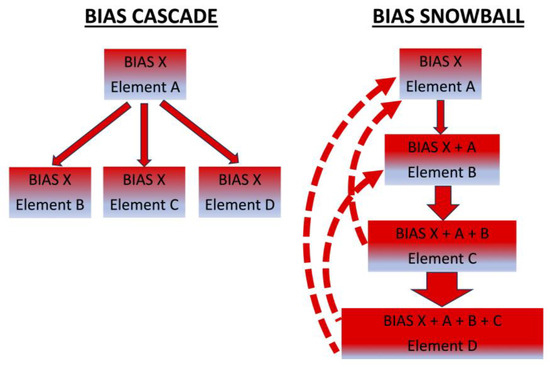
Bias Cascade (left panel) occurs when a bias is introduced and it not only contaminates and impacts that specific element (‘X’ biasing ‘A’ in the left panel of the Figure) but then that same bias (‘X’) cascades to also impact other elements (‘B’, ‘C’, and ‘D’, left panel). Bias Snowball (right panel) occurs when biases accumulate and feed one another. The impact increases as the bias gains greater and greater momentum with more and more biases added. In bias snowball, one bias creates additional new biases, which then support the creation of even more additional new biases, and so forth (including interactive loops adding more bias—the dashed arrows).
define bias snowball
occurs when bias is not just cascading but additional biases are added (as different elements are being biased, they then add a bias that further impacts others), thus increasing the biases as it progresses through the justice and legal systems. Bias snowball is not like bias cascade, which is about one bias cascading to impact other elements, but bias snowball involves more and more new biases being added. As the biases accumulate and interact with one another, they add up and increase in power.
challanges to minimizing bias
the bias blind spot and the implicit nature of cog bias make it hard to acknowledge biases existence, in addition to being transparent about it
errors due to bias may not be apparent- ground truth is often unknown in the justice system- no idea how many people have been wrongfully convicted
adverserial legal system makes i impossive to uncover and acknoelge biasses- fear that acknowldgement will be used against people in court
plea bargains and even dropping charges can be offerend when prosecution realizes that defense will reveal bias against the client
big takeaway from bias cascade paper
as much as possiblem oeople should be blind to biasing ifnormation (ie. fingerprint technicians should not know the clients race or other information about the scene)
if we cant remove bias sources, we shold compartmentalize them so that peeople involved in one aspect of a case do not learn about unrelated information from another aspect of the case
ie. cops should not work as a team with forensic investigators
if we cant seperate things, we also need to think about how we can present info in a sequential way to minimize bias- ie. always present the data first before people discuss it with one another
mandate full transparency so people are reluctant to give irrelevant info or attempt to bias others
talk about the issues with ai and bias
And personalization is the whole pitch. Brisk, MagicSchool, and Khanmigo are already being piloted in classrooms, all promising feedback that adapts to the student in front of it. That promise assumes adaptation is good by default. This study is the first real evidence that adaptation, done without anyone deciding what it should adapt toward, defaults to the same stereotypes a tired, well-meaning teacher falls into on a Friday afternoon- even saw this occur when it was very subtle (ie. a racially stereotypical name as opposed to an overt label like an Indigenous student)
big takeaway: autoamted personalizatioon is not a replacement for a pedagogical design
talk about the 3 types of failure
basic failure- known terriority when a simple error led to the failure
ie. accidentally transfer 900$, not 90$
simple, predictable and preventable
ie. leaving the door open when in a classroom with an eloper- small mistake that leads to huge failure
complex failure- failure with multiple causes
ie. supplu chain breakdowns
multiple basic errors, across different people, decision an actions
ie. did a bad job of unit planning, so all your students didnt learn with enough of a depth of cirriculum in the next grade, and that grades teacher also did a bad job, so by the time kids get to the next grade it is a massive catostrophe because they dont have the knwoeldge base they need and the kids have a gap in their knwoeldge base that continues till they graduate
ie. more and more teachers are quitting early or going on leave of absence- kids experince interrupted learning because every new teacher has a different philosophy and approach so the kids are left behind each time theres a new teacher- lots of factors all over the place
intelligent failure- the right kind of wrong, can lead to new kinds of knwoeldge and discovery
4 criteria for intelligent failure
its in new terriority- we dont yet have the knwoeldge
its in pursuit of a goal
hypothesis driven- not randomly trying stuff
the failure is as small as possible, just big enough to learn from so we dont waste resources
what kinds of experiences do we want kids to have in schools
accouunting for preventable errors and with good, thoughtful decisions and open comunication, trying different solutions to known problems
we want kids to have these experinces in classrooms, and we want teachers to have this- able to use experinces and leanring to know how to do better next time
who do we think like to have intelligent failures
to do this, we have to think like a scientist and welcome the lessons that failure brings
involved expeirmenting with somehting you are not positive will work
what type of situations do intelligent failures occur in
happens in situations where stakes are medium to low- ie. testing in a lab first, not directly on patients
accounting for preventable errors and with good, thoughtful decisions and open communication, trying different solutions to known problems
what do people gget wrong about stakes with mistakes
oftentimes we think the stakes are erroneously high, but this is untrue- a lot of failures are not awful or dangerous, just inconveneint but good because they give us new information
what is a hopeful skeptic
this is what we should aim to be for intelligent failure
means that we are open minded, think like a scientist, but fundamentally believe in the good in others and themselves
approach things with a creative thinking sace- not entirely sure but are open minded and willing to be onvinced
4 types of skepticism/cynicism
hopeful skeptics- open minded, but fundamentally belive that we and others are good. not naive, but willing to listen to new ideas
suspicious skeptics- believe in science and not people- only wants data and wont believe things that arent proven
naive trusters- blindly believe in the good of others but reject scientific evidence- can be closeminded
cynics- end up sicker, poorer and sadder than others, believing neither science nor people can be trusted
t or f- canada has 1 educational system
false- this will be on the quiz- we are one of the only ed systems in the world with 14 educaion systems due to the way our confederation has been formed
what is jurisdiction
jurisdiction- right to make laws or bylaws in a specific area
what is parliment made up of
at the federal level, parliment is made of moonarch, house of commons and senate
the legislative branch is parliment- makes laws and holds gov accounable to canadians
provincial and terrioritial legislations do a similar thing on a smaller scale
who focuses on currency, national defense, criminal law and the postal service
federal gov
who focuses on healthcare, education
the provincial gov (indg ed is handled poorly by the federal gov)
who handles libraries, city parks, and publiic transit
the municipal gov
what is the role of each level of gov in education
provincial goc
fund and legislate public, seperate, and independent/private schools
education system mainly falls under provincial gov- they will fund and come up with policies related to schools
federal gov
resp. for indg reserve education- jordans principle came from federal gov underfunding indg reserve education, schools in prisons, and in the military
tend to follow same cirriculum as the provincial gov of the nation, but dont actually have to
school baord trustees- elected during municipal elections and are accountable to specific boards
the one employee of the school board trustees is the superintendent, and they run everything
people elect trustees—> trustees employ a single person, the superintendent
talk about legal pluralism in canadas legal system
canada has common law (from england)
civil law (quebecs is from france)
indigenous laws and treaties like the great law of peace and wampum, great law of peace
what is the basis of canadas legal system
english common law, french common law, haudensaunee great law of peace
which court in canada has the final say on every court case
the supreme court of canada
who writes laws in canada
elected representatives
what are laws
written rules in legislation, regulations, policies, codes,and by-laws at the federal/provincial/municipal level
what documents have the same onus/power as supreme court decisions in canada and why
treaties are federal legislation- they imapct all fo us because they pre-date canada itself- they are the same as an outcome from the supreme court of canada
what document decides division of power
canaian constitution has the final say for division of power- division of power determines who writes which laws
when was the charter of rights and freedoms added to the consitition
1982- this will be on the quiz- every decision befor 1982 didnt have to take into accouunt the charter of rights of freedoms, and every decision after did have to take it inot account
t or f- overlap between the 3 levels of gov is common, and can be confusing
true
who enforces legislation
enforced by the police or others charged with enforcement and then legality is determined via legal tribunals and courts
case law
used to help interpret legislation, previous cases are used to either support or deny current legal cases. judges make decisions that are in line with previous rulings, but can also make changes
____ legal cases render decisions that become the basis of future cases- ie. banning corporal punishment in canada
landmark legal cases render decisions that become the basis of future cases- ie. banning corporal punishment in canada
what do we use as a reference for legal cases?
case law is like the reference sof current cases- shows what has happened in the past, and helps inform how future decisions can be made
look at previous court decisions fromthe past and use them to help inform the decisions about the current case in front of them
unless there is a big change- ie. in 2001 corporal punishment became ilegal, so case law rhat used corporal punishment could not longer be used for ifnormation by a judge trying to determine the best outcome for a case
talk about the structure of legal systems in canada
supreme court- federal and final court of appeal
provincial and territorial courts- superior court is highest level in the provincial system
tribunals- not a part of the court system, but play a vital role in resolving issues
most likely to see as a teacher via the teaching commission- this happened in 2022- the tribunal used to be run by the ATA and other teachers would determine if stuff was against the code of conduct, but now it is part of the provincial gov and is made up of community members
who decides how legislation will work in practice
the courts
talk about lower arbitrition/court panels
lower court/arbitration panels can be appealed to the next level. in education that means that commission decisions can be appealed in provincial court
when is the last time you can appeal a court decision
federal supreme court- they have the final say
what tells you how specxific laws should be interpreted, and are these subject to change over time?
court decisions tell you how specific legislation is to be understood in practice
words and common meanings/practices become very important when decisions are made
menaing of laws can evolve over time and context via judgements
sometimes a very big leapp will change the fundamental enforcement of a law (ie. corporal punishment)
education can be understoof as a…
legislative portfolio
teachers are accountable to… (list 7 thing)
constitution of 1867 (federal)
charter of rights and freedoms 1982 (federal)
education act from 2023 (provincial)
professional codes of conduct for professionals (provincial)
teaching competency standards (provincial)
health and safety bylaw (municipal)
school board policies (municipal, adapted frrom provincial)- ie. ai use
what act explained language rights in canada
constitution act/BNA act- enshrined that there are english rigths and french rights, which has been exapnded to inlude indg language rights and other language rights. also enshrines that there will be both public and catholic schools which is why there is a dual system (sct 93)
what is problematic about the nonwithstanding clause
the charter of rigthd and freedos changes how legislation was enacted over time, ebcuse we had to consider peoples rights and freedoms everytime legislation was enacted and enforced
ie. the notwithhstanding cause is problematic because it can be used to limit individual rights and freedoms
why are we all treaty people
because treaties were negotiated between indg and non indg peopel
what did the indian act do in the legal system
indian act took away trad. gov systems and iimposed a chief and council sysstem, and a pass system which wouldnt let people off of the reserves withouut permission, prevented them from hiring lawyers, etc.
what is unceded land
land where no indg treaties were made
t or f- treaties follow provincial borders
treaties are not bound by provnicial borders- treaty 6 crosses alberta and sask. into manitoba
what is problematric about how treaties have been interpreted, and how does this relate to reconciliation
supposed ot be upheld in the traditional spirit, but we have to make sure this is how ti is upheld- not being upheld like it is today where the federal gov will only pay for kids education if they are on traditional reserve land
part of reconciliation is to honor the treaties as integral to canadian law
what treaty area are we in
treaty 7
what 3 legal systems have been combined ot make the current canadian legal system
english, french, and indigenous
who creates, who enforces, and who enlivens laws
created by elected politicianms, enforced by police, enlivened by courts
what governs our relatinoships with eachother and our acceptable public behavior
legislation
how do we avoid legislative pitfalls in education
by making thoughtful decisions in classroom based on evidence and court rulings, we can avoiid legidlative pitfalls
what makes us unique
opinions
what type of profession is teaching
a moral and ethical one
what are the core values of education
core values are honestt, fairness, compassion, respect, patience, respect, iimpartiality, care and dedication
who provides a model of appropriate behavior, speech and dialogue for students
teachers
where are expected teaching ethics stated
the professional code of conduct
decision making is like an …
iceberg- lots of things go into it
4 drivers of decisions (maybe need to rewatch video?)
unconscious thoughts
minds process tons of info fast via heuristics- these are like mental shortcuts- can lead to distortions to thinking (ie. biases)
unthinking custom and practice- society, families, culture, etc. alll have sets of beliefs about whats right and wrong- can easily absorb them without ever stopping to ask if we agree with them or if hey are valud
ethical decision making profile- ie. some people focus on relationships, some focus on outcomes, etc.- can lead us to fail to consider other ethical issues
reflective practice- most important- this is conscious decision making- considers context and is guided byy values and principles, and exercises our imagination by thinking about what is possible
we are driven more heavily by the first 3 drivers of decision making
ethics- consicous practice of making decisions- important because so much of our decision making is unconscious- if we cannt id. our bad decisions it is hard to make good ones
talk about a job vs a profession
job- series of predictable tasks
employer/employee
decisions controlled externally
limited autonomy
rouotine
profession
disciplinary knowledge
subjective and idscretionary judgement
situational sensitivity and autonomy
professional instinct or intuition
decision capital- up to you to decide what is most important, what order we do it in, and how kids will be assessed fairly
conduct and competence frameworks unperpin ethical and moral responsibilities (ie. TQS, code of conduct, etc.)