Small Freshwater Fish Families
 Call Kai
 Learn
Learn Practice Test
 Spaced Repetition
 Match
Match Flashcards
 Knowt Play
1/33

There's no tags or description
Looks like no tags are added yet.
Name | Mastery | Learn | Test | Matching | Spaced | Call with Kai | Chat |
|---|
No analytics yet
Send a link to your students to track their progress
34 Terms
Ichthyomyzon bdellium (Petromyzontidae)
A continuous dorsal fin, well-developed dentition, large body size, and a large buccal funnel. Parasitic.

Ichthyomyzon fossor (Petromyzontidae)
Similar to I. bdellium in dorsal fin shape, but has a smaller body size and smaller buccal funnel. Nonparasitic.

Lampetra aepyptera (Petromyzontidae)
Our most common lamprey has a notched dorsal fin, poor dentition, and a tiny buccal funnel. Nonparasitic.

Lampetra aepyptera (Petromyzontidae) ammocoetes

Acipenser fulvescens (Acipenseridae)
Thick caudal peduncle and no caudal filament

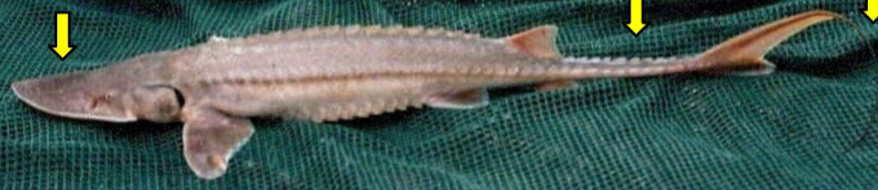
Scaphirhynchus platorynchus (Acipenseridae)
Slender caudal peduncle and a caudal filament coming off tail
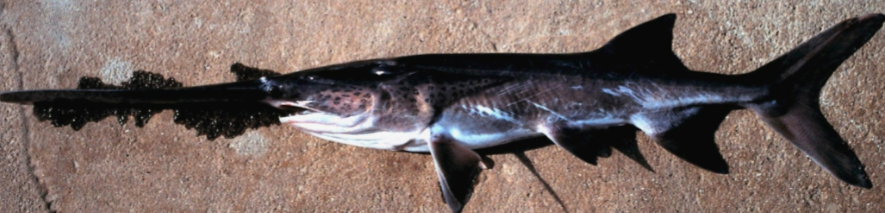
Polyodon spathula (Polyodontidae)
The paddle-shaped rostrum is unique
Atractosteus spatula (Lepisosteidae)
This is Kentucky’s largest fish (10 ft long and 300 lb). It was extirpated but has been reintroduced into extreme western Kentucky. It has the broadest snout of any of the gars.

Lepisosteus oculatus (Lepisosteidae)
Medium width snout with large spots on top and sides of the head.

Lepisosteus osseus (Lepisosteidae)
Long, slender snout, about 10 times as long as broad.

Lepisosteus platostomus (Lepisosteidae)
Medium width snout with no spots on the head

Amia ocellicauda (Amiidae)
Note the gular bone (under the chin), cylindrical body, and long dorsal fin.

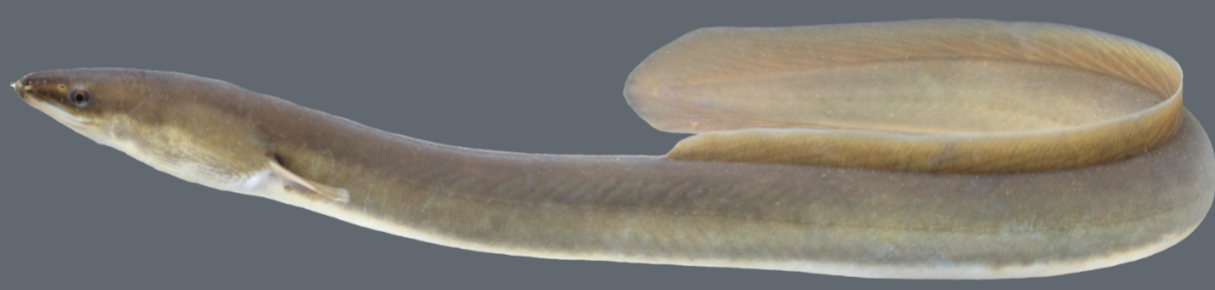
Anguilla rostrata (Anguillidae)
Hiodon tergisus (Hiodontidae)
Superficially like shads and herrings but have toothed tongues
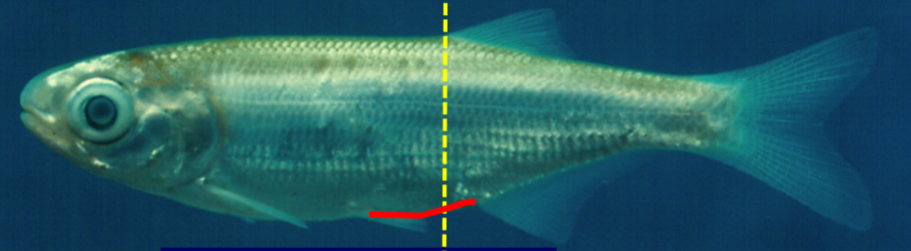
Alosa chrysochloris (Alosidae)
This predator lacks the elongated last dorsal ray. It also has a very large mouth.

Dorosoma cepedianum (Dorosomatidae)
More rounded snout that overhangs the lower jaw.

Dorosoma petenense (Dorosomatidae)
The lower jaw extending in front of the upper jaw

Esox americanus (Esocidae)
Relatively small; cheek and operculum fully scaled; suborbital bar present and usually slightly angled posteriorly; mottled on sides; branchiostegal rays 11-12.
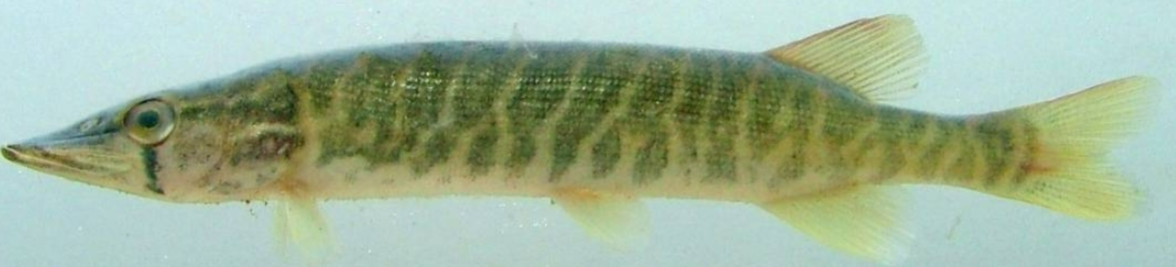
Esox masquinongy (Esocidae)
Relatively large; cheek and operculum scaled only on dorsal half; suborbital bar absent; dark spots or bars on sides; branchiostegal rays 17-19
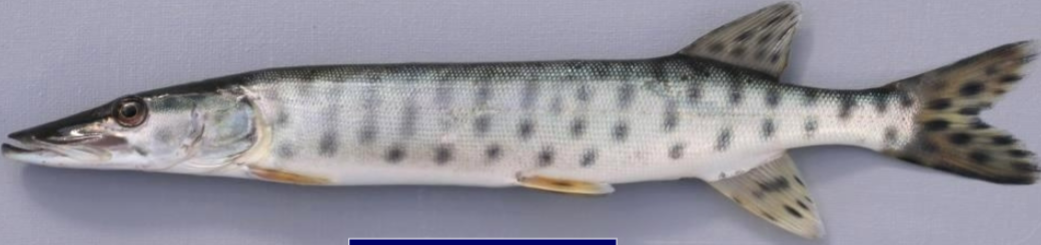
Umbra limi (Esocidae)
Note the black vertical bar at the base of the caudal fin and the posterior position of the dorsal fin.

Oncorhynchus mykiss (Salmonidae)
Lacks white edges on paired fins and has a spotted caudal fin as an adult. Dark spots on side usually not surrounded by a pale halo

Salmo trutta (Salmonidae)
Lacks white edges on paired fins and does not have a spotted caudal fin as an adult. Dark (red in life) spots on mid-side often with a pale halo around them.
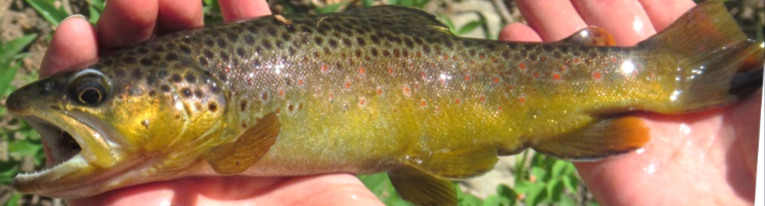
Salvelinus fontinalis (Salmonidae)
This beautiful fish, the only trout native to the eastern U.S., has white edges on the paired fins. Dorsum with pale spots or vermiculations on a dark background.

Percopsis omiscomaycus (Percopsidae)
This small fish has a subterminal mouth, an adipose fin, and sides pale with a few black spots
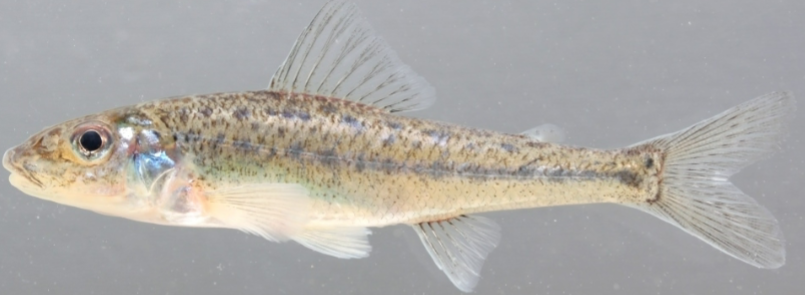
Aphredoderus gibbosus (Aphredoderidae)
Check out the position of the anus on this fish

Forbesichthys papilliferus (Amblyopsidae)
Pale fish with tiny eyes that live near mouths of caves

Typhlichthys subterraneus (Amblyopsidae)
This cave-dwelling fish has no functional eyes and is completely devoid of pigment

Labidesthes sicculus (Atherinopsidae)

Menidia audens (Atherinopsidae)

Fundulus cryptocatenatus (Fundulidae)
Note the thin horizontal lines on the sides. The male in early summer is one of the most spectacular of Kentucky’s fishes
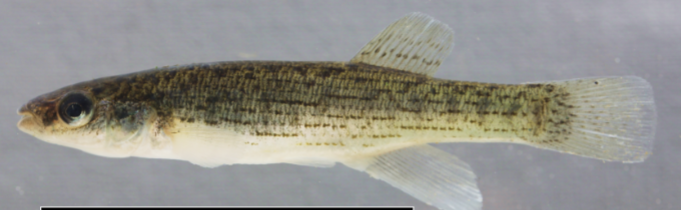
Fundulus notatus (Fundulidae)
This can be difficult to distinguish from F. olivaceus. Both have a dark, wide lateral stripe. In F. olivaceus, the black spots on the side are dark and numerous. In this, black spots on the side are lacking or not at dark as the lateral stripe.
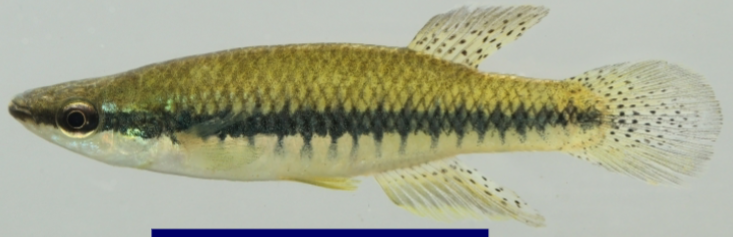
Fundulus olivaceus (Fundulidae)

Gambusia affinis (Poeciliidae)
A tiny fish with a dark triangle under the eye, distinctive cross-hatching on the side, superior mouth, and posterior dorsal fin. Males have an elongate anal fins

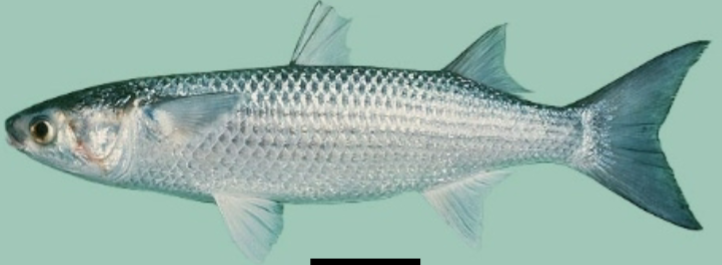
Mugil cephalus (Mugilidae)
Note the stripes (or rows of spots) on the side, two separate dorsal fins, and a rather dorsal position of the pectoral fin.