Biolchem Exam 1 Lecs 1-5
 Call Kai
 Learn
Learn Practice Test
 Spaced Repetition
 Match
Match Flashcards
 Knowt Play
1/136

There's no tags or description
Looks like no tags are added yet.
Name | Mastery | Learn | Test | Matching | Spaced | Call with Kai | Chat |
|---|
No analytics yet
Send a link to your students to track their progress
137 Terms
What is Biochemistry
Understand a system @ molecular level
Into component parts
Study isolated components, & reconstruct from isolated components
In the structures of life, there are ___ major biomolecules, what are they?
4
Proteins
Carbohydrates
Lipids
Nucleic Acids
Energetics of Life: ______
Thermodynamics (Free Energy, G)
What makes a rxn/pathway favorable?
What is required to drive unfavorable rxn/pathway?
What are the 4 most abundant elements of life? Their % of total atoms?
CHON (99.4% total atoms)
What are the most abundant atoms of life?
What atoms appear in structure of nucleic acids and proteins?
What ions play an important role in metabolism?
CHON (99.4% of total atoms)
P & S
Metal ions (Na+, Cl-, K+, Ca2+, Mg2+, & trace elements for metabolism)

Identify Abdundant, Moderate, & Trace elements in life

CHON abundant, 3 below moderate (PSCl & left sided ions), rest are trace
» Carbon forms ___ bonds
» ___ & ___ bonds most common
» Free rotation around ___ bonds
» Double bonds (sp2 trigonal planar) are limited in ___, w/ atoms in a ___ plane
» 4 covalent bonds
» Single & double bonds
» Free rotation around single bonds (sp3 tetrahedral)
» Double bonds limited in rotation, w/ atoms in a single plane
Stereoisomers:
Can it interconvert w/o breaking bonds
Same chemical formula & connectivity, differ in 3-D orientation of atoms
Can have diff physical, chemical, & biological properties
No, must break bond to switch
Enantiomer:
Chiral center/stereocenter:
Cis-trans isomers:
Nonsuperimposable mirror image bc stereocenter
C w/ 4 diff substituents
In double bond
Biomolecule chemical properties are decided by ___________
Oxidized species:
Reduced species:
functional groups
Oxidized species: More bonds to O, fewer to H, less e-
Reduced species: Fewer bonds to O, more bonds to H, more e-
Oil Rig & assign -1 to more eN atom in bond, +1 to other
Review functional groups


Note guanidium is arginine
Gibbs Free Energy
Equation & variables, – & + ΔG
What does coupling do
Direction & spontaneity of rxn
H: Heat
S: Entropy, disorder
T: Temp (in kelvins, usually +)
- Downhill process→ – ΔG (Gf - Gi), spontaneous & favorable, released energy
- Uphill process→ + ΔG (Gf - Gi), non-spontaneous & non-favorable, increased input energy
- Unfavorable rxns can couple to favorable rxns

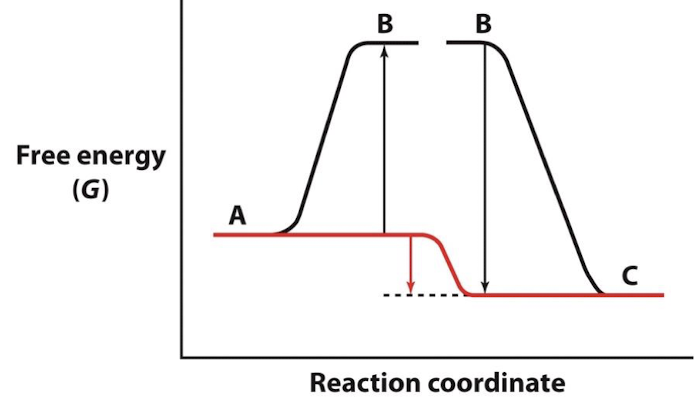
How do the following impact ΔG spontaneity
-ΔG
-ΔH
+ΔS

◦ Protein:
◦ Nucleic Acid:
◦ Carbohydrates:
◦ Lipid:
Is Lipid a polymer?
◦ Protein: Linear polymer of Amino Acid
For signal transduction, catalysis, energy production, structure, adhesion, motility, immunity
◦ Nucleic Acid: Nucleotide monomers (RNA & DNA)
Genetic info, energy, catalysis
◦ Carbohydrates: Sugar mono, di, poly saccharide monomer
Fuel source, energy store, adhesion, immunity
◦ Lipid: Hydrophobic, water insoluble
Membranes, fuel & energy source, signaling
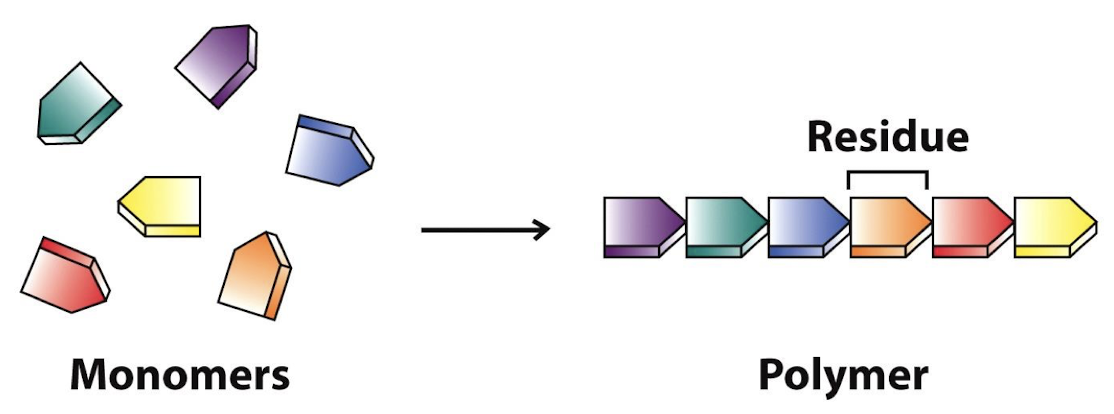
Polymers provide ____ from ____
# possible oligomers: ?
Polymers→Combinatorial diversity from limited building blocks
# possible oligomers: (Monomers)length
In terms of linkages,
Protein:
Carbohydrate:
Nucleic acid:
Protein (dipeptide): Peptide bond (amide)

Carbohydrate (disaccharide): Glycosidic (joins a Carbohydrate sugar to something else) bond (acetal/ketal)

Nucleic acid (dinucleotide): Phosphodiester bond

Polymers built by ___ rxns (_____ H20), broken down by _____ rxns (____ H20)
Polymers built by condensation rxns (release H20), broken down by hydrolysis rxns (require H20)

Nucleotide consists of…
Phosphate + 5 C sugar saccharide (RNA or DNA at C2) + Nitrogenous base
Bases: 2 purines (AG) & 3 pyrimidines (CTU)


Nucleotides can have one (mono-M), two (di-D), or three (tri-T) ____, attached @ C___?
“d” in dATP indicates what?
(Mono-M), two (di-D), or three (tri-T) phosphates, attached @ C5
“d” indicates deoxyribose

DNA is the ____ for most organisms
Some viruses have ___ genomes
DNA is the inherited genetic material for most organisms (the genome)
Some viruses have RNA genomes
The genome contains all info needed for organism function
What is the central dogma
DNA → RNA → Protein
Transcription Translation
(Francis Crick)
Replication:
Transcription:
Translation:
Replication: DNA is copied each time a cell divides into two new cells
• Transcription: DNA sequence is copied into an mRNA (messenger RNA)
• Translation: RNA sequence is decoded into a protein (amino acids)
Interactions between biomolecules are ___
Chemical structure of macromolecules determines ____ (& list examples)
Amphipathic & how that leads to bilayer?
Stereospecific (w/ specific chirality)
Structure determines function
Proteins have binding sites to catalyze rxns
Nucleic acids fold into complementary double stranded structures
Amphipathic: Have both hydrophobic & hydrophilic parts, hydrophilic head & hydrophobic tail
Form hydrophobic barrier between two hydrophilic sides
Head points to aqueous environment, no water in barrier
Allows for compartmentalization inside cells

The plasma membrane is what?
Plasma membrane is ____ to polar molecules
Transporters/channels in membrane allow for _________
Lipid bilayer
Plasma membrane is mostly impermeable to polar molecules
Transporters/channels→selective permeability

All living cells have:
Nucleus in ____, nucleoid in ____ hold ____.
Cytoplasm vs cytosol
Cytoplasm organized by what?
Nucleus in eukaryotes (membrane bound)
Nucleoid in prokaryotes, open/unmembraned
Hold DNA
Cytoplasm is everything inside the cell membrane excluding the nucleus (in both prokaryotes & eukaryotes)
Cytosol is the jelly water
Cytoplasm organized by cytoskeleton
Eukaryotic cells have what?
Membrane bound organelles (mitochondria, chloroplasts)
Nuclear envelope surrounding nucleus

Mitochondria: Energy extraction
ER & Golgi: Synthesis, processing, & sorting lipids/proteins (UPS Truck)
Endosome: Endocytosis, bits of bilayer taken inside
Lysosome: Waste and recycling macromolecules
Vacoule: Storage (large in plant cells)
Chloroplast: Photosynthesis
Cytoplasm is everything inside membrane but nucleus, cytosol is only the liquid. Both prokaryotes & eukaryotes have both cytoplasm & cytosol

Cell Wall: In plants, turgor
From last common ancestor, what emerged?
Bacteria, archea, & eukarya

Prokaryotic cells are not structured: True or false & why?
False, highly structured
Genes defined positions in nucleoid
Protein positions specific in cell
Bacteria have primitive cytoskeleton
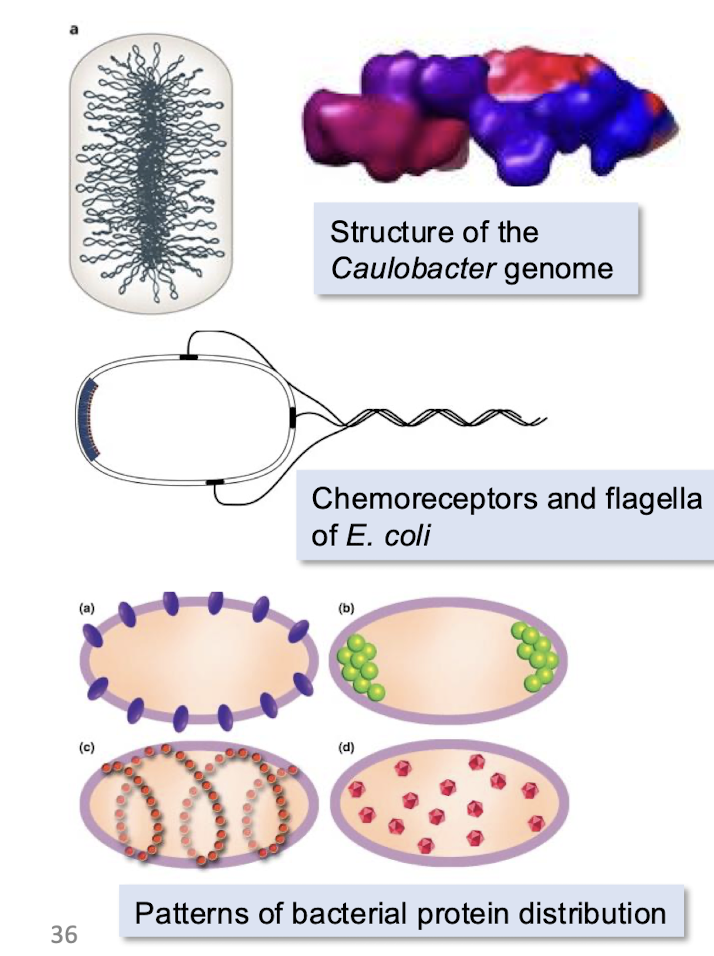

Scale of things

Lec 2 Begin
Noncovalent Interactions
What are these interactions dependent on?
4 kJ/mol = ? Kcal/mol
(Decrease in strength 10x)
Electrostatic interactions (ionic bonds, salt bridges)
Ionic Interactions: Between 2 charged atoms (strongest)
Dipole-Dipole: Between polar molecules
LDFs (Induced dipole-induced dipole & Van der Waals): Weak, temporary attractive forces
4 kJ/mol = 1 Kcal/mol


Interactions→Distance-Dependent
What are electrostatic interactions
What are they called in proteins?
What are they dependent on? Equation for it? Variables?
Ionic interactions between 2 full charges
Called salt bridges in proteins
Distance-dependent



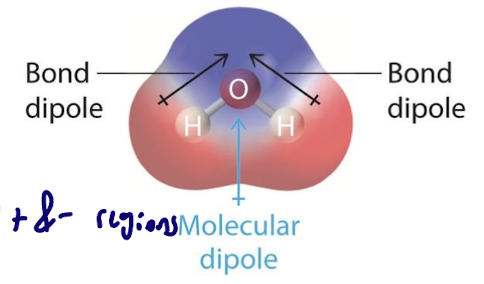
Dipoles, in ________ bonds have a difference in ______ and ______ between atoms.
Must be ______.
Dipoles, in polar covalent bonds have a difference in electronegativity and electron distribution between atoms
One end is δ⁺ (less e- dense) and other is δ- (more e- dense)
Must be asymmetric (not cancel out)

Are these polar or not, and why?

CO2 nonpolar, no net dipole
H20 is polar, has net dipole toward Oxygen
Dipole-Dipole Interaction
Attraction between permanent dipoles

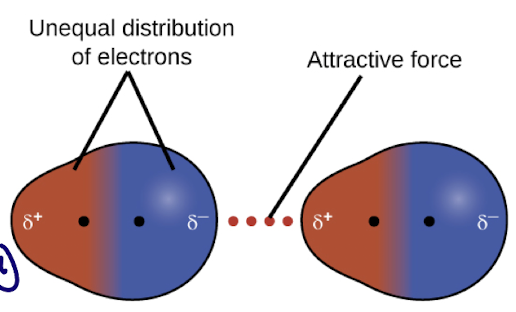
Ion Dipole Interaction
Polar molecules orient around charged ion

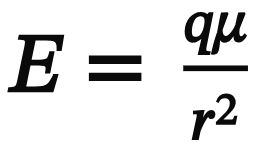
Cation-π Interaction
π system in double bond (like aromatic ring) has δ- below & above plane of atoms
Cations near face attracted

Induced Dipoles
Where can the charge come from (…-induced dipole interaction)?
Eqn for London Dispersion Forces?
Nonpolar molecule’s e- cloud shifts when charge near, temporary partial charge “induces dipole“
Charge can come from ion (ion-induced dipole interaction), permanent dipole (dipole-induced dipole interaction), or another induced dipole (induced-dipole-induced dipole interaction) known as LDF
LDFs equation E=α1α2/r^6

Van der Waals Interaction?
Van der Waals Contact Distance?
Is one weak or strong?
What is stabilized by Van der Waals Interactions?
Attractive force when two non-bonded atoms close (LDFs), but too close→repel
Van der Waals Contact Distance: Min energy (max attraction & stability), “bottom of energy well“
Depends on radius/size of atoms
One is weak, many are strong

Van der Waals stabilizes interiors of tight macromolecule
Hydrogen Bonds? Covalent character percentage?
What is typical bond strength
Does direction matter?
Dipole-dipole w/ covalent-bond character (≈10%)
Small & close
e- orbital overlap
H-FON
Bond strength 8-20 kJ/mol, 2x avg dipole & 2-5% of covalent bond
H-bonds are directional

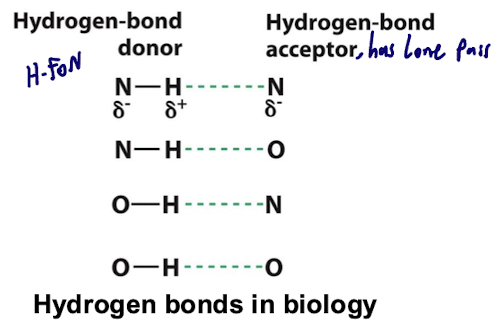
Is H20 SP2?
How many H-bond donating & accepting sites?
Water has _____ mp/bp, why?
Solid water is _____ dense than liquid water, why?
No, H20 is SP3 & polar
2 H-bond donor sites & 2 H-bond acceptor sites

Water has high mp/bp bc of H bonding
Solid water is less dense than liquid water, bc ice has more H-bonding (all 4), more space.
Liquid water has ___% more/less H-bonds than ice
15%, less

Give 3 examples of H bonding in biological systems.
Base pairing in DNA & RNA
Protein structure stability in amide backbones
H-bonding activating nuc in protease active site
Water is a ____ solvent, meaning _____ compounds dissolve in it.
What dissolves in water, and what does not?
Water is a polar solvent, meaning hydrophilic compounds dissolve in it
Polar AA, carbs, nucleic acids, & OHs dissolve in water
Aliphatic chains, aromatics, & lipids don’t dissolve (hydrophobic)
Dissolved ions & polar solutes surrounded by __________ of ________
To interact, solutes must ____ to interact in polar solvent
Hydration shell of water molecules
Desolvate
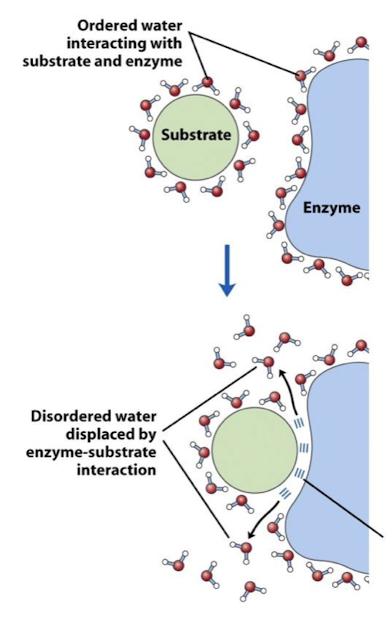
Hydration shell favorable w/ polar solute (interaction, increased enthalpy), nonfavorable with nonpolar solute (bc entropy)
Nonpolar solute in water→what forms?
Why is it thermodynamically unfavorable?
Hydration shell forms
Unfavorable bc water trapped surrounding non-polar solute, lower entropy (no H bonding or dipole-dipole interactions between solute & water)
Thermodynamically unfavorable bc water entropy ↓, water cannot dance freely, so ↑ΔG (non-spontaneous & non-favorable)
What happens when oil + water
What drives this?
Nonpolar oil comes together, oil layer and water layer.
Minimizes oil molecules having hydration shells (unfavorable), want smallest SA.
Hydrophobic effect, not interaction bc no attractive force, entropy-driven (to free up water so it can freely dance ↑S, not bound in hydration shell (↓S). Avoid hydration shell
Hydrophobic effect drives what?
Protein folding: Hydrophobic AA don’t interact w/ water
Lipid Bilayer: Hydrophobic tails don’t interact w/ water
Ka Eqn
Henderson-Hasselbalch Eqn
When pH=PKA, what does that mean?


pH=PKA, [A-] = [HA], amount protonated species = deproted species
pH larger than PKA, deprotonate
pH less than PKA, protonated
Slide 22 & 23 for the pH/PKA charts review
What is a buffer
What range is a good buffer
Buffer maintains & resists change in pH.
Mix of weak acid [HA] & conjugate base [A-]
Good buffer range is pH=PKA±1

What are the 3 biological buffers must know?
Phosphate (H2PO4-) → PKA = 7
Bicarbonate (HCO3-) → PKA = 6 (for blood)
Histidine → PKA = 6.6
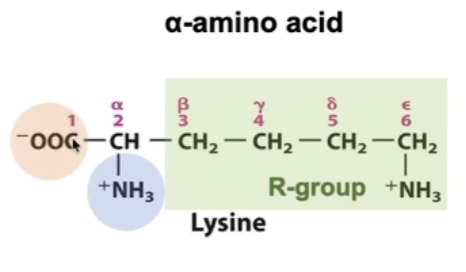
In an amino acid, the amino group (R-NH2) is ____ and the carboxylic acid is ____
What is C1?
What is the alpha carbon?
In an amino acid, the amino group (R-NH2) is basic and the carboxylic acid is acidic.
Carboxyl carbon is C1
Alpha carbon is in the middle (C2)
Explain the CORN rule
Using D or L amino acids for translation?
Place the H in the back then trace out the carboxyl → R group → Amino group (CO-R-N):
Counterclockwise is L (think negative, left-hand)
Clockwise is D
Diff bc does not recognize priority groups like R/S does
Only L Amino Acids for translation

Practice CORN Rule

Explain Fischer Projection (orientation & direction)?
Which side is L or D?
Carboxyl on top, R on bottom, heteroatom (non C/H) & H on horizontal
Horizontal hugs you (coming forward), top/bottom backwards
Heteroatom on left → L
Heteroatom on right → D

Assign L or D based on Fischer projection

Enantiomers ____ plane polarized ____ in ____ opposite direction.
Do L & D indicate direction of rotation? What does?
What does not rotate light?
Chiral molecules have ____ interactions (give example)
Enantiomers rotate plane polarized light in opposite direction.
L & D do not indicate direction of rotation? +/- do
Racemic mix does not rotate light
Chiral molecules have stereospecific interactions (diff functions)
Only 1 enantiomer of ibuprofen gives anti-inflammatory effect, other is filler
Isoelectric point
Zwitterion
All AAs have at least ___ ionizable groups
pH @ which net charge is 0
Molecule least soluble in water here,
Zwitterion: + & - charge on same molecule, net neutral
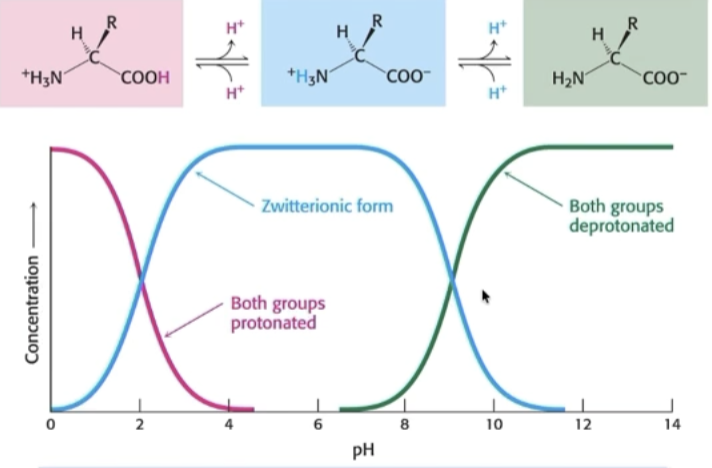
All AAs have at least 2 ionizable groups (amino & carboxyl)
Pick up on part 2 of Lec 3, grind & finish lecs 4 & 5 today. Finish practice 1, and do 2 & 3. Then discussion 1 redo!
Soc reading
EEB reading
Out of the aromatic PTT, which one is polar?
What is the only achiral AA
Tyrosine, bc has OH
Glycine (bc R group is H)
Why is Glycine helpful
What are the 2 simplest AA?
Bc R group is H (small), helpful for tight turns in polypeptides.
Glycine & Alanine simplest AA
What 2 AA are structural isomers
Which AAs has two stereocenters?
What AA causes a bend/kink in polypeptide chain?
What AAs can be phosphorylated?
Leucine & Isoleucine structural isomers (same formula, different connectivity)
Iso meaning same as Leucine, just CH3 moved up to the side
Isoleucine & threonine has 2 stereocenters
Proline causes bend/kink bc limited rotation between C alpha — N, cyclic
Hydroxyls in Serine, Threonine, & Tyrosine can be phosphorylated.
Aromatic AAs can engage in ___-___ interactions, and they _____ UV light at _____ nm for most proteins
Aromatic AAs can engage in π-cation interactions, and they absorb UV light at 280 nm for most proteins.

Aside from PTT, what is one aromatic AA (has another property thus not in PTT)
Histidine (HALGA) is + charged (but basicity & + charge considered more significant)
Cysteine sulfhydryl is ____ & ____. Has PKA =
Ionized forms ___
Oxidized forms ___
Cysteine sulfhydryl is ionizable & redox-sensitive.
PKA 8.3
Ionized forms thiolate (S-), deproted
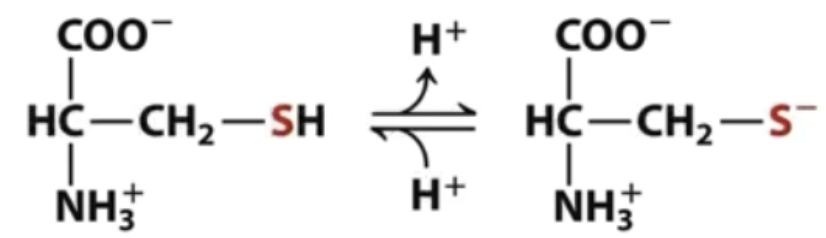
Oxidized forms disulfide bridge

Asp & Glu, because of their negative charge, can form what?
Salt bridges with basic amino acids (being opposite charge w/ H bonding)
PKA impacted by _____
Give an example using Lysine
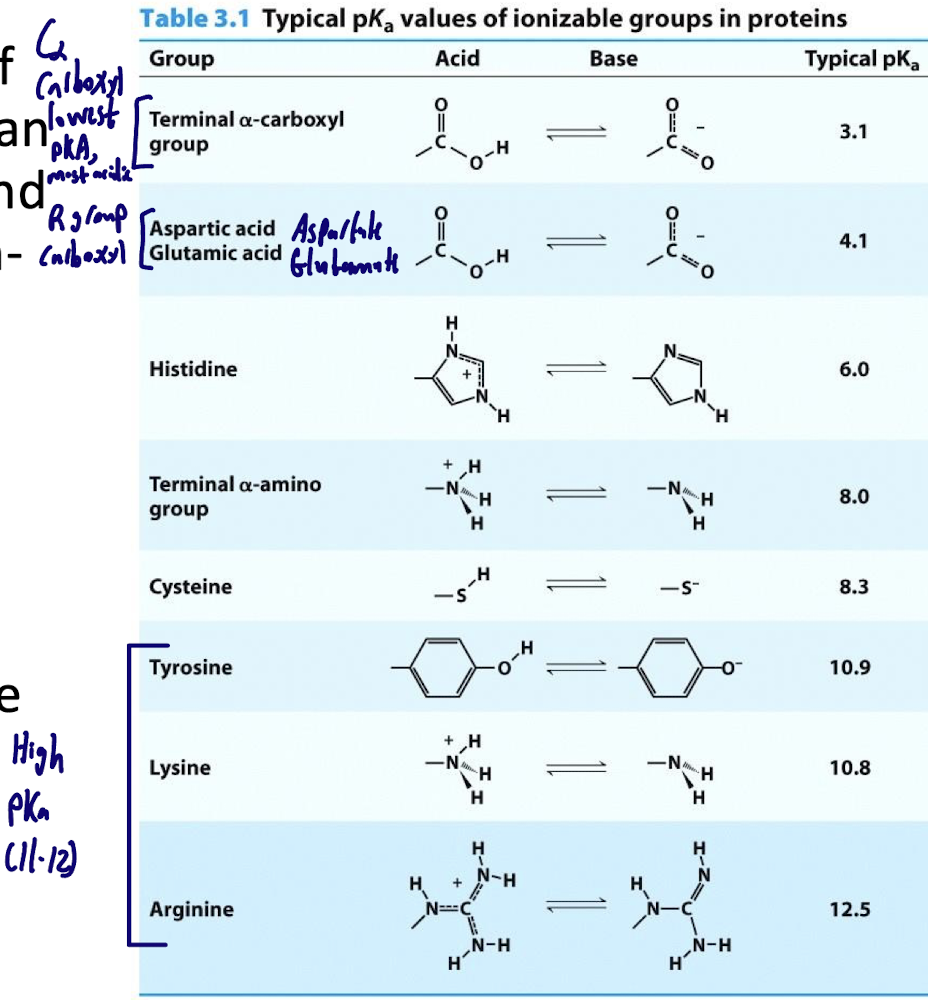
List the gist of PKAs to know in relation to each other
PKA impacted by local environment
Lysine in a hydrophobic environment does not want to be + charged (polar & hydrophilic), so it will be deproted (↓ PKA)
Arginine, Lysine, & Tyrosine have highest PKA
C alpha Carboxyl has lowest PKA (most acidic) followed by R group’s carboxyl.
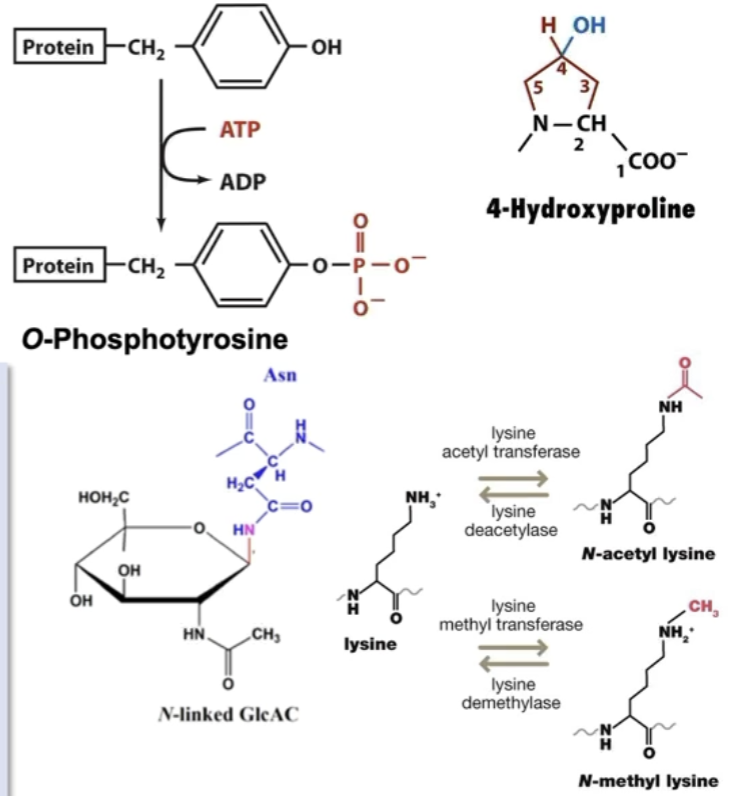
List post-translational Amino Acid modifications, what they do?
What are the 2 non-standard AAs (encoded)
Phosphorylation: Adding phosphate group on OHs
N-acetylation: Acetyl group (usually to Lys)
N-methylation: Methyl group (usually to Lys)
Glycosylation: Adding carbohydrate
Lipidation: Adding lipid
Selenocysteine & Pyrrolysine

___ amino acids are essential, what are they?
____ amino acids are non-essential, what are they?
How many can bacteria make?
9 essential (from diet), 11 nonessential (synthesized in humans)
Bacteria make all 20
Don’t need to know them yet, needed for Exam 3
Amino (NH3+) & Carboxyl → Forms ____ in a ___ rxn
Peptide bond is between ____ & ____
Peptide vs. polypeptide?
Amino (NH3+) & Carboxyl → Forms Amide in a condensation rxn
Peptide bond is between carbonyl & NH

Peptide is short chain of AA
Polypeptide: Chain long enough to fold into functional protein
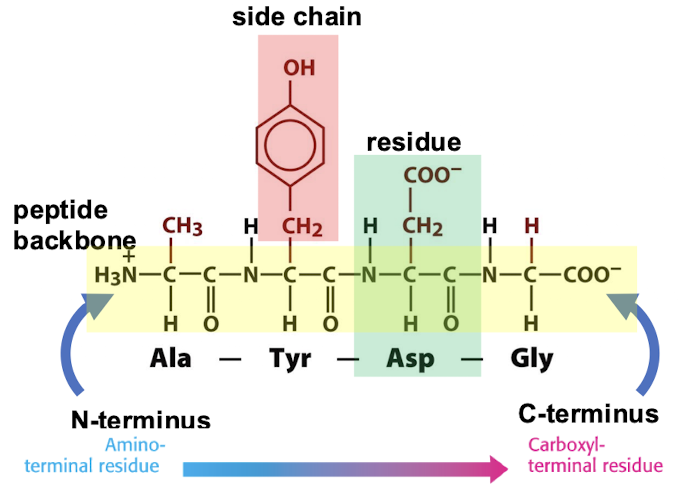
What is a protein sequence? How is it read?
What is a residue?
Peptide backbone vs side chains?
Protein sequence: Order of amino acids
Read from N-terminus to C-terminus, (matching addition in translation)
Residue: Individual amino acid
Backbone is N-Cα-C (carbonyl) → N-Cα-C-N-Cα-C
Side chains: R groups attached to backbone
Primary Structure
Order of amino acids

Secondary structure
Backbone of a polypeptide, alpha helices & beta sheets (backbone H bonding), excludes R group

Tertiary Structure
What types of interactions (4)?
Specific to what?
3D shape/folding based on side chains

How secondary structures are oriented/folded.
Depends on R group residue side chain interactions:
H-bonding (polar)
Hydrophobic packing (nonpolar)
Disulfide bonds, covalent linked between 2 Cys
Salt bridges, (ionic interaction in proteins)
Specific to water-soluble globular proteins
Quaternary structure
What is a subunit
Multi-subunit Proteins described by ____ (give examples)
What is trimer of dimers?
Multiple polypeptide chains
Subunit: Single polypeptide chain
Multi-subunit Proteins described by their numbers dimer (2), trimer (3), tetramer (4)
Combos → Trimer of dimers (3 groups of 2 subunits)


Polypeptides ____ into unique shape to form protein, undergo ____ changes by rotating around covalent bonds. Stabilized by ____ interactions.
Polypeptides fold into unique shape to form protein, undergo conformational changes by rotating around covalent bonds. Stabilized by noncovalent interactions.
Conformational Change
By rotating around bond (unrelated to stereochem)
Rotating around covalent bond is _____ or _____.
What are the 3 repeating dihedrals in backbone?
Dihedral angle or torsion angle.
Phi (Φ): N-Cα
Psi (Ψ): Cα-C
Omega (ω): C-N (peptide bond, top right
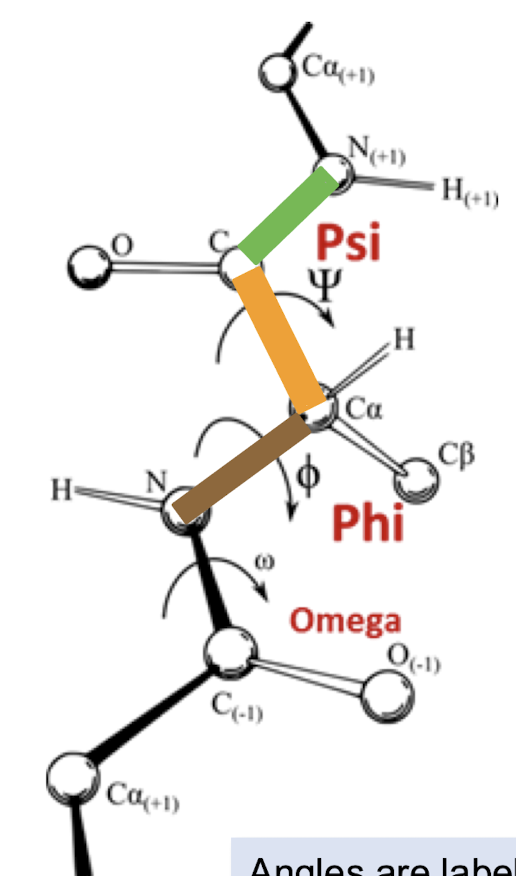
In angles for Ramachandran, which is CW & CCW from + & -
Clockwise (+)
Counterclockwise (-)
Is there rotation around amide bonds? Why or why not?
Amides→double bond character, shorter bond, SP2 trig planar), can’t rotate around double bond

So Phi & Psi rotate, what does not?
6 atoms lie in peptide bond plane, no rotation (only rotation from Cα to Cα)
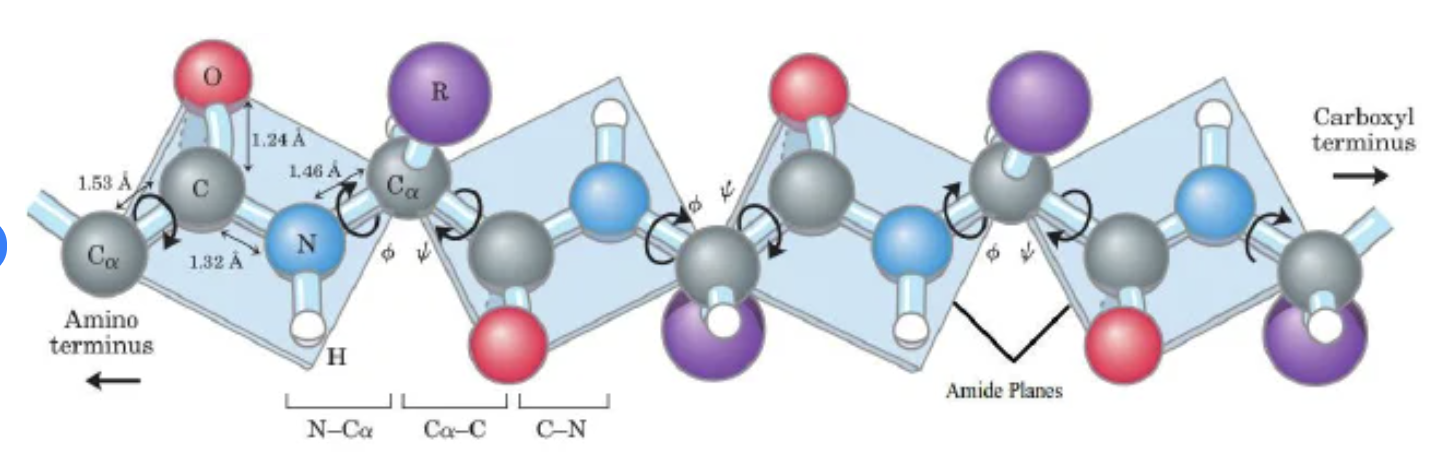
Peptide bond, C-N cannot rotate (partial double bond strcture)
Peptide bond (ω) can only be what angles?
ω only 0 or 180 bc is planar & no rotation
____ conformation in peptide bond is favored, by how much?
Trans (180o) favored, w/ Cα & Cα opposite of peptide (C-N) bond, less steric hindrance
Favored 1000x
Cis (0o) Cα & Cα same side unfavored, steric clash

What can form cis peptide bond? Why?
Proline can form cis bc Cα-N is ring (10%)
Isomerization catalyzed by cis-trans prolyl isomerase
But cis-proline makes larger kink in peptide chain than fixed ring (Φ = -60o)

Ramachandran Plot
Shows favorable, possible combo of phi/psi angles w/o steric clash (clusters/dots best)
25% of combos allowed
2 major regions α (Φ: -60, Ψ: -50) & β (Φ: -120, Ψ: 120)

Does side chain identity impact allowed combos of Φ and Ψ? What are the two exceptions
No, R group has little impact except for:
Proline (fewer conformations, more restricted), no rotation at Φ bc of ring
Glycine (more conformations, more flexible)


Spacefill Model:
Backbone Trace Model:
Ribbon (Cartoon) Model:
Where do arrows on ribbons point?
Spacefill Model: Shows Van der Waals radii (packing)
Backbone Trace Model: Follows polypeptide backbone
Ribbon (Cartoon) Model: Shows secondary structure
Arrows on ribbons point from N to C -terminus (as read)
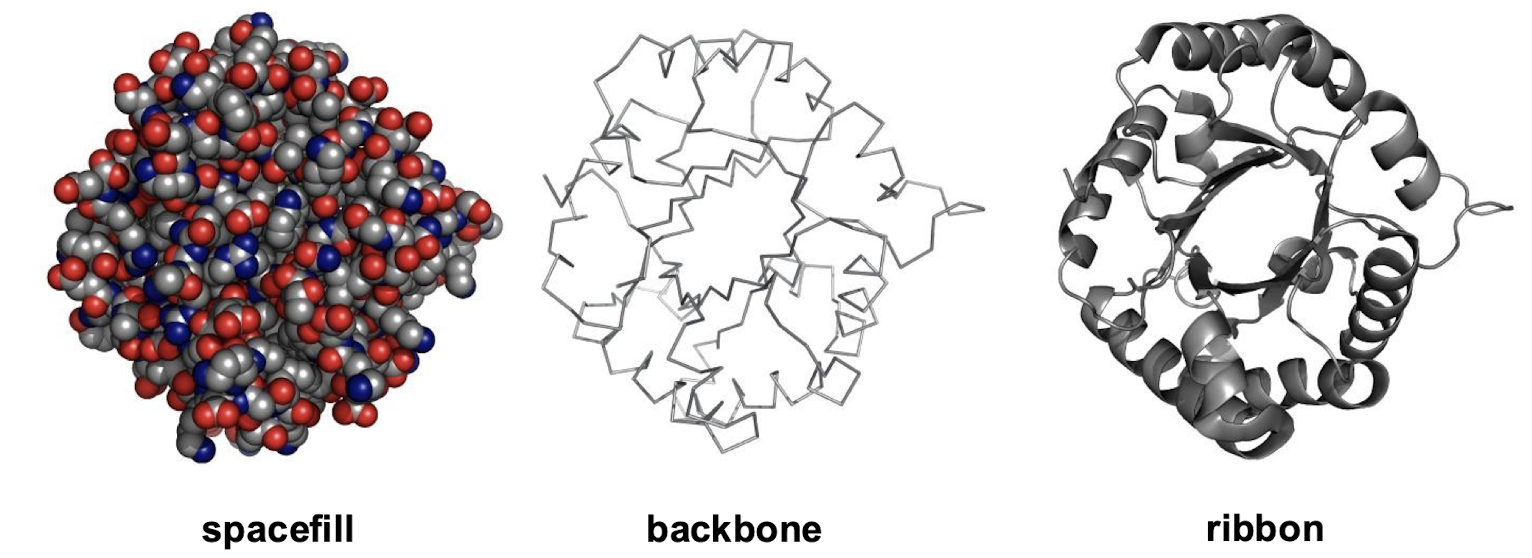
Secondary structures defined by _______ between ________ and ________.
Two main types are _____ & _____
Secondary structures defined by H-bonding between backbone carbonyl and amide.
Two main types are ɑ-helix (cylindrical spiral ribbons) & β-strand (arrows w/ thickness)
What is a random coil
Random bc no defined secondary structure, but we do know where it is

True or False: Regular 2o structures have similar psi & phi values?
True, specific ɑ-helix appears in ɑ-helical region, & specific β strand will appear in the β-sheet region.
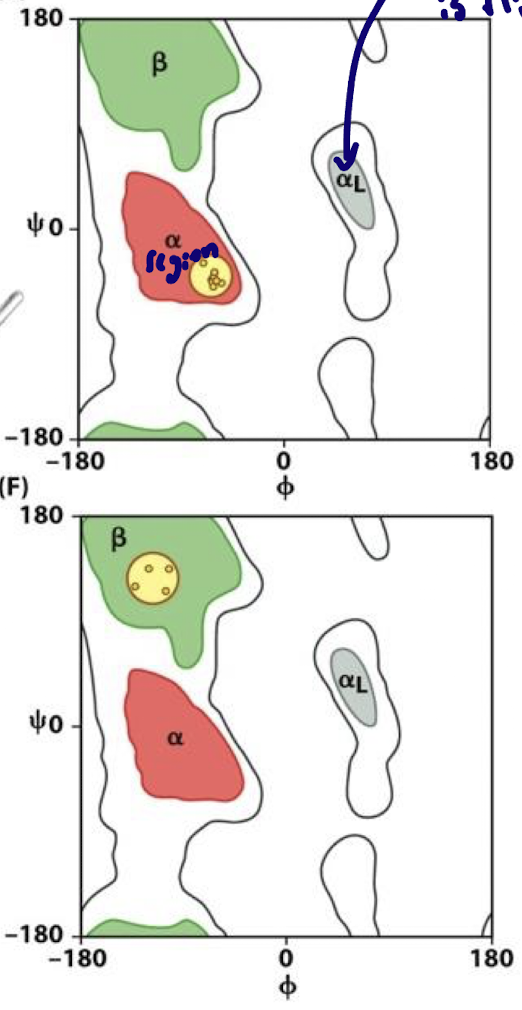
Peptide backbone has a repeating structure & consistent phi and psi values clustered on Ramachandran plot for ɑ helices & β sheets
ɑ helix is usually _____ handed
_____ amino acids per 360o turn, ____ Å (10-10 m) rise per turn
How do the side chains project?
How is the interior?
Right handed (left possible but rare)
3.6 amino acids per 360o turn, 5.4 Å rise per turn
Side chains out % down toward N terminus, C=O toward C terminus
Tightly packed interior


In ɑ helix, H-bonds between what two groups?
_____ of residue i h-bonds to _____ of residue i+4
Backbone amide & Carbonyl
Carbonyl in residue i H-bonds to amide in residue i+4
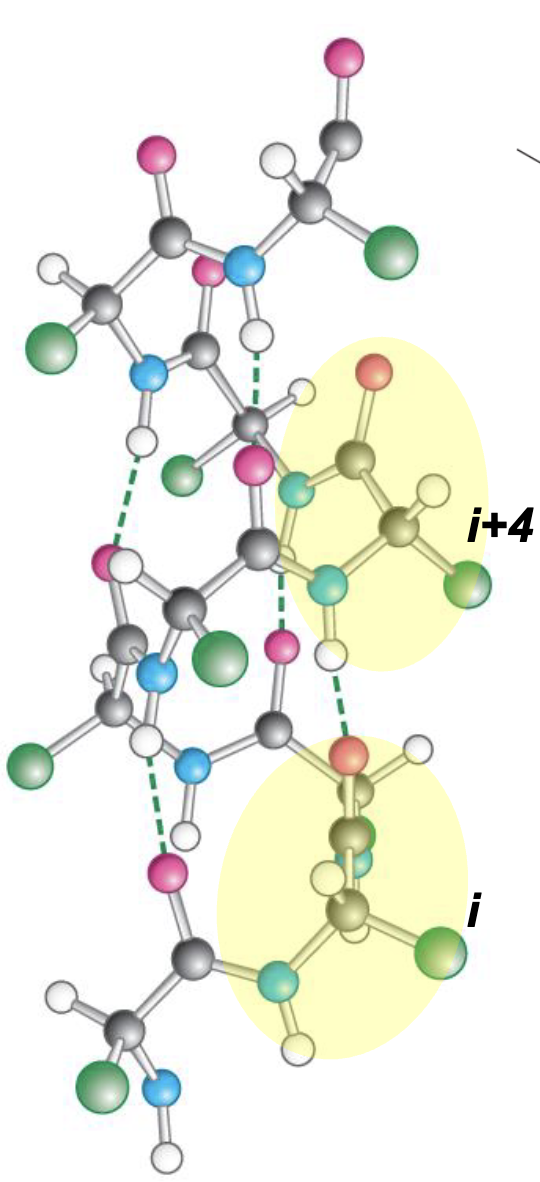
In ɑ helix, H bond describes one _____ (____ residues)
Carbonyls point _____, such that _____ terminus is δ- and _____ terminus is δ⁺
H bond describes one turn (3.6 residues)
Carbonyls point downward, such that C terminus is δ- and N terminus is δ⁺

Does the ɑ-helix dipole have a strong dipole moment, why or why not?
Yes, the carbonyls all point down toward C terminus (parallel to helix axis)

In amphipathic ɑ helix, have _____ hydrophobic face and ____ hydrophilic face.
With 3.6 residues per turn, every _____ residues have similar properties (polar or nonpolar)
Nonpolar residues face _____ of protein, polar face ____
Are all ɑ helices amphipathic?
One hydrophobic face, one hydrophilic face.
With 3.6 residues per turn, every 3-4 residues have similar properties (polar or nonpolar)
Nonpolar residues face interior of protein, polar face exterior.
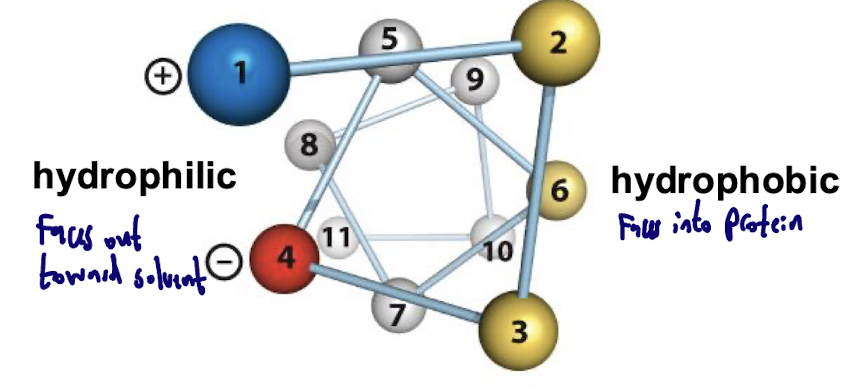
Not all ɑ helices amphipathic, can be all polar or not
β strands → β sheet
How do β strands form β sheets?
β strands are ____, β sheets are ____
β strands form β sheets through backbone H-bonds
β strands are pleated, β sheets are slightly twisted
Side chains project on _____ sides of β strand
Side chain on same face _____ Å apart
Side chains project on opposite, alternating sides of β strand
Side chain on same face are 7Å apart

In ɑ helices, neighbor residues are ____ Å apart
In β strands, they are ____ Å apart
In ɑ-helices, neighbor residues are 1.5Å apart
In β-strands, they are 3.5Å apart
Antiparallel β-sheets run in _____ direction, H-bonds are _____ stable. Are connected by __ amino acid reverse turns (using __ & __ AAs).
Parallel β-sheets run in ____ direction, H-bonds are ____ stable, connected by _____
Antiparallel β-sheets run in opposite direction, H-bonds are more stable. Are connected by 4 amino acid reverse turns (using Proline & Glycine AAs).
Parallel β-sheets run in same direction, H-bonds are less stable (bent geometry), connected by ɑ-helix or large loop.

Mixed β sheets
Both parallel & anti-parallel oriented strands.