3. Bacterial Cell Walls
 Call Kai
 Learn
Learn Practice Test
 Spaced Repetition
 Match
Match Flashcards
 Knowt Play
1/26

There's no tags or description
Looks like no tags are added yet.
Name | Mastery | Learn | Test | Matching | Spaced | Call with Kai | Chat |
|---|
No analytics yet
Send a link to your students to track their progress
27 Terms
The cell wall confers ___ and ___ to the cell.
Shape and rigidity
What is the sacculus?
The continuous, bag-shaped peptidoglycan cell wall that entirely encases a bacterium
What is the main function of the cell wall?
Protecting the (any) cell membrane
Peptidoglycan
A disaccharide unit of glycine has an attached peptide of four to six amino acids
The combination of peptidoglycan are…
NAM and NAG
Peptidoglycan is unique to…?
Bacteria; thus, the enzymes responsible for its biosynthesis make excellent targets for antibiotics
Penicillin targets what enzyme and what is the function of the enzyme?
Transpeptidiase; the enzyme that cross links the amino acids in peptidoglycan
Describe Gram-Positive Bacteria
stains more purple
Has a thick peptidoglycan layer
Threaded by teichoic acids
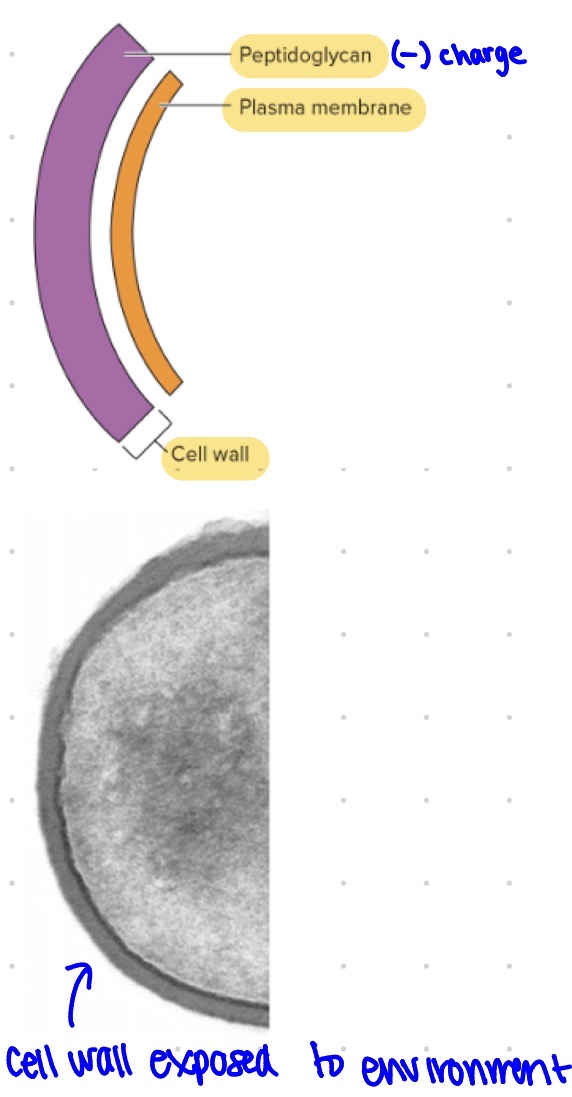
What charge do teichoic acids have?
Negative
Describe Gram-Negative Bacteria
stains more pink/red
Thin layer of peptidoglycan
Have an outer membrane
This makes it more resistant to penicillin

What is unique to gram-negative bacteria?
LPS= lipopolysaccharides
What are lipopolysaccharides (LPS)? Where are they located?
in the outer membrane
Provides support to the cell; if destroyed, the whole cell falls apart
Negatively charged threads
In humans can sometimes act as an endotoxin
What are endotoxins?
Substances that when released from dead bacteria…
overstimulates human immune cells
Dysregulated human cells signaling (cytokines storm)
Hypotonic Environments
solute concentration outside cell is less than inside cell
Water moves into cell and cell swells
Cell wall protects from lysis (the bursting of a cell when too much water enters it)
Hypertonic Environements
solute concentration outside cell is greater than inside cell
Water leaves cell and cytoplasm shrivels up
Cell wall protects from plasmolysis (the shrinking of a plant cell’s cytoplasm and plasma membrane away from its rigid cell wall caused by water loss)
Extracellular Vesicles
small membrane bound particles
How do extracellular vesicles develop?
Develop when a membrane buds out, pinches off, and is released from the cell
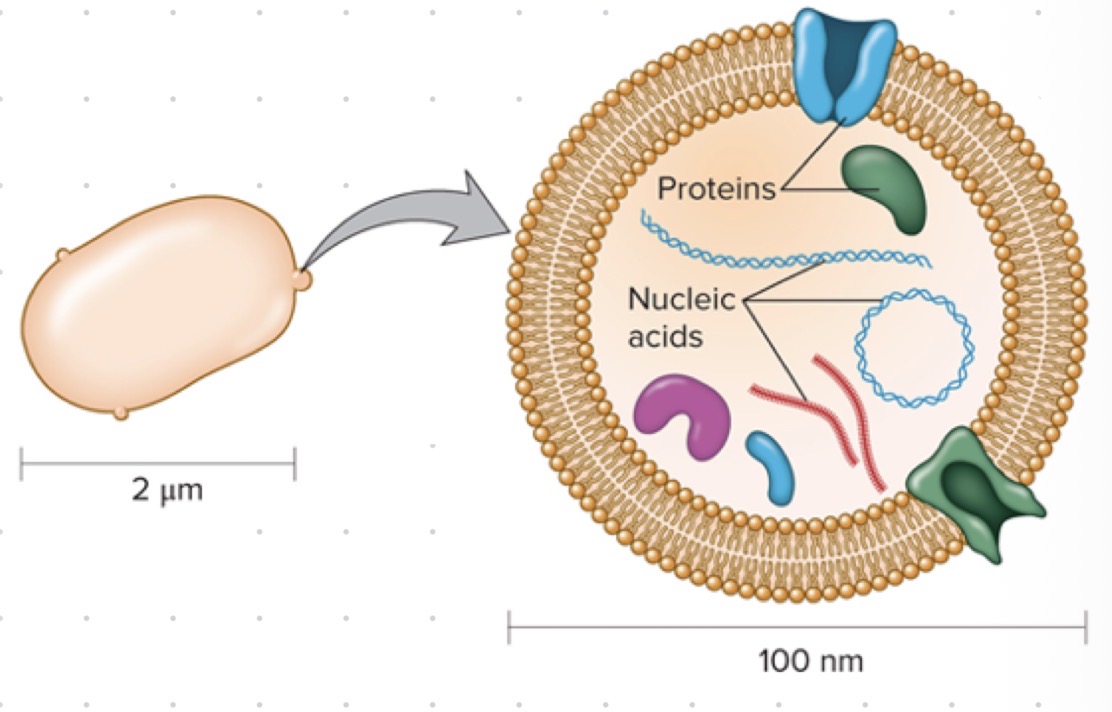
Gram-Positive EVs
Made of the plasma membrane surround a small amount of cytoplasm
Gram-Negative EVs
Made up of LPS, contains organic matter surround a sample of periplasm
Which components are found outside the cell wall? (In the outermost layer in the cell envelope)
capsules
Slime layers
S-layers
Capsules
Well organized layers made of polysaccharides that are covalently bonded and difficult to wash away

What are the protective advantages of capsules?
resistant to host immune cells
Protect from desiccation
Exclude viruses and detergents
Slime layers
Polysaccharide layers that are unorganized and easily washed away
S-Layers
Geometric pattern made of protein that aid in protecting from ion and pH fluctuations

What are the functions of the S-Layers ?
To the outer membrane
In gram-neg bacteria, the s-layer adheres to where?
To the outer membrane
In gram-pos bacteria, the s-layer is associated with what layer?
The peptidoglycan