1.2 Transport Across Cell Membranes

0.0(0)
Studied by 0 people
call kaiCall Kai
learnLearn
examPractice Test
spaced repetitionSpaced Repetition
heart puzzleMatch
flashcardsFlashcards
Card Sorting

1/25

flashcard set

Earn XP

Description and Tags

Flashcard deck covering Key Area 2: Transport Across Cell Membranes, including cell membrane components, selective permeability, diffusion, osmosis, active transport, and experimental problem-solving.

Last updated 12:28 PM on 9/22/26
Name
Mastery
Learn
Test
Matching
Spaced
Call with Kai
Chat

No analytics yet

Send a link to your students to track their progress

26 Terms

1
New cards
<p>What two components make up the structure of a <strong>cell membrane</strong>?</p>

What two components make up the structure of a cell membrane?

Phospholipids and proteins.

2
New cards
<p>What does it mean for the <strong>cell membrane</strong> to be <strong><u>selectively permeable</u></strong>?</p>

What does it mean for the cell membrane to be selectively permeable?

It means that only certain molecules can pass through it, typically depending on their size.
3
New cards
<p>Which structural carbohydrate makes up the  <span style="color: green;"><strong>plant </strong></span><strong>cell wall</strong>?</p>

Which structural carbohydrate makes up the plant cell wall?

Cellulose

4
New cards
<p>State the differences in permeability between the <strong>cell membrane</strong> and the <strong>cell wall</strong>.</p>

State the differences in permeability between the cell membrane and the cell wall.

The cell membrane is selectively permeable, allowing certain molecules to pass through, whereas the cell wall is freely permeable, allowing all molecules to pass through.

5
New cards
<p>Name two examples of <strong>passive transport</strong> in cells.</p>

Name two examples of passive transport in cells.

Diffusion and osmosis.
6
New cards
<p><strong>Diffusion </strong>and <span style="color: blue;"><strong>osmosis </strong></span>are <strong>passive </strong>processes. Explain what is meant by <strong>passive</strong>.</p>

Diffusion and osmosis are passive processes. Explain what is meant by passive.

Transport across a cell membrane that does not require energy.

7
New cards
<p>Describe what is meant by a <strong>concentration  gradient</strong>.</p>

Describe what is meant by a concentration gradient.

The difference in concentration of molecules between two areas (inside vs outside of the cell).

<p>The difference in concentration of molecules between two areas (inside vs outside of the cell).</p>
8
New cards
<p>Describe <strong>diffusion.</strong></p>

Describe diffusion.

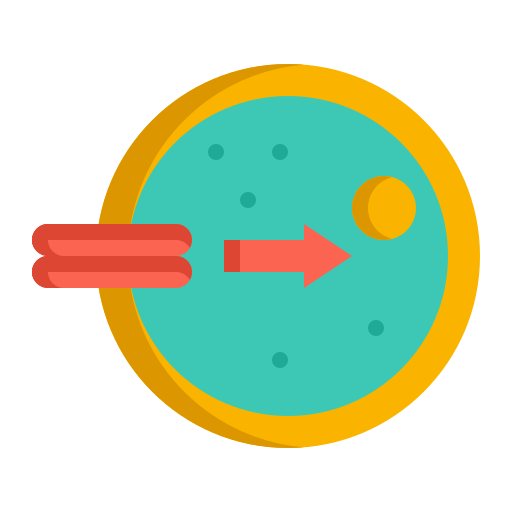
The movement of ions or molecules down a concentration gradient from a higher concentration to a lower concentration until equally spread.
9
New cards
<p>Which useful molecules will pass into animal cells by <strong>diffusion</strong>, and which waste molecules are removed?</p>

Which useful molecules will pass into animal cells by diffusion, and which waste molecules are removed?

Molecules gained include oxygen and glucose; waste products removed include carbon dioxide and urea.
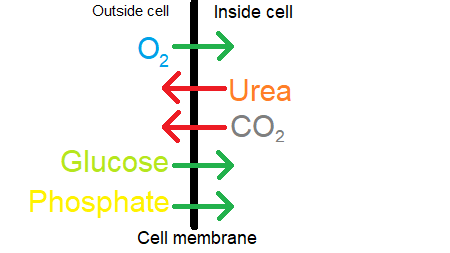
<p>Molecules gained include <strong>oxygen </strong>and <strong>glucose</strong>; waste products removed include <strong>carbon dioxide</strong> and <strong>urea</strong>.</p>
10
New cards
<p>Describe <span style="color: blue;"><strong>osmosis.</strong></span></p>

Describe osmosis.

The movement of water molecules from a higher water concentration to a lower water concentration through a selectively permeable membrane. Water molecules move down the concentration gradient as osmosis does not require energy (it is a passive process).

11
New cards
<p>Explain what happens to an animal cell placed in a solution with a <span style="color: blue;"><u>higher water concentration?</u></span></p>

Explain what happens to an animal cell placed in a solution with a higher water concentration?

Water molecules move into cell by osmosis from a higher to a lower water concentration, causing the cell to burst because it lacks a cell wall.
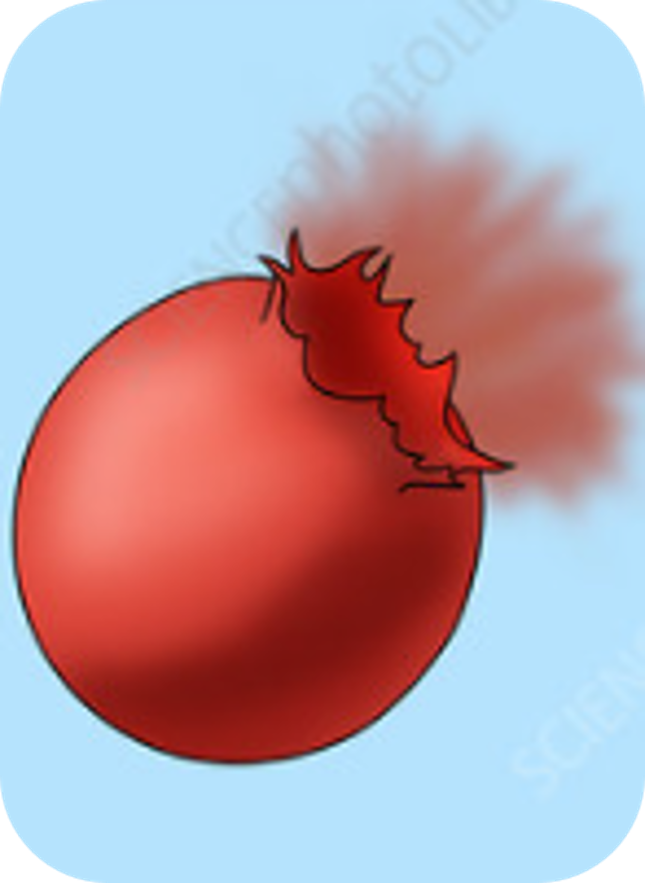
<p>Water molecules move <u>into </u>cell by <span style="color: blue;"><strong>osmosis </strong></span>from a high<u>er</u> to a low<u>er</u> water concentration, causing the cell to <strong>burst </strong>because it lacks a <strong>cell wall</strong>.</p>
12
New cards
<p>Explain what happens to an animal cell placed in a solution with a <u>lower water concentration (</u><span style="color: rgb(245, 147, 18);">high salt/sugar</span>)?</p>

Explain what happens to an animal cell placed in a solution with a lower water concentration (high salt/sugar)?

Water molecules move out of the cell by osmosis from a higher to a lower water concentration, causing the cell to shrink.

<p>Water molecules move <strong><u>out </u></strong>of the cell by <span style="color: blue;"><strong>osmosis </strong></span>from a high<u>er</u> to a low<u>er </u>water concentration, causing the cell to <strong>shrink</strong>.</p>
13
New cards
<p>What happens to a <span style="color: rgb(0, 0, 0);">plant cell</span><span style="color: rgb(0, 0, 0);"> p</span>laced in a solution with a <span style="color: blue;"><u>higher water concentration?</u></span></p>

What happens to a plant cell placed in a solution with a higher water concentration?

Water molecules move into the cell by osmosis from a higher water concentration to a lower water concentration causing the cell to become turgid.
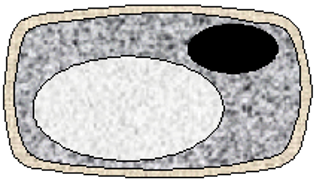
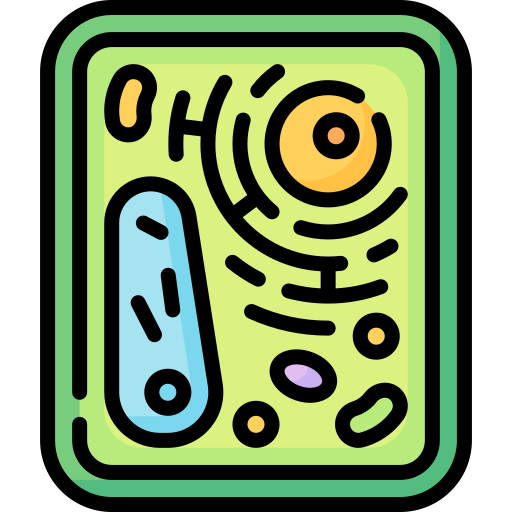
<p>Water molecules move <strong><u>into </u></strong>the cell by <span style="color: blue;"><strong>osmosis </strong></span>from a high<u>er</u> water concentration to a low<u>er</u> water concentration causing the cell to become <strong>turgid</strong>.</p>
14
New cards
<p>What happens to a plant cell placed in a solution with a <u>lower water concentration</u> (<span style="color: rgb(244, 146, 11);">high salt/sugar</span>)?</p>

What happens to a plant cell placed in a solution with a lower water concentration (high salt/sugar)?

Water molecules move out of the cell by osmosis from a higher water concentration to a lower water concentration, causing the cell to become plasmolysed.

<p>Water molecules move <u>out </u>of the cell by <span style="color: blue;"><strong>osmosis </strong></span>from a high<u>er</u> water concentration to a low<u>er</u> water concentration, causing the cell to become <strong>plasmolysed</strong>.</p>
15
New cards
<p>What happens to a plant cell placed in a solution with a <u>water concentration equal to its surroundings?</u></p>

What happens to a plant cell placed in a solution with a water concentration equal to its surroundings?

Water moves in and out of the cell by osmosis at the same rate. The plant cell is neither turgid or plasmolysed.


<p>Water moves <u>in and out of the cell by </u><span style="color: blue;"><strong><u>osmosis </u></strong></span><u>at the same rate</u>. The plant cell is <strong>neither </strong>turgid or <strong>plasmolysed</strong>.</p>
16
New cards
<p>Describe <strong>active transport</strong>.</p>

Describe active transport.

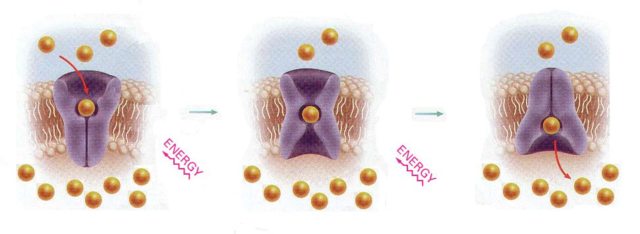
The movement of molecules and ions across the cell membrane from a lower concentration to a higher concentration against the concentration gradient. This process requires energy (ATP).

17
New cards
<p>Why does <strong>active transport</strong> require energy in the form of <strong>ATP</strong>?</p>

Why does active transport require energy in the form of ATP?

For membrane proteins to move molecules and ions against the concentration gradient.

18
New cards
<p>In which cellular <strong>organelle </strong>is <strong>ATP </strong>generated for <strong>active transport</strong>?</p>

In which cellular organelle is ATP generated for active transport?

In the mitochondria, where aerobic respiration takes place.
<p>In the <strong>mitochondria</strong>, where <strong>aerobic respiration</strong> takes place.</p>
19
New cards
<p>What is the function of <strong>membrane proteins</strong> in <strong>active transport</strong>?</p>

What is the function of membrane proteins in active transport?

They act as pumps to transport molecules and ions against the concentration gradient.

20
New cards
<p>How can the<strong> </strong><span style="color: purple;"><strong><u>re</u></strong>liability </span>of the <strong><u>re</u></strong>sults be inc<strong><u>re</u></strong>ased in an experiment/investigation?</p>

How can the reliability of the results be increased in an experiment/investigation?

Repeat the experiment/investigation for each independent variable tested AND calculating an average (if appropriate) OR increase the sample size/number of groups.

21
New cards
<p>How is <span style="color: purple;"><strong><u>v</u>alidity </strong></span>maintained during an experiment/investigation?</p>

How is validity maintained during an experiment/investigation?

By keeping all other variables the same (constant) except for the independent variable.
22
New cards
<p>State the formula for <strong>percentage change</strong>.</p>

State the formula for percentage change.

(Final value - starting value)/(starting value) x 100

<p>(Final value - starting value)/(starting value) x 100</p>
23
New cards
<p>Why is <strong>percentage change</strong> in mass calculated rather than simple change in mass in <strong>membrane transport </strong>experiments with plant tissues?</p>

Why is percentage change in mass calculated rather than simple change in mass in membrane transport experiments with plant tissues?

Because the initial mass of the tissues are different, so calculating percentage change allows for a valid comparison.

24
New cards
<p>Identify a <strong><u>v</u>ariable </strong>not shown in the diagram that would need to be kept constant for <strong><u>v</u>alidity</strong>.</p>

Identify a variable not shown in the diagram that would need to be kept constant for validity.

Temperature of sucrose solution; Volume of sucrose solution; Length of potato cylinder; Type of potato; Time experiment is left for; Size of test tube

25
New cards
<p>State what is meant by <span style="color: red;"><strong>independent </strong></span>and <span style="color: green;"><strong>dependent </strong></span>variable.</p>

State what is meant by independent and dependent variable.

The independent variable is the variable that is being changed. The dependent variable is the variable that is being measured.

<p>The <span style="color: red;"><strong>independent variable</strong></span> is the <strong>variable </strong>that is being changed.  The<strong> </strong><span style="color: green;"><strong>dependent variable</strong></span> is the <strong>variable </strong>that is being measured.</p>
26
New cards
<p>Describe what is meant by a <strong>control</strong>.</p>

Describe what is meant by a control.

A condition in an experiment where the independent variable is removed or replaced, allowing you to prove that the independent variable is what caused the change in the results.

Example: if sucrose concentration is causing a change in the rate of osmosis (measured indirectly by change in mass of tissue), the control is:

Keep everything the same except use distilled water.