AP Psych -- Princeton Review
 Call Kai
 Learn
Learn Practice Test
 Spaced Repetition
 Match
Match Flashcards
 Knowt Play
1/266

There's no tags or description
Looks like no tags are added yet.
Name | Mastery | Learn | Test | Matching | Spaced | Call with Kai | Chat |
|---|
No analytics yet
Send a link to your students to track their progress
267 Terms
Physiological Psychology
study of behavior influenced by psychology
Uses biology and medicine to examine psychological problems
Behavioral Genetics
Application of the principles of evolutionary theory to the study of behavior
Traits
Distinctive characteristics or behavior patterns that are determined by genetics
Genes
Basic biological elements responsible for carrying information about traits between generations
Evolutionary Perspective
How the principles of evolution apply to psychology
Eugenics
Has been discredited
Idea that some genes are superior to others
behavioral-genetics approach
Examines the ways we are different from one another
Heritability
Degree of variance among individuals that can be attributed to genetic variations
Environmentality
Degree to which a trait’s expression is caused by the environment where an organism lives
nature v.s. nurture debate
Debate over the degree our environment and/or our biology impacts an individual
Common view that nature and nurture work together
Our psychological makeup is the result of the interaction of the two
Primary methods of research in behavioral genetics
Twin studies
Adoption studies
Family studies
What are the 2 categories the nervous system can be divided into?
Central Nervous System (CNS)
Peripheral Nervous System (PNS)
Central Nervous System
The brain and the spinal cord
Peripheral Nervous System
Every other nerve in the body — excluding CNS
The brain is the…
Central processing center for behavior, thoughts, motivations, and emotions
What is the brain and nervous system made up of?
Neurons (nerve cells)
Nerves
Responsible for conveying information to and from the brain and the PNS
Afferent Neurons
AKA sensory neurons
Send information to the brain — think afferent arrives to the brain
Efferent Neurons
AKA motor neurons
Send information from the brain — think efferent exits the brain
Reflexes
Controlled by direct transmission from afferent to efferent cells
Quick and involuntary responses to environmental stimuli
Reflex arc
Path goes from sensory neurons to motor neurons
Interneurons
Communicate between afferent (sensory) and efferent (motor) neurons
What subdivisions can the parasympathetic system be divided into?
Somatic nervous system
Autonomic nervous system
Somatic Nervous System
Responsible for voluntary movement of large skeletal muscles
Autonomic Nervous System
Controls the nonskeletal muscles — heart and digestive tract, muscles that typically arent under voluntary control
What subdivisions can the autonomic nervous system be divided into?
Sympathetic nervous systems
Parasympathetic nervous systems
Sympathetic Nervous System
Processes that burn energy
Parasympathetic Nervous System
Complementary system responsible for conserving energy
Returns the body to homeostasis
Nerves
Bundles of neurons
Basic unit of the nervous system
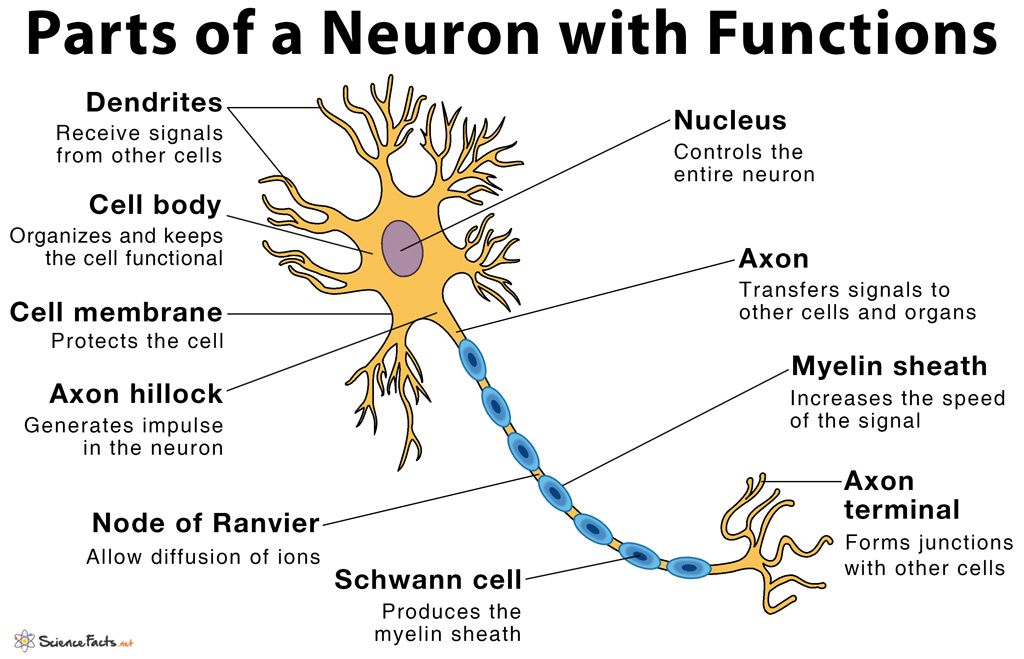
Nuerons
Cells with a defined cell body (soma) with a nucleus
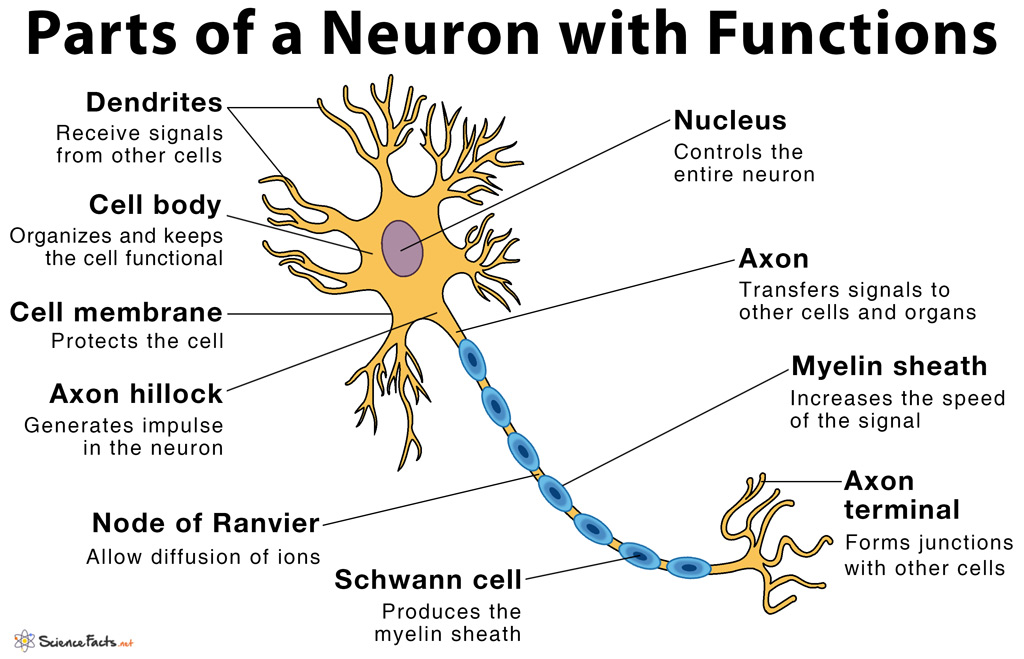
Dendrites
Receive input from other neurons through their receptors
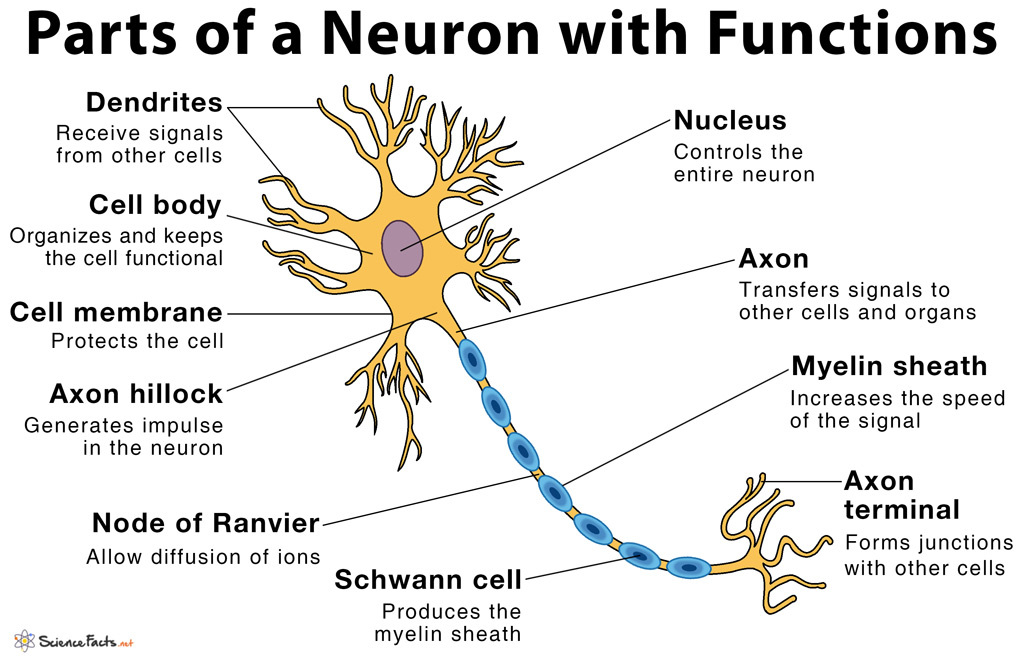
Axon
Long, tubelike structure that responds to input from the dendrites and soma
Transmits a neural message then passes its information to other cells
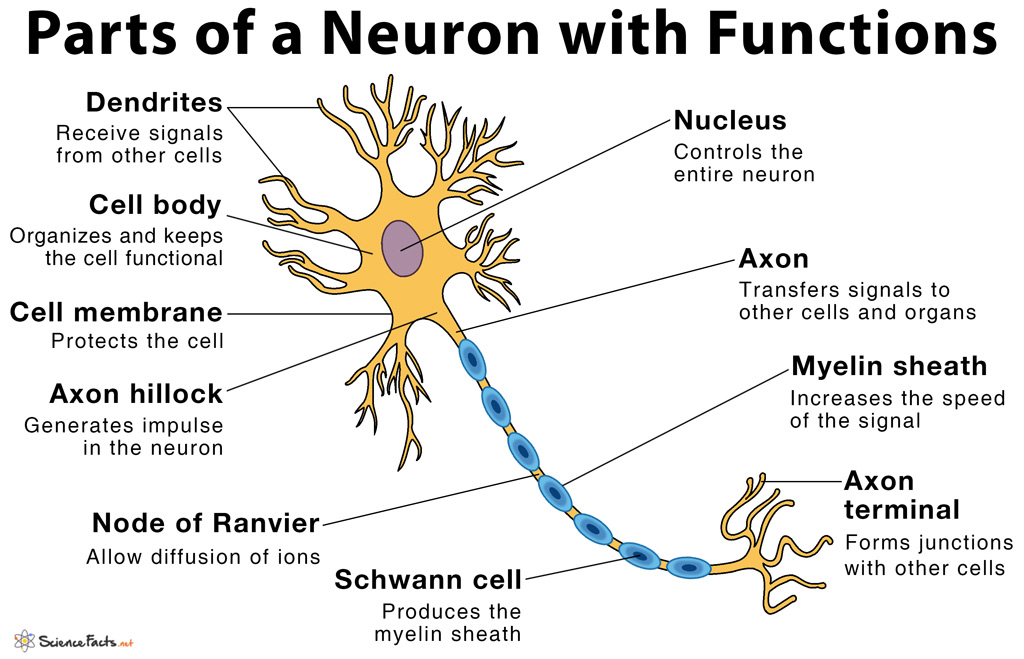
Myelin Sheath
Fatty coating surrounding the axon — picture beads on a string
Insulation for axons
Speeds up the rate at which electrical information travels
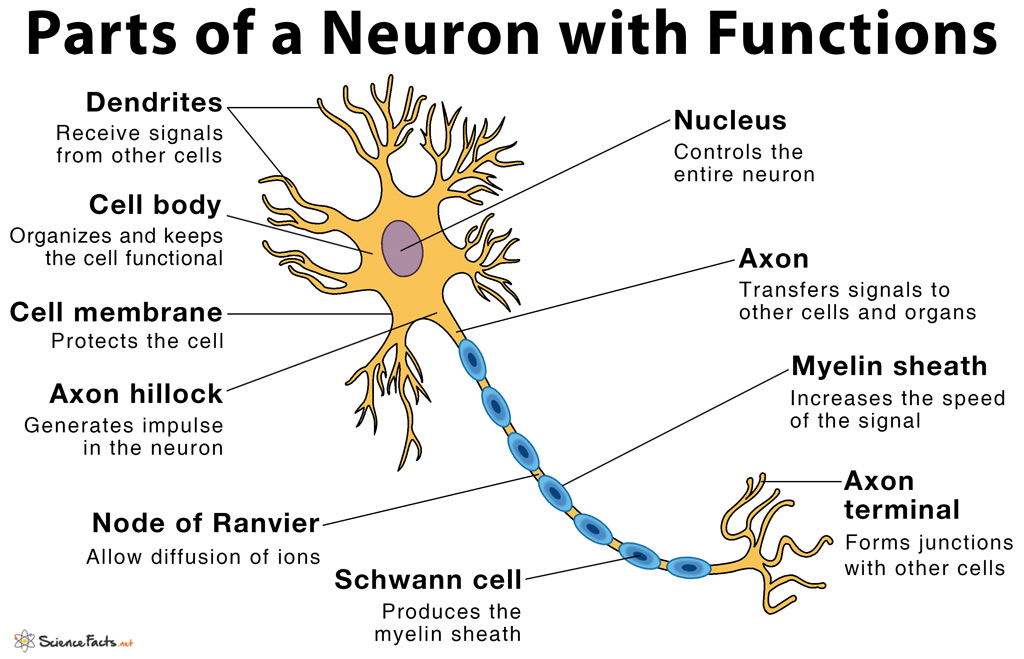
Nodes of Ranvier
Gaps between myelin sheath
Help speed up neural transmission
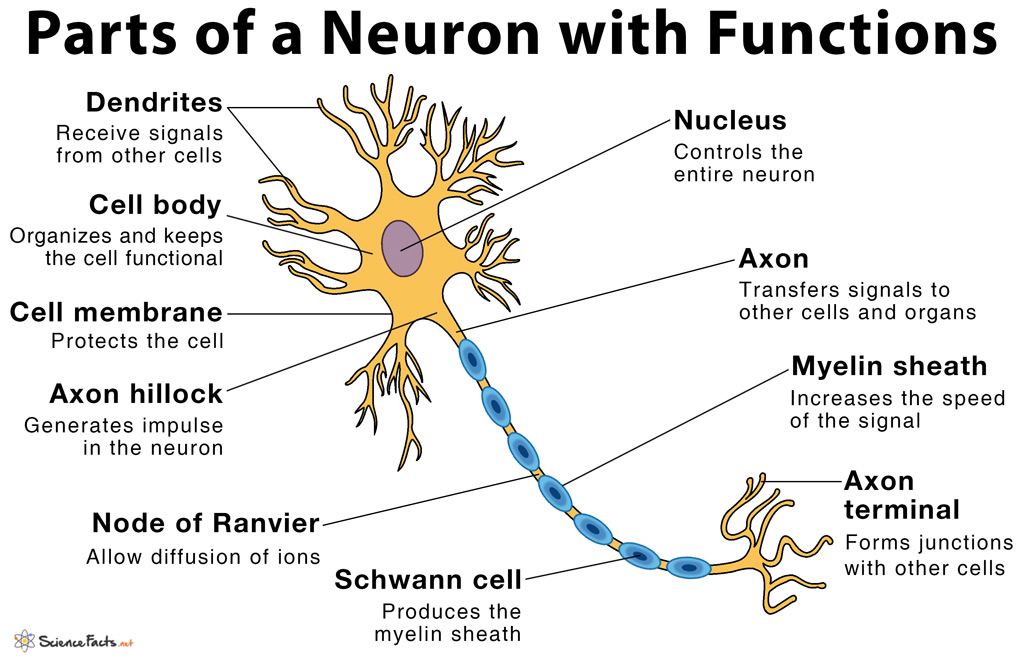
Terminal buttons
Knobs on the end of the axon
Comes close to the cell bodies and other cells dendrites but doesn’t touch
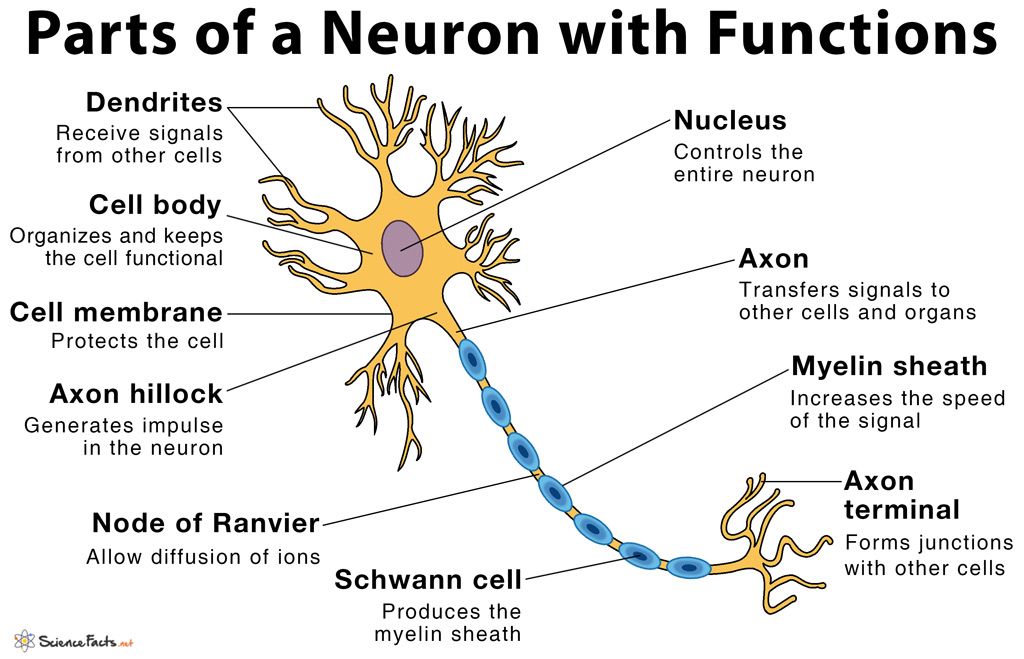
Synapse
Gap between one neuron’s terminal buttons and another neuron’s cell body and dendrites
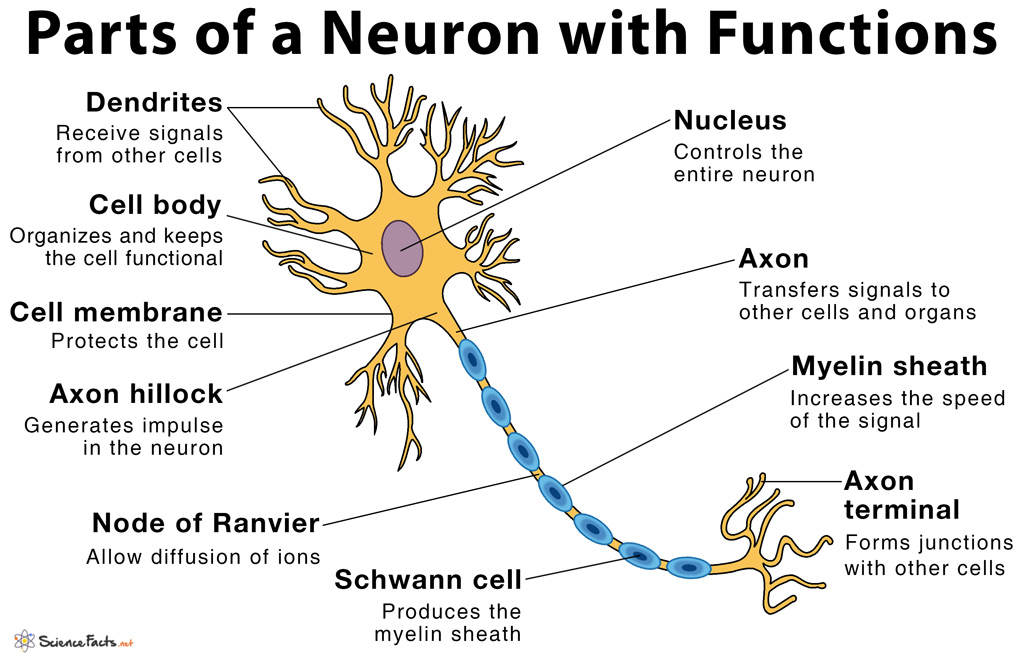
Neurotransmitters
Released by terminal buttons
Chemical messengers sent across the synapse and bind with receptors on a neuron’s dendrites
Glial Cells
Non-neuronal cells that provide support to neurons
Resting Membrane Potential
Electric potential across the plasma membrane of apx —70 millivolts (mV)
Depolarization
Change in the membrane potential from the resting membrane potential to a less negative, or positive potential
Action potential — Nerve Impulse
An electrical impulse along the axon, triggered when the membrane potential hits a specific threshold — causes depolarization
Repolarization
Returns the membrane potential to normal
Action potentials are generated at what kind of strength?
Fixed Strength
“all or none” either it gets fired or it doesn’t
What happens after a neuron fires? Define it.
Refractory Phase: No amount of stimulation can cause the neuron to fire again
Relative Refractory Phase
Neuron needs more stimulation than usual to fire again
Excitatory Neurotransmitters
Excite the cell, or cause the neuron to fire
Inhibitory Neurotransmitters
Inhibit, or stop cell firing
Reuptake
Process where a released neurotransmitter is reabsorbed by the neuron that released it
Acetylcholine
Neurotransmitter
Affects memory function and muscle contraction — specifically in the heart
Serotonin
Neurotransmitter
Arousal, sleep, pain sensitivity, mood, and hunger regulation
Dopamine
Neurotransmitter
Movement, attention, and reward
Imbalances may lead to Parkinson’s disease and schizophrenia
GABA
Neurotransmitter
Inhibitory neurotransmitter
Glutamate
Neurotransmitter
Excitatory neurotransmitter — counter to GABA
Norepinephrine
Neurotransmitter
Affects levels of alertness
Lack implicated in depression
Endorphins
Neurotransmitter
Body’s natural painkillers
Substance P
Neurotransmitter
Pain, mood, vasodilation, and learning
Endocrine System
Way various parts of our bodies relay information
Works through glands that release hormones
Hormones
Affect cell growth and proliferation
Released in blood stream and travel throughout the body
Coordinate a wide range of responses
Primary gland in the endocrine system? Define it.
Pituitary Gland: AKA the master gland — controls other glands in your body, key in regulating vital bodily functions and well being
Just under the hypothalamus
What happens when the sympathetic nervous system is activated?
Release of epinephrine (adrenaline) and norepinephrine (noradrenaline)
Leptin
Hormone involved in regulating hunger and energy
Resistance implicated in obesity
Ghrelin
Hormone that tells your brain it’s hungry
Melatonin
Hormone involved with sleep
Controlled by level of light
Oxytocin
Hormone involved with arousal/romantic attachment, and parental bonding
Agonist
Psychoactive drugs that increase the effect of a neurotransmitter
Antagonist
Psychoactive drugs that decrease the effect of a neurotransmitter
Reuptake inhibitors
Preventing neurotransmitters from being sucked back into the sending neuron
Alcohol effects on CNS and Brain and Body
Depressant
Decreases Dopamine levels
Barbiturates effects on CNS and Brain and Body
Depressant
Inhibits neural arousal centers
Tranquilizers effects on CNS and Brain and Body
Depressant
Inhibits neural arousal centers
Caffeine effects on CNS and Brain and Body
Stimulant
Accelerates heart rate and constricts blood vessels
Reduces levels of adenosine — neurochemical regulator of norepinephrine release
Amphetamines effects on CNS and Brain and Body
Stimulant
Increases body temperature and heart rate
Increases dopamine and norepinephrine production
Cocaine effects on CNS and Brain and Body
Simulant
Heart rate and blood pressure
Increases dopamine, serotonin, and norepinephrine release
Nicotine effects on CNS and Brain and Body
Simulant
Stimulates acetylcholine transmission
Increases heart rate
Opioids effects on CNS and Brain and Body
Depressant
Activate receptors that produce endorphins
Hallucinogens effects on CNS and Brain and Body
Distort sensory perceptions
May increase serotonin levels
Alcohol’s effect on behavior
Symptoms associated with drunkeness
High does can lead to respiratory depression or death
Barbiturates’ effect on behavior
Decrease anxiety
High does can result in respiratory depression or death
Tranquilizers’ effect on behavior
Reduce anxiety without inducing sleep
Caffeine’s effect on behavior
Irritability, anxiety, and insomnia
Amphetamines’ effect on behavior
Feelings of euphoria
High does can lead to motor dysfunction
Cocaine’s effect on behavior
Feelings of increased mental and social ability
Nicotine’s effect on behavior
Depressant behavioral effects
Can cause euphoria and dizziness
Opioids’ effect on behavior
Relaxation and euphoria — can reduce pain
Impaired cognitive ability, nausea, and respiratory depression
Hallucinogens’ effect on behavior
Sensory synesthesia — stimuli from one sense produces sensory effects in other senses
Paranoia
Dependence
Continued drug use to avoid negative physical/psychological effects from not using
Addictive drugs share this characteristic.
Addictive drugs increases dopamine activity in the brain stem — “pleasure center” — leading to feelings of reward and pleasure
Tolerance
Larger doses of a drug are needed for the same effect to occur
Withdrawal
Process of weaning off a drug a person has become dependent on
Physical and psychological symptoms follow
Hindbrain
Oldest part of the brain
Cerebellum, medulla oblongata, reticular activating system, and pons
Forebrain
Limbic system — emotional center of the brain
Thalamus, Hippocampus, amygdala, cerebral cortex, and hypothalamus
Cerebellum
Muscle tone and balance
Coordination of movement
Procedural learning
Brain Stem — medulla oblongata
Involuntary actions — breathing, digeston, heart rate, and swallowing
Reticular Activating System (RAS) — Reticular Formation
Brain’s reward system
Controls some voluntary movement
Role in learning, emotion, and cognition
Pons
Way station — passes neural information from one brain region to another
Implicated in REM sleep
Thalamus
Sensory information — receives and directs sensory information from visual and auditory systems
Hippocampus
Processing and integrating memories
Anterograde Amnesia
Damage to the hippocampus
Prevents the formation of new memories
Amygdala
Anger, frustration, and fear
Hypothalamus
Controls temperature and water balance in body
Controls hunger and $ex drive
Activation of the sympathetic nervous system and endocrine system
Divided into lateral hypothalamus and ventromedial — together regulates eating behavior and body weight