FRN 525 Test 2
 Call Kai
 Learn
Learn Practice Test
 Spaced Repetition
 Match
Match Flashcards
 Knowt Play
1/77

There's no tags or description
Looks like no tags are added yet.
Name | Mastery | Learn | Test | Matching | Spaced | Call with Kai |
|---|
No analytics yet
Send a link to your students to track their progress
78 Terms
Who was the first king of the Burbon dynasty?
King Henri IV (distant cousin of Henri III)
What did Versailles symbolize?
Opulent power and wealth, center of Europe was Versailles and King Louis XIV
What was the town of Versailles like before the palace? After?
Before, Versailles was a small country town. The construction of the palace concentrated power and wealth here as nobility had mansions built to stay closer to the king.
What did King Louis XIV declare himself as?
Le Roi Soleil! (The sun king)
Describe the Golden Age of French Civilization
Artists, musicians, scientists, writers, astronomers, and philosophers were encouraged to push past their limits by King Louis XIV
He also establishes Acadamie Francais and Academie des Inscriptions et Belles Letters which was dedicated to literature, and Academie des Sciences
Plays during the Golden Age
Pierre Corneille and Jean Racine wrote classical tragedies that all of Europe watched
Moliere (maybe the most famous playwright) made comedies which included everyday speech (vernacular) and the king even performed!
What was the economic state of the rest of France?
King Louis XIV’s wealth had a price, including his military conquests (colonies in the Carribean, North Africa, Haiti, Guadelope, etc for slavery) brought massive debt
Louis spending was out of control, even under Colbert, so his death meant the spending had no cap
Economic disparity grew and peasents often went hungry (The country man- born for suffering/ L’homme du village: Ne pour la peine)
Who were the two richest groups in France? Did they pay taxes?
Aristocracy and clergy, they paid no taxes but enjoyed many privileges, tax burden was overwhelming and continued to increase
What groups of society paid taxes?
Bourgeoises and middle class farmers
Describe the Bourgeoisie during King Louis XIV’s rule?
They had become very wealthy as trade increased across Europe and the colonies, nobility were still the upper class but their wealth was nothing like that of this urban proffessional class’
Nobles were born into wealth, vs burgs worked for it
When did King Louis XIV die?
In 1715 when he was 76… leaving a massive debt
What happened to the Edict of Nantes under King Louis XIV?
He declared: One faith, one law, one king, which became the motto of the absolute monarchy, revoking the Edict of Nantes
What happened to the French language under King Louis XIV’s rule?
He also wanted to unify the French language! In the mid 1600s, France was full of dialects, such as Occitan in Southern France and Franco Provencal in Lyon
The Academie Francais kickstarted the unification of French which had Parisian French as the standard since most of the members were educated Parisiens
Schools had to teach this form of French and discourage local dialects which continued in the 1700s and 1800s
By 1900, local dialects mostly died out, which meant the systemic effort standardized the language and destroyed local cutures
Who was king after King Louis XIV died?
His great grandson, King Louis XV!
He inherited the throne at 5 and was also a big spender
Duc d’Orleans was named Regent and served as de facto king until he came of age
He was anointed at Reims
What was France like when Louis XV started ruling? How did he rule?
It was still the dominant power in Europe and the rest of the world, but the debt crisis was concerning
He was not really interested in governing, so that was left to his ministers
He married the Polish princess Marie Leczinska at 15 but was not a loyal husband and had many lovers like Marquise de Pompadour who was known for her intelligence and love of the arts
One of France’s worst kings, reigned for 59 years (second longest reign of a king after Louis XIV)
What was the 7 years war?
1756-1763
During King Louis XV’s reign, France fought a war with England over colonies in North America
New France was lost
The Enlightenment
During Louis XV’s reign, French philosophers like Voltaire, Rousseau, Montesquieu were contributing to The Enlightenment (The Age of Reason)
Philosophers encouraged readers to question old ways and embrace new ideas (human rights, freedom of speech and religion, democracy)
Middle and upper class (Bourgeoises were reading these ideas)
Who ruled after King Louis XV?
King Louis XVI (1754-1793)
Took the throne in 1774 at 20
Married Marie Antoinette of Austria, they were a popular couple for a while
France was in financial shambles, the people with money (Bourgeoisie) were sick of paying taxes and bailing out monarchy
Who was Lafayette?
French Marquis and military commander who visited a general in the British American colonies (George Washington) who asked France to join their fight against Britain! Lafayette agrees and France joins the US in their war for independence
Siege of Yorktown
More French troops than American ones facing the British at this battle in 1781
British surrendered, US was now an independent republic
French monarchy blew a crucial blow to their British rivals
The war gave French people ideas though
Benjamin Franklin
First US ambassador to France
Popular among Parisiens
His tales of America interested the Bourgeoisie in changing France
How was the debt crisis attacked?
Louis XVI needed revenue, so the Estates General convened at Versailles in June 1789, which included members of the clergy, aristocracy, and everyone else (burgeoisies, farmers, etc, except women and poor people)
L’Assemble Nationale
The third estate (Burgeoisie and wealthy farmers) decided tax reforms proposed by King were not sufficient
They decided they would form a new National Assembly and that any new taxes had to be approved by them
Tennis Court Oath
June 20th, 1789, King ordered the new National Assembly locked out of their chambers at Versailles
They moved to a tennis court and vowed not to disband until drafting a constitution that would limit the power of the King, nobility, and Church, and give new power to people (as in wealthy bourgeoisie mean)
THIS MOMENT MARKS THE BEGINNING OF THE REVOLUTION
Cocorades (Tricolore)
Symbols of the revolution- small circular badges that soldiers wore at the time to signal their allegiance
Word spread to Paris and across France of the revolt against the King’s authority
Camille Desmoulins (Parisien journalist) created the Cocorade Tricolore in July 1789 to represent the new revolt, which became their flag
Marianne
Another symbol of the revolution, she represented liberty, given the most common French name (Marie + Anne)
Lasting symbol of French Republic
Bastille
Parisiens enter into open revolt
Bastille (massive medieval fortress that became a symbol of royal oppression) fell to revolutionaries seeking gunpowder and weapons
July 14, 1789
France’s national holiday (La Fete Nationale) is celebrated on July 14th!
Ideals of French Revolution
Aug 4, 1789: National Assembly declares equality of all men before law, removing aristocratic privileges, king is no more special than any other citizen
Aug 20: Passes Declaration of Rights of Man and of the Citizen- major document proclaiming ideas of Revolution (natural rights- liberty and equality)
Church holdings are nationalized and sold off
Aristocratic estates are seized and made public (Such as Chateau au Rochetaille)
Women’s March on Versailles
October 5 (PEYTYN’S BIRTHDAY!) 1789- women in Parisien markets begin to revolt over high price of bread
Organized and began march on Versailles (~23 miles)
Other revolutionaries joined, there were thousands, demanded for arrest of king
Queen responded: Qu’ils mangent de la brioche”
Assembly didn’t arrest Louis but did force him to move to Palace of Tuileries in Paris to be closer to people
Assembly leaves Versailles and moves the seat of its government to Paris
What did King Louis XVI do when he became worried that the Assembly would arrest him?
Attempts to escape in June 1791
Lived in a mix of anger and fear
He and his family attempt to escape to Austria
Was King Louis XVI’s escape successful?
No!
Caught by the revolutionary Garde Nationale (led by Lafayette) before crossing the border
National Assembly places him on de facto house arrest in the Palais de Tuileries
Name of the progressives in the National Assembly? What did they want?
Jacobins
Called for abolishment of monarchy
What did the Jacobins do to Louis?
Louis was officially arrested on September 13, 1792
Moved to a real prison (the Temple)
Assembly officially abolishes Monarchy
French Republic is declared
In his trial, he is known as Citoyen Louis Capet
What were the two subfactions of the Jacobins? What were they like?
Girondins: moderate
Montagnards: radical
Election of 1792 sees the Montagnards win the most seats in the Assembly
Who was the leader of the Montagnards?
Maximilien Robespierre
What did the Montagnards change in order to disassociate from the king?
The calendar!
Did not tolerate ANY references to kings
Instituted Republican calendar
12 months based on weather
Later abandonned in 1805
What was King Louis XVI convicted of?
Conspiracy against the liberty of people
January 1793: Republic led by Montagnards finds him guilty
Sentenced to death by guillotine (January 21, 1793)
Marie Antoinette suffers the same fate in October
La Vendee and Counter Revolution
European royals become nervous after hearing about Louis XVI’s death
They (England, Austria, Prussia) ban together and invade France to crush the French Republic
Government needs soldiers, starts conscripting
Unpopular in Western French region (Vendee), people start revolt against government
Republic faces internal and external threats
Lyon during the Revolution
People of Lyon supported Girondins (moderates)
Began revolt against Montagnard government in July 1793
Lyon was besieged, over 2k people died before it ended in October
City was briefly renamed Ville Affranchie (liberated city)
One of the Montagnards declared that Lyon declared war on liberty so Lyon was no more
Reign of Terror
Government declares state of emergency
Hands power over to small group of radical politicians (Comite de Salut Public- Committee of Public Safety) led by Robespierre
Committee hunts down anyone suspected of being counter revolutionary
Thousands are executed without trial from 1793-1794
Robespierre’s closest allies become concerned for their safety and plan to have him arrested
Robespierre is executed on July 28, 1794, Reign of Terror comes to an end
Committee disbands in 1795
Jean Baptiste Belley
Was sold into slavery on Saint Domingue (modern Haiti) as a baby
Bought his freedom as a young man
Elected as one of the Montagnard deputies in 1792 election (one of three from Caribbean colonies)
First black man elected to France’s government
Speech in Assembly inspired colleagues to abolish slavery in France and colonies on Feb 4, 1794
Unfortunately reinstated in 1802 and not re abolished until 1848
Directory
New elections held in 1795
Winners were Thermidorians (much more modern than Montagnards)
Established new executive- The Directory- council of 5 that lasted until 1799
Republic was still at war with European powers (England, Austria, Prussia)
Napolean Bonaparte in the 1790s
Very talented military commander
Whiz kid, became general in Republican army in 1795 at 26 years old
Astounding victories that excited the people, making him very popular
Carefully cultivated his image in campaigns
Napolean in Egypt
Britain established colonies in Asia by the end of the 18th century
France tasked Napolean with expanding the country’s colonial possessions in fear of Britain’s power
He leads an invasion of Egypt in 1798 which was under the Ottoman empire
Encountered and confiscated many artefacts and works of art
Rosetta Stone
Confiscated in Egypt by Napoleon
Bears inscriptions in Ancient Greek, Egyptian Demotic, ancient Egyptian hieroglyphics
Deciphered by Jean Francois Champollion
Why did Napoleon decide to leave Egypt?
1799, Napoleon receives word that The Directory government was unpopular and would soon collapse
Decides to leave Egypt to return to France
Decided to act on ambitions as he knew he was popular
Understanding key features of Paris
Paris has more people than Belgium and Switzerland
1 out of 5 people in France live in Paris
Combining Boston, New York, Philadelphia, Baltimore, and Washington DC to be able to say 1 in 5 Americans live in this region
¼ of French students study in Paris
70% of Parisiens were born outside of Paris but moved there for their career
France is an extremely centralized country
Where is Paris centered? What is it shaped like? What river is it on?
Ile de la Cite, a boat shaped island on the Seine
The Seine is >480 miles long and is the lifeblood of Paris
Fertile banks for hundreds of miles
Islands are easily defended (Largest islands is Ile de la Cite, the other is the Ile St Louis)
Notre Dame is at the Stern
Links the city to the sea (La Harve) and central France, as well as other rivers (Oise and Marne)
Easy travel and facilitated trade
Fluctuat nec Mergitur
Boat remains symbol of Paris, city crest reads:
“It is beaten by the waves, but it does not sink”
Cité
Center of civilization in France
As the city grew, settlements were established on opposite sides of the river
Island served as protection during conflict
South side of the river: left bank
Right side of the river: right bank
Cite and St Louis islands are sandwiched between the banks
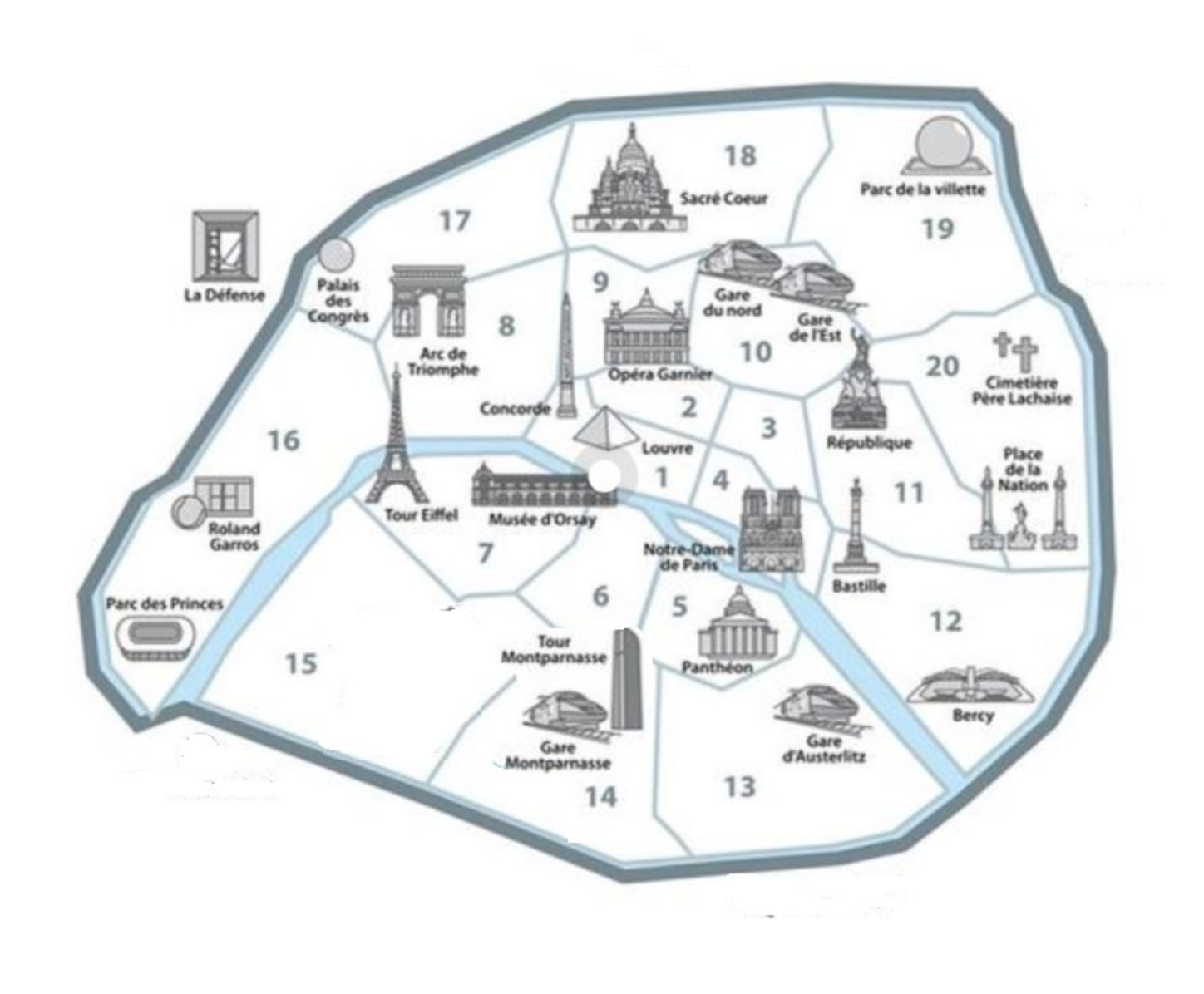
How many arrondissements does Paris have? Which one are we staying in?
20 total
We are in the 3e
System of Arrondissements
First is at the center of Paris, others follow in a clockwise spiral
System was established during French Revolution with 12 arrondissements
Napoleon III established current system in 1860
All 20 have a town hall (mairie)
You can tell which arrondissement you’re in based on the street signs
What are people that live in l’Ile de France region? How many departments does it have?
Les Franciliens
8 departments
Paris is a department and a city
Mayors of Paris
Jaques Chirac
Jean Tiberi
Bertrand Delanoe
Anne Hildago
Emmanuel Gregoire
What were the Gauls residing around Paris called?
The Parisii
What was Lutetia?
Old name of Paris
Well organized Roman town
Paved roads and streets
Drainage system for sewage
Plumbing systems
Describe Genevieve, the Patron Saint of Paris?
Illiterate young shepherd girl
Early convert to Christianity
Urged Parisiens to stand their ground against Atilla the Hun
Stopped the panic and Parisiens prepped for the worst
Attilla struck Orleans to the south
What did King Clovis do?
First Christian king, made Paris the capital city of his kingdom
Where did Charlemagne move the capital to? Then where did Hugues Capet move it to?
Aix-la-Chapelle (Aachen in Germany today)
Hugues Capet made Paris the capital again
Le Consulat
Napoleon worked with two others to establish the Consulate, ruled by three Consuls
The consul was established in the Tuleries Palace
Stability seems to be restored, the new regime is popular
Consultat drafted a constitution which was approved by vote overwhelmingly
Napoleon arranged matters to make himself most powerful, later having himself elected as First Consul, soon designated Premier Consul and he clearly has the power
Le Concordat
The Church had been banished during the revolution
Napoleon invited the Pope to restore the presence of the church (favored by many French)
Clergy had to take civil oath
Catholicism was not the official religion- freedom of cult was reestablished
This ensured the Church would not become a major political force
Consul for life
Napoleon has himself named Consul for life at 33 years old in 1802
Napoleonic Code
He sought change in French society
Established standardized set of laws using the Justinian code (Roman law) as a model
Base of French Jurisprudence today
Napoleon Emperor
1804: Napoleon crowned himself Emperor, snatching crown from the Pope
Crowned Josephine as Empress
Empire was born!
Was Napoleon a popular leader?
Yes! Supported by public
Began a number of major public work projects
Understood importance of full employment for public satisfaction
Began work on Ourcq Canal, built sewage systems, new roads, modern system for numbering houses
La Grande Armee
Military was the biggest employer during the Empire
Napoleon focused on public work projects and overhauled the legal system
Also worked on building large army and navy
Other European powers were concerned, especially fresh after dealing with French revolutionary government’s efforts at exporting Revolution
Napoleonic Wars
Imperial France was at war
Collapse of Amiens treaty in 1803 caused France and England to resume state of war
Why was the divorce of Josephine and Napoleon granted?
Empress Josephine was not bearing children
Caused fears of succession for Napoleon (Monarch-like thinking)
Napoleon was granted a divorce
Also motivated by her affair with one of her husband’s officers
Napoleon arranged a marriage with Archiduchesse Marie-Louise of Austria (eldest daughter of Habsburg Emperor Francis I of Austria)
King of Rome
Napoleon Francois Joseph Charles Bonaparte
Son of Napoleon and Marie-Louise
Moscow Campaign (1812)
Napoleon’s Grande Armee was seemingly unbeatable
Coalition armies could not push it back
Napoleon controlled much of Europe
Fatal mistake was invading Russia in 1812
Russia used the scorch earth tactic
French army lacked food
Napoleon was forced to withdraw after holding Moscow for a few weeks
Collapse of Empire
French were falling back across Europe after defeat in Russia
At Battle of the Nations (Leipzig) coalition armies handed France a defeat
What happened to Napoleon after defeat?
Allies exiled Napoleon to Elba Island in the Mediterranean
French were not forced to pay reparations, allies were generous with terms
He became bored and some supporters wanted him back
Restoration
Allies agreed to allow French to reestablish Bourbon Monarchy in France
Bourbon restoration
Crushing defeat for Republicans (Revolution) and Bonapartistes
Who was king after the Bourbon restoration?
Louis XVI’s sons were dead, so his brother was installed as Louis XVIII
Hundred Days
Napoleon escaped from Elba with outside help
He returned as Emperor from March 1 - June 22, 1815
Allies were peeved
What happened to King Louis XVIII?
Unreliable army, most joined Napoleon
King had little support against Emperor
Forced to make a humiliating retreat
Waterloo
Napoleon raced to prepare an army but didn’t have enough time
Moved to confront Allied forces in Belgium
Defeated at Waterloo
Exile II
N