Skull & Spine Osteology Overview
 Call Kai
 Learn
Learn Practice Test
 Spaced Repetition
 Match
Match Flashcards
 Knowt Play
1/92

There's no tags or description
Looks like no tags are added yet.
Name | Mastery | Learn | Test | Matching | Spaced | Call with Kai | Chat |
|---|
No analytics yet
Send a link to your students to track their progress
93 Terms
You will find the transverse foramen in what region of the spine?
Cervical
bony case of brain, meninges, proximal portions of cranial nerve
Neurocranium
Neurocranium is made up of how many bones?
8 bones (adult):
Midline: frontal, ethmoidal, sphenoidal, occipital
Bilateral paired: temporal, parietal
facial skeleton
Viscerocranium
Viscerocranium is made up of how many bones?
14 irregular bones
How many bones make up the cranium?
22
What structure travels in the transverse foramen?
Vertebral artery
The lumbar spine presents with what type of curve if you are standing in neutral posture?
Lordotic
Which area of the moveable spine has the smallest height for it’s vertebral body?
Cervical
The function of the anterior longitudinal ligament is to:
A. prevent sidebending
B. prevent hyperflexion
C. prevent hyperextension
D. prevent rotation
C
The articulating facets form a joint between the following two structures:
A. inferior or superior facet and intervertebral disc
B. superior facet of inferior vertebrae and vertebral body
C. inferior facet of superior vertebrae and superior facet of inferior vertebrae
D. inferior facet of superior vertebrae and inferior facet of inferior vertebrae
E. superior facet of superior vertebrae and rib
C
T or F: Scoliosis is a curvature of the spine that is primarily in the frontal or coronal plane.
True
The vertebral arch is formed by the ______ and the ________
lamina, pedicle
The intervertebral discs account for _________ of the length of the spine
10%
25%
30%
15%
25%
T or F: False ribs have no connection to the sternum?
False
Functions of the axial skeleton
supports head, neck, back, chest and allows for mvmt of these regions
Protects brain, spinal cord, heart, lungs
Stores fat and minerals
Houses blood-cell producing tissue
Cervical Vertebrae
C1-C7
Curvature of cervical vertebrae
lordotic
Thoracic vertebrae
T1-T12
Curvature of thoracic vertebrae
Kyphotic
Lumbar vertebrae
L1-L5
Curvature of lumbar vertebrae
Lordotic
Sacral vertebrae
S1-S5 (fused)
Curvature of sacral vertebrae
Kyphotic
What plane are the curves of the spine in?
Sagittal plane
Why does the spine have curvatures?
act as springs to cushion axial loads; to absorb and dissipate force, allow more motion than a rigid rod
C1 is called…
atlas
C2 is called…
axis
Junction between thoracic and lumbar regions of the spine
Thoracolumbar junction
Junction between lumbar and sacral regions of the spine
Lumbosacral junction
Junction between cervical and thoracic regions of the spine
Cervicothoracic junction
Junction between cranium and cervical spine
Craniocervical junction
usually result of repeated stress or forceful hyperextension activities, especially when they are combined with rotation
typically overuse injuries
common in the young athlete whose bones have not yet reached skeletal maturity.
Pain gets better with rest
Stress fracture
slipping of one vertebra forward on another
typically occurs due to defects in the bone which usually develop during childhood
may also occur due to stress fractures in each pars interarticularis. This may occur due to excessive athletic or sporting activity involving repetitive hyperextension of the spine.
Spondylolisthesis
Lateral curvature of the spine that occurs most often during the growth spurt just before puberty.
Scoliosis
The cause of most scoliosis is ___________
unknown
disc deterioration that can cause back and neck pain
injury or the regular aging process
may go undetected unless it has irritated a nearby nerve.
Disc protrusion
A protrusion here can cause shoulder problems
Cervical region
a protrusion here may be responsible for leg weakness
Lumbar region
a protrusion here is relatively rare but can occur
Thoracic region
affects a region of bone known as the pars interarticularis
Spondylolysis
stress fracture of the lumbar spine
Spondylolysis
the zygapophysial joints (facet joints, from C2 to S1) cause back pain
Facet impingement
what motion causes facet joints to open?
flexion
what motion causes facet joints to compress?
extension
What region of the spine is the most mobile all around?
Cervical spine
The lumbar spine is good at ________ but does not have much ________
flexion, rotation
T or F: Rotation and SB decrease caudally
True
Facets compress
extension
Facets distract
flexion
Facets compress and distract
lateral flexion

What joint is this?
Atlanto Occipital Joint
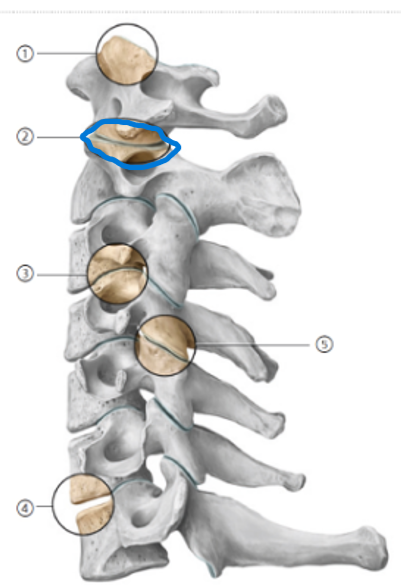
What joint is this?
Atlanto-axial joint

What joint is this?
Facet joint
Guide and restrict spinal movements
Angulations differ at different levels
Facet joints
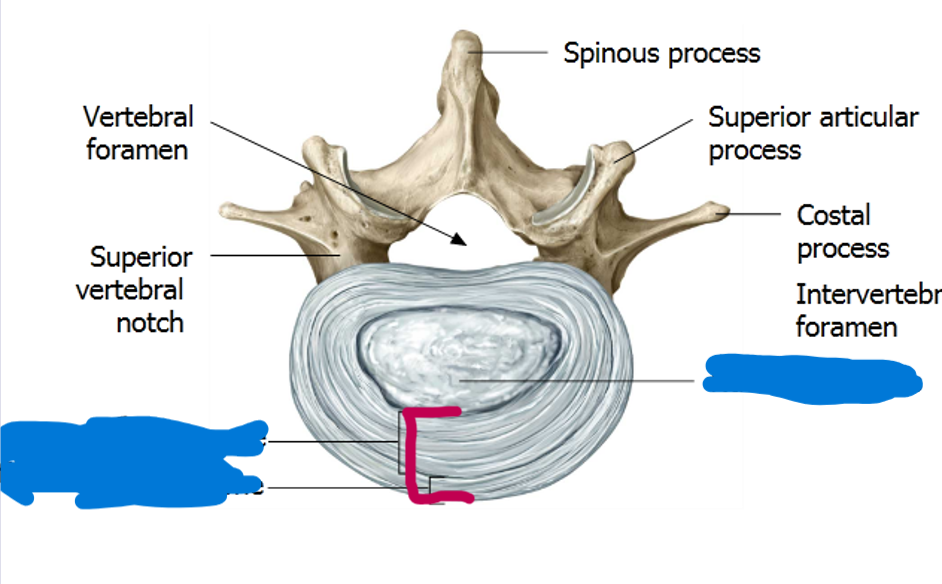
Anulus fibrosis

Nucleus pulposus
gelatinous core; “water cushion” to absorb axial loads on disk; 80-85% water
Nucleus pulposus
external fibrous ring; outer (fibrous sheet, high tensile strength, crisscross and inner zone
Anulus fibrosis
What is the function of intervertebral discs?
Function to absorb and distribute force
Why do intervertebral discs run from thinnest to thickest?
Wolf’s law, lower discs support more weight
Where are vertebral discs NOT location?
AO, AA, and sacrum
What is inside the vertebral column?
Spinal cord
What passes through the vertebral foramen
Spinal cord
Where does the spinal cord exit the skull?
Foramen magnum

Foramen magnum
What ribs are true ribs?
1-7
What ribs are false ribs?
8-10
What ribs are floating ribs?
11-12
Ribs 11-12
Floating ribs
Ribs 8-10
False ribs
Ribs 1-7
True ribs
normally connected anteriorly to sternum
True ribs
joined by costal cartilage to the cartilage of the rib directly above forming the structure of the costal margin (arch)
false ribs
terminate freely between muscles of lateral ABD wall
Floating ribs
Vertebrae/joint responsible for nodding (flexion/extension) the head
C0-C1 (Atlanto Occipital Joint)
Vertebrae/joint responsible for rotating the head
C1-C2 (Atlanto-Axial Joint)
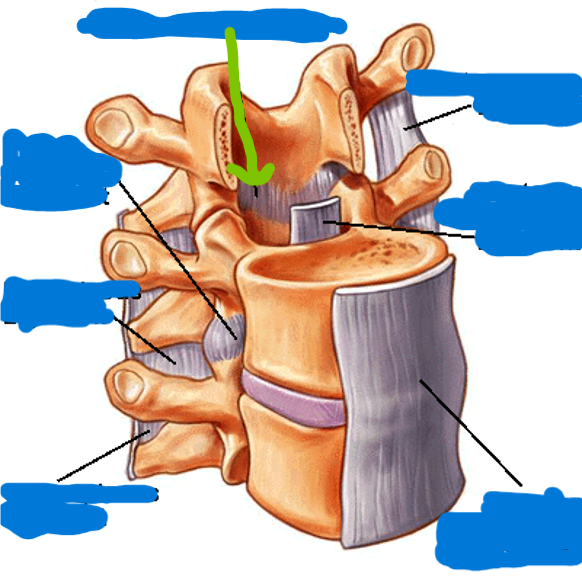
Ligamentum Flavum
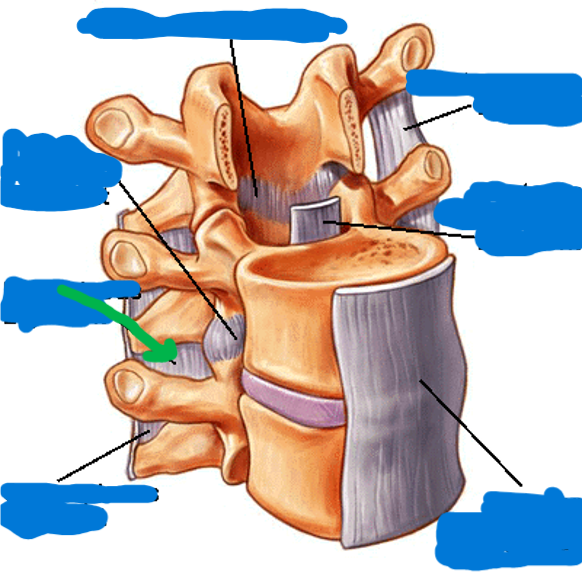
Interspinous ligament

Intertransverse ligament

Supraspinous ligament

Posterior Longitudinal ligament

Anterior longitudinal ligament
bind vertabra to one another and enable spine to withstand high mechanical loads, shearing stresses
ligaments
Vertebral body ligaments (2)
ALL, PLL
Vertebral arch ligaments
Supraspinous, interspinous, intertransverse, ligamentum flavum, nuchal
Function of anterior longitudinal ligament
prevents hyperextension of spine
Function of posterior longitudinal ligament
prevents hyperflexion of spine
Both ALL and PLL…
maintain normal curves of spine
Function of ligamentum flavum
stabilize spine in sagittal plane and limit forward flexion, connect laminae
Function of intertransverse ligaments
Limit lateral flexion and rotation
a midline ligament located at the back of the neck. It is continuous with the supraspinous ligament and plays a key role in cervical spine support
Nuchal ligament
The nuchal ligaments runs from…
external occipital protuberance to C7