HP exam 1
 Call Kai
 Learn
Learn Practice Test
 Spaced Repetition
 Match
Match Flashcards
 Knowt Play
1/53

There's no tags or description
Looks like no tags are added yet.
Name | Mastery | Learn | Test | Matching | Spaced | Call with Kai | Chat |
|---|
No analytics yet
Send a link to your students to track their progress
54 Terms
Cell membrane- Tonicity
the amount of solute dissolved in a solution
Isotonic
solution with equal solute concentration as another solution
hypotonic
less concentrated than inside the cell
water enters causing the cell to swell or even rupture(lysis)
hypertonic
more concentrated than inside the cell
water leaves, causing cells to shrink
What is blood hypertonic to?
other cells and water
What does tonicity always need?
A comparison to something else
Where is the concentration of bodily fluids tightly regulated at?
the kidneys
What fraction of total body water is within cells(intracellular water)
2/3
What is the remaining 1/3 of water of the whole body called?
extracellular water
What fraction of ECW is in blood plasma?
1/3
Outside of blood plasma, where is the remaining fraction of ECW located?
2/3 is in the spaces between cells(interstitial fluid)
In terms of Na and K, compare and contract them in intracellular and extracellular water
Intracellular water has more K than extracellular water
Extracellular water has more Na and Cl than intracellular water
Donnan Equilibrium
Donnan equilibrium is the uneven distribution of charged particles (ions) on either side of a semipermeable membrane.
Do animals have more positive or negative charged proteins
negative
Examples of bases that cannot go through the non-permeability layer of intracellular solutes
-DNA
-Negatively charged amino acids.
What ion is mostly in intracellular fluid and how much is there?
K ; 55mM/L
What ion is mostly in extracellular fluid and how much is there?
Na ; 145 mM/L and Cl; 120mM/L
What the inverse concentrations of the ions
Na; 12mM/L and Cl ; 4mM/L and K ; 4mM/L
What is active transport
transport using ATP
What is facilitated diffusion
Facilitated diffusion is the passive transport of molecules or ions across a biological membrane down their concentration gradient, assisted by specific transmembrane proteins.
What is diffusion
The net physical movement of atoms, molecules, or ions from a region of higher concentration to a region of lower concentration using NO ENERGY
What type of transportation does the sodium/potassium pump use
Active transport.
What is the ratio of Na in : K out
3:2
What are the steps of the Na/K pump
Sodium Binding: Three intracellular sodium ions (Na⁺) bind to the pump from inside the cytoplasm.(Sodium is freely moving and happens to attach)
ATP Phosphorylation: A molecule of ATP transfers a phosphate group to the pump, providing the necessary energy for the shape change.
Conformational Change (Outward): Phosphorylation alters the pump's shape, opening it to the exterior of the cell and releasing the sodium ions into the extracellular fluid.
Potassium Binding: The new shape exposes two extracellular binding sites, allowing two potassium ions (K⁺) from outside the cell to attach to the pump.
Phosphate Release: The attachment of potassium ions triggers the release of the phosphate group from the pump.
Conformational Change (Inward): Without the phosphate group, the pump returns to its original shape, releasing the potassium ions into the cell's cytoplasm and resetting the cycle for the next batch of sodium.
Where is Na/K-ATPase located?
Surface of almost all cells
Why does Cl not try to go through the membrane
Because it’s in Donnan equilibrium
Why does blood cells not use Na/K pump
it has proteins
it throws off Na/K pump because of extra negative charge
What is secondary active transport?
Secondary active transport is the movement of a substance across a cell membrane against its concentration gradient, powered by the potential energy of an existing ion gradient rather than direct ATP use.
What are membrane potentials
The potential current flow across the cell membrane IF the barrier of the membrane is removed
What is MP a direct result of?
Unequal distribution of electrical charges across membrane. (Think of Donnan Equalibrium)
Where is MP present at?
ALL cells
How much charge does MPs have
70mV
What are MPs also called
Resting potentials(RMP)
What is dynamic equilibrium
answer this later
Why can’t Na/K be predicated
Because they are ions and respond to the electrical gradients
what is the nernst equation
The Nernst equation calculates the electrical potential (voltage) across a cell membrane at which an individual ion is in equilibrium (i.e., its concentration gradient is perfectly balanced by the electrical gradient).
What is Equilibrium potential
The equilibrium potential (also known as the Nernst potential) is the exact electrical charge difference across a cell membrane that perfectly balances the concentration gradient of a specific ion, resulting in no net movement of that ion.
What does the Nerst Equation predict
Equilibrium potential for each ion
What is the nernst equation
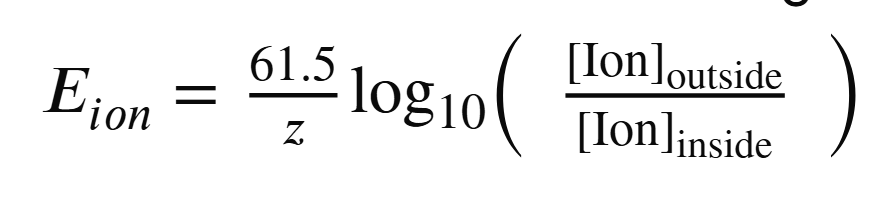
What is the EP for the ions
Na → +65mV
K → -96mV
Cl → -70mV
What is the GHK equation(definition)
The Goldman-Hodgkin-Katz (GHK) equation is a foundational formula in physiology used to calculate the resting membrane potential of a cell. Unlike the Nernst equation, which only accounts for a single ion, the GHK equation determines the overall membrane potential by factoring in the concentration gradients and relative membrane permeabilities of multiple ions simultaneously.
What is the GHK equation

Which ion moves freely during resting potential
K
What does the Dendrites of a neuron do
Collect electrical signals
What does the cell body of a neuron do
integrates incoming signals and generates outgoing signal to axon
What does the Axon of a neuron do
Passes electrical signals to dendrites of another cell or to an effector cell
anterograde vs retrograde transport
Anterograde transport is the movement of molecules and organelles away from the cell body (e.g., toward the axon terminal). In contrast, retrograde transport is the movement of materials toward the cell body (e.g., from the synapse back to the soma).
What are depolarizations