P4 Forces and Motion
 Call Kai
 Learn
Learn Practice Test
 Spaced Repetition
 Match
Match Flashcards
 Knowt Play
1/66

There's no tags or description
Looks like no tags are added yet.
Name | Mastery | Learn | Test | Matching | Spaced | Call with Kai | Chat |
|---|
No analytics yet
Send a link to your students to track their progress
67 Terms
Newtons 3rd Law
When object A exerts a force on object B, B exerts a force of equal magnitude and opposite direction back on A
What is Friction
The resistance that one surface or object encounters when moving over another.
Friction is a contact force that opposes the motion of an object
Give an example for Friction
When walking friction between your shoes and the ground
What is a normal contact force?
Normal contact force is the upward force exerted by a surface that supports the weight of an object resting on it.
It always acts at a 90° angle (perpendicular) to the surface of contact.
Give an example of Normal contact force
Cat on a chair--> cats weight and normal reaction force
Give some non-conact forces
Magnetic forces
Electrostatic forces
Gravitational forces
What is magnetic force?
Two like poles exerting repulsive forces on each other
OR
Two unlike poles exerting attractive forces on each other
What is Gravitational force and an example
The forces of attraction between two objects with mass
Example: The earth exerts a gravitational pull on you but you exert an equal and opposite gravitational pull on the earth
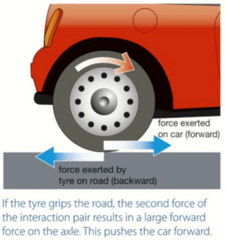
Give an example of an interaction pairs
What is Weight
The gravitational force of attraction on an objec
(Newtons)
What is Mass
How much matter an object is made up of
(kg)
What is gravitational field strength
A region where a mass experiences a force
(force per kg of mass)
What is the formula linking Weight Mass and Gravitational field stength
w=mg
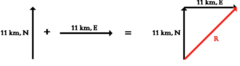
What is the resultant force
The sum of all the forces acting on an object
How to calculate average speed
speed (m/s) =distance/time
What is the typical speedof a light breeze
7 m/s
what is the typical speed of sound in air, water, and solids

What is the typical speed of a person walking, running

what is the typical speed of a person cycling
7m/s
What is the typical speed of a car, fast train, plane
30mph= 13m/s
Train: 300km/h
Plane: 900km/h
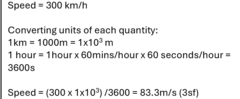
How to convert km/h to m/s
What is a Scalar quantity
A quantity with only magnitude
How do you calculate the distance from a speed time graph
The area under the graph
What is displacement
The straight-line distance and direction from the starting point to the end point
How do you calculate the Displacement from a velocity-time graph
The area under a velocity-time graph
What is instantaneous speed
The speed at which an object is travelling at a particular time. measured by finding its average speed over a very short time interval.
Gradient of a tangent on a distance time graph
What is average speed
total distance/total time
What is velocity
Displacment/time
Gradient of a distance time graph
What is acceleration?
The rate of change of velocity
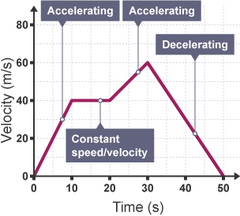
The gradient of a velocity time graph
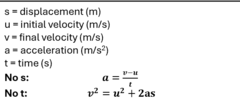
What does suvat stand for
Distance time graph interpretation
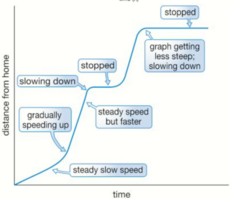
Displacement time graph interpretation
The right graph-->

Speed time graph interpretation
The gradient is the acceleration

Velocity time graph interpretation
Describe an experiment to calculate the average speed of an object
What is a vector quality
A quantity with magnitude and direction
Design an experiment to calculate average speed using a stopwatch and its main source of error

What is Newtons 1st law
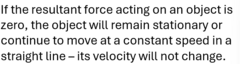
A body will travel in a straight line at a constant velocity unless a resultant force acts upon the object.
What is Newtons 2nd law
When a resulant foce acts the acceleration is directly proportional to the force applied, but is inversly propotional to the mass
F=ma
Describe how a skydiver reaches terminal velocity
Initial Jump: The skydiver accelerates downwards because their weight is the only force acting on them.
Gaining Speed: As the skydiver speeds up, the air resistance acting upwards against them increases.
Resultant Force Decreases: The increasing air resistance reduces the overall resultant force pulling them down.
Acceleration Decreases: Because the resultant force is smaller, the skydiver's rate of acceleration begins to drop.
Forces Balance: Eventually, the upward air resistance becomes exactly equal to the downward weight.
Terminal Velocity: With zero resultant force, the skydiver stops accelerating and falls at a constant maximum speed.
How to add vectors
What is the resultant force when the forces are balanced
0
What is momentum?

What is the resultant force when you have the change in momentum and the time

What is Newtons 1st Law
Describe how an object can be at a constant speed but accelerating
When an object moves in a circular path at a constant speed, it is constantly changing its direction at every point.
Since velocity is a vector that includes both speed and direction, any change in the object's path results in a change in velocity.
Acceleration is defined as the rate of change of velocity, so an object that is constantly turning is technically accelerating even if its speed remains the same.
This acceleration is caused by a centripetal force acting toward the center of the circle, which pulls the object away from its straight-line path.
What is Inertia
The resistance to change in motion
why do a cannon ball and a feath fall at the same rate if there is no air resistance
In a vacuum, the only force acting on both the cannonball and the feather is their weight, which is directly proportional to their mass. While the cannonball has a much greater gravitational pull (weight) than the feather, it also has a much greater inertia, meaning it requires more force to get it moving.

Design an experiment to calculate the acceleration of an object using light gates
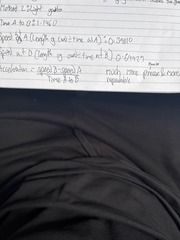
Describe the force acting towards the centre of a circle on a moving object
And the direction of its velocity

What is Centripetal force
Tension in the string is the force causing the change in direction of the ball. If the string breaks the ball would continue in a straight line along a tangent to the circle
Average Reaction time of a human
0.2-0.6s
Describe an experiment to measure reaction time
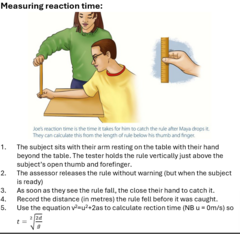
What is stopping distance
thinking distance+braking distance
What is Thinking distance
The time between noticing the hazard and applying the brakes
What is the formula for thinking distance
speed x reaction time
How can thinking distance be increased
Greater speed
Tiredness
Alcohol
Drugs
What is braking distance?
The distance taken to stop whene the brakes have been applied
How do you increase the braking distance
Greater speed
Increased mass of vehicle
poor condition of brakes
Worn tyres
Icy/wet road
Why does braking distance quadruple when speed doubles
As there is 4x the amount of KE (1/2mv2) to dissipate by the brakes
Work done by brakes= KE stored in the vehicle
Braking force * stopping distance
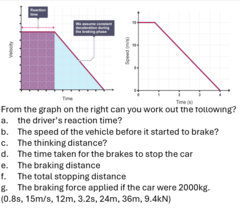
Know how to calculate the stopping distance braking distance ect from a graph
Yes
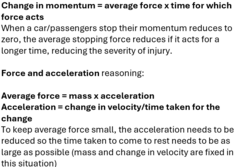
Describe how Crumple zones and Air Bags increase your saftey when driving
They increase the time taken for you to come to a stop from travelling at the same speed as the car
What are Levers and Gears used for
They are used to transmit rotational forces.
What is the moment of a force
Force x perpendicular distance from the force to the pivot
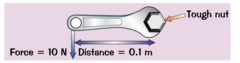
If an object is balanced... Rotational equilibrium
Total anticlockwise moment= total clockwise moment
What is the mechanical advantage with a lever
The force you apply is less than the force on the load, however, you are applying your force further from the pivot than the load so
1. You have to move a smaller force further than the object moves The same amount of work is done but with a smaller force
2. The moment created by the input force exerts an output force that is much larger than the input force.
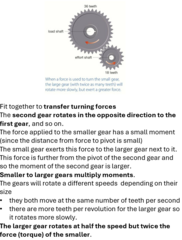
Gears in general